Chapter 1: The New Backpack
Leo was nine, and he liked small promises. The kind you could keep without making a big speech.
On Monday morning, he zipped his backpack twice—once to close it, once just to be sure. His pencils were sharpened. His lunch was packed. His mom had written a tiny note on a napkin: “Have a steady day.”
At school, the hallway smelled like floor cleaner and oranges from someone's snack. Leo walked to his class and saw Amir at the coat hooks.
Amir was new this year. He was quiet in a friendly way, like he listened with his whole face. He and Leo had become desk partners because Leo always remembered to share the ruler without being asked.
Today, Amir's backpack was different.
It wasn't really a backpack at all. It was a worn tote bag with thin straps. One strap had been tied in a knot. The bag looked tired, like it had carried too many groceries and not enough rest.
Amir noticed Leo looking and pulled the tote closer to his side.
Leo's cheeks warmed. He didn't want Amir to feel like a spotlight had clicked on.
“Hey,” Leo said quickly, pointing at Amir's pencil case. “Is that the one with the little soccer ball on it?”
Amir's eyes brightened. “Yes. My cousin gave it to me. It is… old, but I like it.”
“It's cool,” Leo said. And he meant it.
In math, Amir's pencil snapped. The lead fell out like a tiny gray stick. Amir stared at it for a moment, then tried to write with the broken end anyway.
Leo slid his own pencil across the desk without a word. Just a gentle push.
Amir looked at him, surprised.
Leo whispered, “I have extras.”
Amir took it, careful, like it might be made of glass. “Thank you,” he whispered back.
At recess, Leo noticed something else. Amir stayed near the fence and watched the other kids play tag. He laughed when someone tripped and got up again, but he didn't run in.
Leo walked over. “Do you want to play?”
Amir smiled, then shrugged. “Maybe later.”
Leo nodded, like that was completely normal. Because sometimes, it was.
When the bell rang, Amir picked up his tote bag. The knot on the strap pulled tight against his hand.
Leo decided something then: he would be loyal. He would be kind. And he would be careful—careful not to make Amir feel small.
He didn't know the best way yet.
But he would find it.
Chapter 2: The Missing Permission Slip
On Tuesday, Ms. Carter clapped her hands and said, “Class, field trip forms are due Friday! We're visiting the science museum next week.”
A wave of excitement whooshed through the room. Kids began whispering about dinosaur bones and the giant planet room. Leo's mind filled with the smell of popcorn from the museum café and the sound of footsteps echoing in big halls.
Ms. Carter handed out permission slips. The paper was bright yellow, like it wanted to be noticed.
Leo folded his neatly and put it in his folder. He looked at Amir. Amir stared at his form like it was written in another language, even though it wasn't.
“Everything okay?” Leo asked softly.
Amir's fingers traced the bottom of the page where it said: Cost: $12.
“It's fine,” Amir said, but his voice went thin, like a string pulled too tight.
At lunch, Leo opened his sandwich and watched Amir unwrap his food. Amir had two plain slices of bread. Nothing in the middle. Just bread.
Amir smiled quickly, as if to say, Look, I have lunch, see?
Leo felt a tug inside his chest, like someone had gently pulled a ribbon there.
He thought of saying, “You can have half my sandwich!” But that felt loud in his head. Like a trumpet.
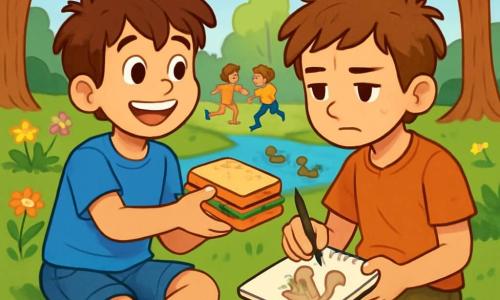
Instead, Leo said, “My mom packed me too much. Do you want to trade? I'm kind of bored of turkey.”
Amir hesitated.
Leo held out his turkey sandwich and pointed at Amir's bread. “That looks like… the most serious sandwich ever. Very plain. Very dramatic.”
Amir's mouth twitched. “Dramatic bread,” he said.
They traded. Amir took a bite and chewed slowly, then nodded like a judge. “It is good.”
Leo took a bite of the plain bread and made his eyes wide. “Wow. It tastes like… air's cousin.”
Amir laughed. A real laugh. Quiet, but real.
After lunch, Leo kept thinking about the field trip slip. It sat in Amir's desk like a rock.
That afternoon, Leo walked home with his mom. He kicked a pebble along the sidewalk, letting it bounce off the cracks.
“Mom,” he said, trying to sound casual, “what happens if someone can't pay for the museum trip?”
His mom didn't answer too fast. She was like that. She listened first.
“Sometimes the school helps,” she said. “Sometimes families talk to the teacher. There are ways. But it can feel hard to ask.”
Leo nodded. Hard to ask. Easy to notice. Easy to pretend you didn't.
At home, Leo opened his piggy bank. It wasn't huge. It didn't make rich noises. Mostly it clinked in a small, hopeful way.
He counted: seven dollars and some coins.
Not enough.
But maybe it was a start.
Chapter 3: The Quiet Plan
On Wednesday, Leo arrived early. The classroom was still sleepy. The chairs stood on top of desks like upside-down bugs.
Ms. Carter was writing the day's schedule on the board. Leo walked up to her desk and waited until she looked at him.
“Yes, Leo?”
Leo swallowed. His heart felt like it was doing jumping jacks.
“Ms. Carter,” he said, “is there a way kids can get help for the museum trip without… everyone knowing?”
Ms. Carter's eyes softened. She didn't smile in a big way. She smiled in a careful, respectful way.
“Yes,” she said. “We have a fund for trips. Families can also talk to me privately. And sometimes… classmates help in ways that don't embarrass anyone.”
Leo nodded fast. “Okay. I was just wondering.”
“Thank you for wondering,” Ms. Carter said. “That's a kind kind of curiosity.”
All morning, Leo watched Amir. Amir worked hard. He wrote neatly. He raised his hand once, then lowered it when someone else got called on. He helped pick up markers when the box spilled, even though they weren't his markers.
At recess, Leo saw Amir take out an old soccer ball from his tote bag. The ball's surface was peeling a little, like it had been played with in too many summers.
Some kids ran over.
“Cool ball,” said Josh. “Can we play?”
Amir's face tightened. Leo could tell Amir wanted to say yes, but also wanted the ball to come back in one piece.
Leo stepped in. Not in front like a hero in a movie. Just beside Amir.
“Sure,” Leo said. “Let's do a small game. No super-kicks. This ball is a veteran.”
“A veteran?” Josh asked.
“It's been through things,” Leo said seriously. “Like… puddles.”
Josh laughed. “Okay, fine.”
They played gently. When the ball rolled toward the street, Leo chased it first. When someone got too excited and kicked too hard, Leo called, “Careful! Veteran ball!”
Amir watched Leo, then nodded, grateful without saying it.
After school, Leo had an idea that felt both simple and tricky.
He made a list at home: “Ways to help without making it weird.”
He wrote:
1) Ask Ms. Carter about helping fund.
2) Do something as a class.
3) Share things quietly.
4) Don't talk about it like it's gossip.
He stared at the list and tapped his pencil.
Then he added:
5) Remember Amir is not a problem to solve. He is a friend.
The next day, he brought in a small envelope with his seven dollars and coins inside. He didn't write “For Amir” on it. He just wrote: “Field Trip Fund.”
He planned to hand it to Ms. Carter privately.
But when Thursday came, something happened that made Leo's plan change shape.
Like dough when you press it.
Chapter 4: The Class Project Jar
Thursday morning, Ms. Carter announced, “We're starting a class kindness project. We'll be collecting spare change for the community pantry down the street.”
She placed a clear jar on her desk. It was empty, but it looked ready.
“A pantry?” someone asked.
“It's a place where people can get food when money is tight,” Ms. Carter explained. “Families, seniors, anyone who needs it. We help because we can.”
Leo glanced at Amir. Amir stared at the jar, blinking slowly, like he was thinking about something far away.
Ms. Carter added, “If you bring something, it can be coins. It can be a can of food. It can also be your time—like helping make posters or sorting donations. Not everyone has money to give, and that's okay.”
Leo felt his shoulders loosen. That sentence felt like a window opening.
At recess, Leo walked with Amir along the edge of the playground.
“Are you going to bring something for the jar?” Leo asked.
Amir shrugged. “I can maybe bring a can. My mom… we use the pantry sometimes. Not always. Sometimes.”
He said it quietly, like he was placing a fragile cup on a table.
Leo didn't gasp. He didn't say, “Oh no!” He didn't want to make Amir regret saying it.
He just said, “Thanks for telling me.”
Amir looked relieved, like Leo had chosen the right door.
Leo nodded toward the soccer goal. “Want to practice shots? Gentle ones. For the veteran ball.”
Amir smiled. “Yes.”
That afternoon, Leo handed his envelope to Ms. Carter when no one was near her desk.
“This is for the field trip fund,” Leo whispered. “Not… a big deal. Just… yeah.”
Ms. Carter's eyes met his. “Thank you, Leo. I will use it wisely and privately.”
On Friday, the yellow permission slips were due.
Leo watched Amir pull his slip from his tote bag. It was folded neatly. Amir walked up to Ms. Carter's desk and placed it in the stack.
No money showed. No announcement happened. Ms. Carter simply nodded and said softly, “Got it.”
Amir returned to his seat. His face looked calmer, like a storm had moved away.
Leo didn't ask questions. He didn't wink. He didn't say, “I helped!”
He just passed Amir the eraser when it rolled off Amir's desk.
At lunch, Amir brought a small can for the pantry jar. The label said “Peaches.” The can looked new.
Amir set it down near the jar, then hurried back to his seat as if the can might shout his name.
Leo leaned over and whispered, “Peaches are the best fruit. They taste like sunshine decided to be food.”
Amir snorted. “Sunshine food,” he whispered.
Leo grinned. “Exactly.”
Ms. Carter saw the can and said to the class, “Thank you to everyone who brought something. Every bit helps.”
She didn't point at Amir. She didn't point at anyone. The thank-you was big enough for everyone to stand under it.
Leo thought: This is what discretion looks like. It looks like helping without making a stage.
Chapter 5: The Museum Day
The field trip day arrived with bright skies and extra noise.
Kids bounced on their toes. Teachers checked clipboards. The bus waited like a giant yellow loaf of bread.
Leo sat with Amir. Amir held his tote bag on his lap. The knot on the strap was still there, still tight.
As the bus rumbled forward, Leo said, “What are you most excited for?”
Amir thought. “The space room. The big planets.”
Leo nodded. “Same. I want to stand under Saturn and pretend it's a giant hula hoop.”
Amir laughed. “Saturn hula hoop.”
At the museum, everything felt huge. The dinosaur skeleton towered above them like it was trying to peek into the next room. The floor shined like it had been polished by a million sneakers.
In the planet room, the ceiling was dark and dotted with lights. A soft voice explained stars and distances. The room was quiet in a cozy way, like a library made of space.
Leo watched Amir's face. Amir's eyes were wide, reflecting the tiny lights.
“It's like… the night is inside,” Amir whispered.
Leo whispered back, “Yeah. But warmer. And with school rules.”
Amir smiled.
At lunchtime, the class sat in a bright area with tables. Some kids had bought food. Some had brought lunches.
Leo opened his lunch. His mom had packed an extra apple and two granola bars.
He looked at Amir. Amir had a small container of rice and beans.
Leo didn't want to do the “Do you need food?” question. It could feel like a spotlight again.
So he said, “My mom thinks I'm a growing plant. She keeps sending snacks. Want a granola bar? Otherwise I'll roll out of the museum.”
Amir hesitated, then nodded. “Okay. Thank you.”
Leo handed it over like it was the most normal thing in the world. Because it was normal for friends to share.
After lunch, they visited the gift shop. It glittered with postcards and toy rockets and shiny rocks in small boxes.
Leo had five dollars saved for a souvenir. He held it carefully. Amir stood beside him and touched nothing, his hands tucked in his sleeves.
Leo didn't say, “Do you have money?” He didn't want Amir to have to answer.
Instead, Leo said, “Let's pick one thing to look at. Just for fun.”
They wandered. Amir stopped at a small basket of postcards. One postcard showed a picture of the night sky with a bright comet.
Amir stared at it.
“It's nice,” Leo said.
Amir nodded. “My little sister likes stars.”
Leo looked at his five dollars, then at the postcards. They were fifty cents each.
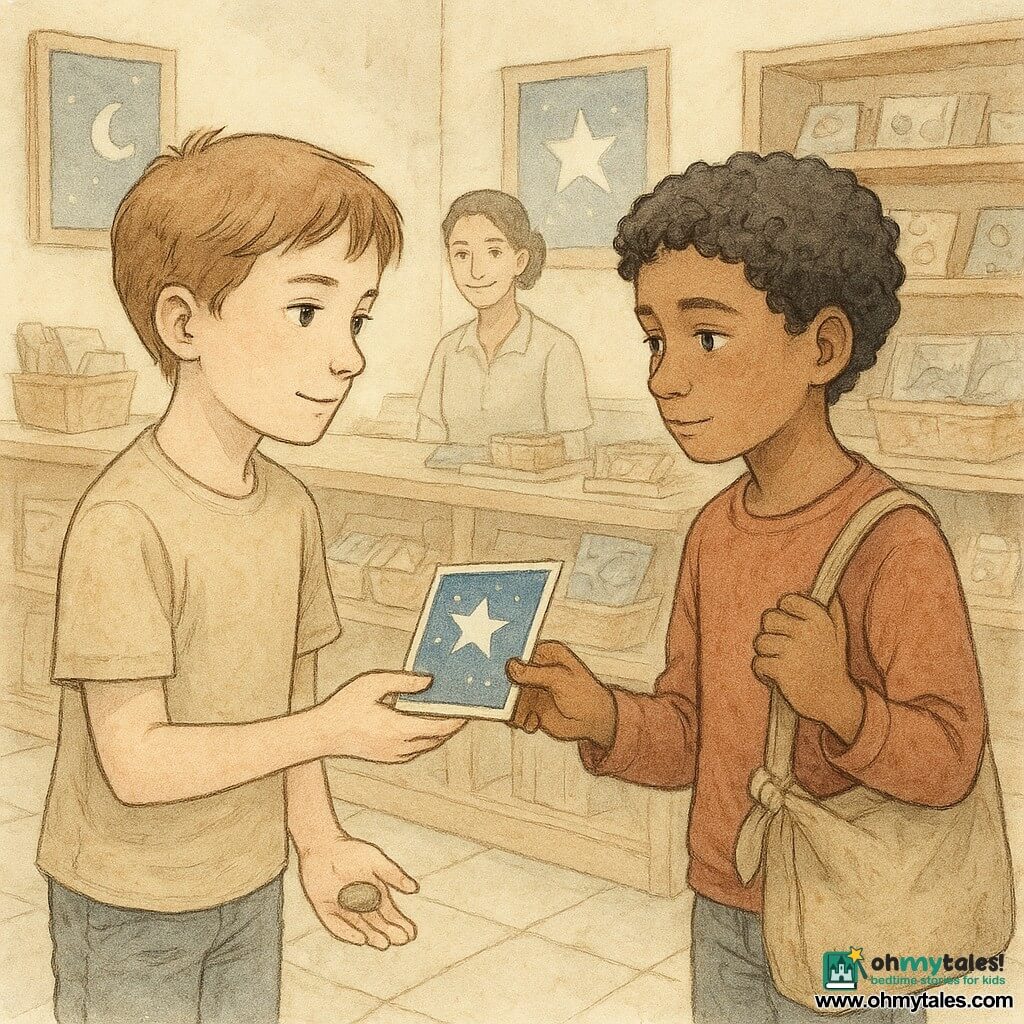
He picked up two postcards and brought them to the counter with his own souvenir—a smooth stone that looked like it had a tiny galaxy inside.
Outside the gift shop, he handed one postcard to Amir.
Amir blinked. “Leo, you—”
Leo cut in quickly, gently. “It's just a postcard. It doesn't even take up space. It's basically flat happiness.”
Amir looked down at it, then smiled, small and warm. “Thank you,” he said. “I will give it to her.”
They walked back to their group. Amir held the postcard carefully, like it mattered. Because it did.
On the bus ride home, Amir leaned his head against the seat and closed his eyes. He looked tired, but happy-tired, like after a good game.
Leo watched the passing trees and thought about all the ways people could have different amounts of stuff. Some kids had new backpacks and big lunches. Some had worn tote bags and careful choices.
But today, everyone had stood under the same pretend stars.
That felt important.
Chapter 6: A Steady Kind of Friendship
The next week, Ms. Carter announced the result of the pantry jar. The jar was half full of coins, and there were bags of donations by the wall.
“We're going to bring these to the pantry on Friday,” she said. “A few volunteers can help carry bags.”
Hands shot up. Leo raised his hand too, then looked at Amir.
Amir raised his hand slowly.
After class, Leo and Amir walked to the coat hooks. Amir's tote bag strap was still knotted.
Leo pointed at it. “That knot is working very hard.”
Amir sighed. “Yes. It is… tired.”
Leo thought for a moment. “My dad has extra clips from his tool box. Not expensive ones. Just little ones. If I bring one tomorrow, would that help?”
Amir's face showed relief mixed with pride. “Yes,” he said. “If it is not trouble.”
“It's not trouble,” Leo said. “It's a tiny mission.”
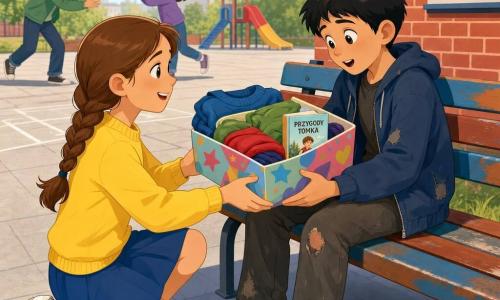
The next day, Leo brought a small black clip. During reading time, he slid it across the desk the same way he had slid the pencil.
Amir attached it to the strap. The knot loosened a little, like it could finally breathe.
Amir tested it, lifting the bag. “Better,” he whispered.
Leo nodded. “Good.”
On Friday, they walked as a class to the pantry with Ms. Carter. The building was plain, with a sign in the window. Inside, volunteers smiled and moved boxes carefully. It didn't feel sad. It felt busy. It felt like people doing work that mattered.
A volunteer thanked the class. “This helps families have dinner,” she said. “Thank you for thinking of others.”
Amir carried a bag with Leo. They walked together, their steps matching.
On the way back, Amir said quietly, “Sometimes people think if you don't have much, you should feel ashamed.”
Leo kicked a pebble gently, like he was thinking with his feet. “My mom says everyone needs help sometimes. Even grown-ups.”
Amir nodded. “Yes. And… it is better when people help without making noise.”
Leo smiled. “Like ninja helping.”
Amir laughed. “Ninja helping.”
At school, when other kids talked about the museum souvenirs, Leo didn't mention the postcards. He didn't mention money or forms or envelopes. Amir didn't mention them either.
Their friendship didn't need an announcement. It didn't need proof.
It was in small things: a shared pencil, a gentle soccer game, a granola bar offered like it was nothing special, a clip to fix a strap, a postcard that became “flat happiness.”
One afternoon, Leo found a note in his lunchbox, written on a napkin again: “Have a steady day.”
He looked at it and thought: steady is good. Steady is loyal. Steady is quiet kindness that doesn't make anyone feel smaller.
After school, Amir walked beside him partway home.
“Leo,” Amir said, “thank you for… being my friend.”
Leo shrugged, trying to act normal, because this was normal. “Yeah,” he said. “Friends do friend stuff.”
Amir nodded, smiling. “Yes. Friend stuff.”
They walked on, their backpacks—one new, one repaired—swinging in the same rhythm, as if they had agreed on it together.