Chapter 1: The Not-Fasting Errand
Mina was eleven and very serious about promises—so serious that her little brother said she would probably promise the toaster she'd love it forever.
On the first Saturday of Ramadan, Mina walked beside her Auntie Salma to the pharmacy. The air smelled like wet pavement and bakery steam, and the sky was the color of a clean spoon.
Auntie Salma carried a small paper bag and a big, calm smile.
Mina tried not to stare at the bottle of water peeking from the side pocket of Auntie Salma's bag. It glinted like it was winking.
“Auntie,” Mina said carefully, “you… you brought water.”
“I did,” Auntie Salma said, as if she'd brought a perfectly normal pet goldfish. “I'm not fasting today.”
Mina felt her eyebrows leap up by themselves. “But it's Ramadan.”
“It is,” Auntie Salma agreed. “And Ramadan is also about kindness. Some people fast, some people can't. The point isn't to be the Hunger Champion of the Universe.”
Mina snorted. She tried to look dignified, but the idea of a golden trophy shaped like a stomach was too much.
Auntie Salma nudged her gently. “You're fasting, right?”
Mina nodded. “I promised Mama I'd try the whole day. No sneaking snacks. No ‘accidentally' chewing gum. A real promise.”
“That's brave,” Auntie said. “But being brave doesn't mean being strict with everyone else. It means being gentle with yourself and with others.”
At the pharmacy, Auntie Salma bought her medicine and, on the way out, took a sip of water behind her scarf, discreet as a magician.
Mina watched, then looked away quickly. Her mouth suddenly remembered it had a mouth.
Auntie Salma noticed. “You okay?”
“I'm fine,” Mina said, too fast. “My tongue is… practicing patience.”
Auntie Salma laughed. “Tell your tongue it's doing great.”
As they walked home, Mina noticed an empty spot on the sidewalk, like a missing puzzle piece. It made her think of someone else who was missing.
“Do you think Grandma will call today?” Mina asked.
Auntie's steps slowed. “Grandma's been quiet lately.”
Mina's stomach made a small dramatic noise, like it wanted to audition for a soap opera. Mina placed a hand on it, sternly. “Shh. This is not your scene.”
Auntie Salma chuckled. “You know what we can do? We can check on Grandma. Not by worrying—by reaching out.”
Mina held that idea like a warm mug. “Like… calling?”
“Or visiting,” Auntie said. “Or sending something. Ramadan is a good time to remember the ones who feel far away.”
Mina looked up at the sky, pale and wide. “Okay,” she said, and the word felt like a new promise being born.
Chapter 2: The Promise Jar and the Missing Voices
At home, Mama was stirring soup. The kitchen smelled like tomatoes, cumin, and the future if the future was delicious.
Mina washed her hands and announced, “I want a promise jar.”
Mama lifted an eyebrow. “A jar that promises things?”
“No,” Mina said. “A jar where I keep my promises. So they don't roll under the couch and get lost.”
Her brother Youssef, eight years old and mostly made of questions, hopped onto a chair. “Can I put my promise in it too?”
“You don't keep promises,” Mina said. “You keep excuses.”
“I can change!” Youssef declared, as if he'd just been elected mayor.
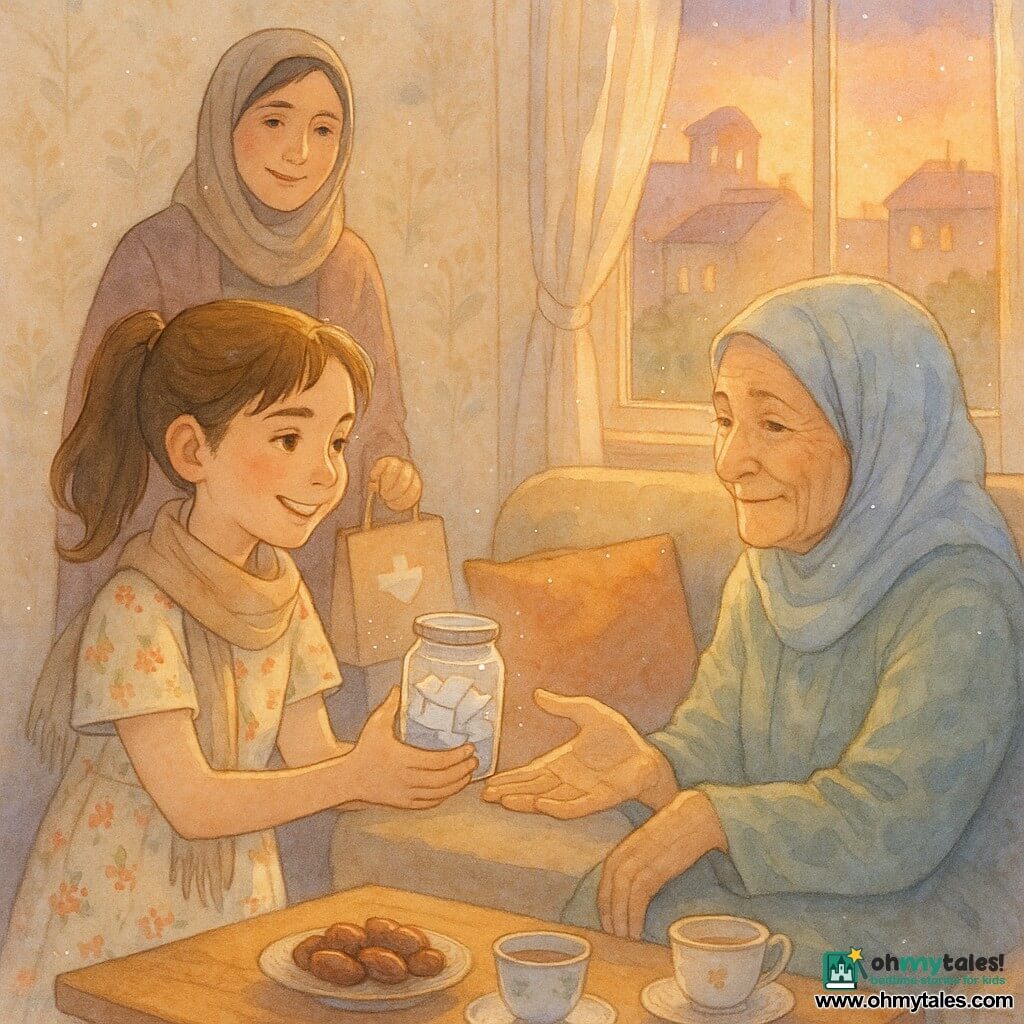
Mama slid a glass jar across the counter. “Here. Write your promises on paper slips.”
Mina tore a page from her notebook and wrote carefully:
1) Fast all day (try my best).
2) Be kind when people don't fast.
3) Ask about someone who's absent—every day.
She stared at number three. It felt bigger than the others, like it had pockets.
Youssef leaned over. “Who's absent? Like… the teacher when she's sick?”
“Like Grandma,” Mina said softly.
Mama's stirring slowed, just for a second. “That's a beautiful promise,” she said, voice gentle. “Grandma likes hearing from you.”
Mina dropped her paper into the jar. It fluttered down like a tiny white bird.
That afternoon, Mina called Grandma. The phone rang, and rang, and rang—like it was jogging in place.
No answer.
Mina tried again later. Still nothing.
Youssef wandered in, chewing a pencil. “Maybe Grandma is napping.”
“Maybe,” Mina said, but a worried pebble sat in her chest.
At sunset, the house changed. The light turned honey-colored, and the air seemed to hum with quiet excitement. Plates appeared. Dates sat in a bowl like shiny little moons. Mama put out water glasses that looked like they were holding their breath.
Mina watched the clock. The minutes stretched, slow and teasing.
“Ten seconds,” Baba announced.
Youssef whispered, “My stomach is writing a complaint letter.”
Mina giggled, then pressed her hand to her belly again. “Mine is composing poetry.”
When the call to prayer sounded from a phone app on the counter, gentle and clear, everyone reached for a date.
Mina took her first bite. Sweetness burst like a tiny firework, and relief washed through her, warm as a blanket.
“Alhamdulillah,” Mama murmured, smiling.
Mina drank water. It tasted like the best idea anyone ever had.
After iftar, Mina slipped her promise jar off the counter and carried it to her room. The jar clinked softly as if it approved.
She opened her window. Outside, the night sky was velvet with scattered silver pins.
“Grandma,” Mina whispered, as if the stars could deliver messages. “I'm trying.”
Chapter 3: The Lantern That Listened
The next day, Mina went with Auntie Salma to the community center. They were helping pack small food boxes: rice, lentils, pasta, dates, tea—practical treasures.
Mina liked the neat rows. She liked how everyone moved with quiet purpose, like a friendly ant colony with better music.
On a shelf near the door sat a lantern. It was old-fashioned—metal frame, glass sides, a little handle. Someone had put battery candles inside it, and it glowed softly even in daylight.
Mina pointed. “That lantern is cute.”
Auntie Salma smiled. “It's for the Ramadan display. We light it at sunset.”
Mina walked closer. The lantern's light seemed to flicker like it was thinking. For a moment, Mina felt as if it was watching her back.
“Hello,” Mina whispered, feeling silly.
The lantern didn't answer with words, because lanterns are polite and do not interrupt humans. But the candlelight wobbled, and Mina had the strange feeling that it was… listening.
A boy around her age pushed a cart of boxes and nearly bumped into her. “Oops. Sorry. I'm Karim.”
“I'm Mina,” she said, stepping aside.
Karim glanced at the lantern. “That thing creeps me out. It looks like it knows all my embarrassing thoughts.”
Mina laughed. “Then it knows you tried to eat three cookies last night.”
Karim froze. “How did you—”
“I guessed,” Mina said quickly, grinning. “Your face has ‘three cookies' written all over it.”
Karim groaned. “It was only two and a half.”
They packed boxes together. Mina wrote little notes on sticky paper and tucked them inside: “Wishing you a peaceful evening.” “Thinking of you.” “You matter.” She kept the words simple, like small stones placed to mark a safe path.
Auntie Salma watched her. “That's generosity,” she said. “Not loud. Just real.”
Mina nodded, feeling a glow that wasn't from the lantern.
On the way out, Mina turned back. The lantern's light flickered again, and Mina could have sworn it winked.
That evening, Mina tried calling Grandma again. No answer.
Mina sat on her bed, the promise jar on her desk, the night outside her window deep and quiet.
“Okay,” she said to the jar. “I promised to check on people who are absent. So I'm checking. I'm not quitting.”
The lantern wasn't in her room, obviously. But the memory of its listening glow stayed with her, like a friend who doesn't need to speak to be present.
Mina wrote a message to Grandma and sent it:
Hi Grandma. I miss you. I'm fasting and I'm being brave. Call me when you can. Love, Mina.
She stared at the “sent” check mark.
“Now,” she whispered, “we wait.”
Chapter 4: The Secret Delivery of Cinnamon Buns
On the third day, Mina woke up for suhoor with sleepy eyes and dramatic hair that pointed in several directions, like it had been arguing with gravity all night.
Youssef squinted at her. “Your hair looks like a porcupine who got surprised.”
“Thank you,” Mina said, pouring cereal. “I worked hard on it.”
After school, Mama came home carrying a paper bag that smelled like cinnamon and sugar. Mina's heart did a small happy hop.
“Cinnamon buns?” Mina asked.
Mama nodded. “For after iftar. But…” She lowered her voice like a spy. “I thought we could share some with someone.”
Mina's promise jar practically hummed in her mind. “With Grandma?”
Mama hesitated. “Grandma lives across town. But we can start with Mrs. Donnelly downstairs. Her son is away for work. She's alone a lot.”
Mina blinked. Mrs. Donnelly was their elderly neighbor who always wore knitted sweaters and called everyone “dear,” including the mailboxes.
“Yes,” Mina said. “Let's do it.”
They wrapped two cinnamon buns in foil. Mina added a sticky note: “Warm wishes from upstairs.”
Youssef tried to add, “Also from the Best Brother,” but Mina covered his mouth with her hand until he wrote, “From Youssef too.”
At sunset, after iftar, they went downstairs. Mina held the small package carefully, as if it contained a tiny sleeping animal.
Mrs. Donnelly opened her door a crack, then wider, her face brightening. “Well! Look at you all!”
Mama offered the buns. “We thought of you.”
Mrs. Donnelly's eyes softened. “That's very kind. Come in for a minute?”
Inside, her living room smelled like tea and lemon polish. A framed photo sat on the table: Mrs. Donnelly with a tall young man in a graduation cap.
“That's Liam,” she said, following Mina's gaze. “He's in another city. Calls when he can.”
Mina's chest pinched with recognition. “Do you miss him a lot?”
“Every day,” Mrs. Donnelly admitted. Then she smiled. “But it helps when people remember me. When someone knocks on the door just to say, ‘You're not forgotten.'”
Mina swallowed. Her promise jar felt heavier, but in a good way—like a backpack filled with useful things.
Back upstairs, Mina checked her phone again. No message from Grandma.
Auntie Salma called that night. “How's my favorite promise-keeper?”
Mina sighed. “I'm keeping promises, but Grandma is still quiet.”
“Then tomorrow,” Auntie said, “we go visit. Sometimes kindness needs shoes.”
Mina smiled at that. “Okay,” she said. “Kindness with shoes. I can do that.”
Chapter 5: The Visit and the Warm Quiet
The next afternoon, Mina and Auntie Salma took the bus across town. Mina sat by the window, watching streets slide by like pages turning.
She didn't snack on the emergency crackers in her backpack. She didn't even sniff them dramatically, though she wanted to.
Instead, she imagined her promises like little lights in her jar, shining even when she felt tired.
Grandma's building was small and beige, with a front garden that looked like it tried its best. A few brave flowers poked up like they were raising their hands.
Auntie Salma pressed the buzzer. “It's us.”
The door clicked. They climbed the stairs.
Grandma opened the door slowly. Her hair was wrapped in a soft scarf, and her eyes looked tired—like she'd been carrying invisible bags for too long.
“Mina,” Grandma said, and her voice was a hug.
Mina stepped in carefully, as if the room might break. “Hi, Grandma.”
Auntie Salma kissed Grandma's cheek. “You've been quiet.”
Grandma sighed and sat down. “I didn't want anyone to worry. My phone's been acting strange. It rings… then it stops. Sometimes I can't hear it at all.”
Mina felt her shoulders drop with relief so big it almost made her laugh. “So you weren't ignoring me!”
Grandma's eyebrows rose. “Ignoring you? Never. You're my favorite little person.”
“Excuse me,” Auntie Salma said. “I am also a little person. Compared to a giraffe.”
Grandma chuckled, and the sound made the room brighter.
They checked Grandma's phone together. Mina, who loved solving problems, poked through settings like a detective with a ponytail. The ringtone had been turned down so low it was practically whispering.
“Grandma,” Mina said, trying to sound respectful, “your phone was being shy.”
Grandma stared. “Well. That explains a lot.”
Auntie Salma tilted her head. “Or maybe you turned it down while watching those loud cooking videos.”
Grandma's eyes widened innocently. “I have no idea what you mean.”
Mina laughed, the worry pebble in her chest finally rolling away.
They sat with Grandma for a while. Mina told her about fasting—about her stomach's “complaint letters” and her tongue “practicing patience.” Grandma listened, smiling, offering Mina a cushion, as if comfort could be a snack.
“I'm proud of you,” Grandma said. “Not because you're fasting. Because you're trying to be thoughtful. That's bigger.”
Mina looked around the room. A folded blanket on the sofa. A half-finished puzzle on the table. A silence that wasn't empty—just waiting.
“Grandma,” Mina said, “do you want us to visit again this week?”
Grandma's eyes shone. “I'd like that very much.”
When they left, Grandma held Mina's hands. “Thank you for coming. You brought sunshine with you.”
Mina walked down the stairs feeling lighter than air, even though she hadn't eaten since morning.
Outside, the sky was turning soft gold, the day leaning toward evening.
Auntie Salma nudged her. “See? Checking on the absent turns them into the present.”
Mina nodded. “And it turns my worry into… something useful.”
“Exactly,” Auntie said. “Like turning old bread into croutons.”
Mina laughed. “That's oddly perfect.”
Chapter 6: The Night of Shared Light
On the last Friday of that week, the community center held a small evening gathering. Nothing fancy—just people bringing dishes, kids running around, and a table of desserts that looked like it had been designed by happy squirrels.
Mina helped Mama carry a tray of mini sandwiches. Youssef carried napkins like they were precious documents.
Karim was there too, holding a jug of lemonade and wearing a serious expression. “I've been trusted with liquid,” he announced. “Pray for everyone.”
“I will,” Mina said. “Especially the floor.”
At sunset, the old lantern was placed in the middle of the room. Its candlelight glowed warmly, turning faces soft and friendly. For a moment, Mina felt as if the lantern gathered everyone's voices and stitched them together.
Mina spotted Mrs. Donnelly near the door, looking a bit nervous, holding a small plate.
Mina hurried over. “Mrs. Donnelly! You came!”
Mrs. Donnelly smiled shyly. “They invited me. I brought lemon bars. Liam's favorite recipe.”
Mina's heart warmed. “That's amazing.”
When it was time to eat, Mina watched people share: a spoonful offered, a chair pulled out, a laugh passed around. It felt like the room itself was breathing kindness.
After the meal, Mina slipped away to a quiet corner with her phone and called Grandma. This time, Grandma answered on the second ring.
“Mina!” Grandma said. “Your phone is loud enough to wake a dragon now.”
Mina grinned. “Good. Dragons should keep in touch.”
She described the lantern, the food, and Mrs. Donnelly's lemon bars. Grandma made pleased noises and asked about school and whether Mina was drinking enough water at night.
When Mina hung up, she saw Auntie Salma watching her with gentle eyes.
“You did it,” Auntie said.
Mina blinked. “Did what?”
“You turned a promise into a habit,” Auntie said. “And habits can carry kindness even when we're tired.”
Mina looked at the lantern. Its light trembled softly, as if it approved of that sentence.
Youssef ran past, chased by Karim, both of them laughing too loudly.
“Be careful!” Mina called.
Youssef skidded to a stop, pointing at the lantern. “Does that thing judge us?”
Karim whispered dramatically, “It knows everything.”
Mina leaned down to Youssef. “If it judges you, it will probably just say, ‘Nice running. Please don't crash into the hummus.'”
Youssef looked relieved. “Okay. I respect the lantern.”
Later, when they stepped outside, the night air was cool and sweet. The moon hung above the rooftops like a patient lantern in the sky.
Mina held her promise jar in her mind, full of little paper slips and invisible light: kindness, checking in, generosity, gentleness.
She looked up at the sky and felt her gratitude rise naturally, like a bird finding its way home.
“Thank you, sky,” she whispered. “Thank you for the people who answer. Thank you for the people we can go find. Thank you for the light that comes back every evening.”
And above her, the moon stayed bright and calm, as if listening.