Chapter One: A Lantern on the Windowsill
Sami leaned his chin on the cool sill and watched the sky change colors, soft as watercolor. A pale toothbrush moon curled over the rooftops. Down on the street, someone dragged a folding table across the courtyard. The evening smelled like bread and rain.
“It's here,” he whispered. “Ramadan.”
Behind him, his mother stacked bowls with a quiet clink. His sister Layla darted between the kitchen and the living room like a bird, tying ribbons around the paper lanterns they'd made the night before.
Sami held up his favorite lantern—one he'd pieced together from star-shaped scraps and golden thread. When he cupped it between his palms, he could feel a gentle hum, like a tiniest bee napping inside. He didn't tell anyone about the hum. He wasn't sure if it was real, or if it was only how kindness sounded to him.
“Are you going to try a half-day fast tomorrow?” Layla asked, her eyes bright.
“I think so,” Sami said. He remembered last year, when he'd managed a few hours and then given up, sweaty and embarrassed. This year he had a plan. He would be stronger. He would do it all by himself.
He turned the lantern so its star points caught the light. The hum warmed his fingers.
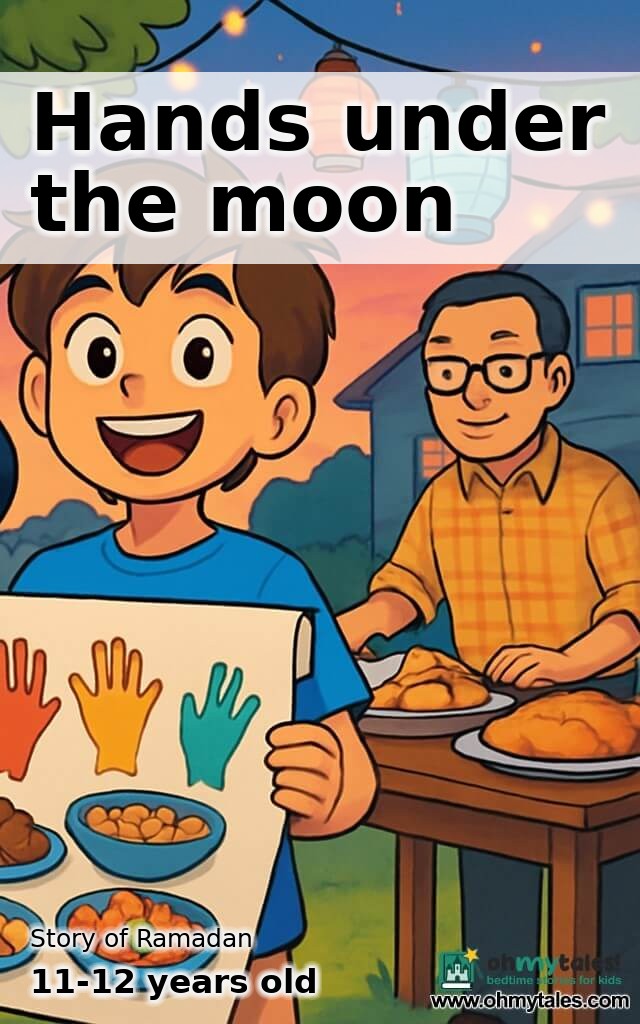
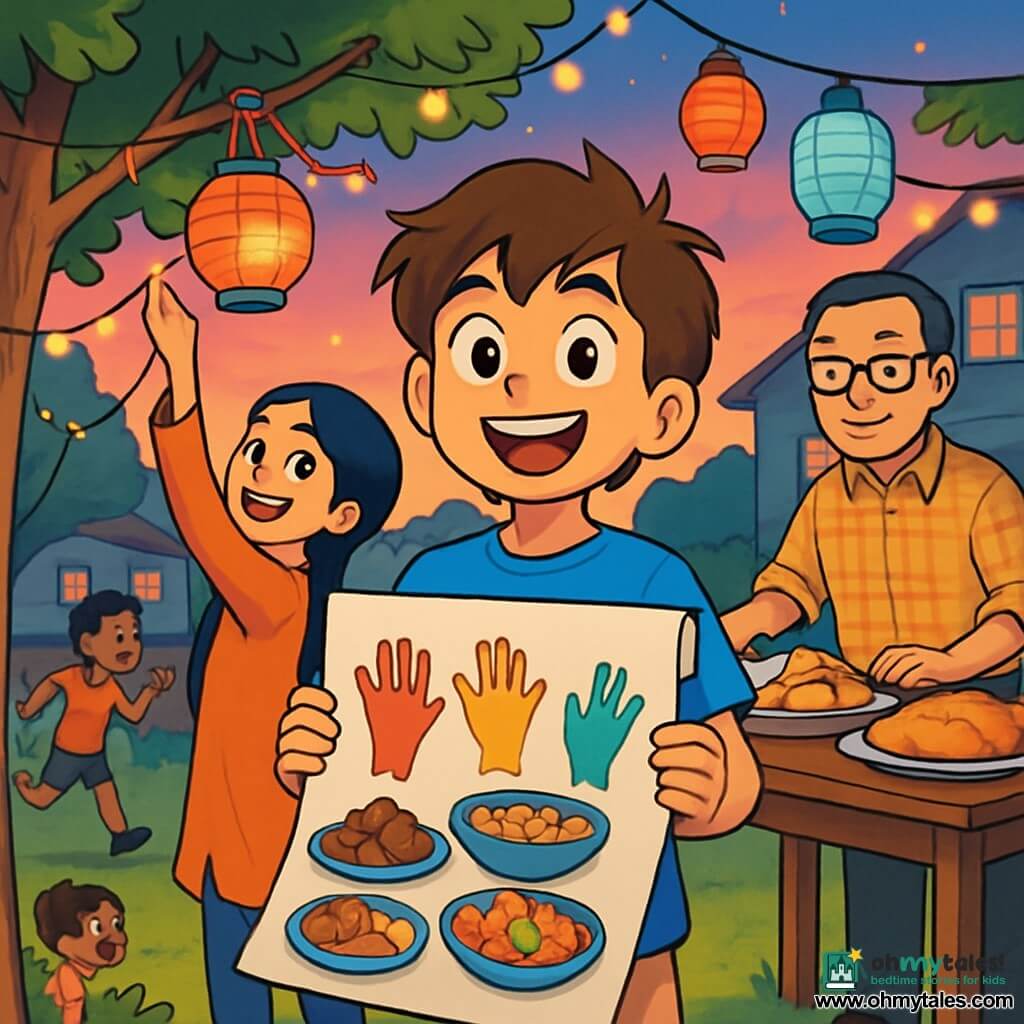
He had another plan too, the kind that made his stomach flutter with a nervous thrill—a secret iftar, a welcome table in the courtyard for anyone who needed a place to sit. And he'd make a drawing to hang in Mr. Park's shop window: a picture of hands passing plates under the moon. It would be the biggest thing he'd ever drawn. He could already see it in his head, shimmering with colors.
He pressed his forehead to the window glass and made a small wish he could almost hear, whispering like a breeze through the thin paper stars: Let me do this right.
“Come help taste the soup,” their mother called. “Just a sip.”
Sami padded to the table, lifted a spoon, and blew on it. The lentils were soft as a sigh. “Perfect,” he said. “It tastes like blankets.”
His mother laughed. “Then it will keep us warm.”
He touched the lantern again. Something inside it hummed, and he felt brave enough to keep his secret a little longer.
Chapter Two: A Secret with Too Many Pieces
At suhoor, while the sky was still gray and the city was half-asleep, Sami ate a small bowl of porridge and a slice of his father's sweet bread. He drank water until it sloshed, then tucked his plan under his tongue like a secret coin.
After school, he rushed home and cleared space on the living room floor. He unrolled a roll of paper so wide it touched the couch on one side and the wall on the other.
“This is the… hallway map,” he told Layla when she poked her head in.
“I can help,” she offered. “What are we mapping?”
“Thanks—I've got it,” Sami said too quickly. He set down his pencil, and the lantern on the windowsill dimmed, as if a tiny cloud passed inside it.
He began to sketch. First, a round table, then plates, then hands—big and small, knobby and smooth—passing bowls of olives, a basket of dates, a jug of water catching the moon's curve. He drew the moon too, a thin silver shape that watched with a kind face.
By the time the clock ticked toward afternoon, his stomach was a small, hollow drum. He carefully folded the edges of the paper so it wouldn't wrinkle, then grabbed his backpack.
“I'll be back,” he called.
“Before iftar,” his mother said. “We'll walk down together.”
Outside, the courtyard glowed with practice; neighbors were already trying out where to put tables and chairs. Mr. Park, who ran the corner shop, nodded as he taped a handwritten sign that said: Bring what you can. Take what you need.
Sami slipped inside the shop, choosing a box of dates, a package of paper cups, and a coil of cheap string lights. He counted his coins twice. He'd saved for weeks. The string lights wobbled out of his arms, but he caught them with his chin.
“You need a hand, little man?” Mr. Park said.
“No, thanks!” Sami squeaked. “I'm strong.”
He walked out with a box balanced on his knees and a plastic bag looped around his wrist. A cat with a black mask over its eyes watched from a sunlit car hood, looking amused.
By the time he staggered to the building's front steps, the plastic loop had cut a red half-moon in his skin. He was sweating. He tucked the dates under his arm and tried to open the door with his elbow. The string lights slid like a snake and thunked to the tiles.
The lantern in his bag thumped against his knee. Hummm, it seemed to say, almost like a sigh.
“I've got it,” Sami told the lantern, which was also the same as telling himself. He propped the door with his foot and squeezed through, holding his breath as the box scraped the wall. He didn't notice a small rip starting on the corner of the date box. He didn't notice the cat slipping in behind him, silent as a whisper.
Chapter Three: Chalk and a Clever Cat
The next day, in art class, Ms. Rivera set out a rainbow of chalk pastels. “Sometimes art is a team sport,” she said, smiling. “Even paintings enjoy being made with company.”
Sami's pencil made a soft skritch on the page. He was drawing a hand passing a glass of water. His stomach rumbled in the quiet room, but it didn't bother him. The rumble felt like part of the rhythm of the day. Besides, he had work to do later. He'd finish his giant drawing. He'd hang the string lights. He'd figure out the table. He'd…
“You're frowning,” said Zoe from the next table. “You look like you're trying to build something with invisible bricks.”
“Just thinking,” Sami said. He shaded a knuckle. The chalk left a powdery blue glow. He wondered how to add light to a picture so it shone back, even after the sun went down.
After school, the masked cat trotted at his heels as if it had decided they were friends. It led him past the laundromat, where steam rolled out in creamy puffs, to the corner where he'd seen kids chalking hopscotch the week before. The air smelled like soap and someone's cookies.
The sidewalk was a palette of stars and squares and names. On the curb, a leftover box of chalk sat with its lid flopped open. The top chalk stick was silver-gray, like the edge of the moon.
“You can't steal,” Sami told the cat. The cat yawned, showing pink, as if to say, Borrow.
He looked up and down the street. “Hello?” he called. No one answered. The chalk lay there like a gift someone forgot to collect. Sami picked up the silver-gray piece and drew a tiny crescent near his sneaker. The chalk line shimmered, not with sparkles, but with the soft sheen of a snail trail.
The cat stepped on the chalk crescent. For a breath, it glowed, then faded, leaving a mark that looked like a smile.
“Okay, that's… cool,” Sami said. “Maybe I can use this for the moonlight on the table in my drawing.”
The cat bumped his ankle as if to say, You still have to carry the table.
“I can do that,” Sami insisted. He tucked the chalk into his pocket. The lantern, snug in his backpack, gave a barely-there hum. It reminded him of a story his grandmother told him once, about a bird that sang only when it heard other birds sing first.
He brushed the thought away. Asking for help felt like turning down his own song. He wanted to be the kind of person who could hold all the strings by himself.
Chapter Four: The Spilled Dates
On the third evening, the sun was a slow coin rolling toward the edge of the world. Sami piled everything into his arms again: the box of dates, the paper cups, the string lights, and now the big sheet of drawing paper, folded carefully like a treasure map.
He took one step down the hall. The cat sprang out from under the radiator and weaved around his ankles. Sami flinched. His knee bumped the door. The box of dates snagged on the rip he hadn't noticed. The corner gave way with a soft, terrible sound like breath leaving a balloon.
The dates poured out, bouncing in slow-motion. They rolled like dark marbles, little moons making a runaway river down the stairs.
“Oh no,” he said, very tiny.
He sat on the bottom step and listened to the dates settle. The hallway was still for a heartbeat. Then a door opened.
Mr. Luca, the baker from two floors up, peered out. “Is it raining fruit?” he asked, eyebrows jumping.
Another door opened. “I heard a thunk,” said Auntie Noor, whose earrings always chimed. “Ah! Dates making their own parade.”
Sami's face burned. “I was trying to carry everything. I wanted to make a welcome table downstairs, and hang lights, and put up a drawing, and—” He swallowed. His throat felt high and tight. “And I didn't want to bother anyone.”
Auntie Noor knelt and picked up a date, rolling it between her fingers like a marble. “Bother? Asking is not bothering,” she said. “It is an invitation to join in.”
“You're allowed to lean,” Mr. Luca said. “We all lean. On shelves. On counters. On each other.”
The cat nosed a date and looked up at Sami, as if to say, Well?
Sami's chest loosened. He took a breath so deep he could feel it tickle the bottom of his ribs. “Can someone help me?” he said. The words were small and bright, like seeds.
“Of course,” said Auntie Noor, almost before he'd finished. She stood and clapped her hands. Her earrings chimed their yes.
Mr. Park's door opened at the bottom of the stairs as if the building itself had been listening. “I have extra boxes,” he said. “And a folding table. And more dates, if you need them.”
Layla leaned over the railing from above. “I have markers,” she called. “I knew you were making something! Why didn't you tell me?”
Sami looked up at her. “I thought if I asked, it wouldn't be mine anymore.”
She ran down the steps and tapped his forehead with a finger. “It will be more yours,” she said. “And more everyone's. That's the magic of help.”
His backpack hummed. He pulled out the lantern, and this time when he held it, the hum didn't feel like a secret. It felt like a song he could share.
“Okay,” he said, standing. “Let's do it together.”
Chapter Five: Hands in the Picture
They worked like a moving picture. Mr. Park brought out a table and wiped it with a cloth that smelled like lemons. Mr. Luca appeared with baskets of small rolls speckled with sesame. Auntie Noor unwrapped a plate of samosas that hissed softly with spice. Someone strung the string lights from the railing to a tree; the lights twinkled on like very obedient stars.
Children from the building and the block poured in with crayons and chalk and scissors. Zoe came running with a jar of buttons and said, “For decoration.” The masked cat leapt onto the windowsill and kneaded a cushion, supervising.
Sami unrolled his paper in the courtyard and taped down the corners. He drew the round table bigger, the moon brighter. Then he held up his chalk and said, “I want to put all of us in this. I want to draw our hands.”
“That's too many hands,” someone giggled.
“Then we should start now,” Sami said, a smile tugging at his mouth.
He sketched hands quickly—some with bitten nails, some with bracelets, some with little scars that told old stories. “Keep still for fifteen seconds,” he told Mr. Luca. “Okay, now move.” He passed the chalk to Zoe. “Can you shade the shadows?”
“Like this?” she asked, brushing soft gray along a wrist.
“That's perfect,” Sami said, surprised and pleased. “It looks like the moon is hugging your arm.”
Layla drew her hand with a ring of tiny flowers on the finger. “Add our names near our hands,” she said. “So we are here even when we're upstairs.”
“Good idea,” Sami said. He wrote SAMI. Layla wrote LAYLA with the tail of the Y looping into a vine.
Mr. Park crouched and drew his own hand steady and square. “I never draw,” he said, cheeks pink. “It feels like I'm walking on my hands instead of my feet.”
“Looks good to me,” Zoe said.
Neighbors stepped close, then closer. They leaned over the paper with the careful hush people use around sleeping babies. They added peppers and lemons to the plates, a pitcher with slices of yellow floating inside, a pile of dates like smooth stones.
“Draw the sound of laughter,” a little kid suggested, serious as a scientist.
“How do you draw sound?” Sami asked.
“With lines like butterflies,” said the kid, flapping his fingers. Sami glanced at Layla. She shrugged. Draw it, her eyes said.
He did. He drew small winged lines around a mouth, and somehow, the picture felt warmer.
The lantern hung from a low branch where they'd tied it. Every time someone added a detail, it hummed. When Mr. Park showed a teenager how to coil the string lights without tangles, hum. When Auntie Noor pressed a samosa into the hand of a kid who looked shy, hum. When Sami stepped aside so Zoe could color the glass of water with her careful blue, hum.
As they worked, the sky slid from pale to plum to deep blueberry. Streetlights clicked on, little moons at eye level. The paper's edges fluttered when a breeze strolled through, carrying the smells of cardamom and tomato and sugar, and the buzzing of someone's radio playing a song that felt like satin.
Sami stepped back and rubbed chalk from his hands onto his jeans. He felt not bigger, exactly, but stretched in a right way, like dough after you've rested it. The idea that asking for help would shrink him now seemed silly, like a coat he'd outgrown without noticing.
He looked up at the lantern. It swayed, which he expected. But then, for a breath, it lifted. It rose a few centimeters, as if the hum turned to helium. No one else seemed to see, or maybe they saw and just smiled inside their smiles.
“Huh,” he said to the cat. The cat's eyes reflected the string lights, twin galaxies. It yawned again and bumped his shin.
“Almost time,” said his mother, arriving with a basket wrapped in a clean towel. “I made soup with mint.”
“Perfect,” Sami said. He looked at his drawing and felt a knot loosen somewhere in his chest. He had wanted to hold all the strings. Now they were all holding one string together, and the string belonged to everyone, and somehow, that made it stronger.
Chapter Six: A Window for the Moon
Evening settled like a friendly blanket. The tiny moon slipped higher, a silver boat sailing slow. The courtyard buzzed and breathed. Feet tapped. Plates clinked. Someone told a story about a date palm that grew up through a cracked sidewalk and made little shadows that looked like fish.
Sami stood with his family at the welcome table. They waited, soft and still, letting the moment grow. Then, gently, with the grace of a promise kept, they broke their fast. A date smooth as a pebble, the first sip of water cool like river stone. Warm soup. A roll that opened like a smile.
“Good?” his father asked.
“Good,” Sami said, and the word meant more than taste.
Children darted in and out with lemonade. Mr. Luca passed a basket until it was empty and then full again, as if bread could multiply if you moved it between enough hands. Laughing lines drew themselves in the air, invisible unless you believed in them, which tonight seemed easy.
The drawing lay in the middle of it all, full of hands that didn't tire. People leaned over to find their names and point them out to friends. “There's me!” “That's my bracelet.” “Look, your scar.” “I like your moonlight.”
The masked cat walked carefully along the edge of the paper, then jumped down and curled up beneath the lantern as if it had been part of the plan all along.
“Where should we put it?” Sami asked finally, when the dishes were mostly crumbs and the pitch of voices turned soft.
“Somewhere everyone can see it,” Layla said.
Mr. Park wiped his hands on a towel. “My front window is ready,” he said, “if you'll trust me with it.”
Sami felt a bubble of pride float up and pop in his chest. “Yes,” he said. “That's perfect.”
They carried the drawing together, four corners held by four pairs of hands. It felt like carrying a light wooden door that opened onto something better. The paper was surprisingly heavy and surprisingly gentle. When they reached the shop, Mr. Park opened the window latch. The night air met the warm shop air and shook hands.
“Careful,” Sami said, and Mr. Park said, “Yes, captain.”
They smoothed the drawing against the inside glass. From the street, the string lights reflected in the window, pinning tiny stars across the paper sky. The faces and hands looked back at them, real and not real, like a memory you can touch.
“Maybe we should call it Hands Under the Moon,” Zoe said.
Sami looked up at the actual moon, which seemed to be smiling. He looked at the lantern in the tree, humming gently. He looked at the cat, who blinked slow approval.
“We can call it anything,” he said. “It knows what it is.”
Behind them, in the courtyard, someone began to sing very softly, the kind of song that doesn't need to be loud to be heard. Neighbors leaned on each other. A little kid fell asleep on a bench, a smudge of blue chalk on his cheek like a sky he'd been saving.
Layla bumped her shoulder against Sami's. “You did it,” she said.
“We did it,” he said. The words felt right in his mouth, like a new taste he already loved.
His mother tucked a loose curl behind his ear. “How did it feel, asking?”
“Like opening a window,” he said, surprised to hear himself say it. “Like letting the wind come in and fix the air.”
His father nodded. “Windows are for sharing light both ways.”
They stood there for a while, listening to the hum of the evening and the lantern and the quiet that comes after a good day. In the shop glass, their reflections stood among the drawn hands. If Sami tilted his head, he could almost believe the chalk lines were moving, passing bread and water, offering. He didn't want to blink.
“Ready to go home?” his mother asked.
“In a minute,” he said.
He took the silver-gray chalk from his pocket and, with Mr. Park watching kindly, drew one small crescent at the corner of the window. The chalk left its snail-trail shine. The crescent seemed to nod at the moon, and the moon, in its slow silk way, seemed to nod back.
Then he stepped away and looked at the drawing again, all those hands held together by the simple thing he'd finally learned to do. It glowed in the shop window, catching the string lights and the moonlight and the light of everyone's quiet joy. And there it stayed, the next day and the next, smiling out at the street, a window for the moon and a home for their shared hope.