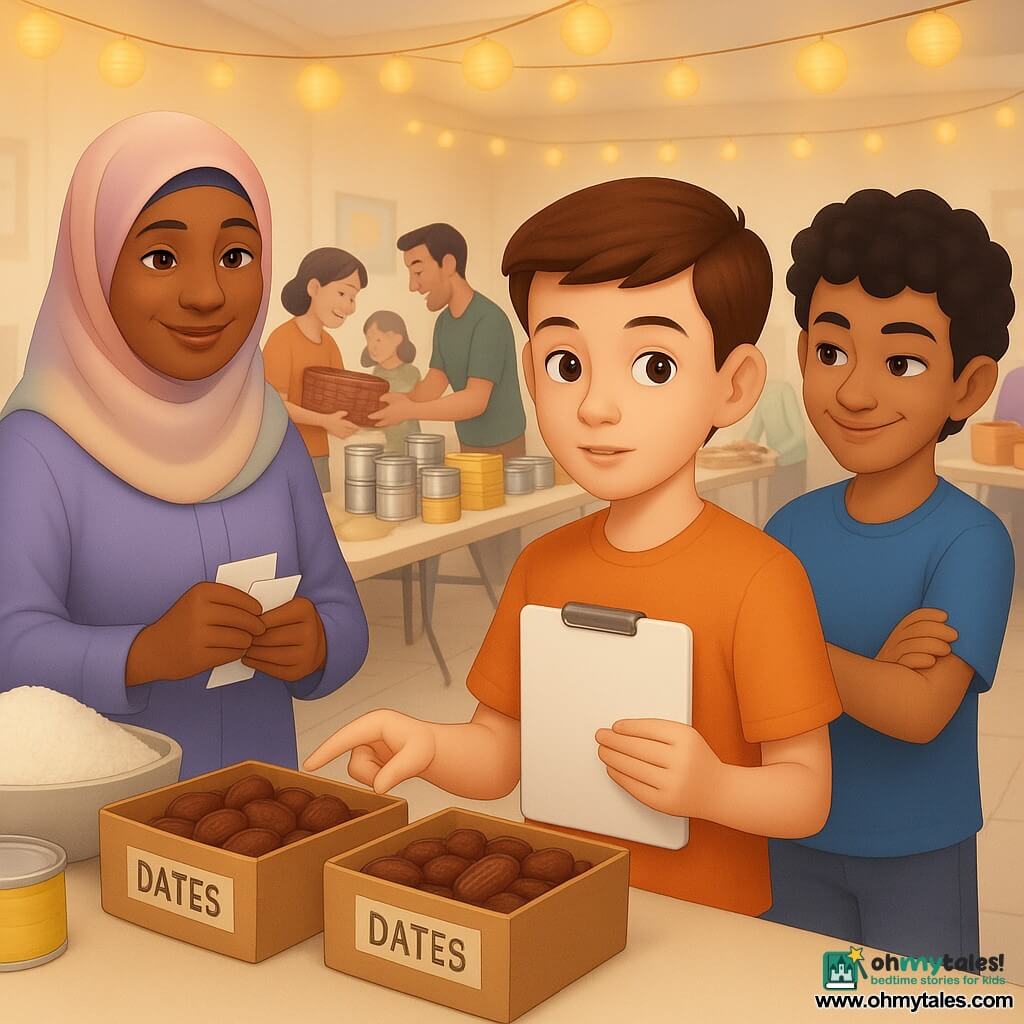
Chapter 1: Lists, Labels, and Lemon Dates
Milo liked rules that sat still.
Rules like: wash your hands before cooking. Put cans with cans. Keep tape on the edge of the table so the boxes line up perfectly. Simple rules made his brain feel tidy, like a drawer where all the socks match.
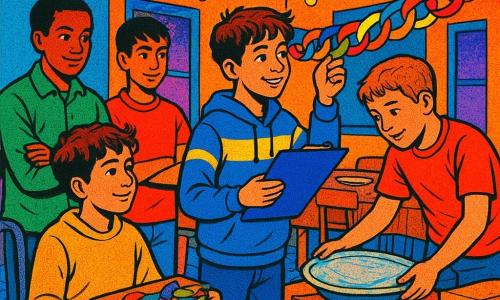
That afternoon the community center smelled like cardboard, cinnamon, and somebody's very enthusiastic lemon cleaner. Long folding tables filled the room. On one table, a mountain of rice bags leaned like sleepy elephants. On another, towers of pasta boxes stood straight as soldiers.
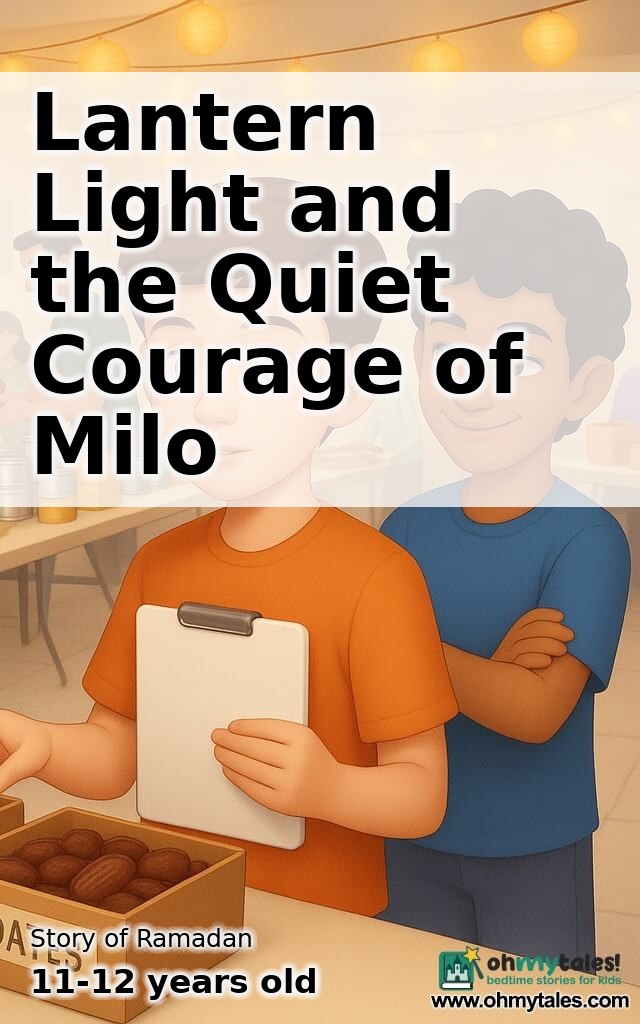
Milo held a clipboard like it was a shield.
“Okay,” he announced, reading the list. “Basket one: rice, lentils, dates, tea, oil, chickpeas, soap.”
Beside him, Ms. Farah—who could tie a scarf and a conversation at the same time—smiled. “You sound like a tiny newsreader.”
“I am not tiny,” Milo said automatically, then sighed. “I mean… I'm eleven. That's medium.”
A boy with curly hair pushed a box toward Milo. “Where do these go?”
Milo glanced at the label. “Tomato paste. Table three. Left side. In rows of six.”
The curly-haired boy raised an eyebrow. “Rows of six?”
“Yes,” Milo said. “Because six fits in the box. And it looks… correct.”
The boy laughed, not meanly—more like his laugh had soft edges. “I'm Sami. I'll do rows of six. Captain Correct.”
Milo's cheeks warmed. He pretended the clipboard needed urgent attention.
People came in with shopping bags and rolling carts. Someone played quiet music from a phone, the kind that sounded like raindrops tapping a window. Kids darted between legs until a volunteer clapped and said, “Walking feet, please!”
Milo liked “please.” It was a rule wrapped in kindness.
He helped fill baskets: sturdy ones with handles and checkered cloth liners. The baskets were for families who needed extra help this month. Milo had heard grown-ups call them “solidarity baskets,” which sounded like a superhero's snack pack.
When Milo placed a packet of tea into a basket, he lined it up with the lentils so the labels faced forward. He paused, satisfied.
Then he looked up.
A whole line of volunteers moved together—hands passing items down the tables like a river carrying shiny stones. A woman at the far end taped boxes shut. A teen wrote names on tags in careful loops. Sami stacked baskets into neat columns, humming like he had his own theme song.
Milo felt something shift, like a puzzle piece clicking into place. The rules weren't only his. The room itself had rules—shared ones—made from everyone's small actions.
“Nice teamwork,” Milo said softly, surprised by his own voice.
Ms. Farah leaned in. “Ramadan has a way of gathering people. Like a warm lamp in a dark hallway.”
Milo glanced at the baskets. “It's… kind of amazing.”
“It is,” she said. “And you're part of it.”
Milo straightened his clipboard. He liked that rule: you're part of it.
Chapter 2: The Whisper That Wanted to Be a Voice
As the afternoon rolled on, the community center got louder in a gentle way—paper rustling, tape ripping, people chatting. Milo tried to keep his thoughts in straight lines, but the sound turned them into curly scribbles.
A little girl dropped a bag of flour with a soft thump. Powder puffed up like a tiny cloud.
“Oh no,” she squeaked.
“It's okay,” Ms. Farah said. “Nothing broke.”
Milo stepped forward, then stopped. He wanted to say, “Flour goes on table two. Bags should be double-checked for holes.” It was a helpful rule. A good rule.
But the words got stuck behind his teeth, like they were shy.
Sami noticed. “You gonna tell the Flour Cloud what to do, Captain Correct?”
Milo swallowed. “I… don't like talking loud.”
Sami tilted his head. “You talk to your clipboard plenty.”
“That doesn't count,” Milo muttered.
Across the room, someone called out, “We're low on dates!”
Milo's ears perked up. Dates were important: sweet, sticky, comforting. In Milo's mind, dates were the friendly punctuation mark at the end of a long day.
He scanned the supply table. Two boxes of dates sat behind a stack of canned corn, practically hiding.
If he didn't say anything, the boxes would stay hidden. Someone would run around looking worried. The smooth flow would wobble.
Milo's fingers tightened on the clipboard. He could almost hear his own heart doing jumping jacks.
He walked toward Ms. Farah. “Um… there are dates. Behind the corn.”
His voice came out small, but it came out.
Ms. Farah's face lit up as if Milo had turned on a light. “Wonderful spot, Milo! Could you tell the others?”
Milo's stomach did a slow flip.
Sami gave him a little nod. “Go on. Say it like you're reading the weather.”
Milo turned to the room. The air suddenly felt thick, like wading through honey.
He took one breath. Then another.
“Dates are behind the canned corn,” he said, louder. “Two boxes. We have enough.”
A few heads turned. A man near the tape gun waved. “Thanks, buddy!”
Someone else called, “Great catch!”
Milo's face grew hot again, but this time it wasn't embarrassment. It was something brighter.
He walked to the supply table and pulled the date boxes forward, placing them where everyone could see.
Sami followed him. “Not bad,” he said. “Your voice didn't explode or anything.”
Milo blinked. “Was that a possibility?”
“Only if you're secretly a dragon,” Sami said, very serious. Then his serious face cracked and he grinned.
Milo snorted, surprised at himself.
The room kept moving. The rules kept holding. And Milo's voice—quiet, careful—had found a small place to stand.
Chapter 3: Lantern Light and the Nearly-Perfect Plan
Outside, the late afternoon sky turned the color of peach yogurt. The community center windows reflected strings of paper lanterns someone had hung in the hallway—stars and moons cut from gold paper, wobbling slightly when people walked past.
Milo helped carry finished baskets to the storage room. The baskets smelled like soap, rice, and sweet dates. It was a clean, comforting smell, like a hug that remembered to knock.
In the hallway, Ms. Farah handed Milo a roll of stickers shaped like crescent moons. “For the tags. A little brightness.”
Milo peeled one sticker carefully and pressed it onto a name tag. “Stickers are… acceptable.”
Sami leaned over. “Wow. High praise.”
Milo's eyes followed the lanterns. “Why do we do lanterns?”
Ms. Farah considered. “They remind us of light. Of hope. And also… they're cheerful. Darkness can be polite, but it's not very fun.”
Milo thought about that. He liked fun, in a measured way. Like jokes that arrived on schedule.
Back in the main room, the volunteers slowed down. Some people checked their phones. Others rubbed their hands, tired but happy. A few families came to pick up baskets, smiling with their eyes even when their mouths stayed shy.
Milo watched one boy about his age accept a basket with both hands. The boy's mom whispered something, and the boy nodded, serious. Then he looked at Milo and gave a quick grin, like a secret handshake made of gratitude.
Milo felt something warm move through him. Gratitude didn't clank like a medal. It was quieter. Softer. It made the air feel wider.
Ms. Farah clapped gently. “Everyone, thank you. Truly. This is how a community breathes together.”
Milo wanted to say something too. He had ideas—simple ones, like rules:
1) We did good.
2) Thank you.
3) Let's do it again.
But speaking to the whole room felt like trying to jump over a very tall puddle.
Sami nudged him. “You're thinking loud again.”
“I'm thinking in bullet points,” Milo said.
“That's still loud.”
Milo took a breath. He didn't need to shout. He didn't need fireworks. Calm was his superpower, even if it didn't come with a cape.
He raised his hand, like in class. It felt oddly formal in a room full of tape and rice bags, but Milo liked formal. Formal had edges.
Ms. Farah noticed right away. “Yes, Milo?”
Milo's throat tightened, then loosened, like a knot deciding to be kind. “Um… I just… I liked how everyone worked together,” he said. “It made it easier. And… thank you.”
Silence fell for half a second.
Then a few people nodded. Someone murmured, “That's right.”
A teen at the tag table said, “Good point, Milo.”
Milo's shoulders dropped, relieved. He hadn't tripped over his words. He hadn't turned into a dragon. He had just spoken—calmly, like placing a book back on a shelf.
Sami whispered, “Captain Correct is now Captain Courageous.”
Milo whispered back, “That sounds exhausting.”
Sami laughed. “It's okay. Courage can come in small sizes.”
Milo glanced at his hands—still holding a moon sticker. He pressed it onto the last tag, smoothing the edges.
Small sizes, he thought. That I can do.
Chapter 4: The Iftar Table with a Missing Spoon
That evening, Milo's apartment smelled like toasted bread and soup. The kitchen table had been set with extra care: dates in a small bowl, water glasses lined up, napkins folded into triangles that looked like tiny tents.
Milo liked the triangles. They had sharp corners. They understood the assignment.
His mom stirred the soup. “How was the basket packing?”
Milo sat up straighter. “Efficient,” he said, then paused. “Also… nice.”
His older sister, Lina, raised an eyebrow. “Two whole adjectives. You must be thrilled.”
“I'm medium thrilled,” Milo said, and Lina laughed, which meant she approved.
As the sky deepened outside, the room grew quiet in a comfortable way. They waited together, the way you wait for a favorite song to start. Milo watched the lantern light from the hallway window flicker on the wall, turning it into a soft, moving painting.
When it was time, they ate simply: a date, some soup, warm bread. Milo felt grateful for the food, for the table, for the fact that his family's jokes always found their way home.
Halfway through, Lina frowned. “Where's the big serving spoon? I put it right here.”
Milo looked. The spoon spot was empty. An empty spoon spot was a problem. Problems demanded solutions, preferably in order.
“Rule one,” Milo said, holding up a finger, “check the sink.”
His mom pointed with her chin. “Already checked.”
“Rule two,” Milo said, “check the counter behind the kettle.”
Lina checked. “Nope.”
“Rule three,” Milo said, very serious, “blame the spoon gnomes.”
His mom snorted into her soup. “Spoon gnomes are real. They also steal socks.”
Lina leaned back. “Okay, Captain Rules. Any calm speeches for the spoon?”
Milo opened his mouth, then paused. Lina's teasing wasn't sharp, but he still felt that old shyness, that tiny lock on his voice.
He remembered the community center: the river of hands, the warm nods, Ms. Farah's bright eyes.
He took a breath, slow and steady.
“Everyone,” Milo said, not loud, just clear, “let's look together. Calmly. If we all check one place each, we'll find it faster.”
Lina blinked. “Who are you and what did you do with my brother?”
Milo ignored that. “Mom, check the drawer by the oven. Lina, check the dish rack. I'll check the table and chairs.”
His mom's eyes softened. “Good plan.”
They moved like a small team. Milo checked under napkins and beside plates. He even peeked under the table, because sometimes objects went on adventures without permission.
“Found it!” Lina called from the dish rack. She held up the spoon like it was a trophy. “It was hiding behind the colander.”
Milo sat back down, satisfied. “Spoon gnomes failed.”
His mom tapped his hand gently. “Thank you for keeping it calm.”
Milo felt the gratitude again—warm and quiet, like soup in your stomach.
Later, after dishes and a little laughter, Milo washed his hands and went to his room. The day felt full in a good way, like a backpack packed with useful things.
Before bed, he thought of the baskets: rice, lentils, tea, dates—small comforts traveling to other tables.
He whispered, mostly to himself, “Thank you.”
Then he slept.
Chapter 5: The Dream with the Soft-Edged Stars
In Milo's dream, the community center was bigger, but not in a scary way—more like it had stretched its arms.
The tables were made of smooth wood that glowed softly. The paper lanterns floated above without strings, drifting like patient jellyfish in a calm sea. Their light wasn't bright; it was gentle, the kind of light that didn't demand anything.
Milo walked in holding his clipboard. In the dream, the clipboard was lighter, as if the rules inside it had learned how to breathe.
Sami was there, stacking baskets with perfect rows of six. “Look,” Sami said proudly, “I can do correct now.”
Milo nodded. “Welcome to the club. Membership is free, but we do require at least one calm breath per day.”
Sami saluted. “I can manage two. Maybe three, if there are snacks.”
People formed a line, but instead of looking tired, everyone looked softly glowing, like they'd each swallowed a tiny lantern—just enough to light their eyes.
Milo placed items into baskets: rice, lentils, soap, tea. Each item made a small sound when it landed, like a note in a simple song. Dates made the nicest sound—plop, like a friendly punctuation mark.
Then something strange happened.
Every time Milo thanked someone, a little star appeared. Not a glitter explosion. Just a small, steady star, floating above the baskets. The stars drifted upward and joined the lanterns, making the ceiling look like a sky that had decided to move indoors.
Milo tried it again. He handed a basket to a woman with kind hands.
“Thank you,” he said.
A star appeared—soft-edged, warm, real.
He turned to Sami. “Thank you for stacking.”
Star.
He looked at Ms. Farah. “Thank you for noticing me.”
A brighter star popped into being, and Milo felt his throat tighten in the dream, but in a good way—like he was holding back happy water.
Ms. Farah's voice floated over like a blanket. “Gratitude is light, Milo. Not a spotlight. A lantern.”
Milo watched the stars drift upward. The room felt peaceful, organized, shared. Rules and kindness braided together like two strings making one strong rope.
Then Milo realized something else: his voice didn't feel locked. It felt like a door that could open quietly whenever it needed to.
He stood on a chair—carefully, because rules—and cleared his throat.
“Everyone,” he said, calm as a smooth stone in a pocket, “thank you for working together.”
The room didn't burst into applause. It didn't need to. People simply smiled and nodded, and the lanterns glowed a little warmer, as if they understood.
A shower of soft stars drifted down, not falling fast, just floating like snow that had decided to be gentle.
One star landed on Milo's hand. It didn't burn. It felt like the warmth of a mug on a cold day.
Milo closed his fingers around it and whispered, “Thank you.”
The star melted into a quiet glow that slipped into his chest, right behind his ribs, and stayed there—steady, calm, and kind.
When Milo woke up, the morning light was pale and peaceful. His room was ordinary again: posters, books, a sock that might have been stolen and returned by gnomes.
But the calm glow feeling remained, faint and real.
Milo lay still for a moment and smiled to himself, as if he had tucked a tiny lantern inside his heart—just enough to light the day.