Chapter 1: The Garland of Kind Words
Milo loved walking the way some people loved video games: with total focus and a little bit of drama. He walked fast when he was excited, slow when he was thinking, and extra slow when he wanted the world to notice he was having a meaningful moment.
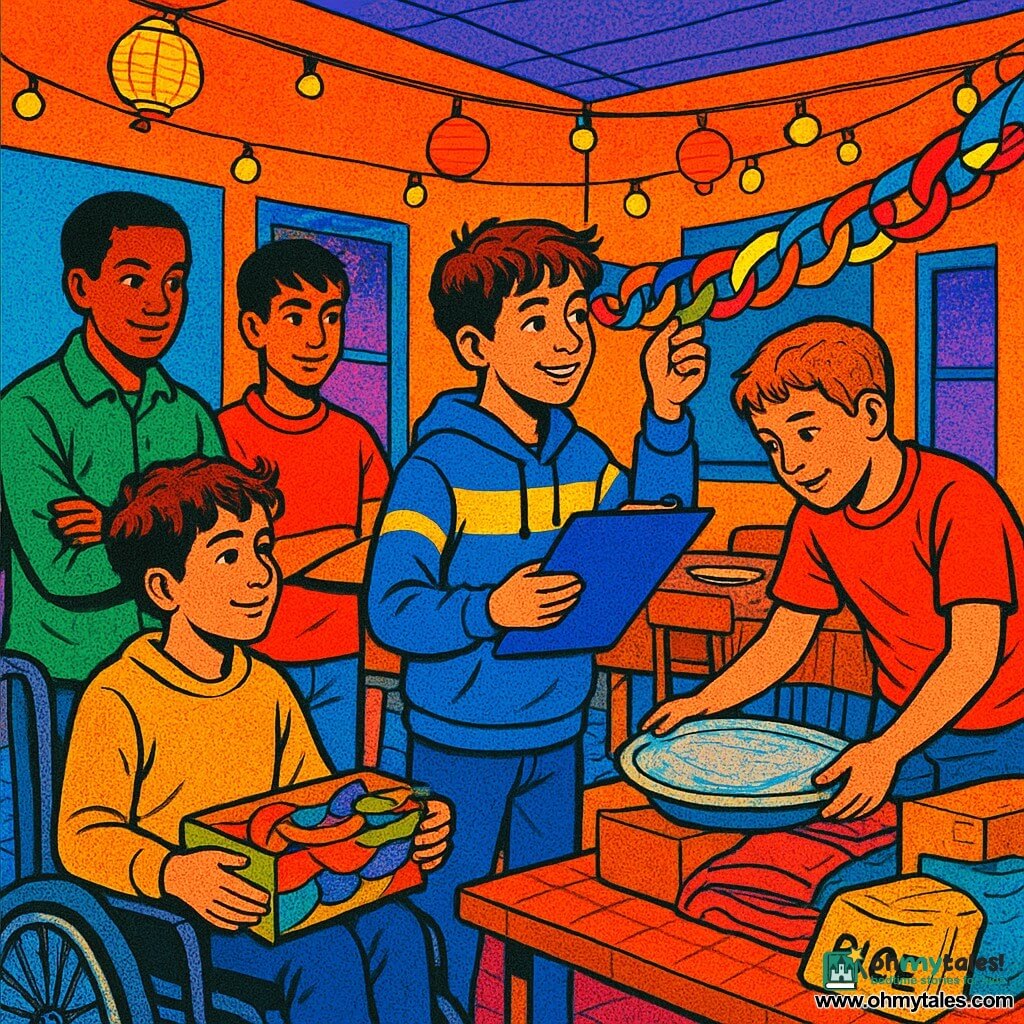
That afternoon, he was sitting on the living room rug with three friends and a mountain of colored paper. Outside, the early-evening sky was the soft blue of a washed hoodie. Inside, the air smelled like glue sticks and oranges.
“Okay,” Milo announced, holding up a strip of paper like it was a sacred scroll. “We're making a Ramadan garland. But it can't just say ‘Happy Ramadan' a thousand times.”
Zayd snorted. “Because your hand would cramp and you'd complain for a week.”
“I would not complain,” Milo said, immediately sounding like someone who would complain. “I would express my artistic suffering.”
Omar laughed and tossed a pen toward him. “Artist, please. What are we writing, then?”
“Kind words,” Milo said, as if the idea had been waiting in the room the whole time. “Real ones. The kind you actually mean.”
Hassan, who sat in his wheelchair with his feet tucked comfortably and his hair sticking up like he'd argued with a pillow and lost, leaned forward. “Like… ‘You're not annoying'?”
Zayd pointed at him. “That's suspiciously specific.”
Hassan shrugged. “Just brainstorming.”
They began writing. Milo wrote in careful block letters: YOU MATTER. Omar wrote: THANK YOU FOR TRYING. Zayd, after a long pause that made everyone stare, wrote: I'M GLAD YOU'RE HERE.
“Wow,” Omar said. “Zayd has feelings.”
Zayd rolled his eyes, but his ears turned pink. “Don't make it weird. It's just… true.”
Hassan wrote: YOU'RE FUNNIER THAN YOU THINK, then immediately added in smaller letters: MOST OF THE TIME.
They linked the strips into loops, one after another, until the garland looked like a bright paper river. The kind words swayed when anyone breathed too hard.
Milo held up the finished chain. It shimmered in the lamplight—just paper, but somehow more than paper. Like it had stored a little warmth inside each loop.
“We should hang it at the community center for iftar,” Omar said. “My mom said there's a big get-together tomorrow.”
Milo nodded, already imagining the walk there. “Yes. We'll take the long route.”
Zayd groaned. “Of course we will. Milo thinks shortcuts are morally wrong.”
“Shortcuts are fine,” Milo said. “But the long way has better sidewalk cracks.”
Hassan tapped the garland gently, making it rustle. “So tomorrow. We hang this up, eat, and try not to spill soup on our shoes.”
Omar held up a glue stick like a microphone. “I will spill nothing. I am elegance.”
Milo looked at their paper loops—kind words, messy handwriting, uneven links. It wasn't perfect. It was better. It felt like something that could belong to everyone.
Outside, the streetlights blinked on one by one, as if the town was slowly remembering how to glow.
Chapter 2: The Long Way to the Lanterns
The next evening, Milo met the others by the corner store, where the smell of warm bread drifted out every time someone opened the door. Each boy carried something: Omar had a covered tray his mom insisted was “not that heavy” (it was), Zayd had a bag of dates, and Hassan had the garland carefully folded in a box on his lap.
Milo carried nothing but excitement, which, unfortunately, weighed a lot.
“Ready?” he asked, bouncing on his toes.
Zayd glanced at his watch like it had personally betrayed him. “Ready to arrive sometime this century, yes.”
Milo led them down a side street lined with small gardens. Some houses had crescent-and-star decorations in windows; others just had ordinary curtains and ordinary TV light flickering behind them. Ramadan, Milo thought, didn't announce itself with fireworks. It showed up like a friendly knock.
They passed a row of trees, their branches stitching shadows across the sidewalk. Somewhere ahead, someone's radio played a soft song. A bicycle bell chimed twice, cheerful as a bird.
Omar adjusted the tray. “My arms are becoming noodles.”
Zayd offered help, but Omar shook his head. “No. I am elegance.”
Hassan laughed. “Elegance that's about to drop chickpeas.”
Milo slowed down when they reached a steep curb cut. Hassan rolled smoothly down it, but Milo still hovered like an overprotective duck.
“I'm fine,” Hassan said, amused. “You're acting like I'm a priceless vase.”
“A priceless vase with excellent jokes,” Milo said.
They reached a crosswalk. The little walking-man sign blinked. Milo watched Hassan's wheels, the steady rhythm of them. Omar's careful steps to keep the tray level. Zayd's longer stride, impatient but considerate enough to match the group.
Milo realized something quietly: they weren't moving the same way, but they were moving together.
Halfway to the community center, Milo spotted a kid up ahead, maybe seven or eight, standing on the sidewalk with a lantern on a stick. The lantern was shaped like a tiny mosque, and it glowed warm yellow inside.
The kid was frowning at it like the lantern owed him money.
Milo slowed. “Hey,” he called gently. “Cool lantern.”
The kid looked up, suspicious. “It's not cool. It keeps going out.”
Omar stepped closer. “Maybe the battery's loose.”
Zayd whispered, “Do we have time for rescue missions?”
Milo whispered back, “We have time for being decent humans.”
Hassan rolled up beside the kid. “Can I see?”
The kid hesitated, then handed over the lantern. Hassan turned it over, fingers nimble, and clicked the bottom panel. The light popped back on, steady as a tiny sunrise.
The kid's eyes widened. “Whoa.”
Hassan handed it back. “Sometimes things just need a small adjustment.”
The kid grinned and ran off, lantern bouncing like a happy thought.
Zayd watched him go, then sighed. “Fine. That was… nice.”
Milo's heart felt lighter, like someone had untied a knot he didn't know he had. “Everyone's walking their own speed,” he said, mostly to himself.
Omar raised an eyebrow. “Is this one of your meaningful moments?”
“Maybe,” Milo admitted. “But I'm still taking the long way.”
Zayd groaned again, but this time he was smiling.
When the community center finally came into view, it looked like a friendly ship docked in the neighborhood—windows glowing, people moving inside, laughter escaping every time the door opened. Milo could almost taste the evening: sweet dates, warm soup, the gentle hush right before a shared meal.
They weren't early. They weren't late. They were exactly where their feet had brought them.
Chapter 3: A Small Piece of Wonder
Inside the community center, the air was alive with sounds: greetings, plates clinking, someone calling, “Careful! Hot!” The room was decorated with paper lanterns and strings of lights that made everything feel softer around the edges.
Families filled the tables. Some kids darted between chairs like pinballs. The scent of cinnamon and baked bread floated above everything, impossible to ignore, impossible to be mad at.
Omar's mom swept in and took the tray with a relieved smile. “My goodness, Omar. Your wrists will sue you.”
“I carried it with elegance,” Omar said.
She patted his cheek. “With drama.”
Milo and the others found a spot on the wall near the entrance. Hassan lifted the garland box onto a chair, and together they unfolded the chain.
The kind words looped down in bright colors: YOU MATTER. THANK YOU FOR TRYING. I'M GLAD YOU'RE HERE. YOU'RE FUNNIER THAN YOU THINK.
A few people paused as they walked in. A woman in a green scarf read the words and smiled to herself, like the garland had said her name. An older man nodded at THANK YOU FOR TRYING as if it was a secret handshake.
Zayd stood back, hands in his pockets. “Okay. That… actually looks good.”
Milo pretended to brush dust off his shoulders. “I know. I am an artist.”
Hassan pointed at the last loop, where his smaller letters said MOST OF THE TIME. “That part is essential.”
As they stepped away, the garland swayed slightly. Milo could've sworn it made the light above it warmer, like the words were soaking up brightness and giving it back.
“That's impossible,” Zayd said, but he wasn't really arguing with Milo. He was staring too.
Omar leaned in. “Did our paper garland just… sparkle?”
Milo narrowed his eyes. “Either it did, or you're very hungry.”
They drifted toward the tables as the time for iftar got close. People sat with dates and water waiting in front of them. The room held a gentle kind of quiet, like everyone was agreeing to breathe together for a moment.
Milo watched a little kid across the room swinging his legs under the chair, trying to look patient and failing. A teenager nearby scrolled on his phone with one hand and held a date with the other, like multitasking was a sport. An older woman adjusted the plate in front of her and whispered something that made her granddaughter giggle.
Different rhythms, Milo thought. Same room. Same warmth.
When the call to break the fast came, it wasn't loud or showy. It was simply the moment arriving.
Everyone took a date, a sip of water. The first bite looked like relief. Like a small celebration you could hold between your fingers.
Milo wasn't fasting, but he ate with the others anyway, carefully, respectfully. The sweetness of the date surprised him every time, like it had been saving up all day just to be kind.
After that, the room burst into motion again: soup served, bread passed, conversations rising. The garland on the wall seemed to glow a little brighter with every laugh.
Omar wiped his mouth and leaned toward Milo. “If your garland starts floating, I'm leaving.”
Zayd smirked. “He'll chase it on foot for three hours.”
Milo grinned. “Obviously.”
Hassan lifted his spoon. “To kind words,” he said.
They clinked spoons and cups like a very strange, very loyal team.
Milo looked at their table. Four boys, eleven-ish, full of jokes and soup and plans. And somewhere between the paper loops and the shared meal, he felt a small piece of wonder settle in—quiet as a lantern light that didn't go out.
Chapter 4: The Boy Who Rushed the Moon
The next day, Milo suggested another walk. This time, Zayd didn't even pretend to be surprised.
“Do you ever stop moving?” Zayd asked as they headed out after school.
Milo inhaled the cool evening air. “Not emotionally.”
Omar rubbed his stomach. “I'm still thinking about last night's soup.”
Hassan rolled alongside them, steady and relaxed. The sidewalks were damp from a quick rain, and the street reflected the sky in wobbly puddles.
They turned a corner and nearly collided with a boy sprinting toward them. He was about their age, wearing a hoodie and carrying a plastic bag that swung wildly.
“Sorry!” the boy blurted, barely slowing down.
Zayd stepped aside. “Watch it!”
The boy stopped, panting. “I'm late. I'm super late.”
Milo noticed the bag: disposable cups, maybe napkins. “Late for what?”
“For the center,” the boy said, eyes wide with panic. “My aunt asked me to bring stuff, and I got distracted because my little brother insisted on showing me his new magic trick, and then I had to find my shoes, and—”
Omar held up a hand. “Pause. Breathe.”
The boy gulped air like it was homework. “I can't. If I'm late, everyone will stare.”
Hassan's voice was calm. “Most people are busy with their own things. And if they do stare, it's usually because they're wondering if you're okay.”
The boy blinked. “Really?”
Milo nodded. “Also, nobody's racing the moon. The sun goes down when it goes down.”
Zayd folded his arms, but his expression softened. “Where do you live? Maybe we can walk with you.”
The boy hesitated, like accepting help might be against his personal rules. Then he sighed. “Two streets over.”
They matched his pace, which was fast at first, then slowly eased as the boy realized nobody was yelling at him. Omar took the bag to help, and instantly made a face.
“These cups are trying to escape,” Omar complained.
The boy managed a small laugh. “I'm Sami.”
“Milo,” Milo said. “This is Zayd, Omar, and Hassan.”
Sami glanced at Hassan's wheels, then at Hassan's face, and treated him exactly like the rest of them—like a kid on a sidewalk, not a problem to solve. Hassan's smile said he noticed, and appreciated it.
As they walked, Sami's shoulders dropped. His breathing steadied. The world didn't feel like it was chasing him anymore.
At Sami's building, his aunt opened the door before they even knocked. “Sami! Oh, thank goodness. I thought you got eaten by a… a very polite bear.”
“A polite bear?” Sami repeated.
His aunt waved her hands. “I don't know. It's Ramadan. My brain is tired.”
Milo couldn't help laughing. “We helped him carry the supplies,” he said.
His aunt's face warmed with gratitude. “That's kind of you. Please, take some cookies for the road. They're not for iftar, they're just… emergency happiness.”
Zayd accepted the bag of cookies like it was a solemn duty. “We will guard these.”
As they walked away, Sami called, “Thanks! I… I rush a lot.”
Milo called back, “The moon still shows up!”
Zayd looked at Milo. “You're getting weirdly wise.”
Milo shrugged. “I'm just noticing things.”
Hassan rolled over a puddle that reflected the pale sky. “Like how everyone has their own pace.”
Omar nodded. “Even Sami, who clearly thinks he's in an action movie.”
Milo smiled. The truth felt simple and steady in his chest: you didn't have to move the same way to move forward. And sometimes, the kindest thing you could do was just… walk beside someone until their panic turned back into ordinary air.
Chapter 5: The Table of Giving
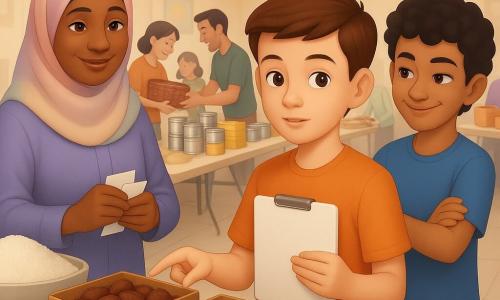
On the last Friday before Eid, the community center buzzed with preparations. The lights were up again, the paper lanterns swinging gently. And at the front of the room stood a long table with a sign taped to it: DONATIONS — TAKE WHAT YOU NEED, GIVE WHAT YOU CAN.
Milo stood with his friends near the entrance, staring at the table. It was covered in neat stacks and friendly chaos: bags of rice, boxes of pasta, jars of sauce, packets of tea, folded blankets, soap, notebooks, small toys, and hand-written cards.
Omar's voice dropped. “That's… a lot.”
Zayd nodded slowly. “More than last week.”
Hassan tilted his head. “People add a little each day.”
Milo looked at the items as if they were tiny promises. He noticed how different everything was—different sizes, different shapes, different kinds of help. Some people gave big bags that thumped onto the table. Others slipped in a small pack of diapers like it was a secret.
No one announced what they gave. No one made it a performance. The table just grew, quiet and steady, like a garden.
A volunteer handed Milo a clipboard. “Could you boys help count items? We're keeping track so we can organize.”
Milo held the clipboard like a mission. “Absolutely.”
Zayd cracked his knuckles. “Counting. Finally, a job I can do fast.”
“Try not to intimidate the noodles,” Omar said, pointing at the pasta.
They split into sections. Hassan counted toiletries and school supplies, his voice calm and rhythmic. Omar counted canned goods, making dramatic commentary.
“Behold,” Omar declared, holding up a can. “Chickpeas. Humble, round, powerful.”
Zayd counted bags of rice and flour. “One, two, three… why are there so many kinds of rice?”
“Rice contains multitudes,” Milo said, writing numbers down.
Milo counted blankets and small toys. He picked up a plush rabbit with one floppy ear and imagined it in someone's arms. He counted notebooks with clean pages, waiting for someone's thoughts.
As they worked, people approached the table. A man in a work jacket placed a bag down quietly, then adjusted the sign so it sat straight. A teen dropped off a stack of hygiene kits and backed away fast, as if kindness might chase her.
Sami appeared too, carrying a bundle of napkins and cups—this time at a normal walking pace. He waved at them, smiling, not rushed.
Milo watched all of it and felt the same gentle wonder he'd felt under the garland. Not sparkle-magic. Real-life magic. The kind made of small choices.
When they finished, Milo totaled the numbers carefully. His pencil squeaked as he wrote the final count.
Hassan leaned in. “What do we have?”
Milo read it out, steady and clear:
“Rice bags: 18. Pasta boxes: 24. Canned goods: 37. Tea packets: 15. Hygiene kits: 22. Blankets: 9. Notebooks: 16. Small toys: 12.”
Omar whistled. “That's a serious table.”
Zayd nodded, eyes bright in a quiet way. “People really showed up.”
Milo looked around the room: the warm lights, the soft chatter, the garland of kind words still hanging by the entrance, swaying as people passed under it. He noticed how everyone moved differently—some quick, some slow, some tired, some laughing—but all of them arriving, in their own ways, to the same shared warmth.
Milo tucked the clipboard under his arm. “I think,” he said, “this is what it means to walk together.”
Omar nudged him. “Careful. You're about to have another meaningful moment.”
Milo grinned. “Let me. It's Ramadan. Meaningful moments are in season.”
Hassan laughed. “So are cookies.”
Zayd held up the cookie bag like a trophy. “Emergency happiness, remember?”
They stood by the donation table a little longer, not rushing, not dragging their feet either—just being there, at their own pace, in a room full of gentle giving. And the paper garland above them rustled softly, as if the kind words were clapping in a very polite, very paper way.