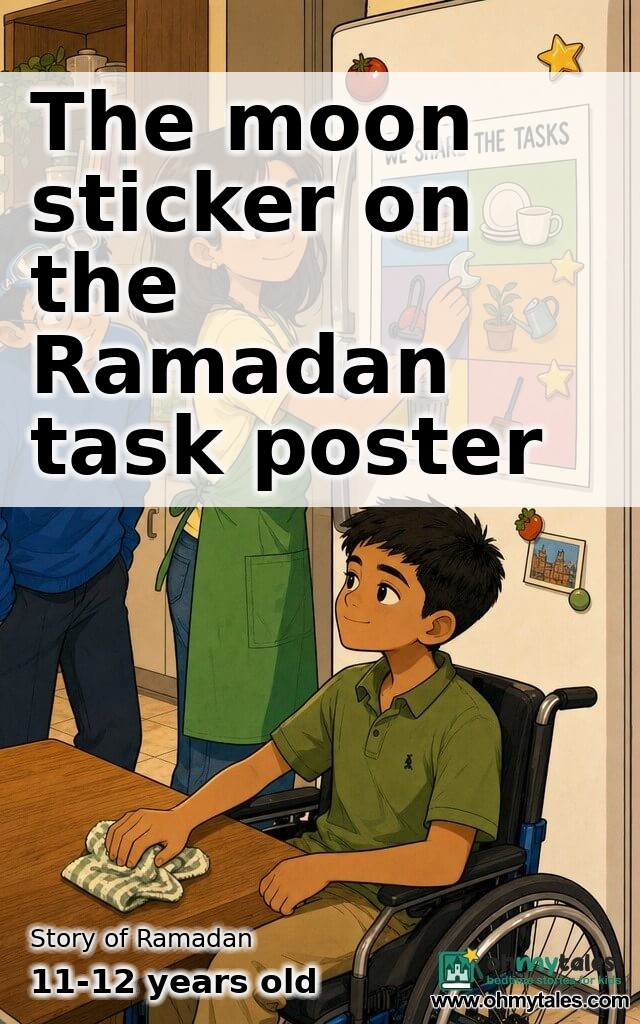
Chapter 1: The “We Share the Tasks” Poster
On the first Saturday of Ramadan, the afternoon light lay on the apartment windows like warm butter. Outside, the street sounded like scooters, birds, and somebody's radio trying very hard to be cool.
Inside, Amal balanced a marker behind her ear and stared at a blank sheet of poster paper on the kitchen table. She liked blank things. Blank things meant you could do better this time.
“Okay,” she said, tapping the paper as if it might wake up. “We are making a plan. A real one. Not the kind where everyone says ‘sure' and then disappears like socks in a washing machine.”
Yusuf, who was nearly twelve and always looked like he was about to ask a science question, leaned closer. “Is this… a chart?”
“It's a poster,” Amal corrected, and then, because she was trying to be modest and not sound like the boss of the world, she added, “A helpful poster.”
Mina grinned and stole the marker from behind Amal's ear. “Write in big letters: ON SHARES THE TASKS.”
“That's not what it says,” Yusuf laughed.
Ayaan, rolling his wheelchair slightly forward so his knees fit under the table, nodded toward the paper. “Make it neat. If it's messy, people will pretend they can't read it.”
“That,” Amal said, pointing at Ayaan like he'd just solved a mystery, “is wisdom.”
She wrote carefully:
ON SHARES THE TASKS
Yusuf coughed. “You missed a word.”
Amal stared. Her cheeks warmed. “I meant WE,” she said quickly, crossing out ON and fixing it with a thick, determined WE. “And nobody is allowed to mention this ever again.”
Mina made a zip-motion across her lips. “My lips are sealed. Like a snack box.”
Amal drew four little boxes beneath the title and wrote their names: Amal, Yusuf, Mina, Ayaan. Then she added lines: Prep, Set Table, Wash Dishes, Wipe Counters, Take Out Trash.
She hesitated, marker hovering. Ramadan always made the days feel different—slower, softer around the edges. People were a little more careful with each other. A little more patient. At least… they tried.
Her mom walked in with a bag of groceries and the kind of smile that meant she'd seen everything. “What's all this?”
Amal lifted the poster proudly. “We're sharing the tasks this month. So nobody gets stuck doing everything before iftar.”
Her mom's eyebrows rose, impressed. “That is… wonderful.”
Amal tried not to look too proud. Modesty, she reminded herself, was like salt: important, but not something you threw in by the handful. “It's just a poster,” she said, even though it felt like a tiny flag of teamwork.
Her dad peeked in from the living room. “Does the poster have a section for ‘taste-testing'?”
Yusuf raised his hand. “I volunteer.”
Mina laughed. “That's not a task. That's an Olympic sport.”
Ayaan studied the chart. “So we actually do this?”
Amal nodded. “We actually do this.”
And for a moment, the kitchen smelled like markers and oranges and possibility.
Chapter 2: The Soup Lesson
The next day, the poster was taped to the fridge with a magnet shaped like a tomato. It looked official. Almost intimidating.
“Today is Prep,” Amal announced after school, reading the schedule. “And it says… Amal and Yusuf.”
Yusuf adjusted his backpack straps like he was preparing for a mountain expedition. “What are we making?”
Amal checked the list her mom had written on the counter: lentil soup, salad, and baked bread rolls. Simple foods, comforting foods—foods that didn't need fancy tricks.
Her mom tied an apron around Amal's waist. “Start with the onions. And go slow.”
“Slow,” Amal repeated. She picked up the knife and suddenly respected every chef on television. The onion sat there like a smug little planet.
Yusuf leaned in. “Want me to do it?”
Amal could have said yes. It would have been easy. But the whole point of the poster was learning, not escaping.
“I'll try,” she said. “If I cry, it's the onion's fault, not my feelings.”
Yusuf snorted. “The onion is an emotional villain.”
Amal sliced carefully. The onion's smell puffed up like invisible smoke. Her eyes watered.
“See?” she said, blinking. “Villain.”
Yusuf, being helpful in his own chaotic way, grabbed two swimming goggles from a drawer. “Protection,” he announced, and placed them over his eyes. “Now I will cut with confidence.”
Mina wandered in and burst out laughing. “You look like you're about to dive into soup.”
Ayaan rolled in behind her. “If he starts doing the breaststroke in the sink, I'm leaving.”
Yusuf cut onions with goggles on, making tiny, precise pieces. Amal stirred lentils into the pot and listened to the soft rattle, like little pebbles settling.
Her mom watched without hovering. “Good. Stir gently. You don't need to fight the soup.”
Amal smiled. The soup was turning golden, steam rising in a slow ribbon. She added cumin and a pinch of salt. The smell changed instantly—warm and earthy, like a blanket you didn't know you needed.
When Mina asked, “Can we taste?” Amal glanced at the clock. Still hours until iftar.
“Not yet,” she said, trying to keep her voice light. “We can smell with our eyes.”
“Smell with our eyes?” Mina repeated.
“It's a talent,” Yusuf said solemnly, still wearing goggles. “Only the most advanced humans can do it.”
Ayaan leaned back, amused. “I'm advanced enough to smell the kitchen from the hallway.”
The soup simmered. Amal felt something settle inside her too—something calm. Preparing wasn't just chopping and stirring. It was paying attention. It was deciding to show up.
When the call to prayer finally floated in from a neighbor's phone, soft and familiar, everyone moved like they'd practiced: bowls out, water poured, dates placed on a small plate.
Amal sat down, tired in a good way, and looked at the poster on the fridge.
One task done. Many to go.
Chapter 3: The Great Dish Mountain
Two nights later, Amal found herself facing the sink like it was a famous monster from a storybook.
On the poster, Wash Dishes had been circled—twice. In Mina's handwriting. With hearts. Which felt suspicious.
Mina leaned against the counter, innocent as a kitten near a fish tank. “Look at you, Amal. A hero.”
“A hero with pruney hands,” Amal muttered.
Ayaan rolled up beside the sink and nodded at the pile of plates. “That is a dish mountain.”
Yusuf poked it with a spoon. “If it rumbles, run.”
Amal sighed and turned on the hot water. Steam curled up, fogging the window. She squirted soap into the basin and watched bubbles bloom—tiny shining planets.
“Okay,” she said, more to herself than anyone. “We do it step by step.”
Mina grabbed a towel. “I'll dry. I'm an elite dryer.”
Yusuf said, “I'll stack. I'm… medium elite.”
Ayaan pointed at the cutlery. “I'll sort forks from spoons. I'm highly qualified.”
Amal raised an eyebrow. “You're all suddenly very involved.”
“We're sharing the tasks,” Yusuf said, grinning. “It's on the poster.”
Amal paused, hands in warm water, and felt her annoyance melt a little. She'd wanted the poster to help everyone, not to make herself a tired captain of a sinking ship. And here they were, actually doing it—making jokes, passing plates, being present.
As she scrubbed, she noticed the small details: the pattern on a glass, the smell of lemon soap, Mina's hair escaping her ponytail in rebellious curls.
Mina held up a spoon and said in a dramatic voice, “This spoon has seen things.”
Yusuf replied, “Every spoon has a story.”
Ayaan deadpanned, “This one's story is ‘I fell behind the stove last week.'”
They laughed, and the dish mountain shrank. Plate by plate, it turned into neat stacks. The sink, once crowded, began to shine.
When Amal finished the last pan, she rinsed it and watched the water run clear. It felt like the kitchen was exhaling.
Her mom walked in and stopped, surprised. “Everything's done?”
Mina tossed her towel over her shoulder like a performer. “We are a professional cleaning crew.”
Amal wiped her hands and tried not to glow with pride. “We just… did it,” she said, modestly, because it was true. No one had performed a miracle. They'd simply shared.
Her mom looked at the four of them, her eyes soft. “That's exactly the spirit.”
Later, when Amal passed the fridge, she noticed Mina had added a tiny doodle under Wash Dishes: a smiling bubble wearing a crown.
Amal pretended not to love it.
Chapter 4: A Whisper of Wonder
On the tenth night, after iftar, the apartment grew quiet in a way that felt friendly, not lonely. The grown-ups talked in the living room with low voices. The TV stayed off. The air smelled faintly of mint tea.
Amal went to the kitchen for one last check. Wipe Counters was her task tonight.
She took a cloth and wiped in slow circles, watching the crumbs disappear like small secrets. The counter reflected the warm light from the lamp, and for a moment it looked like a calm lake.
Then she saw something strange: a speck of silver stuck near the edge of the poster on the fridge.
At first she thought it was glitter. Mina loved glitter the way some people loved breathing.
Amal touched it with her fingertip. It didn't smear. It felt cool, like a tiny coin.
She leaned closer. The silver speck was shaped like a crescent—no bigger than her little fingernail.
A tiny crescent moon.
Her breath caught. “Okay… that's new.”
Behind her, Ayaan rolled into the kitchen quietly. “What's new?”
Amal pointed. “That.”
Ayaan leaned in. His eyes widened a little, but he didn't make a big deal of it, which Amal appreciated. “Looks like… a moon.”
Yusuf and Mina arrived, drawn by the whispery tone that meant either magic or trouble.
Mina gasped loudly on purpose. “A MOON! We have been chosen by the Refrigerator Kingdom!”
Yusuf squinted. “Did you put that there?”
“I thought you did,” Amal said.
Ayaan shook his head. “Not me.”
They stared at the tiny crescent. It seemed to glow—not like a flashlight, but like something that remembered light.
Yusuf poked the air near it without touching. “Maybe it's a sticker.”
Mina leaned in close. “If it's a sticker, it's the fanciest sticker I've ever seen.”
Amal watched it, feeling oddly calm. Ramadan sometimes felt like that—like you were doing normal things, and suddenly they meant more than usual. Like time itself was softer.
“Maybe,” Amal said slowly, “it's just… reminding us.”
“Reminding us of what?” Mina asked, still half-joking.
Amal looked at the poster. The boxes. The names. The tasks they'd been learning, not perfectly, but honestly.
“Reminding us to keep going,” she said. “To pay attention.”
Ayaan nodded. “And to not leave pans soaking for three days.”
Yusuf cleared his throat. “That, too.”
Mina stepped back, folding her hands like a serious scientist. “We should do an experiment. If we complete all tasks for one full week, does the moon grow?”
“Or,” Yusuf said, “does it turn into a star and fly away.”
Amal smiled. “Let's not chase it. Let's just… do what we're doing.”
They left the kitchen, but Amal glanced back once. The tiny crescent stayed put, quiet and patient.
As if it trusted them.
Chapter 5: The Night of Mixed-Up Rolls
A few days later, it was Mina's turn for Prep, and she decided that baked bread rolls needed “a personality upgrade.”
“I'm adding cinnamon,” Mina announced, measuring with dramatic flair.
Yusuf looked alarmed. “Cinnamon… in dinner rolls?”
“It's called flavor,” Mina said.
Ayaan raised an eyebrow. “It's called confusion.”
Amal, trying to be kind, said, “Maybe we do half plain, half cinnamon?”
Mina nodded magnanimously. “Fine. Democracy.”
They worked together at the counter. Yusuf mixed dough, Amal shaped rolls, Mina dusted a suspicious amount of cinnamon on half, and Ayaan read the recipe aloud like an announcer at a sports match.
“Team Dough,” Ayaan declared, “has fifteen minutes left before the oven. Will they survive?”
Yusuf flicked flour at him. “Commentators should be neutral.”
The oven warmed the kitchen, making it feel like a small bakery. Amal washed bowls as they went—she'd learned that cleaning later was like borrowing trouble from the future.
When the rolls came out, they were puffy and golden. Mina's cinnamon ones smelled sweet, almost like a dessert trying to sneak into dinner.
At iftar, everyone reached for a roll. Amal's little brother took a huge bite of a cinnamon roll and froze.
His eyes widened. He chewed slowly, as if considering whether to call the police.
“Well?” Mina demanded.
“It's… weird,” he said politely, which was basically a compliment from him.
Amal tried one. The cinnamon tasted warm and unexpected. Not terrible. Just… surprising.
Her dad took a bite and nodded thoughtfully. “This roll is having an identity crisis.”
Mina held her hand to her heart, pretending to be wounded. “It is a roll with dreams!”
Everyone laughed, even Mina, because she could laugh at herself. Amal liked that about her. It felt modest in its own way—not taking yourself too seriously.
After the meal, they cleaned up. Amal caught herself reaching for the sponge without being asked.
Yusuf noticed. “Look at you. Automatically responsible.”
Amal shrugged, trying to keep it casual. “It's just… nicer when the kitchen isn't a disaster.”
Ayaan smiled. “Your poster is working.”
Amal glanced at the fridge. The tiny crescent was still there. In the warm kitchen light, it looked a little brighter.
Or maybe, Amal thought, she was just noticing it more.
Chapter 6: The Sticker Moon
The last week of Ramadan arrived like a soft-spoken guest. The days felt precious, like pages near the end of a good book.
One evening, Amal came home tired from school, her brain full of math problems and hallway noise. The kitchen was already busy. Her mom was slicing cucumbers; her dad was setting out plates; Mina and Yusuf argued over whether the salad needed more lemon; Ayaan was lining up cups in a perfect row.
Amal went to the fridge and read the poster. Tonight: Set Table and Wipe Counters—Amal and Ayaan.
Ayaan pointed to the counter. “Want to do a race?”
Amal smiled. “A cleaning race?”
“Yes,” Ayaan said, serious. “But a respectful one.”
“Obviously,” Amal said, grabbing a cloth.
They moved quickly, but not wildly. Amal wiped crumbs and sticky spots, feeling the smooth surface beneath. Ayaan set plates and folded napkins neatly, his movements calm and steady. They didn't talk much. They didn't need to. The kitchen itself felt like a quiet teammate.
When they finished, Amal stepped back. Everything looked ready. Not fancy. Just cared for.
Her mom came in and paused, eyes shining. “Thank you,” she said softly.
Amal's chest warmed. She almost said, You're welcome! loudly, with fireworks. Instead she nodded and said, “No problem,” because the work wasn't something to show off. It was something to offer.
As if the kitchen had heard that thought, the tiny crescent on the fridge gave a faint glimmer.
Mina noticed first. “Uh… Amal? Your fridge moon is blinking.”
Yusuf leaned in. “It's brighter.”
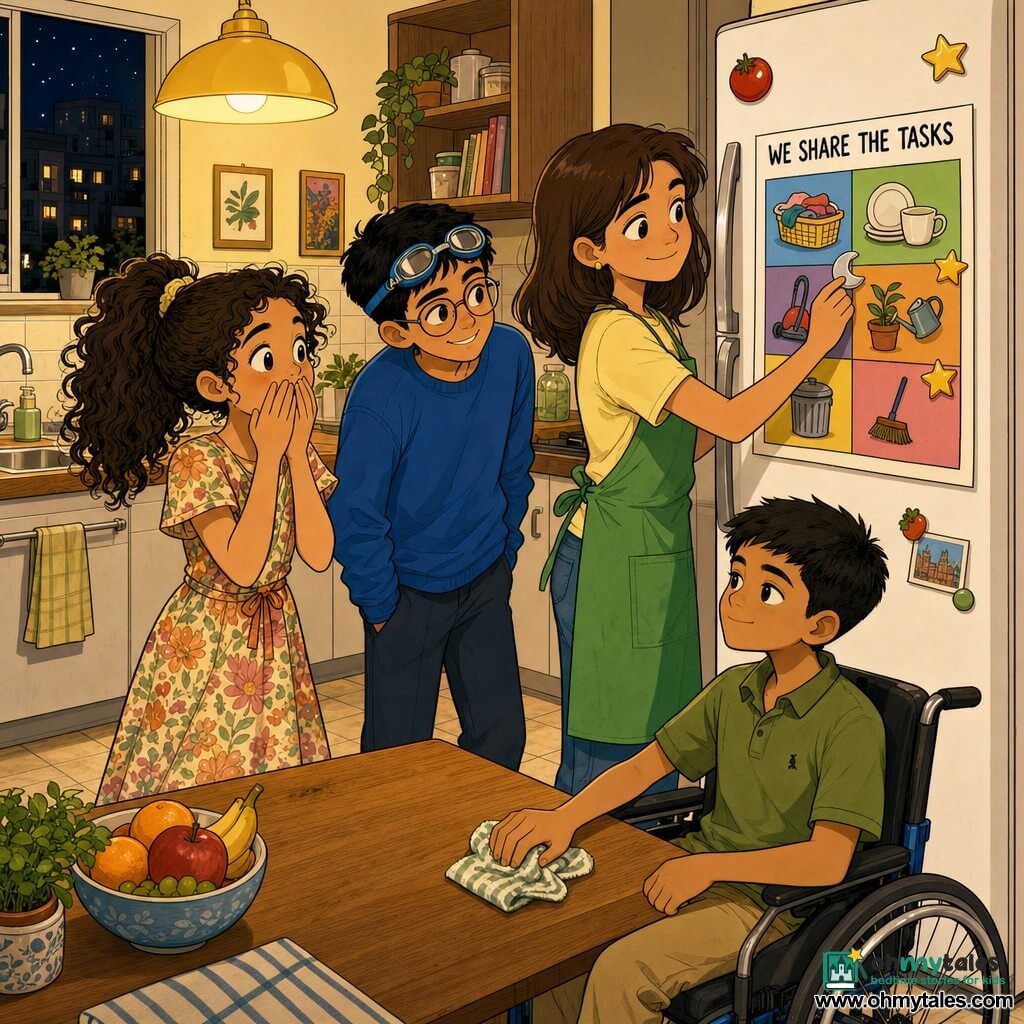
Amal stared. The little silver crescent seemed to loosen at one edge, like it had been waiting for the right moment. Then—without any sound—it lifted slightly and drifted down onto the poster, landing near the bottom like a final check mark.
A sticker moon.
Amal swallowed. “It really is a sticker.”
Ayaan's eyes crinkled with a smile. “A magical sticker.”
Mina whispered, “I want one for my forehead.”
Yusuf said, “Please do not.”
Amal reached out and touched the crescent gently. It was stuck now, secure and real, as if it belonged there. It didn't sparkle wildly. It didn't shout. It simply stayed—quiet, bright, and small.
Her mom glanced over, noticing their faces. “What are you all staring at?”
Amal hesitated. How do you explain a gentle kind of wonder? How do you describe something that feels like a thank-you note from the universe?
She pointed at the poster. “We… completed everything,” she said. “And I think our poster got a reward.”
Her mom leaned closer, then smiled in a way that made her look younger. “A moon,” she murmured. “How lovely.”
Mina bounced on her toes. “So can we add a star next month?”
Yusuf adjusted his glasses. “Let's master dishes first.”
Ayaan tapped the poster lightly. “It's a good reminder,” he said. “Not just for Ramadan. For always.”
Amal looked at the sticker moon—small, modest, glowing like a quiet idea. She thought about the onions and the soup, the dish mountain, the cinnamon confusion, the wiping and stacking and showing up.
Outside, night settled over the city, calm and wide. Inside, the kitchen held their laughter and their work like a bowl holds warm soup.
Amal smoothed the edge of the poster and said, softly, “We share the tasks.”
And the moon sticker stayed right where it was, as if agreeing.