Chapter 1 — The Man by the Peanut Field
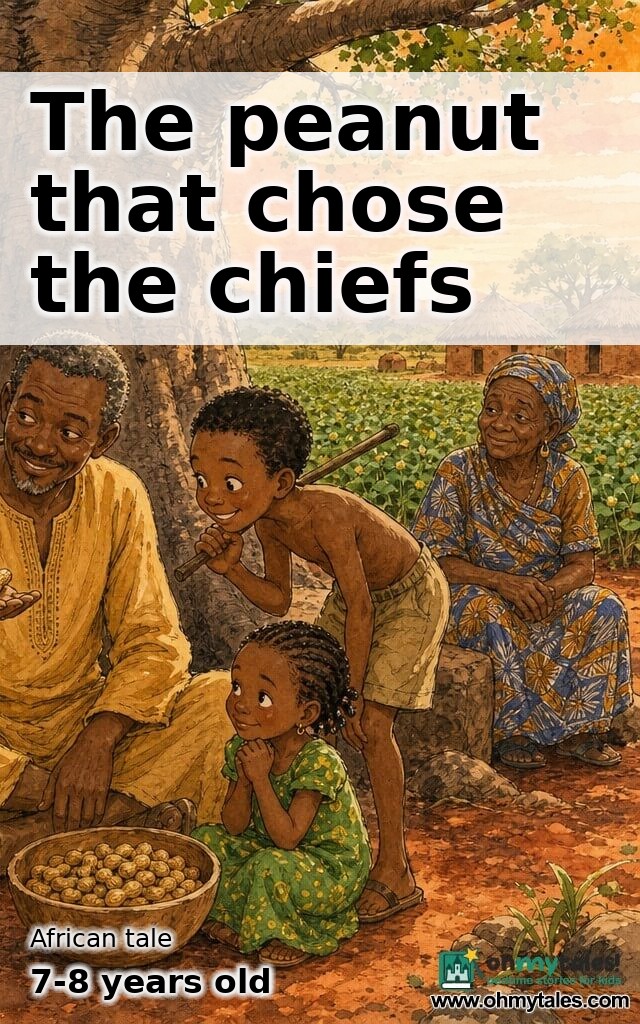
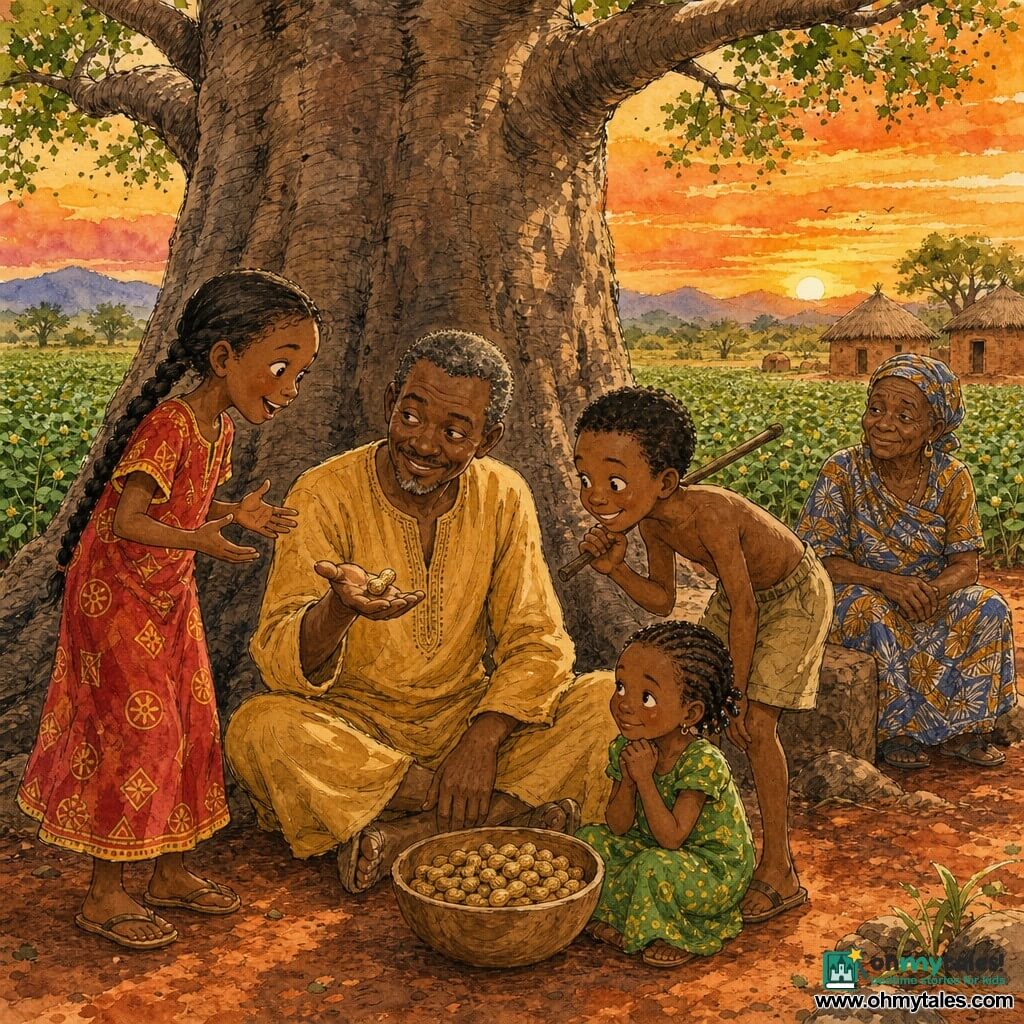
By the edge of a bright peanut field, where the earth smelled warm like fresh bread, lived a clever man named Amadou. Amadou was not tall like a baobab, nor small like an ant, but he was full of quick thoughts that hopped like grasshoppers. He loved stories, song, and the sound of laughter that rolled over the rows of green leaves.
One morning, the children from the village came running to the field, their feet making secrets in the dust. They wanted a leader for a game they called “The River Walk” — a game of pretend where one person guides everyone safely across an imaginary river made of sunbeams. But the children could not choose who would be the chief of the game. Some wanted Amina, who laughed like a drum; some wanted Karim, who could balance a pebble on his nose; and some wanted Fatou, who could whistle like a bird.
Amadou sat beneath the shade of a thin tree and watched. He liked to watch things the way the moon watches the sleeping earth — slowly and kindly. He rubbed his chin and smiled a smile that was part mischief, part wisdom.
“Why do you hesitate?” he asked, voice smooth as warm honey. The children gathered around him like chicks to a hen. “You need a chief.”
“We cannot choose,” said little Sali, folding her arms like a sleepy snake. “Each of us says, ‘I must lead!'”
“'I must lead!'” echoed another, and a giggle trembled through the group.
Amadou looked toward the peanut field. The peanuts hid under the soil like laughter hiding under a lid. He thought of old tales his own grandmother had told, where the right leader was chosen by listening, by watching, by sharing. “Let us hold a small game,” he said. “A test sweet as sugarcane. We shall find our chief by a way that is fair and light.”
The children looked at him. “How?” asked Karim.
Amadou's eyes twinkled like stars in a bright jar. “We will ask the field to help. The field is wise. It knows patience. We will ask the field to point to the one who will be the best chief for the River Walk.”
“Oooh,” whispered the children, and their feet stamped like little drums. “Tell us what to do.”
“First,” said Amadou, standing up as if about to start a dance, “we will each bring a peanut from this field. But do not disturb the roots too much — be gentle, like the wind to a sleeping leaf. Put your peanut in a bowl. Then we will make a circle and share three things about how a good chief should be. Listen with your ears and your heart.”
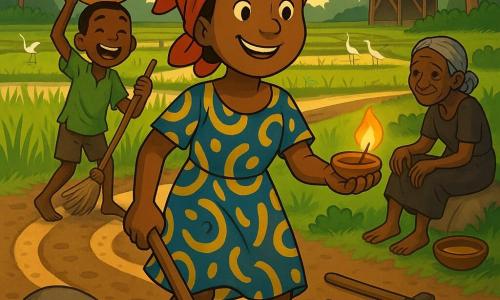
They scattered. The children knelt between the green plants, dug with careful fingers, and found small round peanuts that smelled of earth and promise. Each child came back and put their nut in the bowl.
Amadou took the bowl and held it to the sun. “Now,” he said, “we ask three questions. Each child will say one answer. The peanuts will listen.” He smiled, then whispered, “And the field will listen too.”
Amina stepped forward, her braid swinging. “A chief must be brave,” she said. “Brave like a lion.”
Karim tapped his cheek. “A chief must be clever,” he said. “Clever like a fox.”
Fatou looked at her hands. “A chief must be kind,” she said. “Kind like the shade of a big tree.”
Amadou nodded. “Brave, clever, kind. Good things. Good seeds.” He let the bowl turn slowly, like the wheel of a slow drum. “Now we will let the peanuts choose. We will not choose with loud words. We will listen with silence.”
The children leaned in. Outside the circle the wind moved the peanut leaves, and the field hummed like a soft drumbeat. Amadou put his hand over the bowl and asked, “Who among you will be our chief?” He moved his hand like a bird gliding, then lifted it with one peanut sitting on his palm. He held it up so the sun could wink upon it.
“Who is it?” cried the children.
Amadou smiled and said, “Let the one whose peanut sings in the sun step forward.” He placed the peanut at the center of the circle on a flat stone. “Now each of you will tell a little tale — one short story about a kindness you shared. The peanut will listen and show us.”
Children loved stories. They stepped forward one by one, telling small, shining tales: sharing lunch, helping to tie a shoelace, bringing water to a tired neighbor. The peanut sat like a quiet guest, and Amadou listened, nodding like a gentle drum. When the last story was told, Amadou picked up the peanut and looked at each child with eyes that were like two small pools. “Now,” he said softly, “the field hears. We carry the peanut to the farthest row, near the old termite mound, and leave it there under the moon. The next morning, the field will have a small answer.”
Some children wrinkled their noses, unsure. “The field will answer?” asked Sali.
“The field will answer,” Amadou replied. “It answers in its own way — through touch, through the way the soil keeps the nut. Trust.”
They slept in the dance of night, and the moon stood guard like a kind grandparent. The peanut rested in the field as the leaves whispered lullabies.
Chapter 2 — Night Songs and Morning Footsteps
When the sun woke the earth, the children ran to the field with bright faces. Amadou walked with them, his sandals kicking up tiny stories of dust. They found the peanut, and around it, the soil was soft on one side and a little hollow on another. The earth had given its small answer; it had not shouted, but it had shaped a gentle path.
“This one is near the shadow of the termite mound,” Amadou said. “It leans like a listener.” He looked at the bowl of names in his mind. “We will not force it. We will ask three more questions. The leader must be more than one thing.”
They sat again, and Amadou invited each child to speak about sharing. “A chief must know how to welcome,” he said. “A good leader invites others to the feast, to the hearth, to the play. Tell of a time when you welcomed someone.”
One by one, small voices rose like small birds. Amina told of the time she had shared her umbrella with a friend in sudden rain. Karim spoke of how he had laughed and let a crying boy join his game. Fatou remembered inviting a shy girl to sit by the fire and listen to stories.
When the last welcome was told, Amadou asked, “Who guided someone safely before? Who helped someone cross a real river?” The children named a few who had helped elders across streams and carried baskets for neighbors. “And who can listen?” he added, “True listening is like planting a seed and waiting with patience.”
At each answer, the peanut seemed to sit a little more firmly in the earth, as though the field itself nodded. Amadou led them to try one simple thing: “We will play the River Walk now, but the chief we choose must prove that he or she can help everyone cross. The chief will guide while listening, while sharing, while inviting everyone to step on the stones.”
The children lined up. Amadou clapped his hands. “Amadou?” someone asked in surprise.
“Yes, Amadou?” he said with a bow of mock surprise. The children laughed, for Amadou often pretended to be humble and then danced in small jokes.
“But you are old enough,” said Sali, “and wise, too.” She grinned. “Will you be our chief?”
Amadou shook his head gently. “I will help choose, but the chief must be one of you. A chief of play belongs to the play. I will be the keeper of the rules only, and the friend of the game.”
He crouched and picked up a smooth flat stone. “We will place three stones across the path of dust, and the chief will lead us one by one. The trick is to listen to those who are afraid and invite them to try. The chief must give each traveler a way to cross.”
Amina stepped forward first to be chief in the pretend River Walk. She guided small hands across the stones. “Step here,” she said, “and sing as you step.” Her voice hopped like a frog and soothed even little Kofi, who usually clutched his sleeve when excited.
Karim tried next and made everyone laugh by balancing a stick like a captain's staff. “Follow my rhythm!” he shouted. Everyone stomped to his beat and felt the game become a parade.
Fatou, when it was her turn, sighed like a soft drum and invited the shy ones to whisper their favorite colours as they crossed. “Say blue,” she said, “and step.” The shy girl who hardly spoke smiled and skipped across, saying softly, “Blue.”
Each child led with a different song. The game was full of small lights.
After each leader had guided, Amadou called them together. He placed the peanut in the center and said, “Now, the field has listened. You have played, and the field has seen the way you welcome, the way you help, the way you listen. The chief will be the one who makes the most people feel at home.”
The children thought. Then Amina, Karim, and Fatou, tired and smiling, spoke together: “We cannot choose alone. We will invite the whole village to watch and to talk. A chief is chosen by all.” They formed a plan to ask elders, mothers, and the market women to speak of what made a good leader for the game.
Chapter 3 — Voices Around the Fire
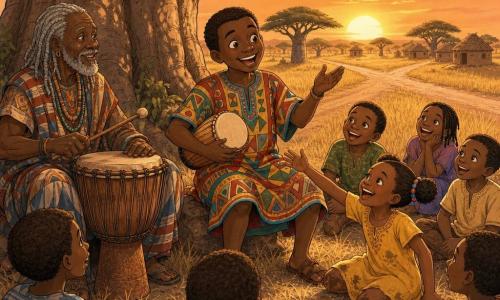
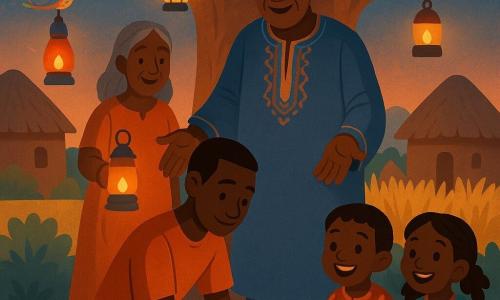
That evening, the village came to the place near the peanut field. They sat around a low fire, a small circle of orange that hummed like a friendly insect. The elders, who carried stories in their bones, came and took places on stones that remembered many feet. Mothers brought bowls of roasted peanuts and chilled water. Children gathered like beads on a string, ready to be threaded into a tale.
Amadou stood in the middle. He spoke like a storyteller, one who knows the rhythm of a river: slow, then quick, then soft again. “We have played our River Walk,” he said. “We have listened. Now, tell us: what does a chief do that makes everyone welcome?”
An elder named Nana Kaba lifted her hand. Her voice was a slow, warm drum. “A chief opens the door,” she said. “Not just the door to the house, but the door to the heart. He or she invites people in, shares the mat, shares the water, shares the story. Hospitality is the first rule of the village.”
Another said, “A chief must fold the small into the big. When a child is afraid, the chief makes a chair next to his own.” They all nodded. The air tasted like cooked yams and good counsel.
Amadou listened and asked gentle questions. “And how does a chief choose? With a shouting match? With a race?” he asked. The villagers laughed. “No,” said an elder, “with eyes that see, with ears that listen, with hands that gather.”
The children, glowing from the firelight, told the elders about the peanut and the field. Amadou explained how the earth had shaped the nut's bed and how each child had shown welcome in small ways. The elders smiled like the moon. They liked simple things.
Nana Kaba reached into her bag and brought a small woven cloth. “We will make a grand chair out of many small things,” she said. “We will choose the chief for the game by the way each child shows welcome and care. But remember this: even a chief is only a guest of the people. Hospitality is the rule for all.”
At that, an idea took root like a new plant. The village decided that the chief of the River Walk would be chosen by a small council made up of a child, an elder, a mother, and Amadou himself. They would watch how each candidate helped another during the next day. It was fair, and it wrapped the choice in kindness like a soft blanket.
The night breathed like a sleeping drum. Stories were told, until even the stars seemed closer, leaning in to listen. Amadou hummed a lullaby under his breath, a tune that smelled of peanut butter and rainy soil. He loved how the village gathered — like hands coming together to clap a rhythm. He loved how a choice was made not by bragging, but by showing how one cared.
Chapter 4 — The Welcoming Shadow
The next day, the tests were gentle and bright. Each candidate was asked to help in one small thing: carry a basket, teach a song, share a peel of fruit. The children watched. The elders watched. The mother with the basket had a basket that was heavy but stitched with love.
Amina carried water and stopped to give half to a thirsty bird. Karim fixed a toy and then gave it to a younger child who had no toy. Fatou invited a tearful toddler into her braid and hummed until his face smoothed like calm water. Each act was small, like a pebble, but their ripples touched everyone.
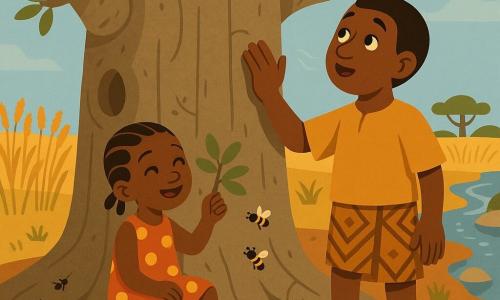
At the end, the council gathered under the shade of a tall tree. The tree's shadow lay like a blanket. Amadou put his hand on the back of the smallest child's shoulder and said, “Who among these made the village feel at home?”
The small child, eyes bright, looked at Amina, then at Karim, then at Fatou. He looked at the elder, then at Amadou, and finally said softly, “All of them did.” His words were a tiny bell.
The mother next to him nodded. “All of them opened doors,” she agreed. The elder smiled and said, “Then we will share the chief's role. They will take turns. They will teach each other. This way, the game is fed by many hearts.”
And so the village decided: the chief of the River Walk would not be only one, but many. The children cheered, a sound like rain beginning. They had learned that leadership could be like a shared loaf of bread — broken and passed around so that everyone could taste.
As they celebrated, Amadou noticed a shadow move in the corner of the field. It was not a scary shadow; it was round and soft, like the shape of a bowl. It slid toward them, cooling their faces like a gentle cloth. Slowly, the shadow covered the circle of people, wrapping them in a quiet coolness. It was the welcoming shadow of the old baobab tree, whose branches stretched wide as a home, whose leaves whispered, “Welcome.”
Amadou stood and pointed. “See,” he said, voice like a flute, “even the earth gives us a roof. The baobab watches and offers shade. Hospitality is not only in hands and voices. It is also in the shade that invites tired soles to rest.”
The children lay back on the ground and looked up through the leaves. The baobab's shadow made shapes on their faces, like painted stories. “Thank you, tree,” said Sali, and the tree seemed to hum in reply. The village sat in that cool umbrella, the world moving softly around them, and their hearts felt big as drums.
Amadou smiled and told one last short story, the kind that folds into sleep. “Once, an old traveler came to a village hungry and tired. A child gave him water, an elder gave him bread, and a tree gave him shade. The traveler rested, then left a song in the long grass. That song grew into a river of kind things. When you choose a leader, remember the traveler — that everyone needs a place to rest.”
The elder clapped slowly, the rhythm of an approving hand. “So the chief is welcome and welcoming,” she said. “The chief is many hands and many songs.”
The game continued, and the River Walk became a place where the sun and shadow played together. The children took turns leading, and each leader remembered to welcome, to listen, and to share. The peanut field watched, its leaves rustling like applause.
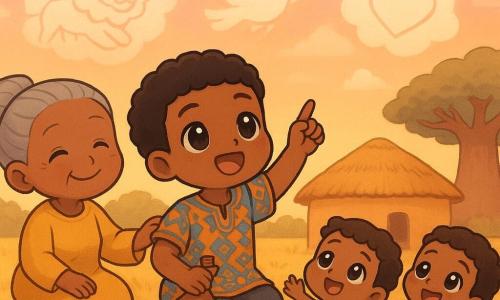
As the sun slid down and painted the earth orange and gold, Amadou rose to leave. The children surrounded him. “Will you be our keeper of stories?” asked Karim.
Amadou patted the peanut bowl and laughed. “I will be your keeper, yes. I will help when you cannot decide, tell you a tale, and remind you to share shade. But remember: the true chief is the one who makes room for others.”
They walked home under the baobab's shadow, which followed them like a soft promise. The welcoming shadow had shown them something simple: that hospitality is a shelter made of hands, songs, and shade, and when everyone shares it, the village becomes a warm home.
At the door of the small houses, children whispered goodnight to the baobab. Amadou paused and listened to the night. He hummed a tune that mixed with the cricket's song and the whisper of peanut leaves. His heart was light, like a kite on a windy day. In his hand he kept the small peanut, now smooth and warm from the sun and full of the village's choosing.
And under the baobab, the shadow waited — patient, welcoming, and wide — like the opening of a kindly hand.