Chapter 1: The Thin Ribbon of Ice
Marco pulled his wool hat down over his ears and looked at the bridge of ice stretching across the silver river. It lay like a thin ribbon, bright as glass, arched from one snowy bank to the other. The village children used to cross it every morning to reach the little schoolhouse on the far side, but winter had broken the path in places and left sharp cracks. People said the bridge was too dangerous. Some thought it should be closed for good.
Marco did not think so. He was calm and steady, with kind eyes and a heart that wanted to help. He had been an explorer for many years, not the kind who climbed tall rocks or fought monsters, but the kind who walked carefully into places that needed fixing. His mission now was to repair the path so children could walk to school again. He carried a satchel with ropes, wooden pegs, a warm thermos, and a small map made by the village teacher.
The wind hummed over the river. It sounded like someone playing a large silver flute. Marco took a deep breath and tasted cold air that smelled faintly of pine. Snow crunched under his boots. He stepped onto the ice where it felt strongest and checked his first peg. The ice ringed the peg and held tight. That was good. He hummed a little tune and walked forward, listening to the ice sing under his soles.
Along the way he found small things that had fallen from the children's pockets—buttons, a tiny wooden soldier, a ribbon. He set each one into his satchel like treasures. They were reminders of why he was doing this. The bridge was not only a path of ice; it was a story that belonged to everyone.
Chapter 2: The Crack and the Decision
Halfway across, Marco saw it—a wide crack that split the bridge like a long, gray mouth. The crack was too wide for a pebble to hop across. It ran in a twisty line and glittered wet inside. A gust of wind puffed up and scattered snow across the gap in tiny white stars.
Marco knelt and ran his glove along the edge. The ice was cold and made a faint ting when his nail tapped it. He thought of the children waiting on the far bank, of their small faces and bright scarves. He also thought of safety. An explorer had to be brave and careful at the same time. He could not be reckless.
He opened his satchel and took out a roll of rope and several wooden pegs. He measured the distance with his hands, estimating and counting the swings it would take. Then, using two pegs, he fixed a line to the strong part of the ice and threw a light rope across for a test. It fell short by a flurry of inches. Marco smiled to himself. It was like solving a puzzle—one that made his hands warm even in the cold air.
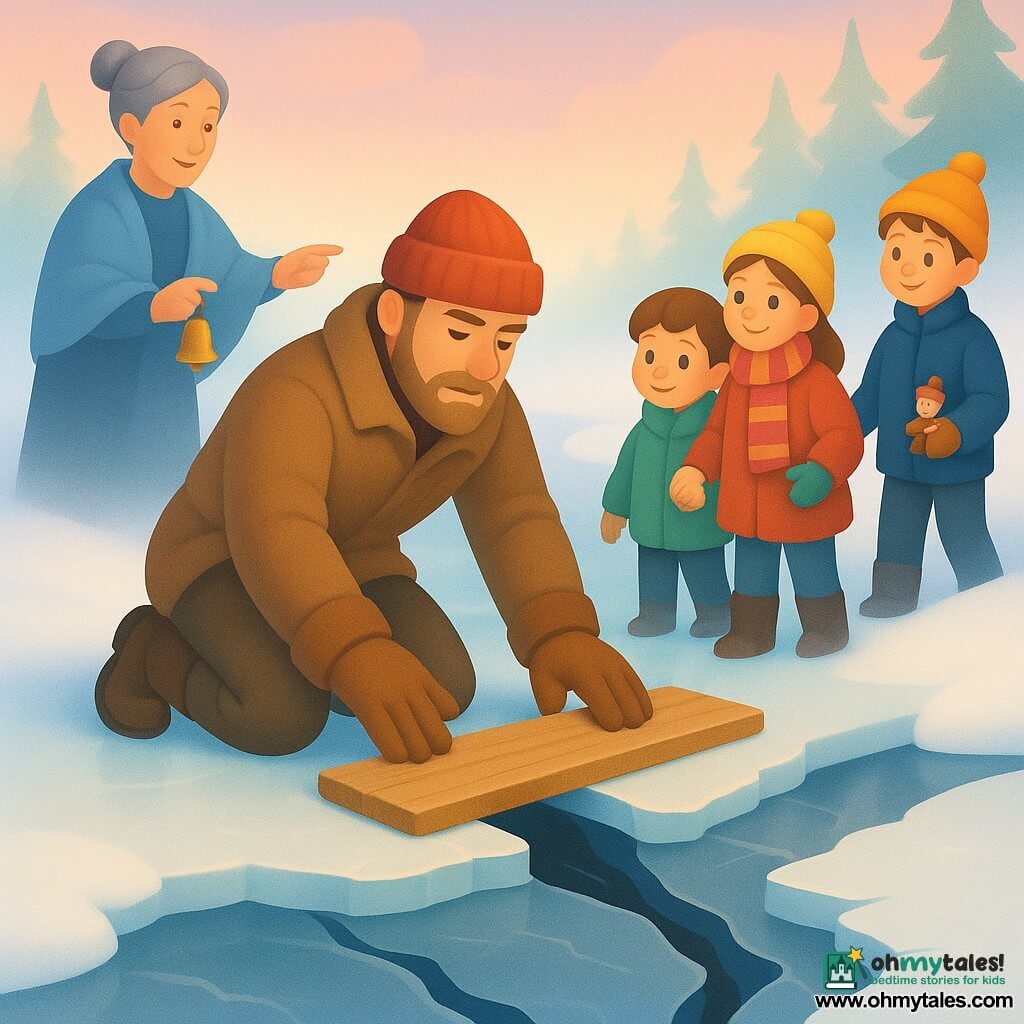
“Slow and steady,” he told the river. He liked speaking to the quiet places; they never argued. He worked carefully, using a long, flat plank to press into the crack and steady the ice while he lay a bridge of pegs and ropes. The plank was heavy and tasted of old pine. He breathed against the wind and used every ounce of steady strength he had.
A small bird landed on a nearby twig and watched. At first it hopped away, then returned, as if it wanted to see the solution unfold. Marco felt a gentle courage grow inside him. He remembered his teacher's voice, long ago, saying that helping others was a kind of light you could carry inside. He pushed that light forward with his hands.
Chapter 3: The Deep Problem
When the temporary rope bridge held for a small step, Marco prepared for the next part. He needed to make the path stable enough for many feet, not just one. The sun shivered on the ice and made tiny diamonds where it touched. Snowflakes rested on his eyelashes. He worked to secure more wooden planks across the crack, fitting them so they overlapped like scales on a fish. Sometimes the ice slipped a little, and a plank would wobble. Marco would sit for a moment, tuck his chin, and think of a new way.
The hardest part was a hollow beneath the bridge, a place where water whispered and made the ice thin. Marco could hear the river like a drumbeat. He looked down through a clear patch and saw small twigs moving under the water like tiny boats. He knew he could not ignore that hollow. He also knew he had to be honest with the people when he reported back. Ethics lived in the heart of every explorer: to tell the truth, to take care, and to put others first.
He fetched a length of braided rope and tied a net of knots that would sit under the planks and catch any loose bits of ice. It was slow work. His fingers went numb, but he kept going, wrapping the net gently and anchoring it to the pegs he had already set. The bird watched, and a small fox nose peeked from behind a snowdrift, wagging its whiskers as if to say, “Carry on.”
When the net was ready, Marco tested it by dropping a pebble. The pebble bounced and was caught. He clapped once, softly. "Good," he said. He felt a peaceful kind of pride: not showy, but true.
Chapter 4: The Storm and the Light
Clouds moved in, like great gray sails. The wind picked up and made the river sing louder. Snow whirled in little dancers and tried to hide the bridge. Marco tightened every knot and huddled under his coat, but he did not leave. The children would need the path in the morning, and the schoolteacher's map showed that the weather would clear by daybreak. He told himself a silly story about a brave penguin who wore boots. The story made him smile.
Then a small storm came, not frightening but firm. The ropes creaked and the planks sighed. For a moment, a plank slipped free and tumbled into the hollow. Marco's heart did a quick hop. He could have retreated, called for help, or given up until spring. But he thought of the little wooden soldier, the ribbon, and the teacher who trusted him. He took a deep breath, steady as a tree, and used a pole to fish the plank back into place. It was slow and clever work. When it clicked back, the bridge felt stronger than before.
The storm passed with a final gust that seemed to clap its hands, and the sky opened up into a ribbon of pale blue. Sunlight spilled across the bridge and tasted like warm honey on cold bread. Marco stood and looked at his work. The path still showed the marks of repair, but that was honest and okay.
Chapter 5: The Return of the Children
At first light, Marco saw small figures on the near bank—children in bright hats, their breath puffing like tiny clouds. The teacher led them, carrying a bell that shingled softly. Marco called out a friendly wave. The children lined up, curious and brave in their own small ways.
“Go slow,” Marco said gently. The children listened. One by one they stepped onto the bridge, holding hands when the twang of the timber made them sway. They felt the rope and the planks and saw the little net underneath. They found the wooden soldier Marco had placed where a child could see it, and the ribbon tied to a peg fluttered like a small flag.
When the last child reached the far side, they all turned and waved at Marco. Their faces shone like sunlit snow. The teacher walked back, her smile a warm map. “You saved our path,” she said simply.
Marco shook his head, because heroes are often small and quiet. He thought of many things: the ethics of keeping promises, the truth of honest work, and the joy of doing something for others without asking for reward. He looked at the bridge, now a bit worn and full of care, and felt a peaceful happiness.
Before leaving, he tied a small note to a peg: For those who walk with courage and kindness. Then he patted the plank he had saved from the hollow and walked away along the bank, leaving a trail of small prints behind him.
That night, by the light of a little fire, Marco wrote a short letter to the village. He wrote about the work he had done, what still needed care, and how the children had crossed with bright hearts. He signed it with a simple line: Keep walking together. And as the north lights shimmered softly above, Marco folded his map, tightened his satchel, and smiled. He knew there would always be new paths and new bridges to mend, and that being an explorer was not only about finding things, but about looking after the stories that belong to everyone.