Chapter 1
Asha walked softly through the tall grass, the morning sun warming her back. Her boots left small prints in the mud. She had a satchel over her shoulder with a notebook, a little rope, and a jar of honey cakes. Birds called from the trees, and a clear stream giggled beside the path. Asha was an explorer. She loved finding places that felt a bit hidden, like secrets waiting to be shared.
Today she had come to find a special clearing, a wide open circle of ground called the Floodplain Glade. The villagers talked about it in the market as if it were a small wonder: "A clearing that fills with water when the moon is full," they would say. Some older people added, in low voices, that a tiny curse lived there. "It tricks anyone who takes and keeps what is not theirs," they warned. Asha tucked that thought away like a pressed leaf. She believed in listening to stories, but she also liked to learn the truth.
When she stepped under the trees that marked the edge of the glade, the air changed. It smelled cool and clean, like after rain. The grass brushed her legs in soft green fingers, and light danced on puddles. A shallow pool lay in the center, its surface mirror-smooth. Tiny white stones sparkled like sugar around the pool's edge.
A little frog peeped. "Hello," Asha said. "I'm Asha. I'm here to learn about your clearing."
The frog blinked, then hopped away. Asha smiled. She pulled out her notebook and wrote, "Floodplain Glade — Circle of stones, shallow pool, soft grass." She noted the sound of water, the smell of wet leaves, the coolness of the air. Keeping notes helped her think clearly.
At the far side of the glade stood a circle of old standing stones. They were not tall, only as high as Asha's shoulders, but they were smooth and worn by rain and wind. Moss made green coats on them. On one stone, faint marks like small letters were carved. Asha ran her fingers gently over the carvings.
"They say a curse makes the water hold on to things," a voice said behind her.
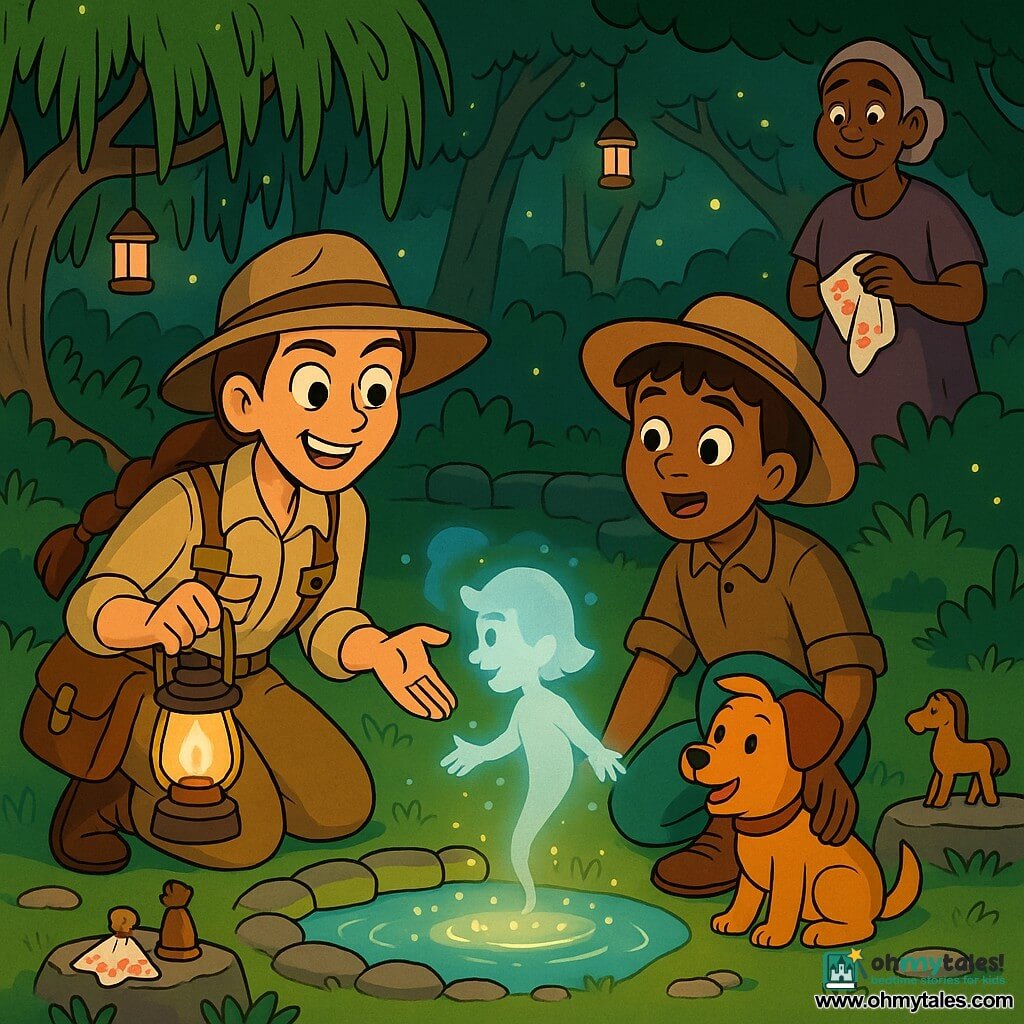
Asha turned. A boy from the village, Samir, stood there with his dog, Mango. He wore a wide-brim hat and a brave smile. "My grandmother told me not to throw coins in," he said. "She said folk took things and never found them again."
Asha nodded. "Stories are good to keep people careful. But I want to make sure the clearing is kind, not scary." She looked at the pool, curious. A few small ripples moved across the water as if someone had tickled it.
Samir peered in. "I dropped a pebble last week," he admitted. "It sank straight down and disappeared. I thought the bottom ate it."
Asha laughed softly. "Maybe the pool is well-fed with pebbles. Or maybe it keeps secrets to itself." She meant it as a joke, but a little worry tugged at her. If the clearing kept things that belonged to others, that was unfair. Explorers helped fix unfair things.
"Will you help me?" she asked Samir. "We can look for ways to lift a small trouble, like this tale says. And we can be careful not to take anything that isn't ours."
Samir's eyes grew bright. "Yes! We can be brave, and smart, and kind."
They sat on the grass and planned. They would watch the pool, read the stones, and check the trees for hints. Asha felt steady and strong. She loved planning. Her heart was full of the bright, warm courage that people feel when they mean to help.
Chapter 2
The sky turned gold in the late afternoon. Asha and Samir walked around the clearing, looking at each stone and listening to the wind. They found small footprints, a scattered line of tiny shells, and a piece of blue yarn tangled in a root. Nothing dangerous. Everything seemed small, like a puzzle for children.
On the stone with the faint carvings, Asha found deeper marks that the water had washed into. They formed a sort of map: a crescent moon, a dot for the pool, and three tiny stars. "Look," Asha said. "This might be a riddle."
Samir tapped the marks with his finger. "Maybe the stars mean steps," he said. "Three steps to do something."
Asha nodded. "Maybe the moon tells us when." She thought about the stories. The moon, the flood, the keeping of things. The idea that the pool filled when the moon was full made sense. If the water took things at the moon, maybe it also kept them until the right thing happened. Asha's mind liked neat patterns.
They made a plan to watch the pool that night. Asha had a small lantern, and Samir's dog, Mango, curled beside their blankets. The air cooled and smelled of damp soil. Crickets began their soft conversations.
At night the glade looked like a different place. Shadows stretched like long friendly animals, and the water shone like a piece of polished glass. The moon rose, round and bright, and the pool's surface lifted as if it were listening. Asha felt the pull of a tiny worry, as if the clearing itself was curious about what would happen next.
Suddenly, a small silver thing bobbed on the water. A tiny coin glimmered and then sank with a soft plop. Asha's heart jumped. A very small, old boat drifted toward the middle of the pool as if finding its place on a stage.
A voice whispered from the stones. "Return what is not yours," it seemed to say, but not with a mean tone—more like a gentle request.
Samir frowned. "Who spoke?"
"No one," Asha said, calm as she could be. "Maybe the stones hold quiet voices. Or maybe the wind tells stories when the moon is full."
Mango barked once, as if to say, "Let's be brave!" Asha felt braver. She had come to help. She would not run away.
A ripple crossed the pool and moved toward the edge where the little coin had disappeared earlier. Suddenly the water glowed faint blue, and a small handkerchief floated up from under the surface. It bobbed like a lily pad. Asha picked it up. It smelled like lavender and belonged to old Mrs. Karim, who sold jams at the market.
Asha looked at Samir. "This belongs to someone," she said. "If the clearing keeps things that people lost, it is keeping what isn't rightfully theirs."
Samir looked sad. "My grandmother said the clearing took things because it was lonely." He thought for a moment. "Maybe it gives things back when it is happy."
Asha thought about kindness. Lifting a small curse might mean making the clearing feel welcome, not frightened. She smiled. "Then we must show it kindness."
They set the handkerchief on a rock and spoke kindly to the pool. Asha said, "We mean no harm. We are friends. We want to return what was lost." Samir added, "We will not take anything that isn't ours."
The water listened. The moon shone. The pool gave them a soft, warm glow. Asha felt something like relief, like the clearing had been waiting to be understood.
But then a low humming came from the grass. Tiny lights blinked up—the glowbugs. They moved in a small slow dance. They pulled at Asha's curiosity and tugged at the edges of the clearing's story. The glowbugs formed a path of lights curving toward the stones.
"Perhaps they are guides," Samir whispered.
"Or friends," Asha said. She rose and stepped lightly along their path. Each light made the grass look like a tiny sea of stars. Where the glowbugs led, an old root lay half-covered by moss. Under the root, hidden like a secret, lay a small wooden box. It had a simple latch. Asha opened it.
Inside were three things: a child's wooden horse, a copper bell, and a flat stone with a smooth hole in the middle. Asha touched the bell. It made a soft, gentle sound.
"We should ask who these belong to," Asha said. "They are not ours."
"Maybe the pool kept them because they were forgotten," Samir said. "Maybe someone lost these long ago."
Asha thought about the right thing to do. The storybook she carried always said: explorers must be honest and fair. She would try to find the owners. She took a paper from her notebook and wrote descriptions. "Child's horse, copper bell, stone with hole," she wrote. She drew little pictures.
They left the box open near the stones and went to sleep beneath the sky, feeling like they had done a kind thing. The clearing hummed with small contentment, like a cat that had been petted.
Chapter 3
In the morning, the glade welcomed them with bird song. A village woman, Mrs. Karim, arrived carrying jars of jam. Her eyes widened when she saw the handkerchief on the rock. "My little cloth!" she cried. "I have looked for this for weeks!"
Asha handed it to her. Mrs. Karim's hands shook with happiness. "Thank you, dear. How did you find it?"
Asha smiled. "The clearing gave it back. We watched the pool last night and listened. We promised to be honest and kind."
Mrs. Karim patted Asha's cheek. "Kindness is magic. The clearing likes that."
Word spread. Samir ran back to the village and returned with his grandmother. His grandmother took one look at the child's wooden horse and gasped. "That was my sister's toy," she said, tugging at her shawl. "We lost it when we moved. Oh, how the years make us forget."
Asha handed the little wooden horse to her. The woman's face brightened like a candle lit in dark. People came slowly, each with memories of small lost things. A boy found the copper bell and remembered how he once rang it to call his friends. Mrs. Karim left a jar of jam on the grass as a thank-you.
The clearing seemed to smile. Water in the pool shimmered and sent up a silver spray that smelled faintly of lemon. Asha felt the lifting of tension, like clouds moving away. The small curse that took things because it was lonely seemed to soften when people came kindly to ask for what was lost.
But all was not yet simple. The standing stones held one more puzzle. At the center stone, the carved map showed the three stars again. Asha counted: the stone with the handkerchief, the root with the box, and a third place — the old willow tree at the glade's edge.
They walked to the willow. Its branches brushed the ground like soft curtains. Beneath it was a patch of dark soil and a small hollow. Asha knelt and used her hands to feel. She pulled up a round, flat piece of wood that fit like a lid. Beneath it lay an old map, folded and worn. It looked like a map of the glade itself, but in the corner, written small and careful, was a note: "For the finder who will be kind."
Asha's chest warmed. She opened the map. The map showed the pool, the stones, and a tiny picture of a sun and moon side by side. There was also a short poem in small, looping letters:
"When moon keeps things away,
Speak with care, and give what you may.
Return with truth, and leave a light,
So small sorrows might take flight."
"It asks for truth and light," Samir said softly.
Asha folded the map gently. "We must do more than return things. We must also bring light, like the glowbugs did. We must remind the glade that people can be honest and kind."
They decided to place small lanterns around the pool. Lanterns would show light and could be used by anyone who came to the clearing. They borrowed a few from the village and hung them on low hooks near the stones. They left a note pinned to a tree: "If you find something here, tell the glade and return it when you can. Be kind." Asha wrote the note in her tidy hand.
As they hung the last lantern, a small wind blew through the willow. The lanterns swayed and cast gentle, warm circles of light across the grass. The pool glowed, and the stones seemed to breathe a soft sigh. The little curse, a lonely habit, felt smaller and quieter.
That evening, the village gathered at the edge of the glade. People listened as Asha told them what she had learned. "The clearing is not mean," she said. "It keeps things because it is lonely and unsure. If we come with truth and return what is not ours, and we bring light so the clearing will not feel afraid, its trick will not mean harm."
Mrs. Karim raised a jar of jam like a glass. "To Asha, who found a way to be kind." The villagers cheered. Samir gave Asha a large grin and a stick he called a 'bravery wand.' Asha laughed and tucked the wand into her satchel.
Chapter 4
The next night the moon rose again, round and patient. The lanterns shone like a ring of small suns. Asha and Samir walked the circle and felt calm. They knew the glade would keep things no more in secret if people kept being honest and fair.
But as they neared the pool, a thin mist began to lift from the water. It swirled in soft, silver curls, and then formed the shape of a little child made of mist. The child looked at them with eyes like drops of water.
"Why do you make us keep what is lost?" the mist-child asked in a voice like a bell.
Asha knelt and looked softly into the mist's eyes. She remembered the poem: speak with care, return truth, leave a light. She thought about the villagers who had come. "We did not mean to take," she said gently. "We wanted to find what we had lost. If something belongs to someone else, we will give it back. We will ask, we will listen, and we will bring light so you do not have to keep things to feel safe."
The mist-child tilted its head, curious. "Will you promise?"
Asha thought about promises. They were important. She felt the weight of saying true words. "I promise," she said. "I promise to be honest and to help others return what they find. I promise to be kind to this glade and to teach others to be kind too."
Samir stepped forward. He placed his small hand on the pool's edge. "I promise too. I will not take anything that isn't mine."
The mist-child smiled, and the mist around it shimmered like a shy laugh. The pool's surface calmed. A soft ripple spread, and small silver flakes rose up like snow and fell gently into the grass. The clearing smelled of chamomile and sweet earth. For the first time, the pool did not seem to want to hide things. It seemed to want to keep memories safe until they could be returned.
Asha felt proud. Her heart hummed with happiness, and a little warm glow lived under her ribs. She had helped a place find peace. She had used courage to step into the unknown, intelligence to read the signs, and resilience when things felt strange or scary. She had not taken short cuts. She had chosen what was right.
In the days that followed, the glade became a place of gentle wonder. People came to leave small lights and to look for things they had thought lost. They left notes and pictures as if the clearing were a friend. They taught their children to be honest and to ask before taking.
Asha wrote the final lines in her notebook and drew a little picture of the glade with lanterns and smiling stones. She kept the map safe in her satchel. It was a map that showed how kindness could lift a small sorrow. She felt its lesson in her bones.
One bright morning, before she left the glade to continue her explorations, Asha tied a small bell to the willow's lowest branch. It chimed softly in the wind. "For people to remember," she said.
Samir hugged her. "Will you come back?" he asked.
Asha smiled and touched the brim of his hat. "Every explorer must keep going, but I will always come back to places that need care. And I will tell others about this clearing so they will be kind too."
She walked away with her satchel and her notebook and Mango trotting at her heels. The villagers waved. The glade hummed a happy song. The floodplain clearing had been a small puzzle of worry and wonder. With truth, light, and honest hearts, it had found peace.
Asha looked back once, then forward to the next hidden place that might need a little courage and a lot of care. She felt ready. The world was full of small mysteries that needed gentle hands and brave hearts. She was an explorer, and she would keep learning how to help.