Chapter 1: The Stone Dome on the Hill
Milo Hart was the kind of explorer who always packed two things first: a notebook and a snack. He said both were needed for brave thinking. The notebook was for questions, maps, and careful guesses. The snack was for when your brain tried to turn into pudding.
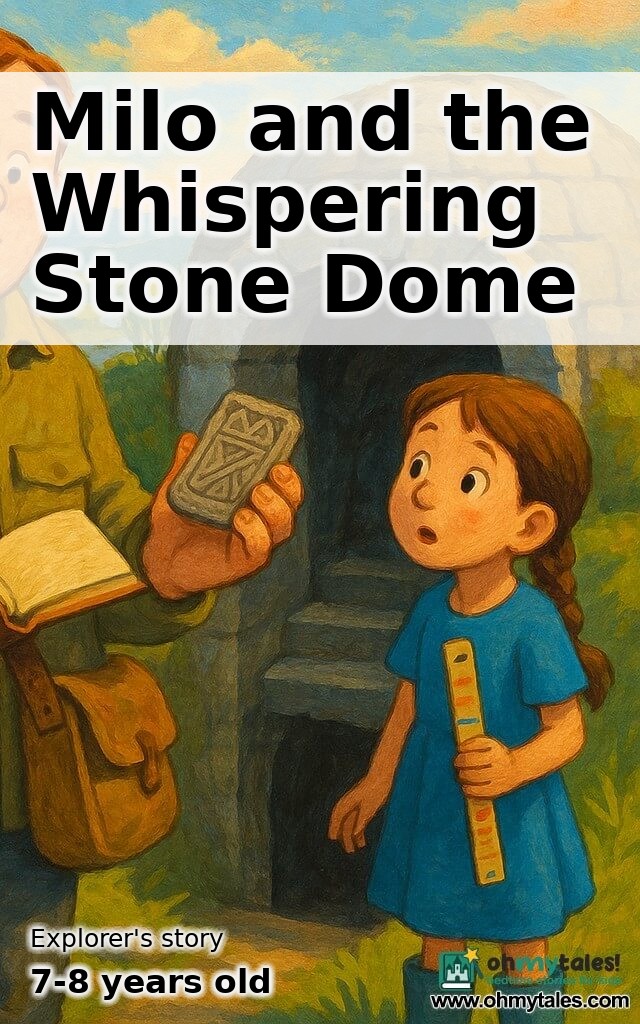
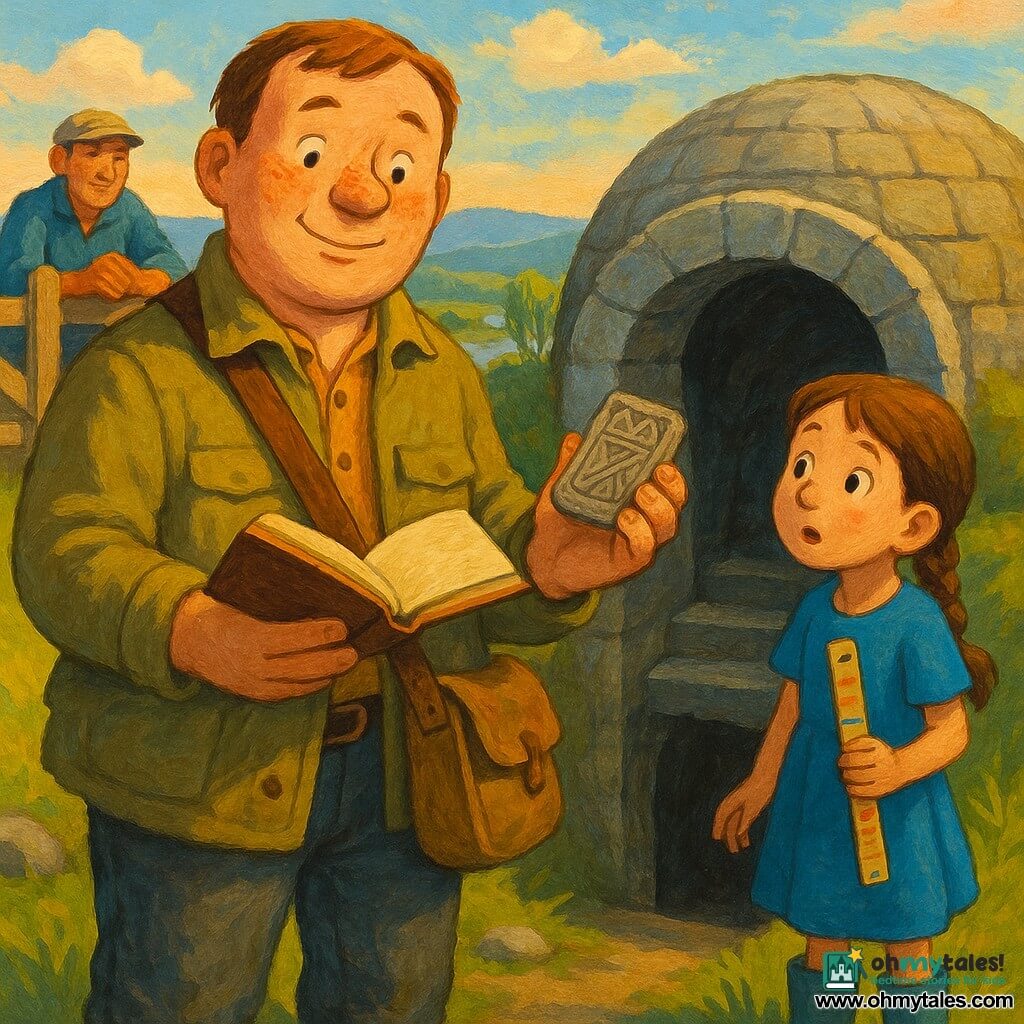
On a sunny morning with a breeze that smelled like warm grass, Milo climbed a round hill outside the town of Wrenford. The hill had looked ordinary from far away. Up close, it looked like someone had placed a giant stone bowl upside down on the ground.
The dome was made of pale gray blocks fitted so neatly together that even a curious ant would have trouble finding a crack. Tiny plants grew in soft spots near the base, and the stones felt cool under Milo's fingertips.
Milo wasn't here just to admire old rocks. The valley below had changed in a strange way. The river that once curled like a ribbon had started to shrink during summers. Some trees near the bank had leaves that turned brown too early. People worried, but worry alone never fixed anything.
Milo's job was to estimate the impact of the environmental change—how big it was, where it came from, and what could help. He believed the dome held clues because it was built by people long ago who watched nature closely. Ancient builders had to be smart; otherwise their houses would fall down, their crops would fail, and their stories would end too soon.
He set his pack down and took out his notebook. On the first page he wrote:
“Questions I must answer:
1) What changed?
2) When did it change?
3) Why did it change?
4) What can we do about it?”
Then he added a small drawing of the dome with a careful arrow: “Main entrance?”
He walked around the dome, counting steps to measure it. Ninety-eight steps around. Big, but not impossible. He noticed something odd on the east side: a line of stones that looked slightly darker, like they had been touched by more hands.
Milo tried pressing them gently, one by one. Most did nothing. Then one stone, smooth as a river pebble, gave a tiny click.
A narrow door outline appeared, as if the dome had been holding its breath and finally let it out. The door did not swing open fast or loud. It slid aside with a soft scrape, like a chair moving across a floor.
Milo's heart jumped, but he kept his smile. “Good morning,” he said to the doorway, because being polite made him feel brave.
Cool air flowed out. It smelled like damp stone and something faintly sweet, like dried mint. The inside looked dim but not scary—more like the quiet part of a library.
Milo took out a small lantern and lit it. A warm circle of light spread across the floor.
“Notebook?” he asked himself.
It was in his pocket, safe. Snack? Also safe.
Milo stepped inside the stone dome, and the door slid shut behind him with a gentle shush. For one second he stood very still.
Then he heard it: a drip… drip… drip, steady as a slow clock.
“Water,” Milo whispered. And water meant answers.
Chapter 2: The Whispering Map
The lantern light showed a curved hallway that followed the shape of the dome. The walls were covered in carvings: lines, dots, waves, and tiny pictures of plants and clouds. Milo leaned close.
“These are not just decorations,” he said softly. “These are notes.”
He traced a carving of a cloud with lines falling down. Rain. Next to it was a picture of a tall plant with a thick stalk. Nearby were circles like suns in a row.
A calendar?
Milo's mind felt awake, like a cat sitting up to watch a bird. He walked slowly, letting the lantern flicker across the stone. The drip sound grew louder.
Soon the hallway opened into a wide room. The ceiling curved above him like the inside of an eggshell. In the center was a shallow stone basin. A narrow stream of water fell into it from a tiny hole above.
Drip… drip… drip.
The basin was not overflowing. In fact, it looked a bit too empty. There should have been more water for a steady drip like that.
Milo crouched and touched the water. Cold. Clear. He smelled it—fresh, not muddy.
He spotted grooves carved into the basin's rim, like marks on a ruler. Measurement lines.
“This is a water gauge,” Milo said, pleased. “A long-ago way to check how much water the ground holds.”
On the wall behind the basin, a large carving showed the dome on a hill, the river in the valley, and lines pointing toward the mountains. Little arrows and numbers sat beside them. Milo could not read every symbol, but he could understand patterns.
He took out his notebook and began copying the shapes.
As he worked, he noticed something else: the carvings formed a path, like a map that went from picture to picture. Rain cloud to river to trees to a spiral shape that looked like wind.
Milo followed the “map” around the room until it reached a flat stone panel. In the center was a carved circle with a notch, like a cookie with one bite taken out.
Under it were three smaller circles: one with wavy lines, one with tiny dots, and one with a leaf.
Milo tilted his head. “Options,” he guessed. “Water, soil, plants.”
He liked guessing, but he liked checking better. He looked for clues: Which symbol was worn more? Which one had more finger smudges? The leaf circle was the smoothest, as if many hands had touched it.
But smoothness could mean curiosity, not correctness.
Milo tested his ideas the way he always did: he asked the dome a question.
“If the river is shrinking,” he murmured, “what should I examine first to estimate the impact?”
Water. Soil. Plants.
He thought of the valley: dry summers, early brown leaves. That could mean less water, or soil that couldn't hold water, or plants that were stressed.
“Water is the easiest to measure,” Milo decided. “So I start there.”
He pressed the circle with wavy lines.
The panel rumbled like a sleepy stomach. A section of wall slid aside, revealing a new passage. Warm air drifted out, carrying the smell of sun-baked clay.
Milo laughed quietly. “The dome likes science.”
He walked through, lantern held high. The passage sloped downward. The drip sound faded, replaced by a soft humming—almost like someone rubbing a wet finger around the rim of a glass.
At the bottom he found a chamber with three stone jars set into the floor. Each jar had a carved label: wavy lines, dots, leaf.
Milo kneeled beside the wavy-lined jar. Inside was a long stone tube with markings. A measuring stick, ancient and clever.
He lowered it carefully. The stick came out damp only at the very tip.
Milo's smile disappeared for a moment, not from fear, but from thinking hard. “The water table is low,” he said. “Lower than it used to be.”
He checked the marks carved on the jar's rim. Another line, higher up, was darker, as if water had reached it many times before. Now it did not.
Milo wrote in his notebook:
“Evidence: underground water level has dropped.”
He added another note, because exploring was also about being honest:
“Question: Is this new, or part of a cycle?”
He stood and looked at the other jars. The dome wasn't giving him a single answer. It was offering a puzzle, and puzzles asked you to think from more than one angle.
Milo took a deep breath. “Okay,” he told himself. “Let's keep our minds open and our feet steady.”
Chapter 3: The Puzzle of the Three Doors
Milo checked the jar with tiny dots next. The smell inside was earthy, like a garden after rain. He used a small spoon from his pack to lift a bit of soil. It crumbled too easily between his fingers.
“Dry,” he said. “And sandy.”
He remembered the farms near the valley edge, where farmers had started adding more compost. They said the soil felt “tired.” Milo had thought it was just a saying. Now he understood it could be true.
He wrote:
“Evidence: soil holds less moisture. Might be erosion or loss of rich topsoil.”
He moved to the leaf-labeled jar. Inside were pressed plant samples sealed under smooth stone plates, like a museum display. Some leaves looked strong and dark. Others were pale with spots.
A carving beside the leaves showed the same plant growing in different seasons, with marks beside each drawing. Milo guessed the marks meant “good year” and “hard year.” The hard-year drawings had more pale leaves.
Milo's chest felt tight with concern, but he kept his thoughts calm. The dome wasn't telling a sad story to scare him. It was telling a useful story to guide him.
He turned back toward the passage. In the far wall, three stone doors stood side by side. Above them were symbols: a mountain, a swirling wind, and a shining sun.
Milo's eyebrows rose. “Causes,” he guessed. “Water comes from mountains. Wind can dry things. Sun can heat the land.”
Each door had a small stone handle shaped like a simple tool: the mountain door had a pick, the wind door had a fan, the sun door had a flat mirror.
Milo smiled. “Someone had a sense of humor.”
He had to choose, but he didn't want to choose blindly. Critical thinking, he reminded himself, meant looking for evidence, not just picking your favorite picture.
He sat on the cool floor and opened his notebook to a new page:
“Possible causes:
A) Less snow or rain in mountains
B) More wind drying soil
C) Hotter sun (higher heat)”
He thought of the last few summers. People had complained about more hot days. But were there also fewer rainy days? And what about the mountains—had their snow melted early?
Milo remembered a shepherd he met last spring who said, “The snow line is higher now. My goats have to climb more.” Milo had written it down as a small detail. Now it felt important.
“Mountains first,” Milo decided. “If the source changes, everything else follows.”
He stood, brushed stone dust off his knees, and pulled the pick-shaped handle.
The mountain door didn't open right away. Instead, a row of carved stones above it lit up with faint bluish light. The lights moved like slow fireflies, forming a pattern: three short flashes, then two long ones.
Milo blinked. “A code?”
Then he noticed something clever: the same pattern was carved around the water jar—three short grooves, two long grooves.
“A matching system!” Milo said. He hurried to the water jar and counted the marks. Three short, two long… and beside them, a stone peg that could slide left or right.
Milo slid the peg to match the pattern. Somewhere, deep inside the dome, gears clicked. The mountain door swung open a hand's width.
Milo chuckled. “The dome wants explorers who pay attention.”
He stepped through into a new corridor that smelled like cold air and wet rock. The lantern light shimmered off tiny crystals in the stone. The corridor led to a room with a wide stone window—no glass, just an opening that looked out through a narrow shaft to the outside world.
Milo peered through. The view aimed straight at the distant mountains. He could see their tops, pale and sharp against the sky.
Under the window was a stone table covered in carvings: mountain shapes, lines that flowed downward, and rows of small marks that rose and fell.
A long-ago record.
Milo traced the marks with his finger. Some rows were tall—years with much snowmelt, maybe. Some were short. The last few rows were shorter than most.
He swallowed. Not scared—focused.
“So the mountains are giving less water,” he said. “Or the snow is melting too soon.”
He wrote in his notebook:
“Record suggests reduced mountain water input recently.”
Then he added, because a good explorer double-checks:
“Need to compare with heat and wind records.”
Milo left the mountain room and returned to the three doors, feeling steadier. The mystery wasn't a monster. It was a message. And messages could be understood.
He chose the sun door next.
This time, the door opened easily. Inside was a chamber with a stone disc on the ceiling, carved like a sun with many rays. On the floor were tiles in different shades, some darker, some lighter.
Milo noticed that the darker tiles were warm to the touch, even inside the dome. The lighter tiles were cooler.
“Heat storage,” Milo guessed. “Dark surfaces hold more warmth.”
A carved chart on the wall showed a sun climbing higher in the sky across many seasons. The highest marks were clustered near the end of the chart.
Milo nodded slowly. “More hot days. That means more evaporation. The ground loses water faster.”
He felt a little spark of hope, because if you could name a problem, you could start to solve it.
Finally, he checked the wind door. That room held a tall stone column with holes. When Milo walked around it, air moved through the holes and made gentle whistles.
Not spooky—more like a musical teapot.
On the wall, carvings showed arrows across the valley, getting longer over time. Longer arrows likely meant stronger wind.
Milo wrote:
“Wind seems stronger or more frequent. Adds to drying.”
He leaned back against the wall and took out his snack: an apple with a brave crunch.
He had gathered evidence from three angles. Now he needed to estimate the impact and think of helpful actions. He could not command the sun to cool down or tell the wind to go away, but he could offer ideas for how people might adapt.
He finished the apple and stood up. “Time to put the puzzle together,” he said, and his voice sounded confident in the quiet dome.
Chapter 4: The Valley's Answer
Back in the main room with the dripping basin, Milo sat beside the water gauge and spread out his notes. He drew three circles, like the dome had done, and labeled them:
Mountains: less snowmelt
Sun: more heat
Wind: more drying
Soil: weaker at holding water
Plants: more stress
He then drew arrows to show how one change pushed another. Less mountain water meant the river started lower. More heat and wind meant the river shrank faster. Dry soil couldn't help keep moisture in place. Plants suffered and lost leaves early, which made shade weaker, which made the ground even hotter.
“It's like a chain of dominoes,” Milo said. “Not one single cause. Several causes working together.”
That was an important lesson, and he wrote it in a big box:
“Critical thinking: Look for more than one cause. Use evidence. Check patterns over time.”
Now he needed an estimate, a way to explain the impact clearly to the town. Milo looked at the measurement lines in the basin. He compared the current water level to a darker stain line higher up.
He measured the difference using his ruler. Then he checked the marks in the mountain record room he had copied.
He did not have every number, but he had enough to make a careful estimate.
Milo wrote:
“Estimate: underground water level is about one hand-span lower than the common mark from past years. River flow likely reduced in late summer by about one quarter.”
He paused and tapped his pencil. Estimates were not magic. They were smart guesses based on evidence, and you had to say how sure you were.
He added:
“Confidence: medium. More measurements outside dome needed.”
Then Milo turned to the last question: what can we do?
He thought of small changes that could help: saving water, planting trees near the river for shade, building simple barriers to slow rainwater so it soaked into the soil, using mulch to keep soil moist, fixing leaks, collecting rainwater.
He remembered the dome's gentle lessons: measure, compare, and act with care.
Milo stood and walked to the carvings again. He noticed a final panel he hadn't touched. It showed people planting reeds along a riverbank. Another showed stones laid in a zigzag line across a slope. A third showed a barrel catching rain from a roof.
The ancient builders had faced change too. They had left advice in stone.
Milo smiled, feeling less alone. “Thank you,” he said to the dome.
He pressed the panel, and a small compartment opened. Inside lay a thin stone tablet, smooth and light, with a carved symbol of an eye and a leaf together.
“Watch and protect,” Milo translated in his head. He slipped it carefully into his pack.
As he turned to leave, the dome seemed to brighten. The lantern flame steadied, and the drip in the basin grew slightly faster.
Milo froze, then listened. Drip… drip… drip-drip.
Had he imagined it?
He leaned close and saw the water stream was a bit stronger. Not a flood, not a sudden change—just a gentle increase.
Milo laughed under his breath. “Maybe the dome is saying, ‘Good work.' Or maybe a cloud passed over the hill and changed pressure in the ground.”
He wrote quickly:
“Note: water drip increased slightly. Could be natural variation. Do not assume it's magic.”
That made him grin even more. Wonder was welcome, but thinking clearly mattered too.
Milo returned to the entrance hallway. As he approached the door, it slid open without a click, as if it already knew he was ready.
Outside, the afternoon sun warmed the stones. The wind carried the sound of the valley: birds, distant voices, and the soft rush of the river—still there, still trying.
Milo walked down the hill, notebook snug in his pocket, stone tablet safe in his pack, and his mind full of plans.
In Wrenford, people gathered near the town hall when they heard Milo had returned. Milo did not give a grand speech. He sat with them on the steps, where everyone could see his drawings.
He explained the dome's evidence in simple parts: mountain water was lower, summers were hotter, winds were drying the soil, and the plants were feeling it. He showed his arrows and his measurements. He also showed how sure he was—and where he still had questions.
People asked, “What do we do?”
Milo nodded, glad they asked. Questions were the start of wise action.
He shared the ancient ideas and added new ones: plant more shade trees near the river, protect the banks with reeds, collect rainwater, cover garden soil with mulch, and measure the river each month so they could see changes early.
The town liked that last idea best. Measuring felt hopeful. It meant they were not helpless.
So they made a “River Watch” group with children and grown-ups together. They painted a simple measuring pole and placed it at a safe spot on the bank. Once a month they checked it, wrote the number, and also noted the weather, the wind, and the plants.
Milo visited often. He taught them how to compare the same month to the same month, how to look for patterns, and how to change their minds if new evidence appeared.
Because courage wasn't only for dark caves. Sometimes courage was for looking closely at a problem and not turning away.
And each time Milo looked up at the stone dome on the hill, he felt the same steady comfort.
The world could change. People could learn. And smart, kind actions—one careful step at a time—could help the valley stay green and bright for many seasons to come.