Chapter 1: The Map with a Wet Corner
Milo Finch was an explorer, but not the kind who jumped into trouble. He was the kind who packed extra socks.
On a bright morning, Milo sat at his small desk and opened his travel journal. The pages smelled like paper and sunshine, with a tiny hint of peppermint from the sweets he used as bookmarks. He checked his list out loud, because lists liked to be respected.
Rope: yes. Compass: yes. Water bottle: yes. Sandwich: double yes.
Then he unfolded an old map he had found in the town library. The map was drawn in brown ink, with careful lines and a funny little sketch of a bird wearing a hat. One corner looked as if it had been dipped in water long ago. Right there, in wobbly letters, were the words:
THE SINGING SPRING
Milo had heard of springs that bubbled, springs that were warm, and springs where frogs held noisy meetings. But a spring that sang? That sounded like a mystery with good manners.
He tapped the map with his pencil. “If something is called the Singing Spring,” he said softly, “it is probably because it makes a sound. Sounds can be clues.”
He looked out the window. The day was clear. The breeze was gentle. It was the perfect kind of day to explore carefully.
Before he left, Milo visited Mrs. Pebble, the librarian, who knew everything about old books and nearly everything about old places.
Mrs. Pebble pushed her glasses up her nose. “The Singing Spring sits in the Fernwood Hills,” she told him. “People used to visit it long ago. They said the stones around it were painted by time.”
“Painted?” Milo asked.
“In colors you don't see every day,” Mrs. Pebble said. “If you go, be cautious. Don't step where you can't see. Don't rush. And write down what you notice.”
Milo nodded. He liked that advice. It sounded like the explorer version of holding hands before crossing the street.
He set off along a path that led out of town. The road turned into a trail, and the trail became narrower, winding between soft green ferns and tall trees with bark like puzzle pieces. Birds made bright, cheerful calls, as if they were cheering him on.
After a while, he reached the first strange sign: a line of smooth stones laid across the trail like a tiny, tidy wall. Each stone had a mark on it—circles, dots, and swirls, as if someone had practiced drawing stars.
Milo didn't step over right away. He crouched and studied them. “A message?” he wondered.
He took out a small notebook. He sketched the shapes and counted the stones. Ten stones. Ten marks.
He followed the line with his finger until he noticed something: the circles pointed toward the left, where the ferns were a little more bent down, as if many feet had passed there before.
Milo smiled. “A polite hint,” he whispered.
He followed the hidden way, careful to test the ground with his walking stick. His stick was not fancy, but it was loyal and good at poking suspicious places. The path led to a clearing where the air felt cooler and smelled like wet leaves.
Somewhere ahead, he heard a sound.
Not scary. Not loud.
It was a soft, repeating tone, like wind humming through a bottle. Like a tiny, careful song.
Milo's heart did a small hop. He tightened the straps of his pack. “Slow steps,” he reminded himself, and walked on.
Chapter 2: The Humming Rocks
The clearing opened into a bowl-shaped valley. In the center stood a ring of rocks, some as big as stools, some as big as tables. They looked ancient, but not angry. More like very old grandparents who had sat still for a long time.
And there it was: the spring.
Water rose from a crack in the ground, clear as glass, and flowed into a shallow pool. The surface shivered with tiny ripples, as if it was giggling.
The singing sound came from the rocks. When the breeze passed through holes and grooves in them, the air made gentle notes. One rock hummed low. Another made a higher sound, like “oooh.” Together, they formed a soft, wobbling tune.
Milo stood at the edge and listened. It felt like the place was breathing.
He did not run to the water. He did not poke it with his hands. He remembered Mrs. Pebble's words: Don't rush.
Instead, he looked for the safest way to get close. He walked around the ring, watching the ground. The soil near the spring looked different from the soil on the trail.
That was his clue. He had come for it.
The ground around the pool was not plain brown. It was streaked with colors—rusty red, pale yellow, and even a strange greenish gray. It looked like someone had spilled powdered crayons and then smoothed them with a brush.
Milo's eyes widened. He felt as if he had stepped into a painting.
He knelt on a dry rock and leaned forward, keeping his shoes away from the softer earth. He held his notebook close and wrote carefully:
The soil around the spring is striped. Red like brick dust. Yellow like sand. Green-gray like cloudy jade. The colors form rings, darker near the water, lighter farther away.
He paused. “Why would soil have rings?” he murmured.
He sniffed the air. The spring smelled clean, with a tiny hint of metal, like when you hold a coin in your hand. Milo knew that some rocks and minerals could color the earth. If the water carried them up, it could paint the ground over time.
He traced the edge of a ring with his gaze. In one spot, the colored soil formed an arrow shape pointing toward a flat stone near the pool.
Milo's stomach fluttered. A clue that looked like a clue was the best kind.
He stepped carefully from rock to rock, never placing his foot on the soft, colored soil. His walking stick tested each stone first: tap, tap, steady. The singing rocks hummed around him as if they approved of his careful manners.
At the flat stone, he saw carvings: lines and dots in a pattern that matched the ten marked stones on the trail. There was also a shallow bowl shape in the middle of the stone, like a little nest for water.
Milo looked at the spring, then at the bowl. “Maybe it needs a drop,” he said.
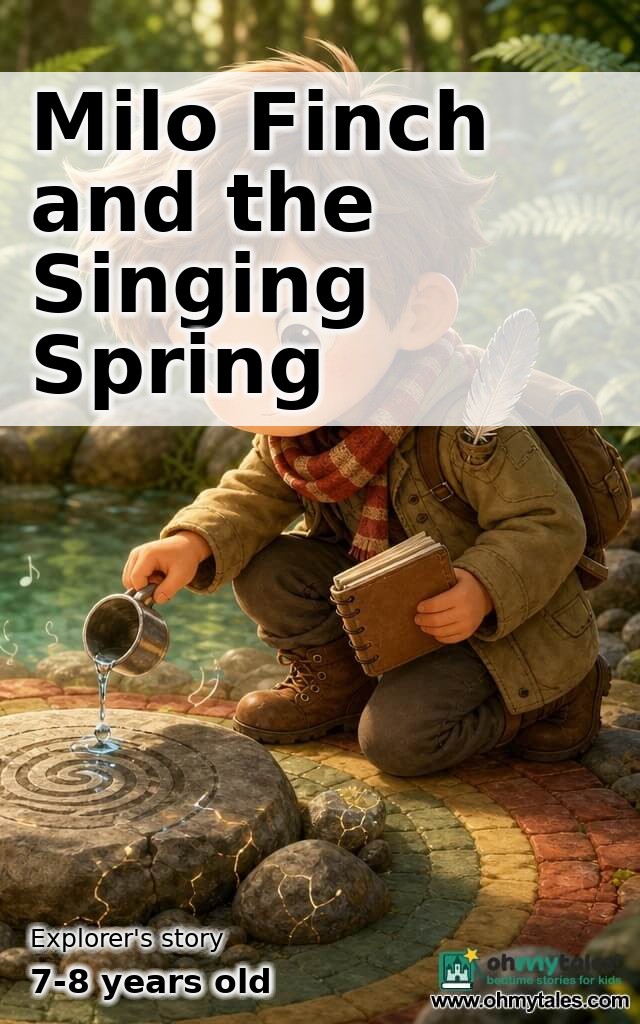
He didn't want to scoop water with his hand. He pulled out a small tin cup from his pack—the kind he used for tea. He rinsed it first with a tiny splash away from the edge, then held it under the spring's trickle.
The cup filled. The water was so clear it almost looked like empty air.
He poured one careful drop into the bowl on the flat stone.
Nothing happened.
Milo waited. He listened to the humming rocks. He noticed the wind shift.
Then, very slowly, the drop spread across the carved lines, like it was following a path. The thin water line traced the pattern, and as it moved, the grooves darkened.
A hidden picture appeared.
It was a map—just a small one—showing the ring of rocks, the pool, and a narrow crack behind a curtain of ferns.
Milo's eyebrows lifted. “A secret path,” he breathed.
He felt a pinch of nervous excitement, like standing at the top of a slide. But he also felt steady, because he had rules: be cautious, observe, and never go where you cannot come back from easily.
He checked his pack straps again. He took a slow sip from his water bottle. He looked around for danger. There was none—only quiet trees, singing air, and the soft shine of water.
Still, he treated the place with respect, as if it could get upset if he behaved like a stomping moose.
He followed the direction on the stone map, stepping back the same way he came. Behind the ferns, he found the crack: a narrow opening between two boulders, just wide enough for a person to squeeze through sideways.
Milo shone his small lantern into it. The light revealed a short passage, not deep darkness. The air smelled cool and rocky.
He took a breath. “I will go only as far as the light reaches,” he told himself. “And if anything feels wrong, I will return.”
He turned sideways and stepped in.
Chapter 3: The Hall of Old Echoes
Inside the passage, the stone walls felt close but not crushing. The floor was mostly smooth, with a few pebbles that clicked under Milo's boots. His lantern painted the rocks gold and made his shadow stretch like a tall, thin giraffe.
The humming from outside grew quieter, but it did not disappear. It became a soft background song, as if the spring were reminding him, I am still here.
After a few careful steps, the passage opened into a small chamber. The ceiling was low, so Milo did not stand too tall. In the lantern light, he saw something that made him grin.
Painted marks on the wall.
Not fresh paint. Not bright. Old marks, the color of dry leaves and soft clay. They showed simple pictures: a person holding a stick, a ring of rocks, and a wavy line that could be water. Nearby were stripes painted in the same colors as the soil outside—red, yellow, green-gray.
Milo's mind clicked like a puzzle piece fitting into place. The soil colors weren't only pretty. They were a message that lasted.
He wrote in his notebook again:
The wall shows the same soil colors. These people used the colors as signs. The rings around the spring may mean “safe path” and “follow the stripes.”
He moved his lantern slowly, reading the pictures like a story. One drawing showed a person stepping on rocks, not on the colored soil. Another showed a hand holding a cup and a single drop falling into a bowl.
Milo chuckled. “So I did it right,” he whispered.
At the back of the chamber stood a stone pedestal as high as Milo's waist. On it sat a flat piece of rock, smooth like a plate. In the center was a small spiral carving.
Milo did not touch it yet. He looked around first. The chamber was quiet. No animals. No loose stones. The air was still and easy to breathe.
He leaned in to read the spiral. It wasn't letters. It was more like a path, turning inward. At the end of the spiral, there was a tiny hole.
Milo thought carefully. “A place for… something small,” he said.
He looked back at the wall paintings. One small picture showed a feather. Another showed a leaf.
Milo patted his pockets. He had snacks, string, and a handkerchief. No feather.
Then he remembered the funny bird wearing a hat on the map. The bird must matter.
Outside, he had seen birds. He could find a feather without bothering any bird at all, because feathers often fell like little gifts.
Milo stepped back through the passage, keeping his lantern steady. The singing grew louder as he neared the opening, like a friendly welcome. He slipped out into daylight and took a full breath of fern-scented air.
He looked around the clearing, scanning the ground. Near one of the humming rocks lay a small feather, gray and white, light as a whisper.
Milo picked it up gently. “Thank you,” he said, as if the feather could hear him.
He returned to the chamber, again promising himself he would be careful. At the pedestal, he held the feather over the tiny hole at the end of the spiral.
He hesitated. Even a harmless mystery deserved a pause.
Milo checked the floor, the walls, the ceiling. Nothing seemed ready to fall or snap. The place felt calm.
He set the feather into the hole.
For a moment, nothing happened.
Then the spiral carving began to shine—not bright like a flashlight, but soft, like moonlight on a puddle. The light traveled along the spiral path, curling inward. As it reached the center, a gentle sound filled the chamber.
It was not a roar. It was not a boom.
It was a clear, sweet tone, like a single note from a glass cup.
Milo blinked, delighted. The chamber seemed to “answer” the Singing Spring outside, like they were two parts of the same song.
A narrow slot opened at the side of the pedestal, and a small stone tile slid out, as smooth as a coaster. On it was carved a simple message in pictures: a hand, an eye, a slow step, and a heart.
Milo understood it right away. Watch. Move slowly. Be brave.
He held the tile with both hands. It felt cool and solid, like a promise.
He wrote one more note:
The spring and chamber are a teaching place. The clues reward careful steps, not rushing.
Then he listened again. The chamber's note faded gently, like a song ending the way it should—softly, not suddenly.
Milo felt proud, but not in a loud way. He felt thankful. This was a mystery that wanted explorers to succeed safely.
He carefully placed the feather back in his pocket. “You are my helper feather now,” he said.
He took one last look at the wall paintings. In the lantern light, the colored stripes seemed to glow, reminding him of the rings of soil outside.
Then he turned back toward the passage, ready to return to the spring.
Chapter 4: The Color Clue and the Careful Way Home
Outside, the breeze moved again, and the rocks resumed their gentle humming. Milo walked around the pool one more time, studying the colored soil with new understanding.
The rings weren't just decoration. They were lines of instruction, laid down by water and time, then copied by people who wanted others to be safe.
He imagined ancient visitors arriving with dusty feet and curious eyes. They would see the colored earth and know where not to step. They would follow the stones. They would learn patience and respect.
Milo sat on a dry rock and drew the whole scene in his journal: the ring of humming rocks, the clear pool, and the colored soil in circles like a target made of crayons. He labeled the colors carefully, because he knew details mattered.
Then he added a note in big, neat letters:
THE COLOR OF THE GROUND IS A CLUE.
It tells where the water has traveled.
It shows safe edges and soft places.
It reminds explorers to move slowly.
He smiled at that. It sounded like something Mrs. Pebble would nod at, very seriously.
Before leaving, Milo made sure he left nothing behind. No wrappers. No string. No crumbs. Explorers, he believed, should visit places like guests, not like messy tornadoes.
He stood and listened to the spring one last time. The tune was gentle, and now he could hear it more clearly: low notes from the big rocks, high notes from the smaller ones. Wind was the musician, and the valley was the instrument.
Milo bowed slightly, just because it felt right. “Thank you for the lesson,” he said.
On the way back, the path seemed friendlier, as if it recognized him. The ferns brushed his sleeves like soft green feathers. A squirrel watched him from a branch, looking busy and important.
Milo kept to the safer ground, using his walking stick to test each step where the trail turned rocky. When he reached the line of ten marked stones, he stopped again, not because he was lost, but because he liked solving puzzles properly.
He counted them once more. Ten. He traced the swirls and circles, then looked back toward the valley.
“Good signposts,” he murmured. “Quiet ones.”
As he walked, he thought about courage. Some people thought courage meant racing forward and never stopping. But Milo had learned a different kind of courage, the kind that said: I can be excited and still be careful. I can be curious and still be wise.
That, he decided, was the best explorer courage.
By the time he reached town, the sun had begun to lean toward evening, turning the rooftops golden. Milo went straight to the library, where Mrs. Pebble was returning books to shelves like she was playing a slow, serious game of treasure stacking.
Milo placed his journal on the desk and opened it to the drawing of the spring. He showed her the rings of soil and the notes about the colors.
Mrs. Pebble read quietly, her eyes moving like tiny train cars along the lines. Then she nodded.
“You did well,” she said. “You went, you observed, and you returned safely. That is how a mystery becomes a story.”
Milo pulled the small stone tile from his pack and showed the carved pictures. Mrs. Pebble's eyebrows rose.
“A fine reminder,” she said. “Eye, slow step, heart. That belongs in your explorer kit.”
Milo tucked the tile back carefully. “It will,” he promised.
That night, at his desk, Milo cleaned his tin cup and hung his lantern back on its hook. He placed the feather beside his journal. It looked ordinary, but he knew it was part of something bigger—a song made of wind, water, stone, and careful choices.
He wrote his final line for the day:
Today I learned that the world leaves clues in colors and patterns. If I want to discover them, I must be patient. The safest step is often the smartest step.
He closed his journal with a satisfied thump.
Outside, the wind moved through the trees, humming softly, as if the Singing Spring were still singing far away—and as if it was proud of him, too.