Morning Light and a Little Ribbon
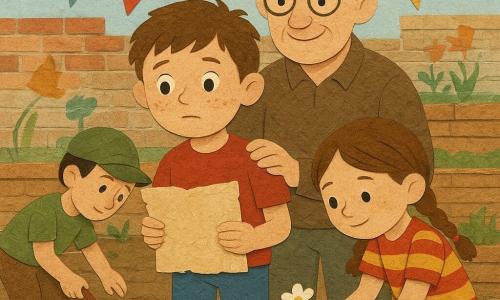
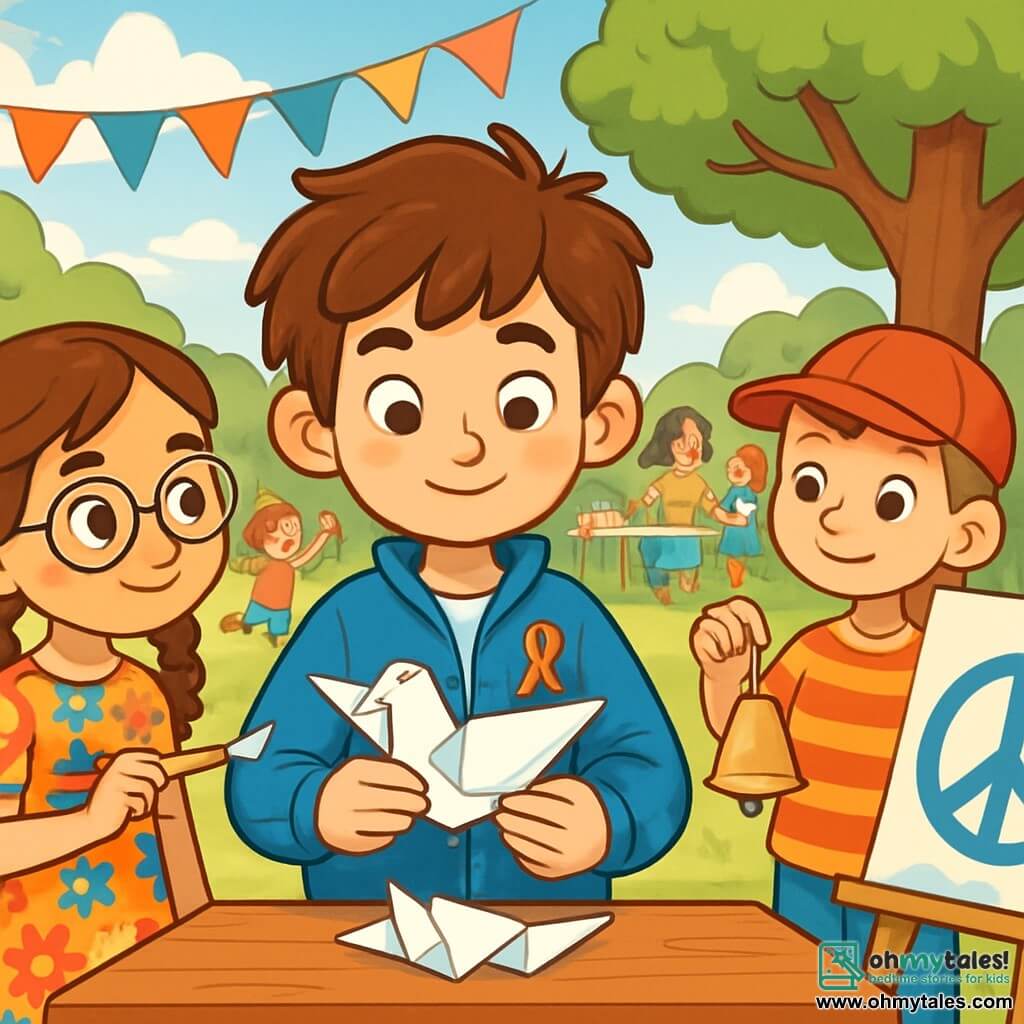
Leo woke to soft light that slipped like a ribbon under his curtains. He tied a blue ribbon to his jacket pocket. It was the ribbon Uncle Mateo had given him before he left. Leo missed Uncle Mateo. He missed the way the uncle hummed slow songs and showed him how to fold paper doves.
"Are you ready for the fair?" his mother asked, smiling as she packed sandwiches.
"I am," Leo said. His voice felt brave and small at the same time. "I put on the ribbon so he is with me."
At the park, bunting swung like sails. Tables glowed with jars of lemonade and bright stickers. A big sign read SOLIDARITY FAIR. People from the neighborhood had come to share food, art and games. There were balloons, warm bread, and a little stage for a puppet show.
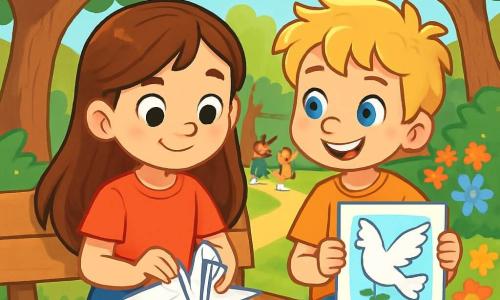
Leo's friend Maya waved. "Hi, Leo! Come help paint the big paper dove."
Leo ran over. He liked making paper doves because they reminded him of bridges—soft things that could fly across a gap. He dipped his brush and painted a wing pale gold.
Around them, voices hummed like bees. Some people were new to the neighborhood. Some spoke different words. All the colors and songs felt like a patchwork blanket. Leo felt warm inside. He thought Uncle Mateo would have liked this.
A pocket on his jacket brushed the ribbon. He touched it. He wished he could tell his uncle about the fair, but he knew he must wait and be patient.
A Dispute Near the Tree
Near the old oak, a group of children gathered for the puppet show. The show needed two helpers to pass out props. Maya, Sam, and Aisha wanted to help. Then Sam and Aisha began to argue.
"I held the mirror last time!" Sam said, stomping his small shoe.
"No, I did!" Aisha answered. Her cheeks were red like a sunburn. "You always get the best part!"
Leo watched. The words felt like pebbles dropped in a quiet pond. Ripples spread. Some children stepped back. The puppet, a soft rabbit, sat waiting on a table and looked a bit lost.
Ms. Rivera, the school nurse, was there with a gentle smile. She worked at the school and liked to come to neighborhood events on weekends. She wore a soft green scarf and carried a little bag of bandages that looked like tiny stickers.
"What's happening?" she asked, kneeling so her eyes were level with the children's.
Sam crossed his arms. "Aisha said I always take the mirror!" His voice shook. "I never get the mirror."
Aisha sniffed. "You don't listen to anyone."
Leo remembered how it had felt when Uncle Mateo had to go away. He had wanted to say a lot, but the words tangled in his throat. He knew a knot when he saw one.
"Can we sit for a minute?" Ms. Rivera asked. "It helps me to hear everyone's side."
She guided them to a soft blanket under the tree. People continued to play around them, the fair like a slow river. The nurse took out three little paper hearts from her bag. They were pale blue, pale green, and pale yellow.
"These hearts are for our voices," she said in a calm voice. "We will take one heart each. When you hold the heart, you can speak. The others listen without interrupting. Then we trade. This is a listening circle."
Leo felt lighter. The idea was like building a bridge with small stones one at a time.
Sam held the blue heart. His hands shook a little. "I feel left out," he said. "I like the shiny mirror. I thought it was my turn."
Aisha held the green heart next. "I feel sad," she said. "I practice really hard for the puppet show. I wanted to do something important."
Ms. Rivera nodded. Then she offered the yellow heart to Leo. "Would you like to say something?" she asked.
Leo touched his ribbon. He thought of the paper doves folded with his uncle. He looked at Sam and Aisha. "When people take turns," he said, "everyone can shine. Maybe we can share the mirror. Or make a new part for someone who feels left out."
Sam's shoulders eased. Aisha's eyes blinked. It was like a small light turning on inside them.
Ms. Rivera smiled. "Listening is the first step. Patience is the next," she said. She showed them a simple breathing trick. "We breathe in like we smell cookies. We breathe out like we blow dandelion seeds."
They all breathed. The air in the circle felt softer afterward.
Building Bridges and Changing Roles
The puppet rabbit still sat on the table, waiting for its friends. Ms. Rivera clapped her hands once. "Puppet shows are like small towns," she said. "Every character needs a job. Sometimes, if one job is too popular, we change the roles so everyone can take part."
"Can we do that?" Maya asked.
"Yes," Leo said. He remembered how Uncle Mateo had taught him to make new bridges when old ones were shaky. "Let's make a new list. Mirror, music bell, story voice, and helper with the props."
They wrote names on colorful paper flags. Sam got the music bell first, and his face lit up because the bell chimed like a tiny laugh. Aisha took the mirror sometimes and the story voice sometimes. Another child, Noor, who had been quiet, was given the job of holding the rabbit's paw. Noor's eyes widened. Noor had been saying she didn't know how to be part of things.
"Now everyone helps," Ms. Rivera said. "And sometimes you swap jobs halfway so each of you can try everything."
"Swap?" Sam asked.
"Yes. After each act, you change one job. That way everyone learns and no one always gets the same part."
They practiced. Leo helped thread a string to hang a little paper dove above the stage. He felt careful as he tied the string—like tying two hands together.
People at the fair clapped when the first act began. The rabbit hopped and told a small, brave tale. It spoke about a little hill that chose to be a bridge. The children laughed when the rabbit sneezed confetti. They listened when it said, "If we all put a little rope of patience together, the bridge holds."
After the act, the kids swapped roles. Sam rang the bell; Aisha told the story. Noor held the paw with a proud smile. Leo felt proud too. He understood that making peace could be done with small, patient steps.
The Nurse, a Story, and a Quiet Light
Later, the park grew calm as shadows lengthened. Ms. Rivera set up a circle of cushions near the flower beds. "Story time," she said. Many small children gathered. Even adults leaned in, curious for a soft moment.
Leo sat next to his mother. He touched his ribbon and thought of Uncle Mateo. He wondered if his uncle felt far away like the moon, or if he could see little lights like the ones in the park.
Ms. Rivera's voice was gentle. "This is a story about a little bridge," she began. "The bridge was made of wood and hope. A long time ago, it felt lonely because it did not know how to hold the hands of strangers. Then a child came with a paper dove. The child taught the bridge to listen. The bridge learned about patience. When the bridge learned to listen, it let everyone cross safely."
The story was like a smooth stone on a pond. It made small ripples in Leo's heart. He felt the day slow down to a soft beat.
After the story, Ms. Rivera said, "If you ever feel worried or alone—maybe because someone went far away or because someone was mean—it's okay to talk to an adult you trust. You can talk to your mom, a teacher, or a nurse. They will listen and help you find small steps to fix things."
Leo's mother squeezed his hand. He breathed in and then out. He felt as if a small bridge had been built inside him, strong enough to carry a memory.
"Uncle Mateo taught me to fold paper doves," Leo told Ms. Rivera softly.
"I remember," she said. "When someone leaves to a place of trouble, we can still make bridges of kindness here. It helps to be patient as things mend."
They made paper doves together. Leo folded precise wings. Ms. Rivera tied a tiny string so the dove could hang like a promise. Leo hung his dove on the branch above him. The dove swayed in the twilight like a small, white light.
Evening Calm and a Gentle Lesson
As the stars blinked awake, the fair came to a gentle end. People hugged, handed out leftovers, and whispered goodbyes. Leo helped pick up crayons and paper flags. The children who had argued earlier walked home side by side. They were not perfect friends yet, but they had begun to mend.
On the walk home, Leo told his mother what had happened. "We listened. We shared jobs. We made a new part for Noor. Ms. Rivera taught us breathing. We fixed things by being patient."
His mother nodded. "That sounds like a very good day. Sometimes fixing things takes a little time. It needs patience and some helpers."
Leo thought of Uncle Mateo and the ribbon on his jacket. He imagined his uncle sitting under a different sky, folding doves and building bridges in his own way. The thought made Leo's chest feel warm like sunlight through a window.
Before bed, Ms. Rivera's story came back to him. He remembered the bridge learning to listen. He remembered the paper dove on the branch. He felt less alone.
In his room, Leo made a small line of doves across his window. They looked like flying bridges. He whispered into the dark, "I will wait and be patient. I will talk when I must. I will help make bridges."
He thought of the way Sam's face had changed when he got a new job. He remembered Aisha's soft smile when she heard someone listen. He felt proud that he had helped.
Ms. Rivera's quiet voice echoed like a soft lamp. "Patience is like planting a seed," she had said. "You water it, wait, and watch it grow into a small tree."
Leo imagined planting words like seeds—kind words, brave words, patient words. He tucked his ribbon under his pillow. He felt safe knowing adults were there to help when knots needed untying.
Before he slept, he read his own small recap in his head, like a bedtime promise:
- We listen without interrupting.
- We give each other turns.
- We change roles so everyone helps.
- We ask a trusted adult when we need help.
- We breathe and wait with patience.
He folded one last paper dove and held it for a moment. Outside, the park's lights twinkled like distant stars. The dove was soft in his hands. He pictured it flying far across the sky, carrying a simple message: I remember you. I will be patient. I will help build a bridge.
Leo smiled. He felt a calm like warm tea. He closed his eyes and thought of bridges, light, and doves. The world felt mended enough for sleep.