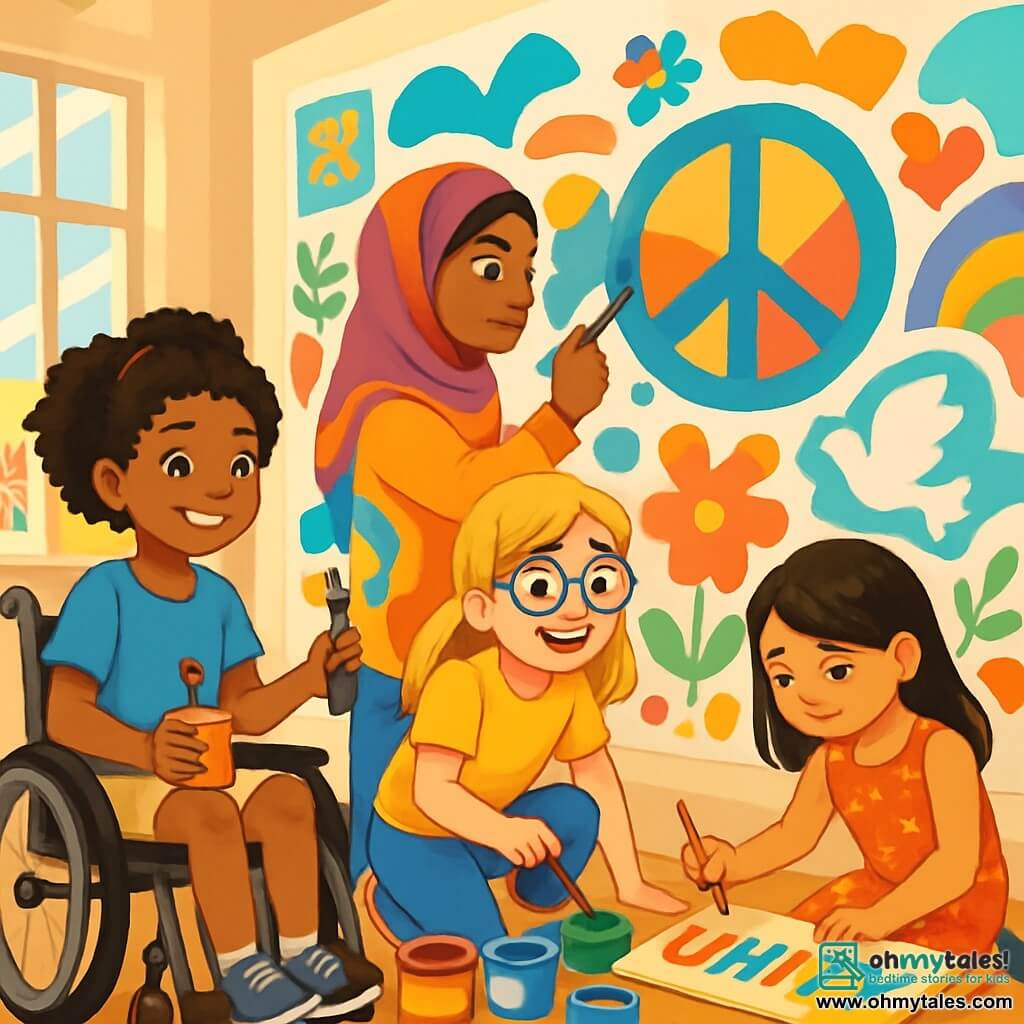
Chapter 1: The Clubhouse on Maple Lane
The sun was barely up, but the four girls were already gathered at their usual spot—the old red-brick clubhouse nestled between two tall maple trees on Maple Lane. The clubhouse wasn't anything fancy; its paint was chipped, and sometimes the roof leaked when it rained, but to Maya, Grace, Lila, and Noor, it was a place where anything felt possible.
Maya rolled up the ramp in her wheelchair, a determined look on her face. She was the first to arrive, as usual, her curly hair bouncing with every push of her wheels. Inside, Grace was already arranging their art supplies, humming a tune under her breath. Lila, who loved books more than anything, was perched on the window sill with a notebook, scribbling ideas for their latest project. Noor, always brimming with energy, burst in last, her backpack slung over one shoulder.
"Morning, everyone!" Noor called out, dropping her bag onto the floor and plopping down beside Maya.
"Ready for our next big adventure?" Grace asked, her eyes shining.
"Always," Lila replied, grinning. "But what are we doing today?"
Maya smiled. "I was thinking… Maybe we could work on something for the school's Culture Week. You know, something about celebrating different backgrounds?"
Noor's face lit up. "That's a great idea! We could do a mural, or a play, or—"
"Or a poetry reading!" Lila interrupted, waving her notebook.
Grace looked thoughtful. "I like the mural idea. It's something everyone can see, and it could bring people together."
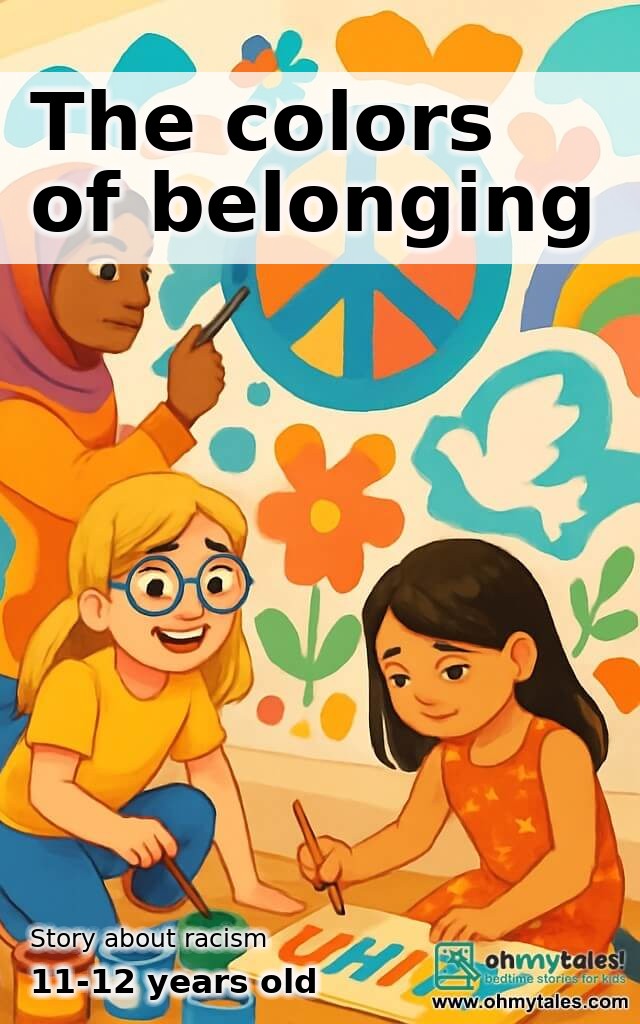
They spent the next hour brainstorming, their ideas flying around the room like bright butterflies. At last, they agreed: they would create a mural showing what diversity and inclusion meant to them.
As they planned, none of them could have guessed how much this project would change the way they saw their school—and each other.
Chapter 2: Shadows at School
At lunchtime the next day, the girls met by the big oak tree in the playground. They talked excitedly about their mural, sketching designs and sharing stories from their families—recipes, traditions, and favorite songs.
But as they laughed, a group of older kids walked by. One of them, a tall boy named Jake, glanced at Noor and made a face. "Why do you always wear that scarf on your head?" he sneered, pointing at Noor's hijab.
Noor stiffened, her smile fading. "It's part of my culture," she said quietly.
Jake rolled his eyes. "Looks weird. Why don't you just take it off and be normal?"
The other kids snickered. Grace clenched her fists, but before she could say anything, Jake and his friends sauntered off, still laughing.
For a moment, the girls sat in heavy silence. Noor looked down, her hands twisting in her lap.
"That was mean," Maya said, her voice trembling with anger. "He had no right."
Grace reached over and squeezed Noor's hand. "Don't listen to him. You're amazing just the way you are."
Lila nodded, her eyes flashing. "We should talk to a teacher."
Noor shook her head. "I don't want to make it a big deal. It happens… sometimes."
The others fell silent, unsure what to say. They'd heard things like that before, but seeing it happen to their friend made it feel different—more real, and much more painful.
That afternoon, as they painted the outline for their mural in the art room, the girls worked quietly. The joy from that morning had faded, replaced by a heavy sadness.
But Maya, watching Noor's careful brushstrokes, felt something shift inside her. She realized that their mural could be more than just art—it could be a message.
Chapter 3: The Stories We Tell
Over the next few days, the girls poured themselves into the mural project. They researched symbols from different cultures, drew portraits of people from all over the world, and added words like “respect,” “unity,” and “belonging” in bright, bold letters.
But Maya couldn't stop thinking about what had happened to Noor. One afternoon, as they cleaned up their brushes, she said, "Noor, does that kind of thing happen a lot?"
Noor hesitated. "Sometimes. It's not always as direct, but… people stare, or whisper. Sometimes they ask rude questions. It makes me feel like I don't belong."
Grace frowned. "That's not fair. You belong here as much as anyone."
Lila looked up from her sketchbook. "My dad says people are afraid of what they don't understand. Maybe if they knew more about your culture, they'd be nicer."
Noor smiled a little. "Maybe. I just wish people would ask questions instead of making fun."
Maya nodded slowly. "Maybe we could add something to the mural about that—about asking questions and trying to understand each other."
The girls agreed. That night, Maya couldn't sleep. She kept replaying the scene with Jake in her mind, wishing she'd said something, done something. She realized that confronting racism wasn't just about making art—it was about speaking up, even when it was hard.
Chapter 4: When Words Hurt
The next week, the girls worked on their mural every day after school. Other students stopped by to watch, sometimes offering to help. Some were curious about the different designs and symbols.
One afternoon, a girl named Emily approached them. She glanced at Maya's wheelchair, then at Noor's hijab. "Why do you guys make everything about being different?" she asked, her tone uncertain.
Maya looked up, choosing her words carefully. "It's not about being different. It's about showing that everyone belongs, no matter where they come from, what they look like, or what they believe."
Emily frowned. "But isn't it better if everyone's the same? Then there wouldn't be problems."
Lila shook her head. "If everyone was the same, the world would be boring. We all have stories to share. That's what makes life interesting."
Emily thought about this, then shrugged and wandered off.
Maya glanced at her friends. "Do you ever get tired of explaining things?"
Noor nodded. "Sometimes. But I'd rather people ask than assume."
Grace smiled softly. "It's hard, but we're changing things—one conversation at a time."
As they painted, Maya felt a quiet strength growing inside her. She realized that standing up to racism wasn't just about big speeches or protests—it was about small moments of courage, every day.
Chapter 5: The Incident
The mural was halfway finished when something happened that shook the girls to their core.
It was Thursday, and the girls were painting after school when they heard shouting from the hallway. They peeked out and saw Jake and his friends cornering a boy named Raj. He was new to the school, and his family had moved from India a few months before.
"What's that weird food you eat at lunch?" Jake taunted, shoving Raj's backpack. "Smells gross."
Raj looked down, his eyes shining with tears.
"Leave him alone!" Noor called, her voice ringing down the hallway.
Jake turned, surprised. "Mind your own business."
Maya pushed forward, her wheelchair steady and sure. "No, you're making everyone's business worse. You can't treat people like that."
Grace and Lila stood beside her, their faces determined.
A teacher finally appeared, and Jake and his friends backed off, grumbling. The girls hurried to Raj's side.
"Are you okay?" Grace asked gently.
Raj nodded, wiping his eyes. "It happens a lot. Back in my old school, too."
Noor knelt beside him. "You shouldn't have to put up with that. We're here for you."
Raj managed a small smile. "Thanks. Most people just ignore it."
The girls led Raj to the art room, offering him a spot to help with the mural. As he picked up a paintbrush, Maya realized that their project was more important than ever.
Chapter 6: Lessons from Home
That night, Maya's mind buzzed with questions. At dinner, she told her parents what had happened.
Her mom listened carefully, then said, "Racism is something people learn, Maya. It's not something anyone is born with. That's why it's so important to talk about it, even when it's uncomfortable."
Her dad nodded. "When people see others as ‘different,' they sometimes feel threatened. But the only way to change that is to help them see the world through someone else's eyes."
Maya thought about this. "But what if they don't want to listen?"
Her mom squeezed her hand. "Then you keep trying. Even small actions can make a big difference."
Later, Maya texted her friends. She wanted to talk about how they could do more—beyond just painting a mural.
The next day, the girls met early at the clubhouse. Maya shared what her parents had said.
"We could organize a day where everyone shares something from their culture," Lila suggested.
"Or have a discussion at assembly about what happened to Raj," Grace added.
Noor nodded. "And maybe invite people to help finish the mural. That way, it belongs to everyone."
They agreed to talk to their teachers. As they made their plans, Maya felt a spark of hope. Maybe, just maybe, they could help their school become a kinder place.
Chapter 7: The Assembly
The girls met with Mrs. Carter, their art teacher, and explained what had happened to Noor and Raj. Mrs. Carter listened carefully, her face serious.
"I'm proud of you for standing up for your friends," she said. "Would you be willing to talk about this at the next school assembly?"
The thought of speaking in front of everyone made Maya's stomach twist, but she nodded. "We'll do it together."
When the day of the assembly arrived, the girls stood on stage, their hands trembling. Maya spoke first, her voice clear but shaky.
"Racism isn't always loud. Sometimes it's a joke, or a look, or being left out. But it hurts just the same."
Noor told her story, her voice strong. Grace and Lila talked about the importance of asking questions and learning from each other. Raj, now part of their group, shared how it felt to be new and different.
When they finished, the auditorium was silent. Then, slowly, people began to clap. Maya looked out at the sea of faces and saw something new—understanding.
After the assembly, students began approaching them with questions. Some apologized for things they'd said or done. Others wanted to help with the mural.
The girls realized that their voices mattered. They couldn't change everything overnight, but they could start small—and watch kindness ripple outwards.
Chapter 8: Colors of Belonging
The last week of Culture Week was a blur of activity. Students painted, sang, danced, and shared food from their families. The mural grew brighter each day, covered in handprints and stories.
One afternoon, Jake approached the girls. He looked awkward, his hands stuffed in his pockets.
"Hey," he mumbled. "I… I didn't mean to hurt anyone. I was just… I don't know. I guess I never thought about how it felt."
Noor looked at him, her gaze steady. "It did hurt. But you can do better."
Jake nodded, his face red. "Can I help with the mural?"
Grace smiled. "Sure. Everyone's welcome."
As Jake picked up a brush, Maya felt a weight lift off her shoulders. Change wasn't easy, but it was possible.
On the last day, the principal gathered everyone in front of the mural. It was a riot of colors—faces, symbols, and words swirling together in a celebration of belonging.
"This mural is a reminder," the principal said, "that our differences make us stronger. Thank you to everyone who made this possible."
The crowd cheered. Maya looked around at her friends—Noor, Grace, Lila, Raj, and even Jake. She felt proud, not just of the mural, but of the courage they'd found in each other.
Chapter 9: Beyond the Clubhouse
After the mural was finished, the girls kept meeting at the clubhouse. They started new projects—organizing book swaps, cooking classes, and even a podcast about kindness.
They still faced challenges. Sometimes, people said hurtful things. But now, the girls knew they could face them together.
One evening, as the sun set and painted the sky gold, Maya looked around at her friends.
"We can't fix everything," she said softly. "But we can start here, with us."
Noor grinned. "And maybe inspire others to do the same."
Grace nodded. "It starts with one person. Then another. And another."
Lila closed her notebook and smiled. "Let's keep telling our stories. The world needs them."
As the girls packed up for the night, Maya felt a quiet joy. She knew the world still had a long way to go. But with friends by her side, anything felt possible.
And in their small corner of the world, on Maple Lane, change was already blooming.
Chapter 10: The Seeds We Plant
Spring arrived, and with it, new faces at school. Raj was no longer the “new kid.” More students joined the girls' club, each bringing their own stories and dreams.
One afternoon, a younger student named Sam approached Maya. He was nervous, fidgeting with his backpack.
"Hi," he said. "I saw your mural. It made me feel… like maybe I belong here, too."
Maya smiled, her heart swelling. She remembered how hard it had been to speak up, to confront what was wrong. Now, she saw the seeds they'd planted growing in ways she hadn't imagined.
"Of course you belong," she said. "Everyone does."
As Sam joined their group, Maya glanced at her friends. They were laughing, sharing stories, planning new adventures.
The world wasn't perfect. Sometimes it felt messy and unfair. But together, they'd learned how to face it—with courage, kindness, and the belief that every voice mattered.
Years later, people would still remember the mural on Maple Lane—the colors, the stories, and the message that began with four girls who believed in something bigger than themselves.
And in every corner of their school, seeds of respect, understanding, and inclusion continued to grow, nourished by the hope and determination of a few brave friends.