Chapter 1: The New Seat
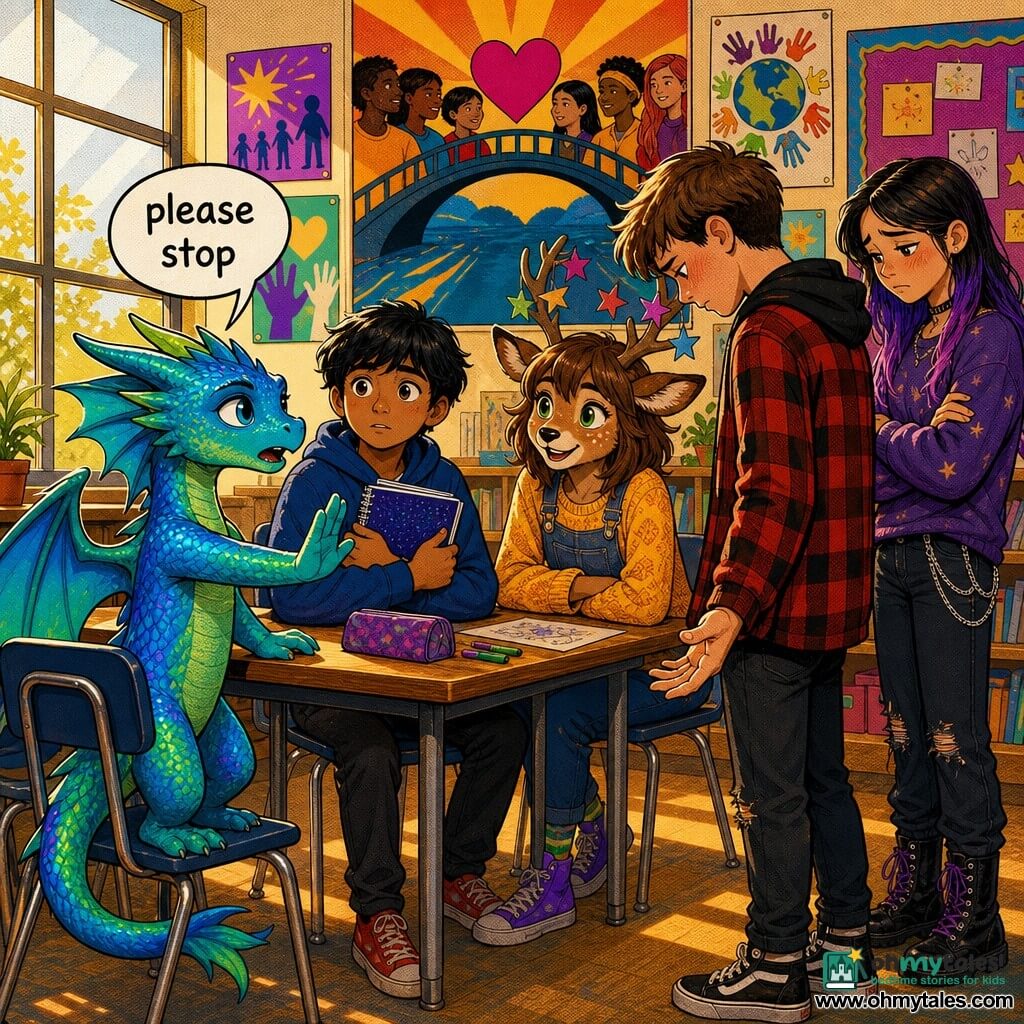
Milo's ears twitched as the classroom door swung open. He liked the sound of mornings in Oakshade School—the scrape of chair legs, the soft thump of backpacks, the hiss of the radiator waking up.
He slid into his seat, careful not to bump his tail against the desk behind him. His scales—smooth as river stones—shifted colors a little when he felt nervous. Today they were leaning toward gray-green, like cloudy pond water.
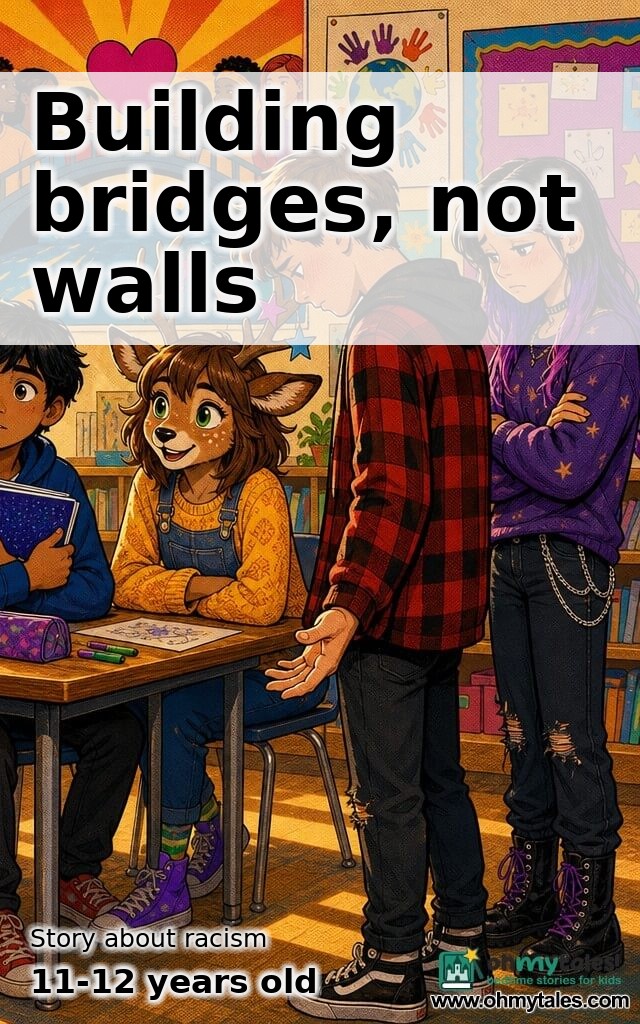
“Morning, Milo,” said Tessa, tapping her pencil in a cheerful rhythm. Her antlers were decorated with tiny paper stars she'd folded herself.
“Morning,” Milo said, and tried to make his scales settle into their usual blue.
A new student stood near the teacher's desk, clutching a notebook so tightly the corners bent. He was small and quick-looking, with a neat scarf wrapped around his neck even though the room was warm. His voice, when he introduced himself, carried a different music.
“I'm Kavi,” he said. “I moved here from Riverbend.”
A few students waved. A few just stared.
Mr. Bramble, their teacher, smiled. “Kavi, you can sit near Milo. Milo is good at showing people where things are.”
Milo felt a tiny spark of pride, like a warm pebble in his chest. He scooted his chair back to make room.
Kavi slid into the seat beside him. Up close, Milo noticed the careful way Kavi held his notebook, as if it might run away. Milo leaned over.
“If you need help finding the library corner,” Milo whispered, “it's behind the plant with the droopy leaves. Don't tell the plant I said that.”
Kavi's mouth lifted in a small grin. “I won't.”
For a while, the morning was normal. Math. A short quiz. Someone dropped an eraser and it rolled like a runaway cheese wheel. Milo's scales turned bluer.
Then, during break, Milo heard it.
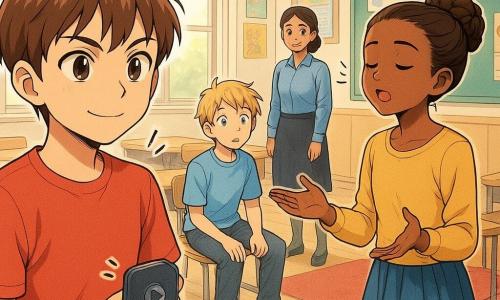
A few desks away, Zed and Lark were whispering and giggling. Zed tilted his head and repeated Kavi's words in an exaggerated, sing-song voice.
“I'm Ka-vee,” Zed said, stretching the syllables in a way that didn't sound like Kavi at all. Lark snorted, then copied it too, louder.
Kavi froze with his snack halfway to his mouth. His eyes flicked around the room like he was looking for a place to hide that didn't exist.
Milo's stomach tightened. His scales prickled, shifting toward a sharp, unhappy green.
“That's not funny,” Milo said, standing before he even realized his legs had moved.
Zed shrugged, too casual. “We're just joking.”
“It doesn't sound like a joke to him,” Milo replied. He kept his voice steady, even though his tail wanted to thump the floor like a drum. “It sounds like you're making fun of how he talks.”
Lark rolled her eyes. “You always act like the feelings police.”
Milo took a breath. His teacher always said, When you feel heat in your chest, cool it with air first.
“It's not about policing,” Milo said. “It's about basic respect.”
Kavi stared down at his snack. The smile from earlier had vanished like chalk in the rain.
Mr. Bramble clapped his hands from the front of the room. “Break's almost over,” he called. “And don't forget—this afternoon we'll visit the older class. They're presenting their project on racism and inclusion.”
The word racism made the room go a little quieter, like someone had turned down the volume.
Milo looked at Kavi and wished he could do something that worked like a blanket—simple, warm, and immediate.
He leaned closer. “Want to sit with me at lunch?” he asked. “The cafeteria noodles are… well, they're noodles. But at least we can complain together.”
Kavi let out a small breath that might have been a laugh. “Okay,” he said softly. “Thank you.”
Chapter 2: Lunch and Little Bridges
The cafeteria smelled like warm bread, apple peels, and the mysterious spice the cooks added to everything. Milo and Kavi carried their trays to a table near the window.
Outside, the school garden was still winter-brown. A robin hopped along the fence, looking like it had a very important appointment.
Tessa sat down with them, balancing her cup so it didn't tip over her hooves. “Can I join?” she asked.
“Please,” Milo said, grateful. Three felt steadier than two.
They ate for a minute in quiet. Then Kavi poked at his noodles like they had personally offended him.
“Do they always do that?” he asked, not looking up.
“Do what?” Tessa asked, then her eyes widened as she guessed. “Oh.”
Milo stirred his noodles. “Sometimes,” he said. “Not always. But sometimes some kids think copying someone is harmless. Like it's a game.”
Kavi's ears drooped. “Where I lived before, my accent was normal. Here it's… loud.”
“It's not loud,” Milo said quickly. “It's just different from what they're used to.”
Tessa nodded. “My cousin has a different way of pronouncing words,” she added. “When we were little, I copied her once. She cried. I didn't understand until I tried to imagine it happening to me every day.”
Kavi finally looked up. “What did you do?”
“I stopped,” Tessa said simply. “And I apologized. It didn't erase what I did, but it was a start. And then I tried to learn her words instead of turning them into a joke.”
Milo felt a little air go back into his chest. “That's the thing,” he said. “We can learn. People can change. But we have to actually try.”
At the next table, Zed was telling a story with huge arm gestures. Every so often, he glanced over. Milo could feel the glances like tiny pebbles thrown at his back.
Milo leaned closer to Kavi. “If it happens again,” he said, “we can tell Mr. Bramble. Or we can say, ‘Please stop.' Clear and calm. Sometimes that works.”
“And if it doesn't?” Kavi asked.
“Then we keep going,” Tessa said. “We don't let unkindness be the loudest thing in the room.”
Kavi took a bite of noodles and made a face. “These noodles might be louder.”
Milo snorted, then laughed. Tessa giggled. Even Kavi's shoulders lifted a little, as if a heavy backpack strap had loosened.
After lunch, Milo walked with Kavi back to class. In the hallway, posters lined the walls: “READING WEEK,” “SCIENCE FAIR,” and one new poster made from bright paper: “BUILD BRIDGES, NOT WALLS.”
Milo stopped. “Did you see that?” he asked.
Kavi tilted his head. “It's nice.”
Milo touched the edge of the poster gently. “I think the older class made it,” he said. “They're the ones doing the project today.”
Kavi's eyes followed the big letters. “Bridges,” he repeated, as if tasting the word. “I like that.”
So did Milo. It sounded like something you could build with your hands.
Chapter 3: The Big Kids' Project
In the afternoon, Mr. Bramble led Milo's class down the hallway to the older students' room. The air changed as they approached—more quiet, more serious, like walking into a library where the books were watching.
The older classroom had posters covering almost every surface. Milo's eyes darted from one to the next.
One poster showed a row of different faces drawn in bright colors, with the words: “DIFFERENT IS NOT LESS.”
Another poster had a simple picture of two paws shaking hands: “RESPECT IS A CHOICE.”
At the front, an older student named Suri stood beside a big cardboard model. It looked like a town with little paper houses and a river made of shiny blue foil. Across the river was a bridge.
“This is our model of our community,” Suri said. “The bridge is for meeting each other. The walls”—she pointed to tall cardboard blocks stacked on the far side—“are for avoiding each other.”
Milo felt Kavi shift beside him. Milo kept his shoulder close, like a silent promise.
Another older student stepped forward. “We're talking about racism,” he said, speaking carefully. “Racism is when someone is treated unfairly because of the way they look, where they come from, or their culture. It can happen in big ways, like being left out of opportunities, and small ways, like jokes that sting.”
Milo's ears warmed. He glanced at Kavi. Kavi's eyes were fixed on the posters, but his fingers were twisting the edge of his sleeve.
Suri lifted a small sign with big letters: “IMMITATION OR MOCKING?”
“Sometimes,” Suri continued, “people copy someone's voice or words. Copying can be respectful if you're learning a language or trying to understand. Mocking is when you copy to make someone feel smaller.”
She paused, letting the words settle.
Milo remembered Zed's sing-song voice. It hadn't been learning. It had been aiming.
The older students invited questions. The room buzzed with whispered courage.
Tessa raised her hoof. “How do you know when you've hurt someone if they don't say anything?”
Suri nodded. “Good question. You watch their face and their body. Do they go quiet? Do they stop joining in? Do they look away? Also, you can ask. Not in a dramatic way—just, ‘Hey, was that okay?' And if they say no, you listen.”
Another student asked, “What if the person who's being unkind says it's just a joke?”
An older student with round glasses replied, “Then you can say, ‘I believe you meant it as a joke, but it didn't land that way. Can you stop?' It helps to focus on the effect, not just the intention.”
Milo's tail curled thoughtfully. Effect. Intention. He liked the way those words fit together like puzzle pieces.
At the end, the older class showed a short skit. In it, one character kept repeating another's words in a silly voice. The character being copied slowly stopped talking. The room in the skit grew cold and awkward. Then another character stepped in and said, calm and firm, “We don't do that here. We treat everyone with dignity.”
The skit ended with an apology that sounded real, not rushed. They shook hands. Then they built a paper bridge together and set it on the model river.
Milo felt something settle inside him. Not anger this time—direction.
On the way back to their classroom, Kavi spoke quietly. “In the skit,” he said, “the apology mattered.”
“It did,” Milo agreed. “But the stopping mattered too.”
Kavi nodded. “I don't want anyone to get in trouble,” he admitted. “I just want… to not feel weird for speaking.”
Milo glanced at him. “You're not weird,” he said. “And you shouldn't have to shrink to fit.”
Kavi's eyes flicked toward the “BUILD BRIDGES, NOT WALLS” poster as they passed it again. “Maybe,” he murmured, “we can build one.”
Chapter 4: The Echo in the Hallway
The next morning, Milo arrived early. The classroom still smelled faintly of yesterday's dry-erase markers.
Kavi came in soon after, holding his notebook a little less tightly.
For the first hour, things were peaceful. Then, during group work, Milo heard a familiar giggle.
Zed leaned over his desk and copied Kavi again, stretching the words like sticky chewing gum. Lark joined in, a second echo.
Milo's scales flashed a bright, warning green before he could stop them.
Kavi's pencil paused mid-sentence. He didn't look up. Milo saw his shoulders tighten, as if he were bracing for a shove that never came.
Milo stood. He could feel the room's attention turn, like sunflowers following the sun.
He remembered the older students: calm and firm.
Milo faced Zed. “Please stop,” he said clearly. “That's mocking.”
Zed blinked, surprised that Milo didn't shout. “We're not mocking,” he muttered. “We're just—”
Milo held up one claw, not threatening, just stopping the flood of excuses. “You might think it's a joke,” he said. “But it hurts. The effect matters.”
Lark frowned. “Who made you the boss?”
“I'm not the boss,” Milo replied. “I'm a classmate. And I want this to be a safe class for everyone.”
Mr. Bramble looked up from his desk. His eyes were gentle but sharp, like a lamp turned on. “What's happening?” he asked.
Milo swallowed. His voice stayed steady. “They're copying Kavi's accent in a way that's meant to be funny. It's not respectful.”
Mr. Bramble walked over, his steps calm. He didn't explode like a volcano. He didn't shrug it off like it was nothing. He stood between the desks, making a small circle of quiet.
“Zed, Lark,” he said, “did you copy Kavi's voice?”
Zed's ears went pink. “We were joking,” he said again, softer.
Mr. Bramble nodded once. “I hear you. But joking is not the same as kindness. Kavi, how did it feel?”
Kavi's fingers tightened on his pencil. He took a breath that sounded like he was borrowing courage from the air.
“It feels like… like my words aren't welcome,” Kavi said. “Like I should talk less.”
The room felt heavier for a moment, as if the truth had weight.
Mr. Bramble turned to Zed and Lark. “When someone feels pushed to talk less because of your behavior,” he said, “that is a problem. Our class is for learning, and everyone deserves dignity.”
Zed stared at his desk. Lark's mouth opened, then closed. For once, they didn't have a clever comeback.
Mr. Bramble continued, “You are capable of better. I want you to apologize—properly—and then we'll talk about how to fix this going forward.”
Zed looked up at Kavi. His voice sounded small. “Sorry,” he said. Then he tried again, clearer. “I'm sorry. I copied you to get laughs. I didn't think about how it would feel.”
Lark shifted, then sighed. “I'm sorry too,” she said, not quite meeting Kavi's eyes. “It was mean.”
Kavi nodded slowly. “Thank you,” he said. “I just want to be… normal here.”
Milo leaned forward. “You already are,” he whispered, only for Kavi.
Mr. Bramble nodded. “After class,” he told Zed and Lark, “you'll help me set up an activity for tomorrow. Something about building bridges.”
Zed blinked. “Like… real bridges?”
“Paper and cardboard,” Mr. Bramble said, but there was a hint of a smile. “Real effort.”
When the lesson started again, Milo sat down. His scales eased back toward blue. He didn't feel like a hero. He felt like someone who had done one small, necessary thing.
Kavi nudged him lightly with his elbow. “Thanks,” he whispered.
Milo shrugged, trying to act casual. “I just don't like echoes,” he said. “They make the hallway feel empty.”
Kavi smiled—this time, it reached his eyes.
Chapter 5: Cardboard, Markers, and Teamwork
The next day, Mr. Bramble rolled a cart into the classroom. It was piled with cardboard pieces, tape, string, markers, and popsicle sticks.
Tessa's eyes lit up. “Craft day?”
“Learning day,” Mr. Bramble corrected, but he looked pleased. “We're going to build bridges. Not only the kind that hold weight, but the kind that show what we believe.”
He divided the class into mixed groups. Milo ended up with Kavi, Tessa, Zed, and Lark.
Zed looked uncomfortable, like his hoodie was suddenly made of sandpaper. Lark kept fiddling with a marker cap.
Mr. Bramble handed each group a paper slip. Milo read theirs out loud:
“Build a bridge that shows how a classroom can be fair and welcoming. Add words or symbols that explain your choices.”
Tessa clapped once. “Okay, team. We need a plan.”
Kavi cleared his throat. “We could make the bridge out of different materials,” he suggested. “Like… different strengths working together.”
Milo nodded. “And we could write promises on it,” he added. “Things we can actually do. Not just ‘Be nice,' but specific.”
Zed picked up a popsicle stick and bent it slightly. “Like what?” he asked, cautiously.
Milo looked at him, then at Kavi. “Like ‘Don't mock how someone speaks,'” Milo said. “And ‘Ask before you joke about someone's culture.'”
Lark swallowed. “And… ‘Invite people in,'” she said quietly. “Like if someone's alone at lunch.”
Tessa's pencil scribbled fast. “Yes. And ‘Listen when someone says something hurts.' That's a big one.”
Zed's ears drooped. “I didn't realize it would make him want to talk less,” he said, voice low. He glanced at Kavi. “I thought I was being… funny.”
Kavi considered him for a second. “You can be funny,” he said. “Just don't use me as the joke.”
Zed nodded, as if that sentence clicked into place in his head.
They got to work. Milo cut cardboard carefully, his claws making neat lines. Tessa used string to create a web-like support under the bridge. Kavi wrote words in steady marker on small paper planks: “Curiosity,” “Respect,” “Fairness,” “Courage,” “Listening.”
Lark drew small pictures along the sides: two backpacks side by side, a hand offering a seat, a speech bubble with a heart inside it.
Zed surprised Milo by focusing hard on the structure. He measured and re-measured, testing the bridge by pressing gently in the middle.
“This part will sag if we don't reinforce it,” Zed said, pointing. “Like… if one promise is missing, the whole thing gets weaker.”
Milo raised an eyebrow. “That's actually a great point.”
Zed gave a quick, awkward grin. “Yeah. I guess I learned something from… getting called out.”
When the bridge was assembled, it looked sturdy and bright. It wasn't perfect—the tape showed in places, and one side leaned a bit—but it felt honest. The promises were readable. The pictures were clear.
Mr. Bramble walked around the room, pausing at each group. When he reached theirs, he crouched to eye level.
“Tell me about your bridge,” he said.
Kavi spoke first. “We used different materials to show different backgrounds,” he explained. “And we wrote specific promises so it's not just decoration.”
Tessa pointed to the string supports. “This part is teamwork,” she said. “It holds things up from underneath.”
Lark pointed at her drawings. “These are actions,” she said softly. “Like inviting someone to sit with you.”
Zed pointed at the reinforced center beam. “This is… fixing weak spots,” he said. “Not pretending they aren't there.”
Mr. Bramble nodded slowly, as if each word was a nail hammered into something solid. “This is thoughtful,” he said. “And practical. That's important.”
At the end of class, Mr. Bramble asked everyone to place their bridges on the windowsill, lined up like a tiny skyline of hope.
Sunlight poured through, making the markers glow.
Milo stood with his group, looking at what they'd made together. Kavi's shoulder brushed his.
“It's kind of nice,” Kavi said.
Milo's scales shimmered blue. “Yeah,” he said. “It is.”
Chapter 6: Building Tomorrow
A week later, Oakshade School hosted an evening showcase. Families of all kinds came—feathered, furred, scaled—filling the halls with warm chatter and the squeak of shoes.
Milo stood near the windowsill display, watching visitors stop to read the promises on the bridges. Some nodded. Some smiled. Some looked thoughtful, like they were remembering something.
Kavi stood beside him, hands behind his back, calmer than he'd been on his first day. Tessa adjusted one of her paper stars. Zed and Lark hovered nearby, pretending they weren't nervous.
A younger student pointed at the words “Listening” and “Courage.” “What does this mean?” the student asked.
Kavi crouched down to the younger student's level. “It means if someone says they're hurt, you don't argue,” he explained. “You listen. And courage means speaking up when something isn't fair—even if your voice shakes.”
Milo felt proud, the quiet kind that doesn't need applause.
Later, as the crowd thinned, Mr. Bramble gathered the class for a final moment near the bridges.
“I've watched you grow this week,” he said. “Not by being perfect. By learning. By noticing. By repairing harm instead of ignoring it.”
Zed cleared his throat. “Can I say something?” he asked.
Mr. Bramble nodded.
Zed faced Kavi, then the group. “I used to think being different was… weird,” he admitted. “Like something to point at. But it's actually just… people. And copying someone to laugh at them is lazy. I'm trying to be better.”
Lark added, “Me too. I didn't stop it when I should have. Next time I will.”
Kavi's eyes softened. “Thank you,” he said. “I'm still getting used to this place. But I like it more now.”
Tessa bumped Milo gently with her shoulder. “See?” she whispered. “Bridges.”
Milo looked at the line of small cardboard bridges glowing in the last of the sunset. He imagined them stretching beyond the windowsill, beyond the school, over every place where someone felt left out.
He thought of how easy it was to build a wall: one joke, one shrug, one “It's not a big deal.” Walls went up fast.
Bridges took more. They took time, attention, and the bravery to admit when you were wrong.
As they walked out into the cool evening, Kavi tugged his scarf tighter. “Milo,” he said, “I used to think I had to change my voice to fit in.”
Milo shook his head. “Your voice is yours,” he said. “The class has to make room for it. We all do.”
Kavi smiled. “Then I want to help make room for others too,” he said. “When someone new comes, we can show them around.”
“Deal,” Milo said.
Tessa lifted her chin, looking at the darkening sky. “Let's build a habit,” she declared. “Not just a bridge.”
Zed groaned dramatically. “A habit? That sounds like homework.”
Lark elbowed him. “It's the good kind.”
Milo laughed, the sound warm in his throat. His scales shimmered a steady blue as they headed home together—four classmates, different in many ways, walking side by side.
Behind them, through the school windows, the bridges stayed on the sill, bright and patient, reminding anyone who passed: it's better to connect than to divide.