After-School Shadows
The sky over Maple Park had the color of a faded soccer ball—soft gray with patches of blue. Max and Imran dribbled between fallen leaves, their sneakers flicking up little spirals of dust. They weren't on a team yet, not officially. They were two almost-eleven-year-olds who liked to pretend the oak tree was a goal, the bench was a defender, and the pathway's cracks were a maze to outplay.
Imran had fast feet and a way of keeping the ball stuck to his shoes, like he was whispering to it. Max had a loud laugh, a goalie's stubbornness, and the kind of grin that made it easy for people to like him. They had done homework at the picnic table and traded pencils when the wind rolled their erasers away. Now their shoulders were damp, their cheeks bright, and the world felt wide and friendly.
They decided—without even saying it—to head to Mr. Costa's store on the corner. The bell chimed when they pushed the door, the cold air brushing their sweaty arms.
The store smelled like lemons and cinnamon. There were stacks of oranges like small suns, rows of cereal boxes smiling with cartoons, and a tiny freezer full of popsicles that cracked with frost when Max opened it. The kind with two sticks you could share.
Max reached in for grape. Imran chose mango, his favorite. They lined up behind a man buying bread and a woman with a bag of peppers. Max looked down, noticed a stain of grass on his knee, and tried to brush it off.
When it was their turn, Mr. Costa glanced up. He squinted a little, focusing on Imran in a way that felt like the light in the store had shifted.
“Make sure you pay this time, okay?” he said, and the words dropped onto the counter like coins.
Max blinked. He hadn't expected that. Imran's hand tightened around the popsicles. The plastic crackled.
“Of course we'll pay,” Max said, and felt his voice climb a step higher than usual. He slid coins onto the counter and tried to make the sound of them landing normal, calm, like the way they always did.
Mr. Costa cleared his throat and looked at the register. “That's… good,” he said, punching buttons. “That's good.”
They left with their popsicles, the bell tinkling behind them. Outside, the air felt warmer than before. A car rolled by with music bumping. A dog yawned, showing a pink tongue.
Max split the grape in half and handed one stick to Imran.
“You okay?” Max asked, keeping his eyes on the popsicle, as if it needed help balancing.
“Yeah,” Imran said, but his voice moved slowly, like it had to push through thick syrup. He licked the mango and looked down the street where the park was a soft smudge of green. “I always pay.”
“I know,” Max said. He tried to think of what else to say, something that could lift the heaviness from Imran's shoulders. “Maybe he was in a bad mood,” he added, and hated the way the words sounded like a bandage too small for a cut.
Imran shrugged, and the shrug wasn't angry. It was more like a sigh that went sideways. “It happens,” he murmured.
They walked back to the park and sat on the swings with the popsicles melting into bright drips. A breeze found them and tugged the sweat from their hairlines. In the distance, a siren sighed and then faded. They said nothing for a while. The oak tree kept standing where it always did. The cracks in the path stayed the same.
Later, when the sun slid lower and the streetlights thought about blinking on, Max kicked at a pinecone and tried again. “I don't get it,” he said softly. “You didn't do anything wrong.”
“I know,” Imran said. He tilted his head up and watched a small flock of birds fold and unfold over the rooftops like a napkin being shaken out. “That's the part that makes it stick.”
They walked home in that quiet, the kind that didn't bruise but still filled up space, and they waved at a neighbor planting mums. By the time Max turned onto his street, his mind had begun to buzz in a new way, a stubborn way. He didn't know what to do yet, but the feeling inside him was like a string tugging him forward. He went to bed with that string tucked underneath his ribs and a plan not yet born but breathing.
The Question That Stuck
The next afternoon, the school's front lawn was scattered with backpacks like colorful turtles. The bell had just released the hallways, and kids streamed out with the smell of pencil shavings and the squeak of sneakers following them.
Max and Imran walked together, matching their steps because that's what friends do without noticing. Imran had a science poster rolled under his arm, and Max had a math test folded in half he didn't want to think about yet. They stopped by the bike racks, where the metal bars threw long shadows like ladders.
“Remember when Jordan asked me where I was really from?” Imran said suddenly, like he had been holding the words in his cheek and finally decided to spit them out. “I told him ‘here,' and he laughed like I'd made a joke.”
Max remembered. He also remembered the way he'd frozen, his mind splashing around and not finding the right thing to say. He clenched his handlebars. Today, he lifted his gaze and kept it steady.
“People think questions can't hurt,” Max said. “But some do.”
Imran nodded. “Sometimes it's not the question, it's the weight it brings,” he said. He was good at science metaphors. “Like asking one person to carry a backpack full of bricks along with their regular backpack. That's how it feels when I get eyed at stores or asked if I speak English, like the other day at the bus stop.”
Max exhaled. The tug in his chest tightened. “We should… I don't know… tell someone? Coach? Ms. Flores in the library?” He remembered Ms. Flores's calm voice and the way she always made space like pulling out an extra chair.
Imran looked at him, eyebrow lifted in curiosity. “About Mr. Costa?” he said.
“About everything,” Max said, and his voice didn't wobble this time. “Maybe we can… do something. Like a thing that helps people talk without being weird about it. A question box that's not a trap.”
Imran's eyes sparked the way they did when he figured out a tricky puzzle. “Like a Question Jar,” he said. “Anonymous. Safe. With some rules for kindness.”
Max grinned. The string inside him tugged hard enough to make him straighten up. “Yes! And snacks,” he added, because most good things were better with snacks.
They parked their bikes and walked toward the library. The hallways were quieter now, a few teachers erasing chalk and a custodian guiding a mop across a spill. Inside the library, it smelled like paper and orange hand soap. Ms. Flores was helping a third-grader choose a book about whales.
Ms. Flores looked up and smiled when she saw them. “Hello, you two,” she said, her bracelets making a soft sound like a tiny bell when she stacked a pile of magazines.
Max cleared his throat. “Can we ask you something?” he said.
“Always,” she said, and gestured to a pair of beanbag chairs.
They told her about the store, about the question Jordan had asked, about the bus stop. Max watched her face as they spoke, the way it stayed open and steady, not shocked or dismissive. She didn't look away. She made room for their words the way a careful listener does, by not crowding them.
“That shouldn't have happened,” Ms. Flores said softly when they finished. “I'm sorry it did. I'm very glad you told me.”
Imran looked at the carpet pattern, a river of woven leaves. “We want to do something,” he said. “Not something huge. Something that fits in our school.”
“A place for questions that aren't bricky,” Max added, feeling a little proud of the metaphor this time.
Ms. Flores nodded slowly. “We could host a Snack & Stories,” she said. “We've done them before for books. But this could be for life. We could set norms—rules for listening and talking. We could have a jar for honest questions, with a promise to answer them with care. And we can make space for people to share if they want. You two could help lead.”
Max and Imran shared a look. It was the kind of look that squeezes a smile into your throat. The string inside Max eased and became a steady line.
“That would be… good,” Imran said. “I'd like that.”
“Me, too,” Max said. “Can we put up flyers? Maybe at Mr. Costa's store?” He felt a flicker of worry. But maybe the flicker could be useful, like the point of a pencil.
Ms. Flores nodded. “Let's plan,” she said. “Let's make it careful and kind. Let's make it ours.”
They spent the next half hour sketching ideas in pencil on the back of printer paper. Ms. Flores drew a big jar and wrote “Questions Welcome—We'll Answer With Care” in bubble letters. Max drew pretzels and apple slices. Imran made a list of gentle norms: “Listen to understand, not to win. Speak from your own life. It's okay to be wrong if you're trying to be right.”
When they finally left the library, the late sun had turned the hall orange. The string inside Max had turned into a cord he could hold onto, a plan he could wrap around his hand.
A Plan with Paper and String
They made flyers after dinner at Max's kitchen table, where a small cactus watched them with patient spikes. Max's little sister practiced piano in the next room, missing a few notes and finding them again. The world had that evening softness, like everything was wrapped in a sweater.
Imran wrote carefully with a black marker: “Snack & Stories: A Talk About Who We Are.” He drew a smiling jar with question marks popping out like bubbles. Max made the snacks look extra delicious, shading apple slices so they shone. They added the details: Wednesday after school, in the library, everyone welcome.
The next afternoon, they brought the stack to school and asked Ms. Gonzales if they could post one on the bulletin board. They taped one in the hallway by the art room where the fish drawings swam. Max folded a flyer and tucked it into his backpack: one for Mr. Costa's window. His chest hummed like a quiet motor.
The bell rang. They walked to the corner store, the flyer warm under Max's palm. The bell over the door chimed. The lemons still smelled like sunshine, and the freezer still creaked with frost.
Mr. Costa was stacking cans of beans, his hands moving fast and practiced. He looked up. His eyes flicked between Max and Imran, and for a heartbeat, he seemed not to know where to settle them.
Max took a breath that filled his belly. He walked to the counter. “Hi, Mr. Costa,” he said. “We're doing a talk at school. Like… about who we are and how to ask questions kindly. Can we put a flyer in your window?”
Mr. Costa's mouth opened, then closed. He wiped his hands on a towel that had a little lemon pattern. “A talk?” he said, his voice cautious.
Imran held out the flyer. “We want people to come,” he said. “And to listen. You're part of our street, so… we thought of your window.”
Mr. Costa took the paper. He looked at the jar drawing, the bubbles of question marks. Max watched his face shift, like sunlight moving over a porch. Mr. Costa nodded to himself, almost imperceptibly.
“You two came in yesterday,” he said, still looking at the flyer. “I—said something I shouldn't have. I was thinking about something else. But that's not really… an excuse that's useful, is it?”
Max felt his shoulders loosen a centimeter. Imran's hands, resting on the counter, were steady.
“I always pay,” Imran said. His voice was quiet, but it didn't shake.
Mr. Costa looked at him, really looked. Up close, they could see the lines around his eyes, carved there by years of squinting into sun and smiling at jokes. He exhaled. “I know you do,” he said. “I used to be the kid people looked at twice. My parents had strong accents. People thought that meant we didn't know how to be decent. It felt like walking into a room with mud on my shoes that wasn't there.”
He tapped the flyer with one finger. “And then I went and made you feel like that. I'm… sorry. Truly.” He took a small roll of tape from under the counter. “You can put it in the window,” he said. “Can I come, too?”
Max smiled. The flyer felt lighter in his hands. “Yes,” he said. “It's for everyone.”
They taped it to the glass where the afternoon light kissed it. People passing could see the big jar, the neat letters, the promise to listen. Mr. Costa picked up a bowl and filled it with oranges.
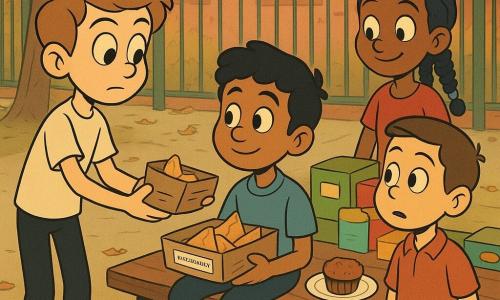
“On the day,” he said, not quite looking at them, “I could bring some cut fruit. For your snacks.”
Imran's mouth turned up, slow and real. “We'd like that,” he said.
They left the store with a bag of pretzels and a tin of mint tea Ms. Flores liked. The sky had gone into its blue hour, the one that makes white things glow. They walked home through that glow, the world slightly adjusted, as if the picture had been refocused.
At school the next day, Ms. Flores helped them set up the library. They pushed the tables into a wide horseshoe, placed a big jar in the middle, and slid slips of paper and pencils into little baskets. They made a poster of the norms, writing them large enough to fill the wall and gentle enough to fill the room.
“What if no one comes?” Max asked, making the apple slices fan out on a plate like a sunrise.
“They'll come,” Imran said, though his own stomach was a small drum. “And if it's just us, we'll still have snacks.”
Ms. Flores laughed softly. “It's brave to begin,” she said. “Let's begin well.”
Snack & Stories
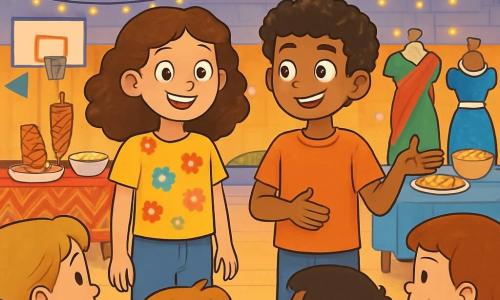
On Wednesday, the library filled slowly at first, then steadily, like a tide. Fifth-graders drifted in, then some six-graders. A couple of parents took chairs in the back. Coach D'Angelo came in with soil still on his shoes from the school garden. Jordan, the same one who had asked Imran where he was really from, slipped into a seat near the window and looked directly at his hands.
Mr. Costa arrived carrying a container of orange slices and a bag of cups. He fidgeted with his tie, which had tiny blue sailboats on it, and chose a spot near a potted fern.
Ms. Flores tapped a bookmark on the table, and the murmur quieted. “Welcome,” she said. “This is Snack & Stories. We'll use our listening rules.” She pointed to the poster. “We'll start with a question from the jar.”
Imran stood up. He could feel his heartbeat as a small bird in his chest. He reached into the jar and pulled a folded square. The paper was smooth against his fingertips.
He read, careful and clear: “What do I do if I ask something and it comes out wrong?”
He felt the room leaning in a little, curious.
“You can say ‘I'm sorry. I didn't mean it that way. Can you help me ask better?'” Imran said. “You can try again. Trying again is powerful.”
Max stood beside him and added, “And if someone tells you something hurt, believe them. That's a shortcut to making it better.”
Jordan raised his hand, slow as a plant growing. Ms. Flores nodded to him.
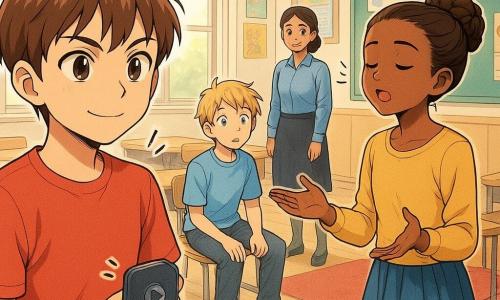
“I asked Imran a dumb question,” Jordan said. His voice was small but steady. “I didn't know it was dumb. I mean… I thought I was being friendly. But it wasn't friendly.” He turned to Imran. “I'm sorry.”
Imran nodded. He noticed the way Jordan's ears had gone pink. “Thank you,” he said. “Maybe next time you could ask what music I like or what books.”
Coach D'Angelo scratched his chin. “It's like soccer,” he said. “If you trip your teammate by accident, you help them up. You watch your steps better. You don't pretend they didn't fall.”
Mr. Costa shifted in his chair. His fingers twined and untwined. “At my shop,” he said, and the room turned its face toward him, surprised but gentle, “I said something to these boys that was unfair. I thought I was being careful about my store, but I ended up being careless with someone's dignity.” He looked at Imran. “I'm sorry. I am learning how to be careful in the right way.”
Ms. Flores nodded. “Thank you,” she said. “Learning happens here. It's why we have shelves full of it.”
They answered questions from the jar: what to do when someone laughs at your lunch, how to handle jokes that make your stomach twist, how to stand up without making a fight.
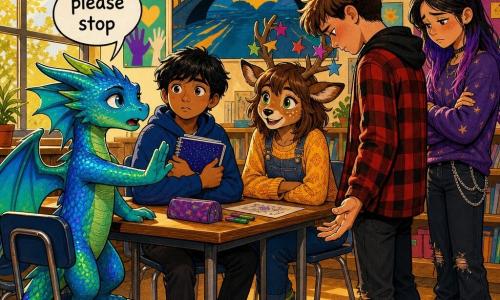
“Sometimes it helps to have a sentence ready,” Max said. “Like a tool you can carry.” He held up a notecard where they had written some. “That's not funny to me.” “Please don't say that.” “We don't do that here.”
A hand went up in the back. A girl with braids asked, “What if you're the one who said something and you only realize later it was bad?”
“Repair is a team sport,” Ms. Flores said. “You go back. You say, ‘I messed up. I'm sorry.' You don't wait for a perfect time; you make a good one.”
They laughed a little. They passed the pretzels, the apple slices, Mr. Costa's oranges that shone like tiny moons. The library felt warm. The potted fern seemed to lean forward as if it, too, was listening.
At the end, Max and Imran stood in front of the group and felt bigger and smaller at the same time. Bigger because courage had stretched them; smaller because they knew how much they had to learn.
“We'll keep the jar out,” Imran said. “For a while. In case you think of something later.”
“Also,” Max added, “we're planning a mini mural by the garden fence with everyone's names and one word they choose about themselves. Maybe ‘reader' or ‘runner' or ‘neighbor.'”
Coach D'Angelo clapped. “Paint is my favorite kind of mess,” he said.
People stood and pushed in chairs. Jordan came up to Imran and held out a sticky note. It said, “Want to trade playlists?” Imran smiled. Outside, the evening yawned and stretched. The tide of people flowed out with quieter feet than they'd entered with.
Game Day Words
Saturday was for soccer, and everyone knew it. The school's patchy field had white lines that wobbled at the edges and a goal with a net that had been mended in three places with shoelaces. The air smelled like cut grass and sunscreen. Parents lined the sidelines with folding chairs and coffee in mugs.
Max tugged on his shin guards, and Imran tied his shoes twice, once to get it right and once to make sure. The other team was from Brookside. They had matching jerseys so bright they looked like traffic cones, and a kid named Trevor with legs that were all angles and speed.
Coach D'Angelo gave a short talk about passing and patience. When the whistle blew, the ball started moving like a thought trying to become a sentence—stumbling here, fluent there.
Imran slipped past a defender with a small shoulder feint that made the boy blink, and Max, in goal, called out the kind of words that are half-help and half-habit: “Left! Left! Good turn!” His voice, at least, felt like it knew what it was doing.
Midway through the first half, a Brookside player blocked Imran and grinned. “You've got fast feet,” he said. “Didn't think someone like you would.”
The words were small on the field, swallowed by shouts and whistles, but Max saw Imran's shoulders stiffen. It was the way a chord stops vibrating. Max's own stomach made a tight knot, the kind you get when you realize you left your bag on the bus.
The ball rolled out of bounds, and the ref's whistle chirped. Max jogged forward, pulling his gloves off. He wasn't sure what he was going to say until he heard himself say it.
“We don't talk like that here,” Max said, and his voice wasn't loud, but it was steady. “We're all someones like us.”
The Brookside kid blinked. He looked thirteen, maybe twelve, and suddenly very young. His grin slid away. “I didn't mean—” he started, and then stopped, the way a car can jerk when the driver forgets a gear. “Sorry,” he said, to Imran, not to the grass or the sky.
Coach D'Angelo jogged over at the edge of listening. “Good catch,” he murmured to Max, and then to both teams, “Words are part of the game. Let's play a better one.”
Play resumed. The ball traveled again, rolling over bumps, picking up dirt. When Imran's foot met it, it moved like it knew where home was. He passed to a teammate who passed to another, and suddenly the goal was a rectangle of possibility. The shot wasn't a rocket; it was a simple, smart tap. The net poofed with the little miracle that happens when ball meets space.
Max whooped in the goal, his joy rippling out across the field. Imran's grin was sunny and easy, and he touched fists with the Brookside kid who had spoken, because repair was a thing you could feel.
On the sidelines, parents clapped. Someone's coffee spilled and nobody minded. The game went on. It wasn't perfect. There were still crooked lines and called backs and shoes that came untied. But the air felt slightly clearer, as if a window had been opened.
Afterward, when they lined up to slap hands, the Brookside kid looked Imran in the eye, which is harder to do than people think. “I'm still sorry,” he said.
“Thanks,” Imran said. “Wanna learn that shoulder fake?” He showed him, right there in the sideline dust, a step and a lean.
Walking home with their gear bags thumping against their legs, Max felt the knot in his stomach loosen and come undone, like a rope tossed back onto a dock. He breathed in, and the air tasted like grass and something else: relief that had done some work.
The Fence with Names
The next week, the air warmed like dough rising. The garden by the field had marigolds like small suns and tomato plants that needed tying up. The fence behind it, once just metal links, had become a place to hang things: laminated poems, a lost glove someone was hoping to find again, and now, the beginnings of a mural.
Ms. Flores had brought boxes of paints and brushes that looked like little broomsticks. Coach D'Angelo had dragged out a table and covered it with old newspaper pages featuring headlines about weather and a photo of a dog that had won a ribbon. Children washed their hands in a plastic tub that turned the clear water into weak tea.
Max painted his name in blue letters that bulged a little, like soft pillows. Underneath, he added “Neighbor.” The paint shone wetly.
Imran painted his name in green with a tiny arrow at the end. Underneath, he wrote “Listener.” He thought of all the times he'd listened to wind, to teachers, to a store bell that had made his stomach dip. He wanted to keep listening. It helped him know which way to walk.
People chose words like “Runner,” “Sister,” “Helper,” “Reader,” “Gardener.” Nobody wrote their grades or their scores. The fence began to hum with color and declarations that felt like small flags. Mr. Costa arrived with a carton of lemonade cups and a damp towel over his shoulder.
He stood near the edge for a moment, unsure. Then he walked up to the table, picked up a brush, and painted “Mr. Costa” in careful block letters next to a small lemon he tried very hard to make look like a lemon. Under it, he wrote “Learner,” and the brush left a slightly shaky line.
He turned to Imran and Max, who were rinsing brushes. “I brought extra cups,” he said, holding up a second bag. His voice had a different sound now, like a radio that had been tuned more precisely to the station. “And… I wanted to say again, I'm sorry for the way I spoke. I'm working on doing better first, not after.”
Imran handed him a towel. “Thanks,” he said. “For the cups. And for coming.” He glanced at the fence and smiled a little. “Nice lemon.”
Mr. Costa laughed. “My lemons are very square,” he said. “But they taste right.”
Children walked up and read the words under the names, sometimes nodding as if they'd learned something, sometimes choosing their own word with new certainty. Jordan painted “Friend” under his name and gave Imran a thumbs-up he didn't try to hide.
From somewhere, music began. It might have been a phone speaker or a radio through an open window. It was the kind of song that made people sway, a little sway that started in the shoulders. The sun softened, and shadows lengthened in friendly ways. The mural longed to dry so it could last.
When they took a pause for lemonade, Max stood with his paper cup, condensation making his fingers wet, and looked at the fence. He thought about jars and commas and the kind of apologies that make new breath in a room.
He sighed, but it was a good sigh, the kind you make when you sit down after work and see that the work changed something. He nudged Imran with his elbow, just enough to say “still here,” and Imran nudged back, just enough to answer “me too.”
Umbrellas and Open Doors
A week later, rain walked into town the way a calm person enters a room. It tapped windows and drew tiny rivers along curbs. The sky became a big gray blanket, and the air smelled like wet pavement and fresh earth. School let out under umbrellas that looked like mushrooms blooming.
Max and Imran shared one umbrella and tried to match its rhythm to their steps. They passed Mr. Costa's store, the window fogged with warm breath and soup steam. Through the glass, they could see the flyer still taped up, a little crinkled now, its jar still bubbling questions.
They went in just to say hello, because it felt important and also easy now. The bell chimed, softer under the rain's percussion. Mr. Costa looked up, his face opening like a door. He had a pot of stew behind the counter, and the smell could have warmed a colder day than this.
“I have extra,” Mr. Costa said, lifting the lid. “Would you like a small cup? For walking home.”
Max looked at Imran, and Imran looked at Max, and they both nodded. Mr. Costa poured the stew into two paper cups, the kind with little white lids. He tucked in spoons and napkins like the way you tuck a blanket around a sleeping child.
“Thank you,” Max said. His voice had settled into a new register in this place.
“You're welcome,” Mr. Costa said. “The mural looked beautiful, by the way. My lemon was ridiculous, but I love it.”
Imran grinned. “Your lemon is perfect,” he said. “It's like a square sun.”
They stepped back into the rain. The cups warmed their hands, and the umbrella caught the drops and made a drum they could walk to. The street was shiny. Cars moved slowly, respectful of puddles. A woman tugged her dog around a little lake that had formed by a storm drain. Their school rose behind them, red bricks deepening in the damp.
“We did something,” Max said after a while, not bragging, just wanting to say it out loud to know it was true.
Imran nodded. “And it was not everything,” he added. “But it was something, and that matters.”
Max watched a little waterfall pour from a gutter spout, and the drops broke apart and found each other again on the sidewalk. “I wish people would just… not say things that hurt,” he said.
“Me, too,” Imran said. “But until then, we can do umbrellas. We can also teach people not to poke holes in them.”
They laughed. The rain softened to a sprinkle, then to a mist. Maple Park, ahead, shone like a clean plate. The oak tree had raindrops hanging from its leaves like beads of glass. The swings held little puddles, and their chains were dark with wet metal.
They stopped at the mural, now glossy and bright in the damp. Their names shone. Beneath them, their chosen words felt like tiny anchors.
A girl from third grade stood there, too, looking up at the colors with her hood dripping. She pointed. “I like ‘Listener,'” she said to Imran. “I want to be one. I asked my grandma to teach me a song in her first language.”
“That's wonderful,” Imran said. He felt something in his chest make room.
She looked at Max's word and tilted her head. “Neighbor,” she read. “That means… like, we take care of where we share.”
“Yeah,” Max said, thinking of the library, the store, the field. “It means saying hello. It means stepping up. It means bringing a cup of stew.”
The girl grinned and skipped away, her boots leaving a repeating story in the mud. Max and Imran sat on the low wall by the fence and sipped the last of their stew. The salt and warmth filled their cheeks. The rain slowed to almost nothing, like a secret.
Max thought about the first day at the store, about the way a sentence can press on you like a thumb on a bruise. He thought about the jar in the library, about questions that came out wrong and were asked again more carefully. He thought about the field and words that had been fixed right away, mid-game, the way a shoelace gets tied.
He pictured a row of umbrellas in different colors—some tall, some small—opening over a line of people as they walked down a rainy street, each person not only under their own umbrella but sharing edges. He liked that picture. It made the world feel possible.
He looked at Imran, who was tapping the rim of his empty cup with a spoon, making a sound like tiny rain. “Want to practice corner kicks?” Max asked. He stood and set his cup in the trash, his hands free now.
Imran stood, too, and flicked water off his sleeve. “Yeah,” he said. He nudged the ball with his toe. “Let's go.”
They played until the clouds frayed and the sky showed blue like a secret held open. When they finally walked home, they felt tall for reasons that had nothing to do with height. The kind of tall you get when your spine has listened to your heart and agreed.
At Max's corner, they paused. A neighbor waved from a porch, and a bicycle wheel ticked as it spun. The air smelled like wet grass and the first hint of someone cooking dinner. Max pushed his hands deep into his pockets.
“I guess the moral is simple,” he said, half teasy, half thoughtful. “Listen, be kind, fix what you break.”
“And cheer for each other,” Imran added. “It makes us faster.”
They bumped fists, a soft thud like the closing of a good book. Then they peeled off toward their homes, their steps steady. The street behind them held their overlapping footprints, which the wind would dry and the next rain would wash, but the path they'd started—of jars, and words, and names under a fence—felt like something that would stay, humming quietly, like a good song you can't help but hum along to.