Chapter 1: The Empty Board
Leo Merrin was eleven, calm as a library, and curious as a cat who had learned manners.
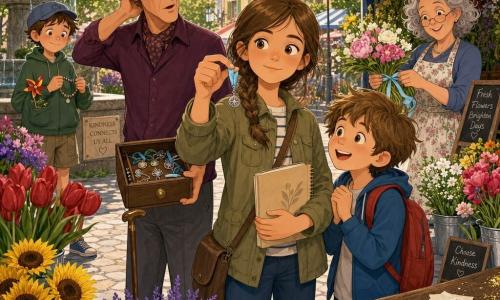
On Saturday morning, he walked to Maple Square with his sketchbook under his arm. Maple Square was a small placette between the bakery and the florist. It had a fountain that gurgled like it was telling secrets and a noticeboard that everyone used for lost gloves, guitar lessons, and “FREE KITTENS (PLEASE ASK MOM).”
Today, the noticeboard looked wrong.
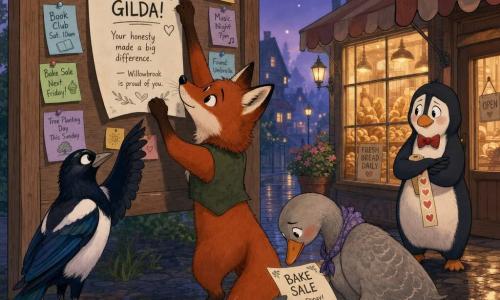
A pale rectangle showed where a poster had been. Fresh pinholes dotted the cork like tiny bite marks.
Mrs. Pimm from the bakery leaned out of her door, flour on her cheek. “Leo! If you're looking for the poster, don't bother. It's gone.”
“What poster?” Leo asked, though his stomach already guessed.
“The one for the Spring Fair,” she said. “The big one with the schedule. I put it up last night. This morning—poof.”
Mr. Darnell the florist set down a bucket of tulips. “Maybe the wind did it.”
Leo tilted his head. The square was calm. The trees barely moved. “Wind doesn't pull out pins neatly,” he said.
Mrs. Pimm crossed her arms. “Exactly. Someone took it. And I don't like it. People need that schedule. The cake contest depends on it.”
Leo's eyes slid to the ground. A few steps from the board, near the fountain, something white lay like a small folded wing.
He crouched and picked it up carefully.
A torn corner of poster paper.
On it was part of a bright red letter: “F.”
“Okay,” Leo murmured, more to himself than anyone. “This is a mystery.”
He opened his sketchbook. The first thing he drew was the noticeboard: the empty rectangle, the pinholes, and the fountain behind it. He added a tiny map of Maple Square: bakery left, florist right, bench in the middle, alley leading to the side street.
Mrs. Pimm watched him. “You're drawing?”
“Helps me think,” Leo said. “And helps me remember.”
Mr. Darnell pointed with a tulip stem. “Try asking around. Lots of people passed through.”
Leo nodded. “I will. And I'll bring the poster back.”
Mrs. Pimm sniffed. “Just don't go accusing people like a tiny judge.”
Leo almost smiled. “I won't. I'm more of a tiny notebook.”
Chapter 2: Three Clues and a Smell
Leo started where all good mysteries started: with questions.
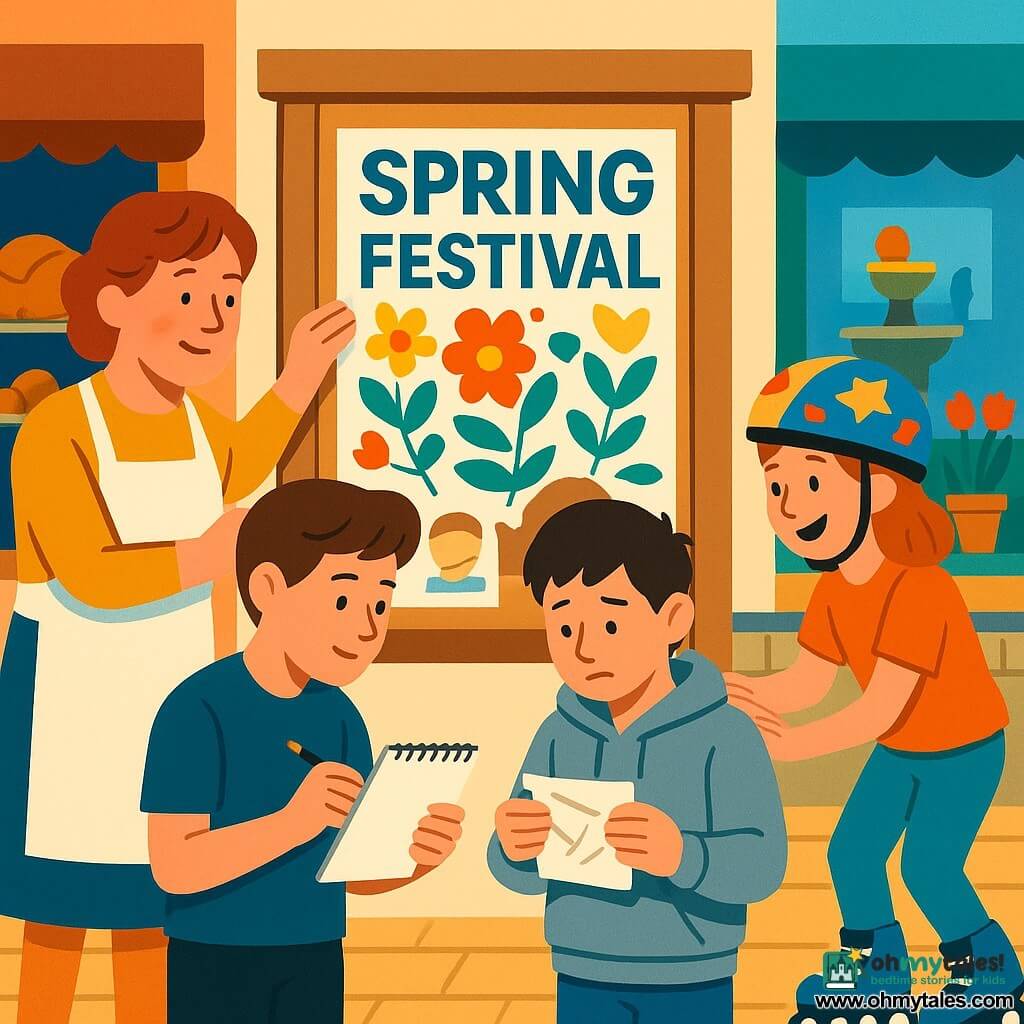
He walked to the bench. A girl with roller skates sat there, tightening her laces. Her helmet was decorated with stickers that said things like COOL BEANS and I BRAKE FOR MUFFINS.
“Hi, Tessa,” Leo said.
Tessa squinted. “You're doing your detective face.”
“It's just my face,” Leo said. “Did you see anyone near the noticeboard this morning?”
Tessa tapped her chin dramatically. “At seven-ish, I was practicing spins. I saw a tall person in a gray hoodie. They were standing close to the board, like… this close.” She held her fingers a few inches apart. “Then they walked away toward the alley.”
“Did you see their face?”
“No. But they smelled like… oranges. Like super orange.”
Leo wrote in his mind: gray hoodie, alley, orange smell.
He crossed to the fountain. Old Mr. Quill fed pigeons there, even though there was a sign that said PLEASE DON'T FEED THE PIGEONS. Mr. Quill claimed he couldn't read small print without his special glasses, which were always “somewhere safe.”
“Morning, Leo,” Mr. Quill said, tossing crumbs with the innocence of a magician hiding a card.
“Morning,” Leo replied. “Did you notice anything odd today? About the noticeboard?”
Mr. Quill rubbed his beard. “I noticed the pigeons were nervous.”
“Pigeons are always nervous.”
“These were nervous with purpose,” Mr. Quill insisted. “They fluttered when a bicycle clattered by. A green bicycle. The rider stopped by the board, looked around, and then pedaled off fast. Toward Willow Street.”
Leo's pencil hovered over the air. Green bicycle, Willow Street.
He looked down by the fountain's edge. A sticky spot glistened on the stone, catching sunlight like a tiny puddle of honey.
Leo leaned closer and sniffed.
Not honey. Not lemonade.
Citrus.
He touched it with his fingertip and pulled away quickly. It was tacky, like spilled soda.
Or orange juice.
He wiped his finger on a napkin from his pocket and stared at the alley entrance. It was a narrow gap between buildings, half shadow, half sun.
“Leo?” Tessa called. “Do you want me to chase the suspect on skates?”
“That's kind,” Leo said. “But I'd rather not add ‘broken ankle' to the case.”
Tessa rolled her eyes. “Fine. Be sensible.”
Leo turned toward the alley. He felt a warm fizz of excitement, like he'd just found the first piece of a puzzle.
But puzzles had rules.
Rule one: don't jump to conclusions.
Rule two: follow the clues.
He opened his sketchbook again and drew the torn paper corner. He sketched the red “F” and the angle of the tear. Then he drew three small icons: a hoodie, a bicycle, and an orange.
“Who smells like oranges?” he muttered.
Chapter 3: Portrait in Pencil
The alley led to a quieter side street with a row of small shops. A repair store, a pet groomer, and—at the end—an art supply shop called Bright & Brave.
The doorbell chimed when Leo stepped in. Inside, it smelled like paper and paint and a little like glue—an honest smell, the kind that meant making things.
Behind the counter stood Ms. Rina, the owner. Her hair was tied up with a pencil, like her head was holding a spare idea.
“Leo! Here for more sketch pencils?” she asked.
“Maybe,” Leo said. “Also… did anyone come in this morning with a big poster?”
Ms. Rina blinked. “A poster?”
“The Spring Fair schedule went missing,” Leo explained. “Someone may have taken it.”
Ms. Rina's eyebrows climbed. “That's silly. Why would anyone take that?”
“Maybe they needed the paper,” Leo said carefully. “Or maybe they didn't want people to see it.”
Ms. Rina frowned and leaned on the counter. “I did see someone unusual. Around eight. Gray hoodie. They bought a set of charcoal sticks and a bottle of fixative spray.”
Leo's heart thumped. “Did you see their face?”
“Not well. The hood was up. But I noticed their hands.” Ms. Rina held up her own hands. “Paint stains on the fingers. And a little bandage on the left thumb.”
Leo pictured it. Hoodie. Paint-stained fingers. Bandaged thumb.
“And…” Ms. Rina added, “they paid with coins. Lots of coins. They were nervous, like they expected someone to shout ‘Stop!'”
Leo nodded slowly. “If you saw them again, could you describe them to me?”
Ms. Rina's eyes softened. “You're serious.”
“I'm calm,” Leo said. “But yes.”
Ms. Rina found a scrap of paper. “I can try.”
Leo opened his sketchbook to a fresh page. “I can draw. It helps.”
He sat on the little stool by the counter. Ms. Rina described what she remembered, and Leo's pencil moved.
“A narrow chin… a freckle near the nose… hood mostly hiding the hair… maybe brown hair peeking out… and a backpack with a rip on the strap.”
Leo drew fast but carefully. A face took shape: not perfect, but recognizable. He shaded the hood and added the freckle like a tiny dot of ink.
As he worked, he asked, “Did they smell like oranges?”
Ms. Rina's mouth opened in surprise. “Yes! Like orange candy.”
Leo set his pencil down. The clues were lining up like students in a hallway. Still, he reminded himself: lines can point the wrong way if you force them.
“Thank you,” Leo said. “If you remember anything else, tell me.”
Ms. Rina glanced at the portrait. “That's good. You might end up solving this.”
Leo tucked the sketchbook under his arm. “I hope I end up returning it. Solving is only the middle. Fixing is the end.”
Outside, the side street was brighter now. People walked by with shopping bags, laughing, living normal Saturday lives.
Leo took a breath. Then he headed toward Willow Street.
Chapter 4: The Green Bicycle
Willow Street had a small playground and, at the corner, a community center. Kids came here for clubs: chess, dance, robotics, and art.
A green bicycle leaned against the community center's wall, its handlebar tassels fluttering like tiny flags.
Leo slowed down.
A boy about Leo's age came out of the building, carrying a box. He wore a gray hoodie.
Leo didn't pounce. He didn't shout. He just watched.
The boy shifted the box to his hip. His left thumb was wrapped with a beige bandage.
Leo's brain went very quiet.
Then, carefully, he stepped forward. “Hi,” he said.
The boy froze, eyes wide. “Hi.”
“I'm Leo,” Leo said. “I'm looking for the Spring Fair poster.”
The boy's gaze flicked toward the bicycle, then the door, then back to Leo. Like a rabbit deciding which way to run.
Leo held up his sketchbook, open to the portrait. “I made this from a description. It looks like you.”
The boy's face turned the color of a strawberry milkshake. “It's not— I didn't—”
“I'm not here to yell,” Leo said. His voice stayed even. “I just want to know what happened. People need the schedule.”
The boy swallowed. “My name's Miles.”
Leo nodded. “Okay, Miles. Can we talk?”
Miles tightened his grip on the box. “Not here.”
Leo glanced around. The sidewalk had a few adults nearby, but no one was listening closely. “We can sit on the steps. Or we can walk back to Maple Square together. Your choice.”
Miles stared at the ground. “Maple Square has Mrs. Pimm.”
“That's true,” Leo said. “She can be… strongly baked.”
Miles gave a tiny, shaky laugh. It sounded like relief trying to get out.
“Steps,” Miles said.
They sat on the community center steps. Between them, the box sat like a nervous third person.
Leo asked the question like he was opening a door slowly. “Did you take the poster?”
Miles's shoulders sagged. “Yes.”
Leo waited. Silence can be kinder than rushing.
Miles blurted, “I didn't want to wreck anything! I just— I messed up.”
“What kind of messed up?” Leo asked.
“The art club is making a big display for the Spring Fair,” Miles said, words tumbling. “A collage wall. My job was to make a ‘center piece'—a huge drawing of the town. Ms. Kwan said, ‘Use something bold. Something everyone recognizes.' And I thought… the schedule poster had the fair logo and all the little icons. I thought it would be perfect to trace parts of it.”
Leo's eyebrows lifted. “You could have asked Mrs. Pimm for a copy.”
Miles's face scrunched. “I tried to be brave. Instead I was sneaky.”
Leo looked at the box. “Is the poster in there?”
Miles nodded. “I folded it. Then… orange soda spilled in my bag. It got sticky. I panicked.”
“So the orange smell,” Leo murmured.
Miles nodded again. “I wiped what I could. But then my thumb got stuck to the tape on the collage board and I yanked it. That's why it's bandaged. It's pathetic.”
“It's human,” Leo said. “And it's fixable.”
Miles blinked. “It is?”
“If you tell the truth,” Leo said. “And if we return it now. Before a hundred people start guessing it was stolen by a rival bakery.”
Miles let out a breath. “Okay.”
Leo stood up. “Bring the box. And the bicycle can come too. But at a normal speed. No dramatic escapes.”
Miles managed another small laugh. “Deal.”
Chapter 5: The Honest Return
Maple Square felt different when you walked into it carrying a secret and then deciding not to carry it anymore.
Mrs. Pimm spotted them first. Her eyes sharpened like she was slicing bread. “There he is,” she said, pointing a floury finger. “And he brought company.”
Tessa rolled up beside the fountain. “Leo! Did you catch the orange bandit?”
Mr. Darnell held a bouquet like it might be used as a witness.
Leo raised both hands slightly. “Everyone, please. No mobbing. This is Miles. He has something to explain.”
Miles swallowed, stepped forward, and set the box down gently. His voice wobbled, but he spoke clearly. “I took the Spring Fair poster. I shouldn't have. I needed it for the art club and I didn't ask. I'm sorry.”
For a moment, nobody spoke. Even the fountain seemed to hush.
Mrs. Pimm stared at him. Her expression was hard to read—like a recipe written in a language you almost know.
Then she exhaled. “Thank you for telling the truth,” she said. “I'm still upset. But I prefer honest upset to mysterious upset.”
Tessa whispered loudly to Leo, “She's doing mature feelings. I'm proud and terrified.”
Mr. Darnell stepped closer. “Is the poster ruined?”
Miles opened the box and pulled out the poster carefully. It was folded, with a sticky smudge and one torn corner.
Leo took out the little scrap he'd found and held it up. “This corner matches,” he said, lining it up. The tear fit like two puzzle pieces finally agreeing.
Mrs. Pimm's stern face softened a notch. “At least we can tape it. The schedule is still readable.”
Miles's shoulders sagged in relief. “I can help fix it. And I can make a new one for you. A clean copy. I'll ask Ms. Kwan to print it.”
Mrs. Pimm nodded once. “That's a fair consequence. Also, you owe Maple Square one public apology and one private promise to stop borrowing without asking.”
“I promise,” Miles said quickly. “Really.”
Leo watched him. He wasn't acting brave now. He was being brave.
Mrs. Pimm took the poster. “Leo, thank you. How did you figure it out?”
Leo shrugged. “Clues. Orange smell. Green bicycle. A gray hoodie. And I drew a portrait.”
Tessa leaned in. “Wait—you drew him? Like, on paper?”
Leo opened his sketchbook to show her.
Tessa gasped. “That is way too accurate. Remind me never to lie near you.”
Leo said, “You don't have to remind yourself. Just… don't lie.”
Tessa blinked, then smiled. “Fair.”
Mrs. Pimm lifted the poster. “All right. Let's get this back where it belongs.”
Chapter 6: The Drawing on Display
They taped the poster to the noticeboard together.
Mr. Darnell provided florist tape “because it's strong but polite.” Tessa held the corners. Mrs. Pimm pressed the center flat with both palms like she was calming a stubborn pie crust. Miles handed over pins and tried not to look like he might vanish into the pavement.
Leo stood back and checked the edges. “It's straight,” he said. “Mostly.”
Mrs. Pimm squinted. “Nothing is perfectly straight in this town. It builds character.”
When the poster was secure, people in the square began to read it again. A dad pointed to the time for the puppet show. A little kid squealed at the words FACE PAINTING. Normal life stitched itself back into place.
Miles shifted from foot to foot. “Leo,” he said quietly, “I'm sorry I dragged you into this.”
Leo closed his sketchbook. “You didn't drag me. I walked in on my own.”
Miles nodded. “Still. Thanks for… not making me feel like a villain.”
“You did something wrong,” Leo said. “But you told the truth. Villains don't usually do that.”
Miles looked at the noticeboard. “I want to make it right.”
Leo hesitated, then flipped to a clean page. “Then do one more thing.”
“What?”
“Let me draw you properly,” Leo said. “Not as a suspect. As yourself. Calm face. Honest eyes. It might help you remember this moment.”
Miles blinked. “That's… weirdly nice.”
Tessa scooted closer. “Ooh! Detective portrait upgrade!”
Miles sat on the bench. Leo drew quickly: the shape of Miles's eyebrows when he wasn't panicking, the small freckle, the bandaged thumb resting on his knee, the hoodie unzipped now like a door left open.
When Leo finished, he showed Miles.
Miles stared. “That's me,” he said softly. “But… better.”
“Not better,” Leo corrected. “Clearer.”
Mrs. Pimm appeared beside them with a strip of tape. “If that drawing is part of the lesson, it should be seen,” she said.
Leo looked up. “You mean—”
Mrs. Pimm nodded toward the noticeboard. “Right next to the poster. People can see the face of someone who made a mistake and fixed it. That's more useful than gossip.”
Miles's cheeks reddened again, but he didn't run. He stood and handed the drawing to Mrs. Pimm. “Okay,” he said. “If it helps.”
Mrs. Pimm taped the portrait beside the Spring Fair schedule. Under it, she wrote in neat, firm letters with a marker: HONESTY FIXES THINGS.
Tessa read it aloud. “That's… actually awesome.”
Leo stepped back. The noticeboard now held two things: the schedule everyone needed, and a drawing that told a quieter story.
The fountain burbled on, satisfied.
Leo felt the pleasant tiredness that comes after solving a problem the right way. Not with shouting. Not with guessing. With questions, clues, and a choice to be honest.
Miles looked at the board and then at Leo. “Next time,” he said, “I'll ask.”
Leo nodded. “Next time,” he said, “I'll bring extra tape.”