Chapter 1: The Missing Bell
Milo Mink took his notebook everywhere. Not because he was forgetful—he was the opposite. He liked facts lined up neatly, like pebbles on a riverbank.
That afternoon, the village of Bramblewick buzzed like a beehive with hiccups. Market Day was supposed to begin with one clear sound: the bright ring of the Town Bell.
But the bell didn't ring.
Instead, Mayor Poppy Porcupine stood on a crate, waving her paws. “Everyone, please stay calm! The bell is… not in its tower.”
“A bell can't just walk away,” muttered Gus Goose, craning his long neck.
“It could roll,” said Tansy Tortoise, practical as always.
Milo looked up at the stone bell tower. The rope hung limp, like a sleepy worm. “When was it last seen?” he asked.
Mayor Poppy's quills trembled. “Yesterday evening, after the closing chime.”
“Then we'll find it,” Milo said, steady and certain. He was an amateur investigator, yes, but a regular one. Reliable. The kind of mink who returned borrowed pencils and always checked his facts twice.
Juniper Jay swooped down beside him, feathers bright as spilled ink. “I'm in. You'll need eyes in the sky.”
“And I'll be your legs on the ground,” said Tansy, already marching.
Milo opened his notebook. “First, we list what we know.”
He wrote:
1) The bell was in the tower yesterday evening.
2) This morning, it was gone.
3) The rope is still here.
A squeaky voice piped up. “Um… there's one more thing.”
It was Pip Squirrel, holding something between his paws like it might bite him.
“A silver button?” Milo asked.
Pip nodded. “Found it near the tower steps. It wasn't there yesterday. I… I think.”
Milo took the button carefully. Smooth. Shiny. One tiny scratch shaped like a crescent moon.
He looked around the busy square—stalls, baskets, fluttering banners. Bramblewick's cobbled plaza spread out like a patchwork of stones, each one worn by a thousand paws. If the bell had been carried, someone had crossed these stones.
Milo snapped his notebook shut. “All right,” he said. “Let's start at the tower. And no guessing—only clues.”
Juniper tilted her head. “You say that, but you love guessing.”
“I love proving,” Milo corrected, and Tansy snorted a laugh.
Chapter 2: Footprints on the Cobbles
At the base of the bell tower, the air smelled of dust and old rope. Milo crouched near the steps where Pip had found the button.
“Look for scuffs,” Milo said. “The cobbles keep secrets.”
Tansy leaned in, her shell catching the light. “These stones are tricky. Everyone walks here.”
“Not everyone drags a bell,” Milo replied.
Juniper hopped down and pointed with a wingtip. “There. A scrape.”
A pale line ran across two cobbles, like chalk rubbed by a hurried paw. Milo followed it with his eyes. Another scrape. Then a faint trail leading away from the tower and toward the market stalls.
“Something heavy slid,” Milo said. “Not rolled smoothly—dragged.”
“Who would drag a bell through the square?” Tansy asked. “It would make a terrible noise.”
“Unless they wrapped it,” Juniper said. “Like a burrito.”
Tansy blinked. “A… bell burrito?”
Milo smiled. “Soft things leave fuzzy clues.”
He sniffed near the scrape marks. A tiny tuft of blue thread clung to a crack between stones. He plucked it out with two claws.
“Blue cloth,” he murmured.
Juniper ruffled her feathers. “Lots of blue around. Half the market loves blue.”
“True,” Milo said. “So we need something more exact.”
He stood and scanned the square. On the cobbled plaza, stalls formed a friendly maze: the Honey Hut, the Seed Stand, the Ribbon Cart, the Bakery Wagon.
Near the Ribbon Cart, a fox in a neat vest was tying bows with quick paws. Silas Fox always looked like he'd just stepped out of a mirror.
“That's Silas,” whispered Pip, who had followed them with wide eyes. “He sells fancy stuff.”
Milo's gaze dropped to Silas's vest. Four buttons. All silver.
Milo didn't accuse. He didn't even frown. He just wrote in his notebook:
Possible match: silver button.
“Let's ask questions,” Milo said. “Politely.”
They approached Silas's stall. Ribbons fluttered like captured rainbows.
Silas flashed a practiced smile. “Ah! Milo Mink. The village's tiniest detective. Shopping for a bow tie?”
“I'm shopping for answers,” Milo said, holding up the button. “Did you lose one?”
Silas's smile froze for half a heartbeat. “Buttons fall off all the time.”
“May I see your vest?” Milo asked.
Silas lifted his chin. “I'd rather not be pawed at in public.”
Tansy stepped forward, calm as a stone. “No pawing. Just looking.”
Juniper leaned closer. “I count four.”
Silas's ears flicked. “Then I'm fully buttoned.”
Milo nodded. “All right. Another question. Did you hear anything last night, after the closing chime?”
Silas shrugged. “I went home early. My paws were tired.”
“Where is home?” Milo asked.
Silas pointed with a ribbon spool. “Above the cobbled square. The old clock house.”
Milo wrote that down.
As they turned away, Pip whispered, “Do you think he did it?”
“I think,” Milo said carefully, “that he noticed the button too quickly. He knew what it was without asking.”
Juniper smirked. “Maybe he's just smart.”
“Smart is fine,” Milo said. “But we need proof.”
A shout came from the Honey Hut. “My jar lids are missing!” cried Bina Bee, buzzing in circles. “All twelve!”
Then, from the Seed Stand: “Someone took my measuring scoop!”
Market Day was unraveling like a loose scarf.
Tansy's eyes narrowed. “This isn't just the bell.”
Milo's tail twitched. “No. It's a pattern.”
And patterns were Milo's favorite kind of clue.
Chapter 3: Listening at the Door
Milo made a list in his notebook:
Missing: Town Bell, twelve jar lids, a measuring scoop.
“Small items and one huge one,” Juniper said. “That's a weird shopping list.”
“Or a distraction,” Milo replied. “If everyone is upset about little things, the bell might be moved without too many eyes watching.”
Tansy nodded. “So the big mystery hides behind small troubles.”
They decided to check the bell tower again, but Mayor Poppy stopped them. “Milo, please—find it soon. The bell is how we start Market Day fairly. Without it, some stalls open early, others wait, and it's chaos. It isn't just tradition. It's justice.”
Milo's chest warmed at the word. Justice mattered in Bramblewick. No one should get an unfair head start.
“We'll do our best,” Milo promised.
Juniper fluttered to Milo's shoulder. “Clock house next?”
Milo nodded. “Silas mentioned it. And I want to see if anyone else lives there.”
The old clock house stood at the edge of the cobbled square, leaning slightly like it was listening to the wind. A narrow stairway climbed to a door with peeling blue paint.
Blue paint, Milo thought. Not cloth. Still… blue.
They climbed. At the top, Milo raised a paw to knock—then paused.
From inside came voices.
“…told you not to grab the lids,” said a low, annoyed voice.
“I only took them to be helpful,” said a second voice, higher and nervous. “You said we needed metal things!”
“Not all at once! Now everyone's looking.”
Juniper's eyes widened. Tansy's mouth fell open just a little.
Milo held up one finger. Quiet.
He pressed his ear near the door. He didn't feel proud about listening. But solving mysteries sometimes meant catching words before they slipped away.
The low voice continued. “If we finish before noon, we can put everything back. The bell too.”
“The bell?” whispered Juniper.
Milo's heart thumped once, hard. He listened again.
“We can't put the bell back if it's stuck,” said the nervous voice.
“It won't be stuck if you stop panicking,” snapped the low voice. “Now—bring the cloth.”
Cloth. Blue thread.
Tansy mouthed: Should we knock?
Milo shook his head. Not yet. If they knew someone was outside, they might hide evidence.
He stepped back, thinking fast. “Juniper,” he whispered, “fly to the mayor. Tell her we found a lead, but don't mention the clock house to anyone else.”
Juniper nodded and slipped down the stairs like a shadow with wings.
Milo whispered to Tansy and Pip, “We need to see who comes out. No rushing.”
They waited in the stairwell, tucked behind a stack of old crates. The smell there was sharp—oil and dusty wood, like a workshop.
A minute later, the door creaked open.
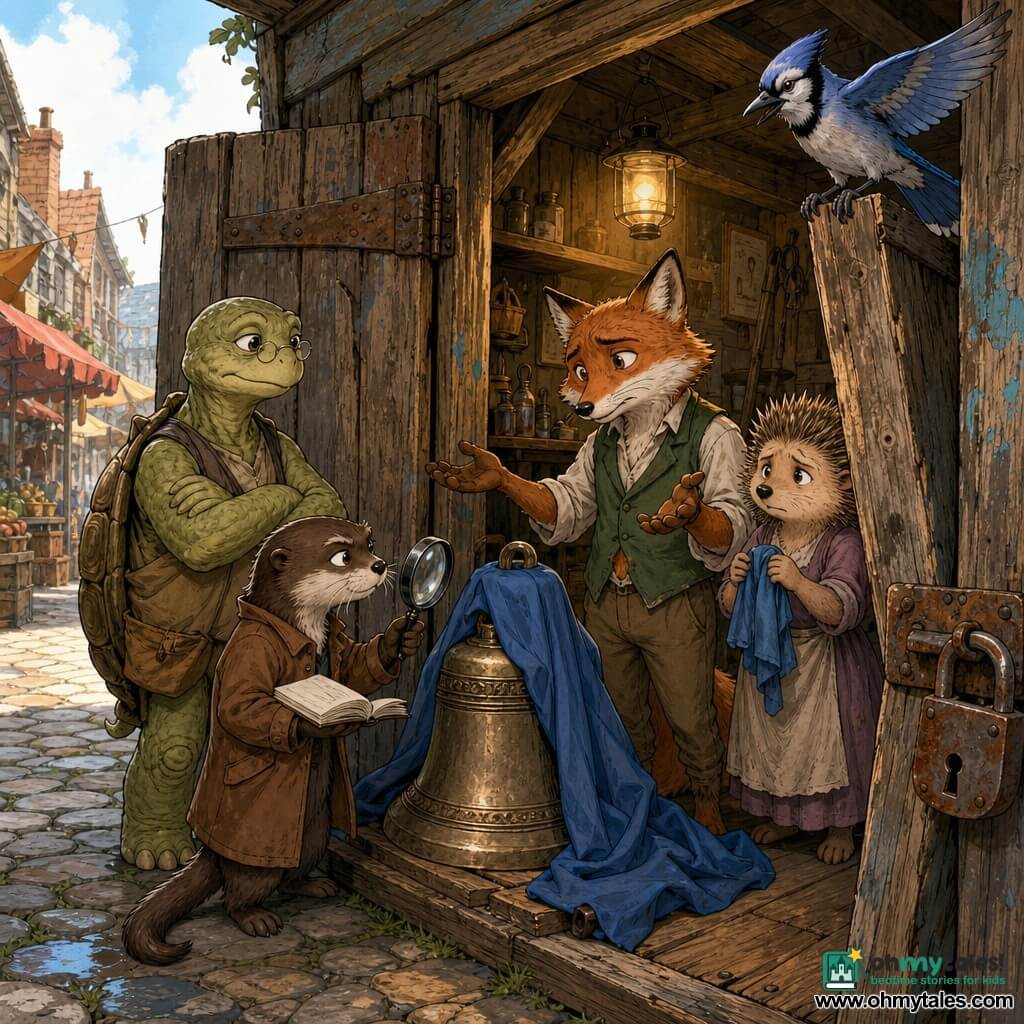
Out stepped Silas Fox, still in his neat vest. Behind him was a small hedgehog carrying a bundle of blue cloth, eyes darting like startled minnows.
“Hester Hedgehog,” Pip breathed. “She helps with repairs sometimes.”
Silas spoke quickly. “Keep your quills down. You'll snag the cloth.”
“I can't help it,” Hester whispered. “I'm… naturally spiky.”
Silas hissed, “To the back alley. Now.”
They started down the stairs.
Milo waited until they passed, then signaled Tansy. They followed at a careful distance, quiet paws on old wood.
At the bottom, Silas and Hester turned into a narrow lane behind the bakery wagon. The scent of cinnamon tried to make the moment cozy. It failed.
Milo peeked around the corner.
At the far end of the lane stood a shed with a rusty lock hanging open. Inside, something large and dark filled the space.
A bell-shaped shadow.
Pip gasped, then clapped both paws over his mouth.
Milo squeezed his notebook. “We found it,” he whispered. “Now we find out why.”
Chapter 4: The Shed of Secrets
Milo didn't run in. Running made accidents. Accidents broke clues.
He watched as Silas and Hester entered the shed. Their voices drifted out.
“Careful,” Silas said. “If the crack widens, we're done.”
“It's not my fault it's cracked,” Hester replied. “It was already like that!”
Cracked?
Milo's mind clicked. A cracked bell wouldn't ring properly. Maybe someone hid it to avoid embarrassment. Or to avoid blame.
Tansy leaned close. “We should confront them. Justice means they can't just hide public property.”
“Yes,” Milo agreed. “But we do it smartly.”
He stepped into the lane, making his pawsteps clear. Not sneaky. Not threatening. Just confident.
Silas and Hester spun around as Milo, Tansy, and Pip approached the shed.
Silas's tail flicked. “Milo. This is… private.”
“The Town Bell isn't private,” Milo said.
Hester's eyes went watery. “We didn't steal it to be mean.”
Tansy crossed her arms. “Then tell the truth.”
Silas's ears flattened. For a moment, his polished market smile fell off, and what was underneath looked tired.
Silas exhaled. “Fine. You want facts? Here.”
He stepped aside.
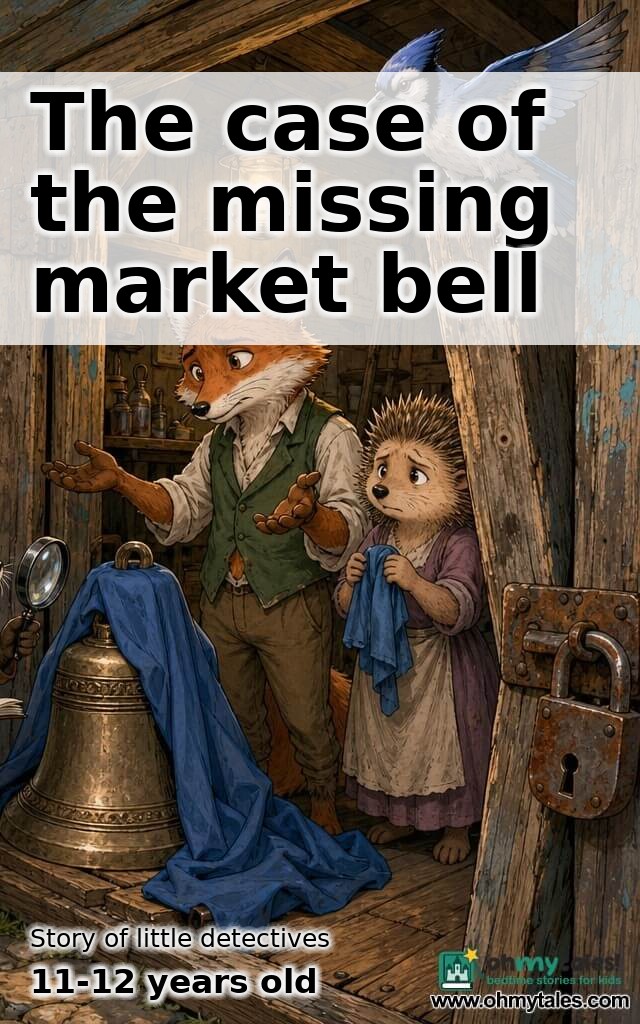
Inside the shed sat the Town Bell, wrapped in blue cloth like a lumpy present. The bell's bronze surface showed a thin crack near the rim, like a lightning bolt frozen in metal. Beside it lay missing items: shiny jar lids and the seed scoop.
Pip squeaked, “Why the lids?”
Hester wrung her paws. “We thought we could fix the crack. Silas found a book about metal repairs. It said you can use clamps and plates to hold a crack steady.”
Silas nodded reluctantly. “The lids are thin metal. The scoop too. We were going to make little plates. We weren't stealing for keeps.”
Milo studied the crack. “When did it happen?”
Hester swallowed. “Yesterday. After the closing chime. I was helping clean the tower steps. Silas came to check his stall spot for today. He leaned on the rope—just a little—and the bell swung and hit the inside bracket. It made a horrible sound. Like a spoon in a teacup.”
Silas winced. “It cracked. Just a hairline. But I panicked.”
“Because you didn't want to be blamed,” Milo said gently.
Silas's voice turned sharp. “Because if the bell doesn't ring, the market isn't fair! Everyone relies on it. And yes—because I didn't want the mayor looking at me like I'm a villain.”
Tansy's gaze softened. “Hiding it made it worse.”
Silas looked down. “I know. But I thought if we fixed it before morning, no one would know. Then I realized the crack was bigger than I thought. We wrapped it to carry it quietly. The cloth was from Hester's repair kit.”
Milo held up the silver button. “And this?”
Silas touched his vest automatically. His paw froze. One button spot was empty—hidden under a ribbon sash he'd tied earlier.
He sighed. “It fell off while we dragged the bell across the cobbles. I didn't notice until later.”
Milo nodded. The clues fit: the scrape marks, the blue thread, the button, the overheard voices.
But there was still something nagging him. “If you wanted fairness,” Milo said, “why take other things and cause more chaos? Lids, scoops… that hurt other stall owners.”
Hester burst out, “Silas told me to! He said we needed metal. I didn't think—”
Silas raised his paws. “That part was my fault. I focused on fixing the bell and forgot about everyone else's morning. I told myself we'd return it all. But meanwhile, Bina Bee can't sell honey neatly, and Bram Mouse can't measure seeds properly.”
Tansy nodded firmly. “Intentions matter. But impact matters too.”
Milo took a breath. This was the moment for justice—not punishment for drama, but fairness with responsibility.
“We're bringing the bell back,” Milo said. “And we're telling Mayor Poppy the truth. Together. You'll return every item, and you'll help make it right.”
Silas's eyes narrowed. “You're going to report me.”
“I'm going to report facts,” Milo said. “And I'm going to make sure nobody gets blamed unfairly. Including you. But hiding things is not justice.”
Hester sniffed. “Will we be banned from Market Day forever?”
Pip whispered, “That would be terrible.”
Milo shook his head. “That's for the mayor to decide. But honesty helps. Also, the bell needs a real repair. Not jar lids.”
Silas gave a small, shaky laugh. “I suppose my plan was… creative.”
Tansy smirked. “Like a bell burrito with side dishes.”
Even Hester let out a tiny giggle.
Then Milo's face grew serious again. “Let's do this the right way.”
Chapter 5: The Fairness Plan
Moving a cracked bell required care. Tansy found a handcart behind the bakery wagon. Silas and Hester padded the bell with the blue cloth, this time not to hide it, but to protect it.
Juniper returned, landing on the cart handle. “Mayor's on her way. I told her only that we found the bell and needed her.”
Mayor Poppy arrived with two council members: Bram Mouse from the Seed Stand and Bina Bee from the Honey Hut. Their faces were tight with worry.
When they saw the bell, Bram's whiskers drooped. “Oh no. It's cracked.”
Bina buzzed low. “And my lids?”
Silas stepped forward before anyone could point. He swallowed. “I took them. I took the scoop too. It was wrong. I panicked, and I tried to fix the bell in secret. The crack happened when I leaned on the rope last night. Hester helped me, and I dragged her into my mistake.”
Hester's eyes were brave even though her paws trembled. “I agreed, but I should have asked questions. I'm sorry.”
Mayor Poppy stared at them, quills lifted. The cobbled square felt suddenly very quiet, as if every stone was listening.
Milo stepped in, calm. “Mayor, the market needs fairness. If we start without the bell, some stalls might open early. Others will wait. That creates resentment. Here's my proposal.”
He flipped open his notebook, showing a neat list.
“Plan A: Use a temporary start signal—three loud drum taps from the Grain Barrel, at exactly the same time, for all stall owners. Juniper can fly to the clock tower face and call the time. That keeps the start fair today.”
Juniper puffed up. “I can do ‘exactly.' Birds invented ‘exactly.'”
Milo continued. “Plan B: The bell gets repaired properly at Wren Wrench's workshop. Silas and Hester will help with the work and pay back by volunteering at the market for two weekends—setting up, cleaning, and helping Bina and Bram first, since their things were taken.”
Bram's ears lifted. “Two weekends of free help? That's… actually useful.”
Bina hovered, thinking. “And my lids come back now.”
Silas hurried to return the lids from the shed. “All of them. Count them.”
Bina counted. “Twelve. Good.”
Mayor Poppy's expression eased, but her voice stayed firm. “Silas, Hester, you will also apologize publicly. Not for drama—so the truth is clear and no rumors spread. Justice needs clarity.”
Silas nodded. “Agreed.”
Hester nodded too. “Yes, Mayor.”
Mayor Poppy turned to Milo. “And you, Milo Mink… thank you. You found the bell, but more importantly, you found a fair solution.”
Milo felt his ears warm. “Justice is easier when everyone helps.”
Tansy whispered, “And when someone listens behind doors.”
Milo coughed. “Sometimes.”
They rolled the cart into the center of the cobbled plaza. Mayor Poppy climbed the crate again.
Silas and Hester stood beside her. Silas cleared his throat.
“Everyone,” Silas called, voice steady but honest, “the Town Bell was cracked last night because of my carelessness. I tried to hide it and fix it secretly. I took items from stalls to do that. That was wrong. I'm sorry.”
Hester added, “I helped, and I should have spoken up. I'm sorry too.”
The crowd murmured. Some looked annoyed. Others looked relieved.
Mayor Poppy raised a paw. “Here is what will happen. We will begin Market Day with a temporary signal, fair for all. The bell will be repaired properly. And Silas and Hester will make amends with work and service.”
Bram Mouse called, “Fair enough!”
Bina Bee buzzed, “As long as my honey doesn't drip everywhere again.”
Tansy leaned toward Milo. “See? Justice doesn't have to be scary.”
Milo watched the villagers settle, the tension loosening like a knot undone. The mystery had been gentle, but the lesson was real: hiding a mistake could hurt everyone.
Juniper flapped to the grain barrel. “On my count,” she shouted. “Three taps!”
Market Day began with three clear thumps, echoing across the cobbles like a heartbeat.
And the village breathed again.
Chapter 6: A Message Sent
By late afternoon, the square was bright with full baskets and lighter moods. Wren Wrench, a small, soot-smudged wren with clever eyes, examined the bell at her workshop door.
“Hairline crack,” Wren said. “Repairable. But no more secret jar-lid engineering, please.”
Silas managed a sheepish grin. “No more.”
Hester looked relieved enough to wobble. “Thank you, Wren.”
Milo stood back, letting the grown-up repair expert take over. His job was done, but his mind still hummed with the neat satisfaction of solved clues.
As they walked back through the cobbled plaza, Pip asked, “How did you know it wasn't some super-sneaky thief?”
Milo tapped his notebook. “Because super-sneaky thieves don't usually plan to put things back. The voices I heard said ‘we can put everything back.' That meant fear, not greed.”
Tansy added, “Also, thieves don't usually sound like they're arguing about cloth burritos.”
Juniper cackled. “Bell burrito! I'll never forget that.”
At home, Milo sat at his small desk, the kind that wobbled if you looked at it too hard. He opened his notebook one last time and wrote a clean summary, like a final puzzle answer.
Then he pulled out a simple messaging shell—Bramblewick's way of sending quick notes along the village line, passed from paw to paw, branch to branch, beak to beak.
Milo wrote:
“Mayor Poppy: Bell found at clock house shed. Crack confirmed. Silas & Hester admitted mistake and returned items. Temporary market start used today to keep fairness. Bell now with Wren Wrench for proper repair. Service plan agreed. Rumors prevented; truth shared. —Milo Mink”
He handed the message to Juniper, who was perched on his windowsill like a curious comma.
“I'll deliver it,” she said, and tilted her head. “You know, you're annoyingly reliable.”
Milo smiled. “That's the nicest insult I've ever received.”
Juniper launched into the evening air with the message. Outside, the cobbled square glowed under lantern light, calm and orderly again.
Milo closed his notebook. Somewhere in the village, a cracked bell waited to be repaired—not hidden, not feared, but fixed the right way.
And that felt like justice, ringing softly even before the bell could.