Chapter 1: The Missing Jar
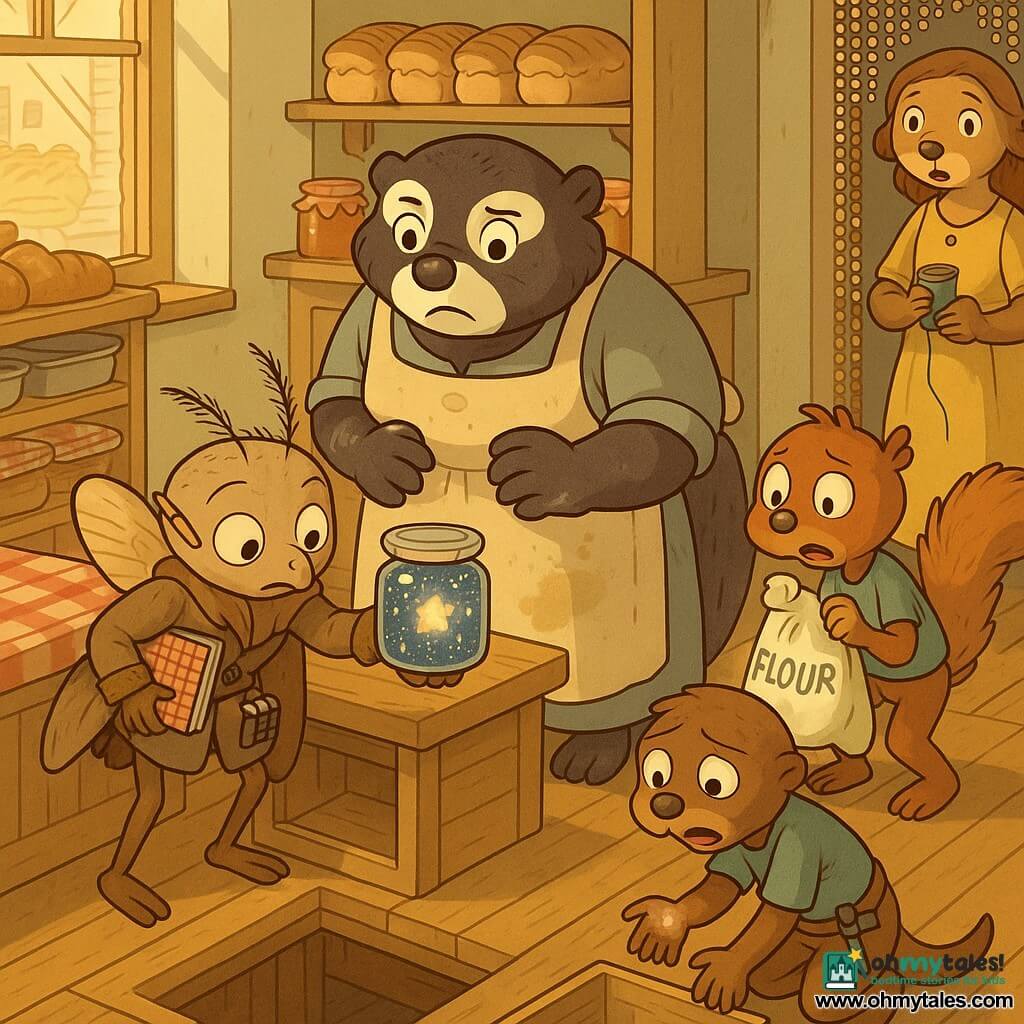
Milo Moth stepped into Maple Street Bakery with his notebook tucked under one wing and a pencil behind his ear. He was small, quiet, and famously careful—exactly the kind of detective who noticed things other animals didn't.
The bakery smelled like cinnamon, toasted nuts, and warm butter. Behind the counter, Mrs. Briar the badger whisked flour from her paws and frowned so hard her whiskers almost trembled.
“Milo,” she said, “something's gone missing.”
“What's missing?” Milo asked.
Mrs. Briar leaned closer, as if the loaves might be listening. “My jar of starberry jam. One whole jar. It was for the Saturday swirl buns.”
Starberries were rare, bright red, and sweet with a tiny sparkly crunch. Jam made from them was expensive and, according to rumor, slightly addictive.
Milo clicked his pencil. “When did you last see it?”
“Yesterday evening,” Mrs. Briar said. “I locked up at dusk. The jar was on the back shelf. This morning, it was gone. No broken window. No mess. Just… missing.”
Milo's antennae tilted. “May I look around?”
“Please,” Mrs. Briar said, pushing open the swinging door. “Be as nosy as you like.”
Milo entered the kitchen. Mixing bowls gleamed. Trays cooled. The air hummed with quiet heat.
On the floor near the pantry, he spotted something that didn't belong: a thin smear of red, like a paintbrush stroke.
He crouched, sniffed, and wrote: Starberry jam smear. Fresh-ish.
Then he noticed three sets of clues:
1) A few sticky paw prints leading toward the back door.
2) A sprinkle of coarse salt near the sink.
3) A single green thread caught on the pantry handle.
Milo straightened and looked at the back door. It was closed. The latch was firm.
“Mrs. Briar,” he called, “who has a key to the back door?”
“Me,” she said, “and my helper, Pip the squirrel.”
“Where is Pip?”
“At school,” Mrs. Briar said quickly. “He's a good kid. Always early. Always helpful.”
Milo nodded. Helpful didn't always mean careful. And careful was what the case needed.
He turned to the reader—right into the quiet space between the words, like he could see you standing beside the flour sacks.
“Here's the problem,” Milo said. “A jar vanished from a locked bakery. We have three clues already. Which one do you think matters most: the jam paw prints, the salt, or the green thread?”
Milo tapped his notebook once. “Let's find out where each clue leads.”
Chapter 2: Questions on Maple Street
Milo stepped outside. Maple Street was busy in a cozy way—delivery carts squeaked, wind chimes sang, and a sparrow band practiced something that sounded like falling down stairs.
He followed the sticky paw prints first. They were faint, but the sun caught them, making them glisten like tiny glass beads.
The prints went from the pantry area (through the back hall) to the back door… and then stopped.
Milo frowned. “That's not normal.”
If someone carried a jar outside, the prints should continue into the alley. Unless…
“Unless the jar never left through the back door,” Milo murmured. “Or the carrier wiped their paws.”
He walked around to the alley anyway. The ground was dusty. Easy to mark. No paw prints. No drag marks. No dropped lid.
Then he noticed something else: the smell.
Starberry jam didn't just smell sweet. It smelled like berries and summer and a tiny snap of sugar. Milo sniffed the air. The scent was weak, but it drifted toward the shop next door: Moss & Thread, the little sewing-and-repair place owned by Nora the otter.
Nora was the neighbor Mrs. Briar always waved to. Nora always waved back, usually with a needle between her teeth.
Milo stepped inside. Bells chimed. Spools of thread lined the walls like colorful towers. Buttons sat in jars, staring like tiny eyes.
Nora lifted her head from a pile of fabric. “Well hello, Milo! Are you shopping or snooping?”
“Both,” Milo said politely. “I'm investigating a missing jar of starberry jam.”
Nora's whiskers perked. “Jam? In a sewing shop? That's a sticky kind of mystery.”
“I found a green thread on the bakery pantry handle,” Milo said. “Do you use green thread like this?”
Nora glanced at the sample Milo held up with tweezers (Milo always carried tweezers; he believed fingers were too enthusiastic). “That's fern-green. I do use it. But so do lots of folks. It's popular.”
“Were you in the bakery last night?” Milo asked.
Nora held up both paws. “Nope. I was here, closing up early. My cousin visited. We drank mint tea. Then I went home.”
Milo jotted that down.
Nora leaned forward, interested. “Can I help?”
“Maybe,” Milo said. “May I see your back room? Your… back shop.”
Nora's eyes twinkled. “My back shop is a mess. That's how you know it's a real shop. Come on.”
Milo followed her through a curtain of bead strings into the back. The air changed—less flowery, more like iron and damp wood. A workbench sat under a lamp. There were tools: awls, scissors, tiny hammers.
And on the floor, near a crate, Milo spotted a sprinkle of coarse salt.
He froze.
“Do you use salt back here?” Milo asked.
Nora blinked. “Salt? No. Unless you count the salty snacks I'm not supposed to eat while sewing.”
Milo crouched. The grains were large, like the kind used in pickling.
He looked up. “Has anyone been in your back shop this morning?”
Nora scratched her chin. “Only me. And… well… my nephew Skiff. He ran in to borrow a screwdriver.”
Milo wrote: Skiff. Borrowed screwdriver. Why?
He stood and faced you again, his antennae tilting like question marks.
“Now we have a connection,” Milo said. “Green thread could be anywhere, but salt in two places is strange. What do you think salt could mean in a jam case?”
Nora crossed her arms. “Unless someone tried to stop the stickiness?”
Milo's eyes brightened. “Good thought.”
A plan began to form—careful, step-by-step, like stitching a seam that wouldn't split.
Chapter 3: The Back-Shop Discovery
Milo asked Nora for permission to look around, and Nora, curious as a catfish, agreed.
He examined the workbench. Tools were neatly arranged—too neatly, Milo noticed. Nora was tidy in the front shop, but this back room looked recently “tidied” in a hurry, like someone had shoved a mess into corners.
Milo moved a box labeled Winter Buttons. Under it was a faint red dot on the wooden floor.
He sniffed. Starberry.
His pencil made a quick note: Jam scent in back shop. Red spot under box.
Nora peered over his shoulder. “That's… not mine.”
Milo carefully lifted the box. Underneath, he found a round mark—like a jar had sat there. The circle was sticky, with a glittering ring of sugar.
“The jar was here,” Milo said softly.
Nora's whiskers drooped. “In my back shop? Milo, I swear I didn't—”
“I don't think you did,” Milo said. “You'd have cleaned this better. You're too proud.”
Nora huffed. “True.”
Milo glanced around. If someone hid the jar here, why? And why the salt?
He spotted a small pile of sawdust near a cracked floorboard. Fresh sawdust. Too fresh.
“Did you have any repairs done recently?” Milo asked.
Nora shook her head. “Not to the floor.”
Milo knelt and slid his tweezers into the crack. The board lifted slightly. Underneath was a dark gap.
He shone his tiny pocket lantern inside.
Something metallic glinted.
He reached in and pulled out… a jar lid.
Starberry jam lid, with a star-shaped sticker on top.
Nora gasped. “Oh no.”
Milo examined the lid. It wasn't bent. It wasn't forced. It was simply removed, as if someone opened the jar calmly.
“Who would open it in your back shop?” Milo murmured. “And where's the jar now?”
He looked closer. On the edge of the lid was a smear of jam mixed with—yes—salt. Salt crystals stuck in the red like tiny ice.
Milo turned to you again.
“Time to think,” he said. “If someone opens a jar of jam and adds salt, what are they trying to do? Make it less sweet? Hide the smell? Or clean up a spill?”
He held the lid up. “And why hide the lid under a floorboard?”
Nora's tail swished. “This is making my fur itch.”
Milo stood. “We need to talk to Skiff.”
Nora sighed. “Skiff is a good kid. But good kids can make… very creative mistakes.”
“Creative mistakes,” Milo agreed, “are the loudest kind.”
They left the back shop. Milo asked Nora to lock the curtain door. “Responsibility,” he said, “means protecting evidence. Even when it's uncomfortable.”
Nora swallowed and nodded. “Locked.”
Outside, Milo headed toward the canal path where otters often gathered. The sun flashed on the water like coins.
If Skiff had borrowed a screwdriver, maybe he'd also borrowed a jar.
Or borrowed trouble.
Chapter 4: The Neighbor's Nephew
They found Skiff the young otter near the canal, skipping stones with his friends. He wore a small tool belt that looked too big for him and a guilty expression that looked even bigger.
When he saw Nora, his stones suddenly became very interesting.
Nora called, “Skiff! Come here, please.”
Skiff waddled over, ears low.
Milo spoke gently. “Skiff, I'm investigating the missing starberry jam from the bakery.”
Skiff swallowed. “I heard about it.”
“I found salt in Nora's back shop,” Milo said. “And the jam lid under a floorboard.”
Skiff's eyes widened, then darted left and right like minnows.
Nora's voice stayed calm, but firm. “Skiff. Tell the truth. Right now.”
Skiff's shoulders slumped. “I didn't steal it,” he blurted. “I mean—I kind of—borrowed it. But I was going to bring it back!”
Milo's pencil hovered. “Why?”
Skiff wrung his paws. “For the science fair. I was making… a jam battery.”
Nora blinked. “A what?”
Skiff brightened for half a second, then remembered he was in trouble. “You can make electricity with fruit stuff. Like lemon batteries. I thought starberry jam would be stronger. It's sticky and… powerful.”
Milo kept his voice even. “How did you get the jar?”
Skiff stared at the ground. “Pip the squirrel let me into the bakery after closing.”
Nora gasped. “Pip has a key!”
Skiff nodded miserably. “Pip said he just wanted to show me the ovens. We didn't take anything at first. Then I saw the jar. I thought—just for one night. I'd do my experiment and return it before morning.”
Milo asked, “Did you take it through the back door?”
Skiff shook his head quickly. “No! Mrs. Briar locks that one tight. Pip opened the front, but we didn't want anyone to see, so we went through the connecting back hallway between shops.” He pointed. “There's a little service passage behind the buildings. It opens into Aunt Nora's back shop. I know because I used it once when I lost my ball.”
Milo's antennae lifted. That explained the missing paw prints outside.
“And the salt?” Milo asked.
Skiff winced. “The jam spilled. A lot. It got on my paws and the floor. Pip freaked out. He said, ‘Salt soaks up sticky stuff!' He grabbed pickling salt from the bakery shelf—Mrs. Briar uses it for pretzel twists.”
Nora groaned quietly. “So that's why there was salt in my back shop.”
Milo nodded. “And the green thread?”
Skiff's cheeks went pink under his fur. “My tool belt strap broke. I tied it with fern-green thread from Aunt Nora's shop. I… didn't ask.”
Nora inhaled slowly, like she was counting to ten in her head. “Skiff.”
“I know,” Skiff whispered. “I know. I messed up.”
Milo closed his notebook. “Where is the jar now?”
Skiff looked even more miserable. “I hid it. In the old milk crate under the bench. But… it's not full anymore.”
Nora stiffened. “Because it spilled?”
Skiff nodded. “And because… Pip tasted it. He couldn't stop. He said it was ‘for quality control.'”
Milo let out a small sigh. “We need to return what's left, and we need to speak with Pip and Mrs. Briar.”
Skiff's eyes shimmered. “Am I going to be banned from the bakery forever?”
“Not if you do the responsible thing,” Milo said. “You'll apologize. You'll help clean. And you'll make it right.”
Skiff nodded hard. “I will.”
Milo glanced at you again, inviting you into the thinking.
“Notice how the clues fit?” he said quietly. “No prints outside because they used the service passage. Salt because they tried to clean sticky jam. Thread because of a broken strap. Mysteries often look scary until you line up the facts.”
Then he turned back. “Let's go.”
Chapter 5: The Service Passage and the Truth
The service passage was narrow and shadowy, squeezed behind the buildings like a secret between friends. Milo walked carefully, counting doors.
“Here,” Skiff said, pointing to a small wooden panel. “It opens into Aunt Nora's back shop.”
Milo inspected the latch. It was simple, not locked—just hidden. A perfect route for animals who didn't want to be seen.
They entered Nora's back shop again. Skiff went straight to the bench and pulled out an old milk crate. Inside, wrapped in a rag, was the starberry jam jar—half full, sticky, and sprinkled with accidental salt crystals like crunchy snow.
Nora pinched her whiskers. “Oh, Skiff.”
Skiff held the jar out with both paws, as if it weighed a hundred pounds. “I'm sorry.”
Milo took it carefully with a cloth. “We'll return it. But first—Skiff, you and Pip must explain together. No hiding parts. That's responsibility too.”
Skiff nodded.
At the bakery, Mrs. Briar was glazing buns with a brush, her movements sharp and annoyed. When she saw the jar in Milo's cloth, her eyes narrowed.
Milo set it gently on the counter. “I found it.”
Mrs. Briar stared. “Where?”
“In the service passage route,” Milo said. “Skiff borrowed it with Pip's help. They planned to return it. There was a spill, and they tried to clean it with pickling salt. The lid was hidden.”
Pip the squirrel, who had just arrived and heard his name, froze mid-step. A flour bag in his arms sagged like it was disappointed too.
Mrs. Briar's voice went quiet. “Pip.”
Pip's tail drooped. “I—Mrs. Briar, I'm sorry. I wanted to show Skiff the bakery because I'm proud of it. And then he saw the jam and—”
“And you let him take it,” Mrs. Briar finished.
Pip whispered, “Yes.”
Skiff stepped forward. “It was my idea. I wanted it for my science fair. I didn't think about… your work. Or your money. Or your trust.”
Milo watched Mrs. Briar closely. Anger was normal. But so was choosing what to do with it.
Mrs. Briar exhaled, long and slow. “You both made a choice. A bad one. But you're here now, telling the truth. That matters.”
Pip sniffed. “We can pay you back.”
Mrs. Briar shook her head. “You're children. You don't have that kind of money.”
Skiff looked panicked. “Then what do we do?”
Milo spoke up. “We make a repair plan. The bakery lost jam and time. You can repay time.”
Mrs. Briar's eyes flicked to Milo. “Go on.”
“Skiff and Pip will clean the service passage,” Milo said, “and scrub the back shop floor where the jam spilled. They'll help in the bakery after school for a week—sweeping, washing trays, organizing. And they'll make signs: ‘Ask before you borrow' and ‘Keys are not toys.'”
Pip nodded so fast his ears flapped. “Yes. Yes! I'll do it.”
Skiff nodded too. “I'll do all of it. And I'll use… apple slices for my battery.”
Mrs. Briar's mouth twitched. “A wise choice.”
Nora, who had been quietly listening, added, “Skiff will also repair the floorboard he pried up. Properly. With permission.”
Skiff sighed. “Yes, Aunt Nora.”
Mrs. Briar looked at the jar. “This jam is salted.”
Pip winced. “Only a little.”
Mrs. Briar sniffed it thoughtfully. “Salted starberry jam might actually work in pretzel-swirl buns.” She paused. “Accidents can sometimes become ideas. But do not mistake that for approval.”
“Yes, ma'am,” Pip and Skiff said together.
Milo wrote the plan down and had them repeat it back, step by step. He liked plans that could be checked like boxes.
He turned to you one last time before the final part of the day.
“Solving a mystery is fun,” Milo said. “But the best ending isn't catching someone. It's helping them fix what they broke.”
Chapter 6: Coffee and a Warm Ending
By late afternoon, the service passage had been swept clean. The sticky spots were scrubbed until the wood no longer grabbed at paws. Nora's back shop floor shone, and the curtain beads no longer smelled faintly of berries.
In the bakery, Pip arranged trays in perfect rows, looking like he was apologizing with every straight line. Skiff washed mixing bowls with serious concentration, as if he could scrub guilt away.
Mrs. Briar tested a small batch of pretzel-swirl buns with the salted starberry jam. The buns came out glossy and fragrant, the sweet and salty smell swirling together like a secret that had decided to be pleasant.
Milo sat at a corner table, his notebook finally closed. His antennae relaxed. Mysteries were tiring, even gentle ones.
Mrs. Briar approached with three mugs on a tray. “Decaf dandelion coffee,” she announced. “For detectives and nervous helpers.”
Pip and Skiff sat across from Milo, paws wrapped around warm mugs. Nora joined them, looking relieved enough to laugh again.
Skiff took a careful sip. “I didn't know coffee could taste like flowers and toast.”
“It's bakery magic,” Pip said, and then added quickly, “Responsible bakery magic.”
Nora chuckled. “Say that ten times while sweeping tomorrow.”
Mrs. Briar slid a plate of the new buns onto the table. “Taste test. Milo gets the first bite. Detective's privilege.”
Milo took a small bite. The bun was chewy and warm, the jam bright, the salt sharp in a good way—like a surprise that behaved itself.
He nodded. “It works.”
Mrs. Briar leaned on the chair back. “Good. Then something decent came from this mess.”
Pip looked up. “Mrs. Briar… thank you for not giving up on us.”
Mrs. Briar's expression softened. “Thank you for choosing to fix it. Trust is like dough. If you rush it, it tears. If you care for it, it rises.”
Skiff smiled a little. “I'll remember that.”
Milo lifted his mug. “To responsibility,” he said.
Nora lifted hers. “To asking first.”
Pip lifted his. “To keys staying on hooks.”
Skiff lifted his. “To apple-slice batteries.”
They clinked mugs gently. Outside, Maple Street glowed with evening light. Inside, the bakery felt safe again—full of warm smells, honest work, and a mystery neatly folded away.
Milo took another sip of dandelion coffee and, for once, didn't feel like writing anything down.