Chapter 1: The Missing Program Stack
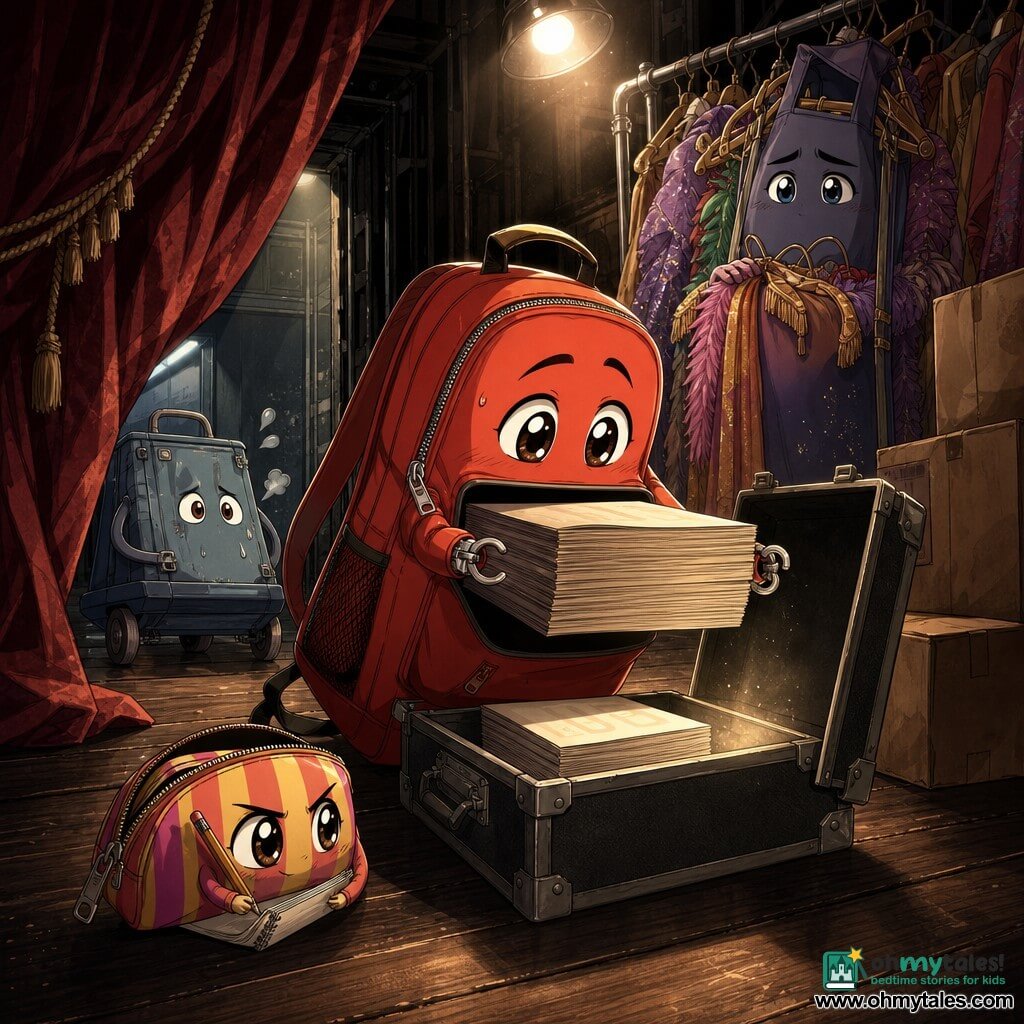
I was a red backpack with a sharp zipper and a sharper nose for trouble. The others at Maplewood School called me “Clip,” because my front buckle clicked like a tiny judge's gavel.
That afternoon, the school theatre buzzed like a beehive in a tin can. Painted flats leaned against the walls. A cardboard moon dangled from a rope. A spotlight blinked as if it had a secret.
Tonight was opening night for “The Comet's Cousin,” and everyone was busy—without any people, of course. Here, props did the hauling, costumes did the fluttering, and the curtains did the dramatic swooshing.
I stood on the edge of the stage beside my best friend, Pippa the pencil case. She was striped, organized, and nosy.
“Check your pockets,” Pippa whispered. “Something's off.”
I checked. Not snacks—still there. Not my notebook—still snug. But the stack of printed programs I had been carrying for the lobby?
Gone.
My zipper teeth clicked. “They were here five minutes ago.”
From the wings, Gus the stage curtain rumbled, “If the audience doesn't get programs, they'll read the exit signs for fun. Terrible.”
A rolling prop trunk named Trundle clanked up, puffing. “I delivered the programs to you, Clip. I saw you tuck them in. Then I rolled away. Straight line. No detours.”
A straight line in the theatre was never truly straight. There were cables like vines, trapdoors like open mouths, and costume racks that loved to snag sleeves.
I took a slow look around. Near the middle of the stage, a chalky mark stood out on the dark floor—small, neat, and fresh.
It was a symbol.
A circle with three short lines pointing outward, like a tiny sun. Or a compass that had lost its directions.
Pippa's zipper mouth went tight. “That wasn't there yesterday.”
I leaned closer, careful not to smudge it. “Someone left a sign.”
“Or a clue,” Pippa said, almost happily, because mysteries were her favorite hobby besides counting paperclips.
I straightened my straps. “All right. We solve this before the curtain rises.”
And because I was a backpack, I already had the most important tool of any detective:
I could carry evidence without dropping it.
Chapter 2: Suspects in the Wings
We started with the nearest witnesses.
Milo the microphone stand stood tall, silver, and dramatic. “I saw movement,” he declared, as if announcing a royal wedding. “A shadow crossed the stage. Quiet. Quick.”
“Who?” I asked.
Milo's base swivelled. “I didn't see faces. Only feet. Well. Not feet. Wheels.”
“Wheels?” Pippa repeated.
Trundle's lid popped open in offense. “Not me. My wheels squeak. Everyone hears me coming.”
From above, a rope ladder swayed gently. It belonged to Laddie, who was proud of his knots and loved gossip.
“I heard the squeak too,” Laddie said. “Not Trundle. Different squeak. Smaller. Like… like a nervous shopping cart.”
A tiny giggle floated from the prop shelf. That was Tilly the teacup, part of a comedy scene. She chimed, “Oh! I saw the program stack earlier. It was on the bench by the side door.”
“The bench,” I said, storing it away like a file in my mind.
Pippa slid open slightly. “Clip, remember: in a good mystery, you don't chase the loudest clue. You chase the most reliable one.”
“Right,” I said. “Let's list what we know.”
I tugged out my notebook and a stubby pencil. Pippa puffed with pride as I wrote.
1) Programs were in me, then vanished.
2) Chalk symbol appeared on stage: circle with three lines.
3) A small wheeled squeak was heard.
4) Programs were seen on the bench by the side door.
We moved toward the bench. The theatre smelled of paint and dust and old applause. Halfway there, we passed the costume rack. It was named Rax, and it always looked overdressed.
Rax's hangers rattled. “Don't look at me. I'm innocent. I don't even have hands. I have… style.”
On the floor under Rax, I spotted a torn scrap of paper. I carefully pinched it with my zipper pull and slid it into my front pocket.
Pippa leaned in. “What does it say?”
Only a few letters were visible: “—RTH.”
“Could be ‘Earth,'” Pippa murmured. “Like the play. Comet. Space.”
“Or ‘North' without the N,” I said, thinking of the symbol. “Circle… lines… maybe directions?”
We reached the bench by the side door. It was empty except for glitter dust and a single chalk stub, snapped in half.
My straps tightened. “So someone carried the programs from me to this bench.”
“Or dropped them,” Pippa said. “Or hid them.”
I looked at the door. It led to the hallway outside the theatre—the familiar school corridor with lockers that loved to squeal.
No people. Just lots of noisy metal.
I took a deep breath through my zipper. “We follow the trail. But we do it smart.”
Pippa's voice turned brisk. “Ask yourself: who needs programs?”
“Everyone,” I said.
“Exactly,” she replied. “So who would take them?”
That was the real question.
Chapter 3: The Symbol on the Floor
We returned to the chalk symbol. The stage lights warmed the spot like a little sun.
I crouched as best a backpack could. “Circle with three lines. What if it's not a sun?”
Pippa clicked open. “It could be a map mark. Like ‘meet here.' Or a logo.”
Gus the curtain rumbled, “I've been hanging here for years. I've seen symbols. Stage crews mark positions with tape, not chalk doodles.”
“So it's unusual,” I said.
Trundle rolled closer, trying to be helpful. “There's a props club that meets in the storage room. They draw symbols sometimes. They call them ‘trade marks.'”
“Trade marks?” Pippa asked.
“They swap props,” Trundle explained. “Borrowing, returning, fixing. Like a secret handshake, but for things.”
A secret swap. A hidden stash. It fit too well.
I studied the symbol again. Three lines. Not four. Not a full compass.
“Think,” I told myself. “If it's a direction, why three?”
Pippa tapped my side with her corner. “What has three parts in the theatre?”
I looked around. Stage left. Stage right. Center stage.
Three places.
My zipper teeth clicked. “Maybe it means ‘center stage.' Like a marker.”
“But the programs were for the lobby,” Pippa said. “Why mark the middle?”
Unless the symbol didn't point to where the programs were taken.
Unless it pointed to where they would be returned.
A plan.
I turned my gaze to the prop shelf again. Tilly the teacup sat beside a painted cardboard star. Above them, the spotlight unit, Spot, blinked like it was trying to wink.
Spot's voice crackled softly. “I… uh… might have seen chalk dust on someone.”
“On who?” I asked quickly.
Spot hesitated. The light beam wobbled. “On Skid.”
Skid was the small wheeled cart used to carry snacks and tape and emergency buttons. Skid was fast, squeaky, and always acting like he was late for something.
Pippa's zipper slid open with a soft hiss. “Skid matches the squeak.”
Trundle snorted. “Skid also loves shortcuts. He zooms through the side door all the time.”
“Then Skid is a suspect,” I said, writing it down.
But I didn't like jumping too fast. In detective stories, the obvious suspect often turned out to be the wrong one—especially in a friendly mystery.
I lifted my front pocket slightly. The torn scrap with “—RTH” felt important.
“Let's find Skid,” I said. “And we'll ask questions, not accuse.”
Pippa zipped shut. “Good. And Clip?”
“Yeah?”
“Remember to say thank you when someone helps,” she said. “Gratitude makes people tell the truth faster.”
I sighed. “That sounds made up.”
“It isn't,” Pippa replied sweetly. “Try it.”
Chapter 4: A Squeaky Trail
We rolled into the hallway. Lockers lined the walls like tall metal books. Some had magnets shaped like planets. One locker door hung slightly open, creaking in the draft.
The squeak came again—faint, quick, and nervous.
“There,” I whispered.
Skid sat near the water fountain, pretending to be invisible, which was hard because he was bright blue and had a sticker that said GO! GO! GO!
“Skid,” I called, keeping my voice calm.
Skid's wheels twitched. “Oh! Hi, Clip. Hi, Pippa. Busy day. Very busy. I'm doing… hallway work.”
Pippa's tone was friendly but sharp. “We're missing the program stack.”
Skid squeaked loudly, as if his wheels answered for him. “Missing? That's bad. Very bad. Programs are important. Paper is… papery.”
I tried Pippa's advice. “Skid, you're always helpful. Thank you for hauling supplies so fast. Did you see anything near the theatre bench?”
Skid blinked—well, his handle wiggled like blinking. “Uh… thanks. I… I did pass the bench.”
“Did you pass it,” I asked, “or stop at it?”
Skid's sticker seemed to sweat. “Stop. Briefly. For a… safety check.”
Pippa leaned closer. “Did you move the programs?”
Skid's wheels spun a tiny circle. “Not steal. Not steal! Just… moved.”
“Where?” I asked.
Skid hesitated, then blurted, “To keep them safe!”
“From what?” Pippa demanded.
Skid lowered his handle. “From the drip.”
“The drip?” I echoed.
Skid rolled a bit, then pointed his front wheel toward the ceiling. A small dark stain spread above the theatre door, like a cloud deciding whether to rain.
“There's a leak,” Skid said. “It drips right onto the bench sometimes. Paper gets soggy. Then Gus yells. And Gus is… loud.”
From inside the theatre, right on cue, Gus thundered, “I HEARD MY NAME!”
Skid flinched. “So I moved the programs. I was going to tell someone, but then Spot blinked at me, and I got nervous, and then Trundle rolled by, and—”
“Skid,” I said gently, “where did you move them?”
Skid nodded toward the end of the hall. “Storage room. In a clean bin. Dry as crackers.”
Relief warmed my straps. “That's not a crime. That's a rescue.”
Pippa frowned. “Then what about the chalk symbol?”
Skid tilted. “Oh. That. I didn't draw it.”
“Did you see who did?” I asked.
Skid's squeak softened. “I saw chalk in Rax's area. And I saw… glitter.”
“Glitter?” Pippa said, eyes narrowing like a detective in a movie.
I remembered the glitter dust on the bench. And the snapped chalk.
We thanked Skid—properly, even—and hurried toward the storage room.
But halfway there, I stopped.
“Wait,” I said. “If Skid moved the programs to storage… why is there a torn scrap that says ‘—RTH'?”
Pippa went quiet. “Unless there are two mysteries.”
Or one mystery with two layers.
Chapter 5: The Storage Room Switch
The storage room smelled like cardboard and brave old glue. Boxes towered like sleepy giants. A mop bucket hummed in the corner, proud of being useful.
In the middle sat a clean plastic bin with a lid. Skid squeaked beside it like a guard dog.
“There,” Skid said. “Safe.”
I popped open my zipper and lifted the lid.
Inside were programs.
But not the programs.
These were glossy, fancy, and wrong. The title on the front read: “The COMET'S COUSIN,” but the letters were crooked, and the school logo was missing. The paper felt flimsy, like it had been printed in a hurry.
Pippa inhaled sharply. “These are copies.”
My zipper teeth clicked in annoyance. “So someone switched them.”
Skid's wheels froze. “Switched? I didn't switch! I just put the stack in here!”
I believed him. His panic was too honest, and besides—he had tried to protect the programs, not hide them.
I pulled out the torn scrap from my pocket. “Look. ‘—RTH.' What if it's part of a word on the real programs?”
Pippa flipped open and dug out a tiny magnifying lens she used for reading tiny notes. “Show me one of the fake programs.”
I held one steady. The back page had a list of “Thanks To:” but it was short and strange. It thanked “The Great Audience” and “Mysterious Helpers.” No names. No club. No gratitude in the real sense—just empty words.
Pippa's voice went colder. “Someone doesn't want anyone thanked.”
That hit me like a dropped textbook. In our school, the theatre always ended with a big thank-you list—props club, paint crew, lighting team, costume rack, everyone who helped. It was tradition. It felt good. It made the whole building glow a little.
If the programs were switched, maybe someone wanted to erase the real helpers.
I turned to Skid. “Did you see anything else? Any symbol? Any mark?”
Skid nodded quickly. “On the bin lid earlier, before you got here. A chalk sun-thing. Like the one on stage.”
My straps tightened again. The symbol was a tag.
A label for a trade.
Trundle had mentioned a props club that swapped things. Maybe someone was “swapping” programs too.
Pippa snapped, “We need the real programs before the show starts.”
I looked around the storage room. If I were hiding a stack, where would I put it?
High shelf: too obvious. Under a box: risky. Inside something else: clever.
I noticed a tall, black case leaning in the corner—the case for Milo the microphone stand when he traveled. It was long, hollow, and closed with a latch.
“Milo's case,” I murmured. “No one checks that.”
Pippa's eyes widened. “And ‘—RTH' could be from ‘WORTH.' Like ‘thanks for your hard work'—it's a word you'd use in a real thank-you list.”
I stepped toward the case. My zipper hand wasn't a hand, but my pull-tab could hook a latch if I tried.
“Reader's job,” I said quietly, as if the theatre itself could listen. “Help us think. If you wanted to hide the real programs, would you pick a place that's: quiet, close to the stage, and easy to shut?”
I hooked the latch and tugged.
Click.
The case opened.
Inside, neatly pressed, was the real stack of programs—thicker paper, clean print, and a bright school logo smiling at the top.
Pippa exhaled. “Found!”
But tucked on top was another sheet, folded into a triangle. And drawn on it in chalk was the same symbol—circle with three lines.
Below the symbol were three words, written in hurried block letters:
“CENTER. AFTER. BOW.”
Someone had planned to return the real programs later—after the show—so no one would notice the switch until it was too late.
We weren't done yet. We had the programs, but we still needed the “who” and the “why.”
Chapter 6: The Glittery Truth
We carried the real programs back to the theatre. I kept them safe inside me, snug as secrets. Pippa marched beside me like a tiny general.
Onstage, Gus practiced a dramatic swish. Spot tested his beam. Trundle rolled in circles to stay limber. Milo stood tall, rehearsing silence.
Rax the costume rack shimmered with sequins and confidence.
I stepped up to Rax. “Rax, can we ask you something?”
Rax rattled his hangers. “Depends. Is it about fashion? Because I have opinions.”
“It's about chalk,” Pippa said. “And glitter. And a switch.”
Rax went very still. A feather boa slid off one shoulder and drooped dramatically to the floor.
I took out the fake program and held it up. “Someone made these to replace the real ones. Someone who had access to printing. And someone who hates long thank-you lists.”
From behind the flats, a small wheeze sounded. It was Printa, the portable printer used for posters and last-minute signs. Printa was usually proud, but now her paper tray looked embarrassed.
“I… I printed them,” Printa admitted in a thin voice. “Someone asked me to. They said it was a ‘cleaner design.' No clutter.”
“Who asked?” I said, gently.
Printa hesitated. Then, like a page finally turning, she whispered, “Rax.”
All hangers turned toward Rax. Even Gus paused mid-swish.
Rax's voice came out squeaky, not stylish. “Fine. It was me.”
Pippa didn't pounce. She simply asked, “Why?”
Rax's hangers shook. “Because the thank-you list was too long. It made the programs look… busy. And it reminded everyone that I needed help.”
I blinked. “You needed help?”
Rax's voice dropped. “I can't zip costumes. I can't stitch torn hems. I can't even carry my own hats without tangling. The others do so much for me. And when the programs list all those names—props, lights, curtains, carts, printer—I feel… exposed. Like I'm just a rack standing there while everyone works.”
Gus rumbled softly, not angry now. “We help because we can.”
Trundle rolled closer. “And because we like you, you shiny coat-hanger disaster.”
A little laugh broke the tension. Even Rax's feather boa seemed to perk up.
Pippa's voice softened. “So you tried to erase the thanks, so you wouldn't feel like you owed anyone?”
Rax nodded. “Yes. But then Skid moved the programs to keep them dry, and I panicked. I swapped them with the fake ones and marked the places with the symbol so I could switch back later. Center stage, after the bow, when everyone's distracted.”
I opened my zipper and pulled out the real programs. “But gratitude isn't a spotlight that embarrasses you. It's more like… the warm glow after a good scene. It shows what worked.”
Rax's hangers sagged. “I didn't mean to ruin opening night.”
I thought of Skid trying to protect paper from leaks. Of Printa doing what she was asked. Of Spot blinking truthfully. Of Pippa reminding me to say thank you.
“We can fix it,” I said. “But we do it honestly.”
I turned to Printa. “Thank you for telling the truth.”
Printa's paper tray lifted a little. “You're welcome.”
I turned to Skid, who peeked from the wings. “Thank you for trying to keep the programs safe.”
Skid squeaked once, proud. “Anytime!”
Then I looked at Rax. “You can help too. By putting the real programs out yourself.”
Rax trembled. “Me?”
“Yes,” Pippa said. “It's brave to accept help. And it's brave to thank people for it.”
Rax inhaled—well, as much as a rack could. “All right.”
Together, we rushed to the lobby table. Rax carefully arranged the real programs in neat stacks. He added a small handwritten note at the top:
“THANK YOU FOR HELPING THIS SHOW SHINE.”
The letters weren't perfect. They were honest.
The theatre felt lighter.
The mystery was solved.
Almost.
Chapter 7: The Last Little Riddle
The show went beautifully. The cardboard moon swung at the right moment. Spot's beam hit the painted comet like magic. Gus swished with perfect drama. Milo stood silent at exactly the right times, which, for him, was heroic.
After the final bow—no people, just the cast of costumes and props lined up like proud puzzle pieces—the applause came from the building itself: the walls creaked happily, the seats thumped, and the air hummed with that special after-show joy.
Backstage, Rax rolled up beside me. “Clip,” he said softly, “thank you for not yelling at me. I deserved it, but you didn't.”
“Yelling wastes time,” I replied. “And we had a case.”
Pippa added, “Also, yelling gives Gus ideas.”
Gus rumbled, pleased. “IT DOES.”
Rax glanced at the chalk symbol still faintly visible on the stage floor. “I should erase that.”
“Wait,” I said, leaning in.
Beside the symbol, someone had added a tiny detail while we were busy: a small dot inside the circle, like an eye.
Pippa's zipper clicked. “That wasn't there before.”
Spot flickered. “I didn't do it.”
Trundle's wheels stopped. “Not me.”
Skid squeaked, “Nope!”
Rax shook his hangers. “I swear, I'm done with symbols.”
I stared at the mark. Circle, three lines, and now an eye-dot.
Not a sun. Not a compass.
A watching sign.
A reminder.
I pulled out my notebook and wrote one last line:
5) Someone else knows the symbol.
Pippa leaned close and whispered, “Maybe it's the props club tag Trundle mentioned. Maybe there are more swaps planned.”
I looked around the theatre. Everything seemed peaceful—too peaceful, like a stage right before a surprise prop falls.
I turned the notebook toward you, the reader, as if you were standing beside us in the wings.
“Here's our looped riddle,” I said. “We found the thief, but a new clue appeared.”
I tapped the page.
“Who could have added the dot without being noticed during the rush—someone high up, someone quiet, or someone who was already near the stage?”
The spotlight blinked once, slow and thoughtful.
The rope ladder swayed slightly, as if trying not to look guilty.
And the chalk symbol, with its tiny eye, seemed to stare back—waiting for the next curtain to rise.