Chapter 1
Maya Bell didn't look like a detective. She looked like a twelve-year-old with a neat braid, a backpack that always held a notebook, and a calm face that made adults talk more than they meant to.
On Saturday morning, she stood in her kitchen while the kettle rumbled like a small train.
“Remember,” her dad said, tying his shoes, “Mrs. Grindle's bouquet is today. Big anniversary. Don't forget the ribbon.”
“I won't,” Maya said. She slid a pale blue ribbon into her pocket.
Her little brother Leo skidded in, socks slipping on the tiles. “I'm coming! I can carry flowers. I'm basically a delivery robot.”
“You're more like a noisy robot,” Maya said, but she handed him the shopping list anyway.
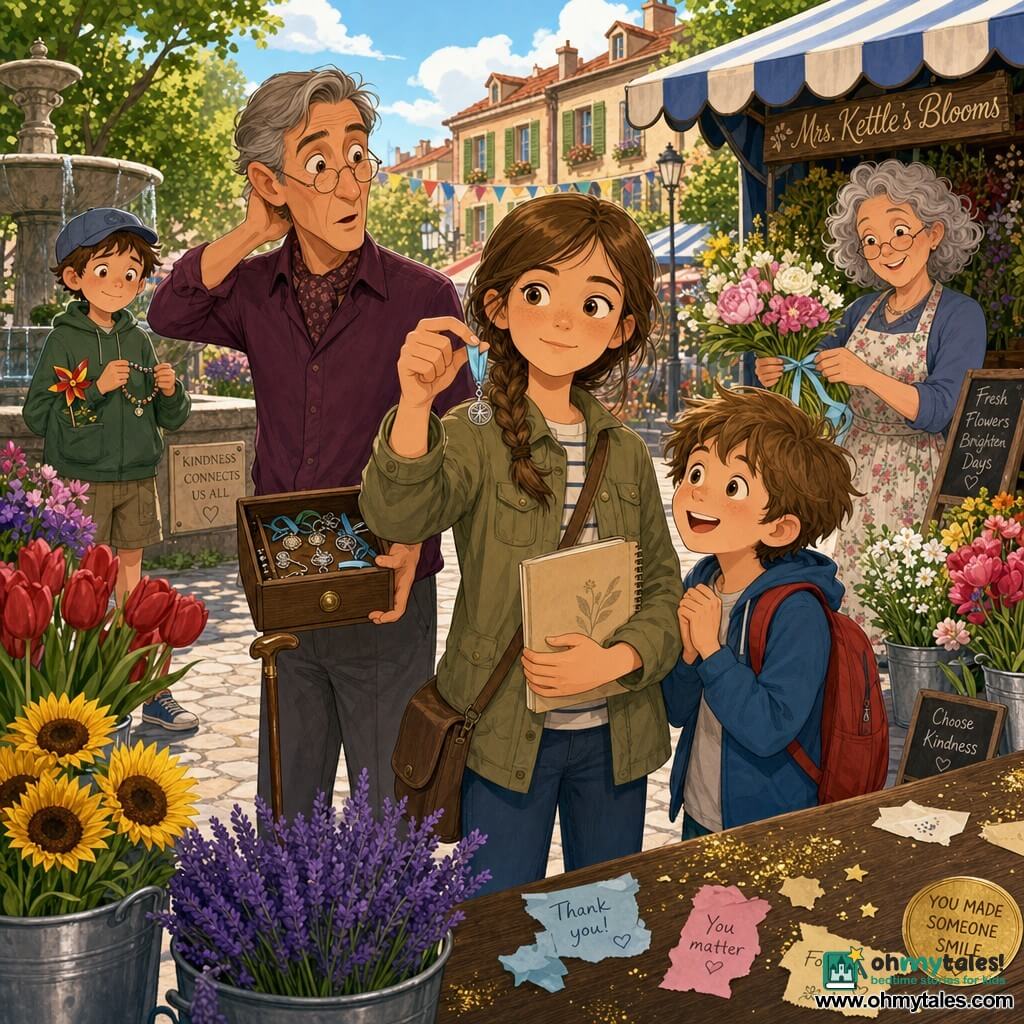
They walked to Clover Street, where the weekend flower market opened like a bright umbrella. Even from the corner, Maya could smell it: damp leaves, sharp eucalyptus, sweet roses, and soil that reminded her of rainy playgrounds.
The market was a patchwork of stalls. Buckets of tulips stood like paintbrushes. Sunflowers stared at everyone. Lavender made purple clouds.
At the busiest stall, a sign read: BLOOM & BOW — MRS. KETTLE, FLORIST.
Mrs. Kettle leaned over a table of ribbons. Her gray curls bounced as she talked. “Morning, Maya! Morning, Leo!”
“Morning,” Maya said. “We're here for Mrs. Grindle's bouquet. White lilies, pink roses, the blue ribbon.”
Mrs. Kettle's smile flickered. She patted her apron pockets, then her table, then a basket.
“Oh dear,” she said. “The ribbon. The special ribbon. It was right here.”
Leo gasped. “A ribbon thief!”
Mrs. Kettle lowered her voice, as if the tulips might be listening. “Not just a ribbon. It has a tiny silver charm on it. A little circle stamped with a symbol.”
Maya felt a small spark of curiosity, quick but controlled. “What symbol?”
Mrs. Kettle drew a circle in the air with her finger and added three points, like a simple crown. “Like that. A ring with three tiny spikes.”
Maya took out her notebook. “When did you last see it?”
“This morning. Before the rush. I tied it around a bouquet for a customer, but then she changed her mind. I put it back. I'm sure I did.”
Maya looked at the ribbon rack. Lots of ribbons. None with a silver charm.
“And now Mrs. Grindle's bouquet won't be… special,” Mrs. Kettle said, her shoulders drooping.
Leo whispered loudly, “Detective Maya, we must solve this crime.”
Maya didn't roll her eyes. Not out loud. “Okay,” she said, steady. “No panic. We'll find facts.”
She looked around the stall. A damp footprint on the wooden step. A fallen petal crushed into the grain. A faint smudge of glitter—gold, like craft glue.
Maya wrote: FOOTPRINT. GLITTER. SYMBOL CHARM.
Then she looked up at the market, bright and ordinary and suddenly full of secrets.
Chapter 2
Maya's first rule of investigating was simple: don't guess too fast. Guessing felt clever, but it could be lazy.
“Mrs. Kettle,” she said, “who was near your ribbons earlier?”
Mrs. Kettle pursed her lips. “Let me think. There was Mr. Pruitt from the bakery. He always buys daisies for his counter. There was Juno—she's the art club girl, paints little signs. And there was Mr. Finch, the man with the fancy cane. He likes orchids. Oh! And your teacher, Ms. Patel, passed by.”
“My teacher?” Leo squeaked. “She's a suspect?”
Maya nudged him gently with her elbow. “Everyone is a possible clue. Not everyone is guilty.”
They stepped away from the stall so customers could buy their bundles of color.
The market's sounds wrapped around them: laughter, coins clinking, the squeak of bucket handles, a bus sighing at the curb. A man called, “Two bunches for three pounds!” like it was a magic spell.
Maya crouched by the stall's wooden step. The footprint was small, not like an adult boot. The tread pattern looked like tiny lightning bolts.
“Those are kid shoes,” Leo said.
“Maybe,” Maya replied. “Or a small adult. But yes—likely someone our size.”
She followed the glitter smudge with her eyes. It was on the corner of the ribbon table, then on the ground in two tiny flecks, then gone.
Leo pointed. “Glitter trail!”
“It's not much of a trail,” Maya said, “but it's something.”
They walked slowly, scanning. Maya tried to see with “market eyes”—not just looking at flowers, but at hands, pockets, bags, and what people left behind.
Near the fountain, she spotted another dot of gold glitter on a stone edge. It looked like someone had brushed a sleeve there.
At the fountain sat Juno from school, her hair in a messy bun, sketchbook open. Her fingers were stained with paint. A little jar of glitter glue stood beside her.
Leo leaned close to Maya. “Case closed.”
Maya wrote in her notebook: JUNO = GLITTER GLUE.
Then she made herself write another line underneath: GLITTER CAN COME FROM MANY PLACES.
She approached Juno calmly. “Hi.”
Juno looked up, startled, then grinned. “Maya Bell! If you're here to buy flowers, pick the sunflowers. They look like they know jokes.”
“We're not exactly shopping,” Maya said. “Mrs. Kettle is missing a ribbon. Pale blue, with a silver charm. A circle with three points.”
Juno's eyebrows jumped. “That sounds cool.”
“It's important,” Maya said. “Did you see anyone near her ribbon table this morning?”
Juno tapped her pencil against her teeth. “I saw Mr. Finch there. Cane guy. He leaned on the table while Mrs. Kettle went to fetch orchids. And I saw a kid—maybe eight or nine—running with a pinwheel. He bumped the table and nearly knocked a bucket over.”
“A pinwheel?” Maya asked.
Juno nodded. “Red and yellow. Like a tiny spinning fire.”
Maya wrote: KID WITH PINWHEEL. MR. FINCH LEANED ON TABLE.
“Did you take the ribbon?” Leo blurted.
Juno snorted. “No. I'd steal snacks before I'd steal ribbons. Besides, glitter gets everywhere. Even in my cereal.”
Maya believed her… but belief wasn't proof. “Can I see your hands?” Maya asked.
Juno held them up, palms out. Paint and glue. No ribbon.
“Thanks,” Maya said. “If you remember anything else, tell me.”
As they walked away, Leo muttered, “You didn't even search her bag.”
Maya kept her pace slow. “We don't accuse people just because they have glitter. We collect more pieces first.”
They passed Mr. Pruitt's bakery stall. The air smelled like warm cinnamon and butter. Mr. Pruitt handed a bun to a toddler with a face like serious pudding.
Maya noticed something on Mr. Pruitt's apron: a pale blue thread.
Not the ribbon. But a thread.
Maya's notebook opened again. THREAD ON APRON.
“Mr. Pruitt,” she said, “did you help Mrs. Kettle with ribbons today?”
He chuckled. “Me? I can't tie a bow to save my life. My buns are neat, my knots are tragic. Why?”
Maya pointed at his apron. “That thread.”
He looked down. “Oh, that? Probably from a gift bag. Folks bring all sorts. Hey—if you're sniffing out a mystery, talk to Ms. Patel. She bought flowers earlier and looked… rushed.”
Maya's stomach did a small flip. Ms. Patel had always seemed organized, like a walking calendar.
Leo whispered, “Teacher thief!”
“Or teacher witness,” Maya said.
They headed toward the edge of the market, where the book stall stood under a striped awning.
And there, by a box of used mysteries, was Ms. Patel.
Chapter 3
Ms. Patel held a small pot of mint and a paper bag. She looked up and smiled, but her eyes were a little tired.
“Maya! Leo! Shopping with your dad?”
“Just us,” Maya said. “Ms. Patel, can I ask you something? Mrs. Kettle's special ribbon is missing.”
Ms. Patel blinked. “Missing?”
“It's pale blue with a silver charm,” Maya said. “A circle with three points.”
Ms. Patel's mouth formed a silent “oh.” She glanced down at her paper bag as if it might bite her.
Leo leaned forward. “Is it in there?”
Maya shot him a warning look. Then she softened her voice. “Did you see anyone near the ribbon table this morning?”
Ms. Patel exhaled. “I did. I was buying flowers for my sister. I saw Mr. Finch with his cane. And I saw… your friend, Leo, running.”
Leo froze. “Me?”
“You zipped by with a pinwheel,” Ms. Patel said.
Leo's cheeks turned pink. “I don't have a pinwheel.”
Maya looked at him. Leo's hands were empty. His pockets bulged with normal kid things: a crumpled receipt, a pebble, and the shopping list.
Ms. Patel continued, “I heard a clink. Like metal on wood. I thought it was a coin. I didn't think anything of it.”
Maya wrote: MS. PATEL HEARD CLINK.
“And,” Ms. Patel added, “I saw something else. On the corner of the table there was a sticker. A little circle with three points—same shape you described. Like a tiny stamp.”
Maya's head lifted. “A sticker?”
Ms. Patel nodded. “Gold. Shiny. I remember because it looked like a secret club logo.”
Maya's heart beat faster, but her voice stayed even. “That's important. Thank you.”
Leo tugged Maya's sleeve when they walked away. “A sticker? So the ribbon charm has a matching sticker?”
“Or someone put the sticker there,” Maya said. “Like a signature.”
They returned toward Bloom & Bow. Mrs. Kettle was rearranging tulips with the focus of someone trying not to worry.
Maya told her what they'd learned: the kid with the pinwheel, Mr. Finch leaning on the table, Ms. Patel hearing a clink, and the gold sticker with the same symbol.
Mrs. Kettle frowned. “A sticker? I never use stickers on my tables.”
“Could it be from packaging?” Maya asked.
Mrs. Kettle shook her head. “No. But… I've seen that symbol before.”
Maya's pen hovered. “Where?”
Mrs. Kettle lowered her voice again. “On a small box. A delivery last week. The box had the same ring-and-three-points symbol. Inside were charms and ribbons from a craft supplier.”
Leo's eyes widened. “Secret supplier!”
“Probably not secret,” Maya said, “just… marked.”
Maya looked around the stall. The market was friendly, but mysteries didn't need dark alleys. They only needed one small decision made in a hurry.
She crouched and examined the table corner. There it was: a tiny gold sticker, almost hidden under the overhang, like someone placed it carefully.
Maya touched it with her fingertip. It was fresh—still slightly tacky.
“So someone recently put it here,” Maya murmured.
Mrs. Kettle leaned in. “Oh my. I didn't notice.”
Maya straightened. “If the sticker is a clue, we need to ask: who carries stickers like that?”
Leo said, “Juno! Art club! Stickers!”
Maya didn't argue, but she didn't agree either. She glanced across the market.
Near the far end stood a stall that sold handmade trinkets: keychains, charms, and tiny metal shapes. A sign read: FINCH & FINDINGS.
Mr. Finch stood behind it, tall and thin, with a polished cane leaning against the table. His hair was silver. His tie was the color of plums.
And on his display board were little gold stickers—round, shiny—holding price tags in place.
Maya's calm turned into a focused calm.
“Let's talk to him,” she said.
Chapter 4
Mr. Finch greeted them with a smile that looked practiced, like he'd rehearsed it in a mirror.
“Good morning,” he said. “Looking for a charm? A lucky coin? A tiny compass to keep you from getting lost in the cereal aisle?”
Leo giggled. Maya stayed serious.
“We're looking for a specific charm,” Maya said. “Silver. On a pale blue ribbon. The charm has a symbol: a circle with three points.”
Mr. Finch's eyes flicked—just a quick glance—to the side of his display. Then they returned to Maya's face. “Interesting. Many symbols in the world.”
Maya nodded. “True. That's why details matter.”
She pointed at his price tags. “Your stickers. That symbol on them—does it match?”
Mr. Finch lifted a sticker sheet. The design was the same: a ring with three tiny spikes, like a simple crown.
“It's my shop mark,” he said smoothly. “A brand. People like brands. They feel… official.”
Maya's mind clicked. Mrs. Kettle said the ribbon charms came in a box with that symbol. Mr. Finch sold charms. Mr. Finch had matching stickers. Mr. Finch was seen leaning on the ribbon table. Ms. Patel heard a clink.
But Maya forced herself to doubt her own neat story. Neat stories could be wrong.
“Where do you get your charms?” Maya asked.
“Suppliers,” Mr. Finch said. “The same as everyone. The world is small.”
Maya looked at his cane. The handle was silver, curved like a question mark. Something about it seemed familiar.
She glanced back at Bloom & Bow. Mrs. Kettle's ribbon table stood at the same height as Mr. Finch's cane handle.
“Mr. Finch,” Maya said politely, “would you mind showing us your hands?”
He blinked. “My hands?”
“It's a standard question,” Maya said, very calm. “We're trying to find a missing ribbon.”
Mr. Finch chuckled. “Detective work, is it? Fine.”
He held out his hands. Clean. No paint. No ribbon fibers.
Leo leaned in anyway, peering like a meerkat. “No ribbon!”
Maya's eyes moved to Mr. Finch's cane. On the lower part, near the rubber tip, there was a tiny scrap of pale blue fabric, snagged like a whisper.
Maya pointed. “What's that?”
Mr. Finch glanced down, too quick again. “Lint.”
Maya reached into her pocket and pulled out the shopping list. She tore off a small corner and crouched. “May I?”
He hesitated. That was new.
Maya gently pinched the scrap with the paper and pulled. It came free. Pale blue satin.
Mrs. Kettle's ribbon was satin.
Mr. Finch's smile thinned. “Children are very… observant.”
Maya stood up. “Did you take it?”
Mr. Finch's gaze drifted to the crowd, to the buckets and shoppers. “I did not ‘take' it. I picked it up.”
Leo crossed his arms. “So you did take it.”
Mr. Finch sighed, as if the market was exhausting him. “There was a commotion. A child with a pinwheel bumped the table. Something fell. The charm clinked. The ribbon slipped. I stepped back, and my cane caught it. I didn't notice until later.”
Maya held the scrap of ribbon. “And the charm?”
Mr. Finch opened a small tin from under his table. Inside were bits of metal: hooks, rings, tiny bells.
He tipped the tin slightly. Something silver flashed.
He lifted it with two fingers. A silver circle with three points.
Leo made a triumphant sound that was half cheer, half squeak.
Mr. Finch looked annoyed now, but not angry. More like someone caught with mud on their shoes. “I meant to return it,” he said. “But I saw the mark and thought it was one of mine. I assumed Mrs. Kettle had bought it from me and then… misplaced it.”
Maya's eyebrows rose. “So you doubted her without checking.”
Mr. Finch's cheeks colored. “I—yes. Perhaps.”
Maya nodded. “It happens. But when we doubt, we should investigate. Not assume.”
Mr. Finch looked at the charm, then at Maya. “You sound like a tiny judge.”
“I'm twelve,” Maya said. “It's basically my job to ask questions.”
He huffed a laugh despite himself. “Fair.”
Maya held out her hand. “May we return it?”
Mr. Finch placed the charm in her palm. It felt cool and honest, like a coin that had finally come back to the right pocket.
“And the ribbon?” Leo asked.
Mr. Finch reached into a drawer and produced the pale blue ribbon, slightly wrinkled. “There.”
Maya noticed something else tied loosely around it: a tiny red-and-yellow pinwheel ribbon, like a child's decoration.
“That wasn't there before,” Maya said.
Mr. Finch looked surprised. “It was on it when I found it.”
Maya's mind turned. The pinwheel kid. The bump. The commotion. Maybe the kid had grabbed the ribbon first, then dropped it, and Mr. Finch's cane snagged it.
Which meant Mr. Finch wasn't the first person to touch it.
“Thank you,” Maya said. “We still need one more answer.”
Mr. Finch lifted his brows. “Do you?”
Maya nodded. “Who put the sticker on Mrs. Kettle's table?”
Chapter 5
They returned to Bloom & Bow with the ribbon and charm. Mrs. Kettle let out a sound like a balloon finally allowed to be a balloon.
“My ribbon!” She pressed it to her apron. “Oh, thank goodness.”
Maya didn't relax yet. She pointed at the gold sticker. “This was placed recently. Did you see anyone touch this corner?”
Mrs. Kettle squinted. “Not that I recall.”
Leo bounced. “Maybe the sticker is magical. Maybe it appears when ribbons are stolen.”
Maya gave him a look. “Maybe it's just… a sticker.”
Still, the sticker bothered her. It felt like a deliberate breadcrumb, not an accident.
Maya scanned the ground again, and this time she noticed a tiny thing near the step: a plastic bead, red and yellow, like a miniature pinwheel without blades.
She picked it up. It had a small hole, as if it belonged on a bracelet.
“A clue!” Leo said.
“A clue,” Maya agreed.
“Who wears bracelets?” Leo asked.
“Lots of people,” Maya said. Then she added, “But we're looking for red-and-yellow pinwheel colors.”
They walked through the market again, eyes open. Maya focused on children: running, skipping, tugging parents, begging for honey sticks.
Near the fountain, she spotted a kid about nine, with a red-and-yellow pinwheel tucked into his cap. On his wrist was a bracelet made of beads—mostly red and yellow—with one bead missing.
He was staring into the fountain like it owed him money.
Maya approached carefully, keeping her voice gentle. “Hi. I'm Maya.”
The boy glanced up. His eyes were big and guilty-looking, like a puppy beside a torn pillow. “I'm Sam.”
“That's a cool pinwheel,” Leo said.
Sam touched it defensively. “It's for my little sister. She's sick. She likes bright things.”
Maya nodded. “Bright things help.”
She held up the bead. “Did you lose this?”
Sam's face went pale. “Maybe.”
Maya sat on the fountain edge, giving him space. “We're trying to solve a small problem. A ribbon went missing from a flower stall. It has a silver charm. Nobody's in big trouble. But we need the truth.”
Sam swallowed. “I didn't steal it.”
Maya stayed calm. “Tell me what happened.”
Sam's shoulders hunched. “I was running and my pinwheel hit a lady's flowers. I didn't mean to. The flower lady looked mad, so I… I ducked by the ribbon table. I saw a ribbon with a shiny charm. It looked like a prize.”
Leo whispered, “It was a prize for Mrs. Grindle.”
Sam continued quickly. “I just wanted to look. I picked it up. Then I saw the flower lady turning, and I panicked. I dropped it. It fell, and then this fancy man with a cane stepped back and his cane snagged it. I ran.”
Maya listened carefully. “Did you put a gold sticker on the table?”
Sam blinked. “A sticker?”
Maya showed him the symbol she'd drawn in her notebook: a ring with three points.
Sam's eyes widened. “Oh. That. I have those.”
He reached into his pocket and pulled out a small sheet of gold stickers—each with the exact symbol.
Leo's mouth fell open. “Why do you have secret stickers?”
Sam looked embarrassed. “My mom works at Mr. Finch's stall sometimes. She lets me have the leftover sticker sheets. I put them on my stuff so I don't lose it. I put one on the ribbon table corner because… because I thought if I came back, I'd find the ribbon again.”
Maya nodded slowly. The story fit the clues: the kid shoes, the commotion, the clink, the pinwheel ribbon tied on, the sticker placed like a marker.
“And you lost a bead while you ran,” Maya added, showing him the bead.
Sam nodded, miserable. “I'm sorry.”
Maya's voice softened. “You made a mistake. But you also told the truth now. That matters.”
Leo tilted his head. “So… we solved it?”
“We solved what happened,” Maya said. “Now we fix what we can.”
They walked Sam back to Mrs. Kettle's stall.
Sam stood very straight, like he'd decided to be brave. “I'm sorry,” he said. “I grabbed the ribbon. I panicked. I put a sticker there so I could find it again. I didn't mean to mess up anyone's bouquet.”
Mrs. Kettle's face changed—first surprise, then a long exhale. “Thank you for telling me,” she said. “Next time, if something shiny tempts you, you can ask. The worst I can say is no.”
Sam nodded hard.
Maya turned to Mr. Finch, who had followed at a cautious distance, looking curious and slightly worried. “And you,” Maya said, “next time you find something with a symbol, you can doubt your first thought and check before you keep it.”
Mr. Finch's lips twitched. “Constructive doubt,” he said. “Yes. I see.”
Mrs. Kettle tied the pale blue ribbon around the bouquet with quick, practiced hands. She attached the silver charm, which winked in the sunlight.
“There,” she said. “Special again.”
Leo breathed out as if he'd been holding his breath the entire market.
Sam whispered to Maya, “Are you going to tell everyone?”
Maya shook her head. “No. The goal isn't to make you feel small. The goal is to help you do better.”
Sam's shoulders loosened, just a little.
Chapter 6
Maya and Leo delivered the bouquet to Mrs. Grindle, who cried in a happy way and offered them lemon biscuits.
By the time they returned to the market, the afternoon sun had softened. Buckets were lower. Voices were quieter. The whole place smelled greener, like stems and shade.
Mrs. Kettle waved them over. “Detective Maya,” she said, “I have something for you.”
Maya raised an eyebrow. “If it's a job offer, I take payment in books.”
Mrs. Kettle laughed and handed her a small envelope. Inside was a thank-you note and a single gold sticker with the ring-and-three-points symbol.
“A souvenir?” Leo asked.
“A reminder,” Mrs. Kettle said. “That clues can be tiny. And that asking questions is kinder than accusing.”
Maya stuck the sticker in her notebook beside her notes. FOOTPRINT. GLITTER. CLINK. PINWHEEL. STICKER.
Mr. Finch approached, clearing his throat in an important way. “Maya,” he said, “I owe you an apology. I acted as if my brand mark made the charm mine.”
Maya nodded. “It's easy to let a symbol make us too confident.”
He tilted his head. “You truly are calm for your age.”
“I practice,” Maya said. “Leo gives me plenty of chances.”
Leo made a dramatic offended face. “I am a peaceful robot.”
Sam came by with his mom, who looked tired but kind. She thanked Mrs. Kettle and Maya. Sam held his pinwheel properly now, like it was something to protect, not something to wave while escaping.
As the market began to pack up, Maya stood at the fountain for a moment. The water rippled, catching the sky in broken pieces. People were just people again—shoppers, sellers, kids with sticky fingers—no longer suspects in her head.
She opened her notebook and wrote one last line:
DOUBT CAN BE A TOOL, IF YOU USE IT GENTLY.
Leo tugged her sleeve. “Can we get one bun? For the road?”
Maya closed the notebook. “Yes. But we're paying. No mysterious bun disappearances.”
They walked away with warm bread and cooler air. Maya glanced back over her shoulder at the flower market—at the bright buckets, the fluttering ribbons, the tiny gold symbol in her notebook.
One last look, to remember: even ordinary places can hide puzzles. And even puzzles can end with everyone a little wiser.