Chapter 1: The Missing Map
The Brightwood Pond Fair was supposed to be simple: stalls, games, and the famous “Reed Ring Toss” where you won a ribbon if you didn't fall in.
Hazel Hopwell—rabbit, junior detective, and champion note-taker—liked simple. Simple meant fewer surprises and more time for snacks.
But surprises hopped in anyway.
“Hazel!” squeaked Tilda the squirrel, skidding to a stop beside Hazel's burrow-door. Her tail looked like a shaken brush. “The Pond Path Map is gone!”
“The big one?” Hazel asked.
“The big one,” Tilda said. “The one we pin up so everyone knows where the lily pads are safe and where the mud tries to eat your shoes.”
Hazel's ears lifted. A missing map on fair morning wasn't just annoying. It could send little ones into the deep reeds, or elders onto slippery stones.
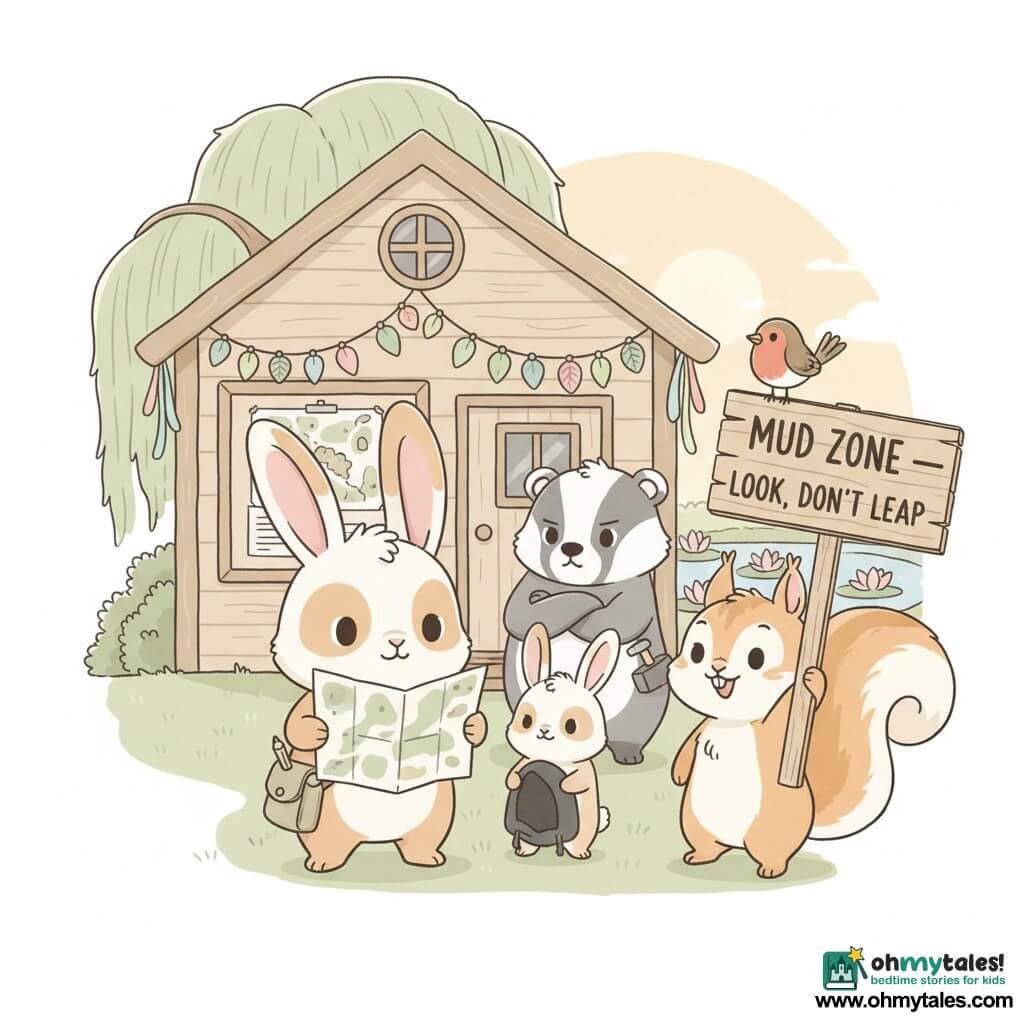
“Show me,” Hazel said, grabbing her detective satchel. Inside: a pencil, a small notebook, a magnifying shell, and three emergency carrot sticks.
They hurried to the Community Hut. The map board stood near the entrance—empty except for four bent pins and a pale rectangle where sun hadn't faded the wood.
Bramble the badger paced in tight circles. “We hung it up at sunrise,” he grumbled. “Now it's vanished. Like a worm into a bird.”
“Anyone see anything?” Hazel asked.
Pip the robin fluttered on a beam. “I saw someone near the board earlier,” he said. “A hood. A quick hop. Then—poof.”
“A hop?” Hazel murmured, pretending not to notice Bramble staring at her feet.
“It could be any hop,” Tilda said quickly. “Lots of us hop!”
Hazel smiled. “Exactly. Which means we use clues, not guesses.”
She crouched by the board. A faint line of dampness led away, then stopped.
“Wet trail,” Hazel said. “From pond water, not morning dew. Dew is everywhere. Pond water travels.”
Bramble snorted. “So the thief came from the pond?”
“Or went to it,” Hazel said. “And we'll be polite and call them ‘the borrower' until we know more.”
She stood. “Let's start where the wet trail starts.”
They followed it out of the hut and onto the path that curved toward Brightwood Pond, where reeds whispered like gossiping neighbors.
Chapter 2: Clues by the Water
Brightwood Pond looked peaceful, like it hadn't swallowed a single shoe all year. Dragonflies stitched blue lines over the surface. The reed beds swayed, hiding secrets the way curtains hide messy rooms.
Hazel knelt at the muddy edge. “Everyone stop right there,” she said. “No stepping on the shore. Mud remembers.”
Tilda clutched her paws. “That is both creepy and useful.”
Hazel leaned closer. In the soft mud were prints—small, oval, and neat. Not paw pads like a fox. Not claw marks like a raccoon. Not webbed like a duck.
Rabbit prints.
Hazel's whiskers twitched. “Okay,” she said, “that's… interesting.”
Pip landed beside a cattail. “So the thief is a rabbit?”
“Not automatically,” Hazel said. “These prints could be from anyone who came here for water. Fair week means a lot of running around.”
She spotted something pale snagged on a reed: a thin strip of paper, slightly soggy.
Hazel eased it free with two sticks so she wouldn't rip it. The strip had a corner of drawing—blue crayon waves, and a tiny red X.
“A piece of the map,” Tilda whispered.
Hazel nodded. “We're close.”
Bramble lumbered up behind them, ignoring the “don't step” instruction with impressive confidence. The mud squelched under his paw.
Hazel winced. “Bramble… you just erased about three useful footprints.”
“My paws are big,” Bramble said, offended. “They do big things.”
“Like big mistakes,” Pip muttered.
Hazel held up the map scrap. “We need to think. The map was taken from the hut, carried to the pond, and torn—maybe by accident, maybe on purpose.”
Tilda tilted her head. “Why tear it?”
“To hide parts,” Hazel said. “Or because it got caught and ripped. The question is: who needed the map gone today?”
They made a list in Hazel's notebook.
1) Someone who wants to prank the fair.
2) Someone who wants fewer visitors at their stall.
3) Someone who is scared of something on the map.
4) Someone who needs the map for another reason.
“Who was near the hut at sunrise?” Hazel asked.
Pip fluffed his feathers. “I did my rounds. I saw Mags the magpie. She loves shiny things and paper things. She was carrying… something flat.”
Tilda's eyes widened. “Magpies do collect stuff.”
Hazel tapped her pencil. “True, but we need more than a bird rumor.”
A cold breeze slid across the pond. On the far bank, a lantern post stood by the willow tree—used at night for evening walks. Even though it was day, the lantern's glass was smudged, like someone had brushed past it.
Hazel hopped closer. The lantern door was ajar, and inside sat a folded, unlit cloth—dark and damp.
“A hood?” Tilda whispered.
Hazel gently lifted it. It smelled like pond water and… sunflower seeds.
“Someone wore this,” Hazel said. “A quick hop, a hood, sunflower seeds.”
Pip chirped. “That sounds like… Nib.”
“Nib?” Hazel repeated.
Nib was a young rabbit from the south burrows, known for two things: falling asleep anywhere and sneaking sunflower seeds from his aunt's pantry.
Hazel's stomach did a small, worried somersault. She didn't like suspecting another rabbit. But she liked lost maps even less.
“Let's not jump,” she said. “We'll ask questions. Calm ones.”
As they turned to leave, Hazel paused by the lantern post.
The lantern was still on its hook, but its switch lever was pushed halfway down. Strange.
Hazel looked at it, then at the bright morning. “Someone tried to turn it on,” she murmured.
“For daylight?” Tilda asked.
“Or,” Hazel said, “someone turned it off in a hurry.”
She wrote in her notebook: Lantern lever half-down. Hood damp. Sunflower smell.
Then she closed it with a soft snap. “We visit Nib.”
Chapter 3: The Rabbit with the Hood
Nib's burrow sat under a patch of ferns, cozy and slightly messy, like a nest built by an animal who believed in “creative piles.”
Hazel knocked. “Nib? It's Hazel.”
A thump, a rustle, and Nib appeared, blinking like he'd been startled out of a dream. One ear bent forward, the other stuck up like a question mark.
“Hazel! Hi,” he said, too fast. “Nice day! Very… map-shaped day!”
Hazel kept her voice gentle. “That's an interesting way to describe a day.”
Tilda leaned in. “We found a hood by the pond. Dark cloth. Smelled like sunflower seeds.”
Nib's nose twitched once. Twice. He swallowed.
“I don't know anything about any hood,” he said, staring at a fern as if it might answer for him.
Hazel opened her satchel and showed the soggy map scrap. “And we found this.”
Nib's eyes went wide. “Oh.”
Hazel waited. Silence can be a helpful tool, like a quiet flashlight.
Nib's shoulders sank. “I didn't mean to steal it,” he mumbled.
Tilda gasped. Bramble, who had followed them despite being told to “stand guard,” huffed loudly, as if he'd been right about everything since birth.
Hazel raised a paw. “Tell us what happened. From the start.”
Nib shifted his feet. “I was out early. I… I couldn't sleep. I kept thinking about the fair.”
“Because you were excited?” Hazel asked.
Nib looked embarrassed. “Because I was worried.”
He took a breath. “Last year, my little cousin got stuck in the mud near the west reeds. Everyone laughed after, because he was okay. But he cried first. I… I hated that part.”
Hazel's ears softened. “So you wanted to prevent it.”
Nib nodded. “I thought if I had the map, I could mark the dangerous spots with extra signs. Like, big signs. Like, ‘DO NOT STEP HERE UNLESS YOU WANT MUD TO EAT YOU.'”
Tilda let out a tiny laugh. “That's dramatic.”
Nib's whiskers drooped. “I know. I tried to borrow the map before anyone came. I wore my rain hood because it was misty. I took it from the hut, then went to the pond edge to compare the drawing to the real shore.”
“And it tore,” Hazel said.
Nib nodded miserably. “The wind gusted. The map caught on a reed. Rip. I panicked. I didn't want anyone to know I'd taken it. So I hid pieces. I thought I could tape it back later.”
Bramble crossed his arms. “And in the meantime, we'd have a fair with no map and lots of mud-eating.”
Nib flinched. “I'm sorry.”
Hazel held up her notebook. “We can fix this. But first we need all the pieces.”
Nib brightened a little. “I can show you where I hid them.”
“Good,” Hazel said. “One more thing. The lantern post by the willow—did you touch it?”
Nib nodded. “I thought it was a storage hook. I hung my hood there. The lantern switch got bumped. I pushed it up, but it felt stuck, so I left.”
Hazel made a note: Not a mastermind. Just anxious.
“Okay,” she said. “We'll recover the pieces, rebuild the map, and then—”
“And then I'll be in trouble,” Nib whispered.
Hazel met his eyes. “Then you'll tell the truth. And you'll help make it right. That's not the same as being crushed by trouble.”
Nib took a deep breath. “I'll help.”
They headed back toward the pond together, the mystery turning into a rescue mission.
Chapter 4: The Pieces in the Reeds
At the pond, Hazel organized the search like a tiny police chief.
“Tilda, you scan the low reeds. Pip, you fly above and look for pale paper. Bramble—please stand on the path and do nothing with your feet.”
Bramble frowned. “Doing nothing is hard.”
“Try,” Hazel said.
Nib led Hazel to the first hiding place: under a flat stone near the cattails. He nudged it aside with a stick. A folded square of map, damp but readable.
“One,” Hazel said, placing it carefully between two clean leaves to keep it flat.
They found another piece tucked in a hollow log. Another wedged in the roots of the willow, like a secret letter.
Pip swooped down. “I see something white floating!” he called.
Hazel's heart jumped. Paper and water were not friends.
She and Nib hurried along the bank. A piece of map drifted near a lily pad, spinning slowly, as if the pond were trying to read it.
“How do we get it without stepping in?” Tilda asked.
Hazel looked around. A long reed stalk lay on the shore, thick and sturdy.
“Problem-solving time,” Hazel said, and glanced at you—yes, you, the reader, the honorary assistant detective.
If you were here, what would you do?
A) Grab it with your paw and risk falling in.
B) Use something long to hook it gently.
C) Throw a rock at it and hope it swims closer.
Hazel chose B.
She slid the reed stalk into the water, slow and steady. Nib held the other end so it wouldn't slip. Hazel hooked the edge of the paper and inched it toward shore.
The map piece glided in like a tired boat. Hazel lifted it out, dripping.
Tilda exhaled loudly. “No mud-eating today!”
They laid all the pieces on a dry patch of grass. The map looked like a puzzle attacked by a confused wind.
Hazel examined the tears. “We're missing one piece,” she said.
Nib's ears drooped again. “I thought I found them all.”
Pip fluttered to the lantern post. “What about inside the lantern?”
Hazel turned. “Inside?”
They hurried to the willow. Hazel opened the lantern door carefully. Inside, at the bottom, lay a curled scrap of paper, stuck to a bit of old wax.
Hazel pinched it gently free.
“There,” she said. “Our last piece.”
Nib let out a breath that sounded like a balloon deflating. “I didn't even know it fell in.”
Hazel smiled. “Lanterns are sneaky. They collect moths, dust, and apparently evidence.”
Back on the grass, Hazel lined up the edges. Tilda held corners down with pebbles. Pip read out landmarks as Hazel fit the puzzle together: the Safe Lily Pads, the Slippery Stones, the West Reeds of Mud.
Bramble watched, impressed despite himself. “You rabbits are good at putting things back together,” he said.
Hazel didn't look up. “Anyone can be, with patience.”
When the last seam matched, Hazel sat back.
“We have the map,” she said. “Now we need the next step: returning it without starting a panic.”
Nib's voice was small. “I can carry it back.”
Hazel shook her head. “We carry it together. And first—”
She glanced at the lantern, still slightly askew. Its glass caught the sunlight.
“First, we turn that lantern fully off,” Hazel said, and reached up. With a click, she pushed the lever into place.
“One light off,” Tilda said. “One mystery nearly solved.”
Hazel tucked the repaired map between two stiff bark sheets in her satchel.
“Let's hop,” she said. “Time for the truth.”
Chapter 5: The Confession and the Signs
Back at the Community Hut, fair helpers buzzed around like bees with checklists. Decorations hung from branches: leaf garlands, ribbon loops, and a sign that read WELCOME, PLEASE DO NOT JUGGLE ACORNS INDOORS.
Bramble cleared his throat loudly. “Attention! The map has been found!”
A cheer rose, then quieted when Hazel lifted a paw.
“We found the map,” Hazel said, “and we found out why it was taken.”
Nib stepped forward, holding his hood in both paws like it was heavy.
“I took it,” he said, voice shaky but steady. “I wanted to mark dangerous mud spots so nobody gets stuck. But I panicked when it tore. I'm sorry. I should have asked for help.”
The room went so quiet Hazel could hear a ribbon flutter.
Then Old Juniper the hare—village storyteller and unofficial judge of nonsense—hopped closer. “You wanted to protect the young ones,” Juniper said. “That's kind. But stealing makes kindness wobble.”
Nib nodded fast. “Yes. I see that.”
Hazel spoke up. “Nib also helped recover every piece, and we repaired it. Now we can add extra signs the right way.”
Tilda lifted a bundle of blank wooden markers. “We can write warnings!”
Pip puffed his chest. “I can direct traffic from above. Very official.”
Bramble grumbled, but it sounded softer now. “I can hammer the signs in. My paws do big things.”
Hazel looked at Nib. “You'll help place them. You know where the mud is trickiest.”
Nib's eyes shone with relief. “I will. I promise.”
They got to work. Hazel pinned the map back onto the board—straight, strong, and shining with fresh ink where Hazel added a new symbol: a little squiggle for “mud zone,” and a star for “safe viewing spot.”
Together they planted three warning signs near the west reeds:
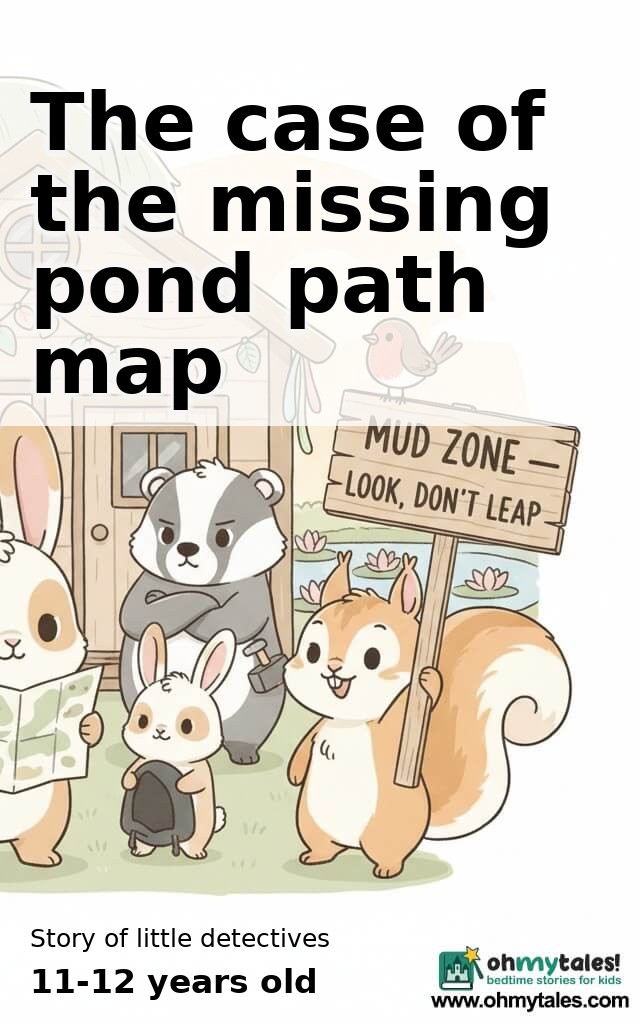
MUD ZONE — LOOK, DON'T LEAP
SAFE PATH THIS WAY
IF YOU DROP A SNACK, LET IT GO
Tilda giggled. “That last one is just good life advice.”
By midday, the fair began. Families of rabbits and other woodland animals wandered in, following the restored map. No one slipped. No one got stuck. The pond stayed calm, like it was pleased to be respected.
Hazel watched Nib guide a group of younger bunnies along the safe stones. He looked proud, not sneaky.
Bramble sidled up to Hazel. “So that's it? Mystery solved?”
Hazel's ears twitched. “Almost. There's still one thing.”
“What?” Bramble asked.
Hazel pointed at the repaired map on the board. The torn edges fit, but one tiny corner was smudged with dark residue.
“Lantern wax,” Hazel murmured. “It means our last piece spent time inside the lantern. Which means…”
Pip tilted his head. “Which means what?”
Hazel smiled. “Which means we should do a final check. A last lap. Just to be sure nothing else fell into odd places.”
Bramble blinked. “You detectives and your laps.”
Hazel patted her satchel. “A good case ends with a last tour of the trail.”
Chapter 6: The Last Tour of the Trail
As the afternoon cooled, Hazel led her team—Tilda, Pip, Bramble, and Nib—back along the path from the hut to the pond.
“Not because we expect more trouble,” Hazel said, “but because we like certainty.”
They stopped at the hut door. Hazel looked at the empty space beside the map board, where the pale rectangle had been.
“What do you notice?” Hazel asked, glancing again at you, the assistant detective.
Tilda squinted. “The pins are bent.”
Pip hopped on the beam. “One pin is missing.”
Hazel nodded. “Exactly.”
She searched the floor. Under a bench, she found a little metal pin, rolled into a corner. It glittered faintly.
“There's our missing pin,” Hazel said. “Dropped during the hurried borrowing. Not a second thief. Just a small detail that could have confused us later.”
Nib let out a nervous laugh. “I really did make a mess.”
“You made a mistake,” Hazel corrected. “And then you helped fix it. That's the important part.”
They walked on to the willow lantern. Hazel checked it again. The lever sat firmly off. The hood hook was empty.
Bramble peered inside. “No more evidence?”
“Just dust,” Hazel said. “And dust is innocent until proven sneezy.”
At the pond's edge, the water reflected the clouds like soft gray ships. Hazel scanned the reeds, the mud, the warning signs now standing proud.
Pip circled once and landed. “All clear from above.”
Tilda nodded. “All clear from below.”
Nib looked at the west reeds and shivered a little. “I'm glad we put the signs. My cousin would've liked them.”
Hazel turned to him. “Curiosity is good,” she said. “It makes us notice problems. But curiosity works best with teamwork. Next time you worry, you come find us. No stealing. No hiding.”
Nib's ears lifted. “Deal.”
Bramble stretched. “So we're done?”
Hazel took one last slow look around—the path, the lantern, the willow roots, the pond that held their clues and gave them back.
“Yes,” Hazel said. “Now we're done.”
They headed back toward the fair, where laughter floated between the trees and the smell of roasted dandelion chips drifted on the air.
Hazel patted her notebook. Another case solved—not with traps or scares, but with questions, careful eyes, and a brave confession.
And as they returned, Hazel couldn't help thinking the best mysteries didn't just end.
They taught you how to look.