Chapter One: The Missing Trophy
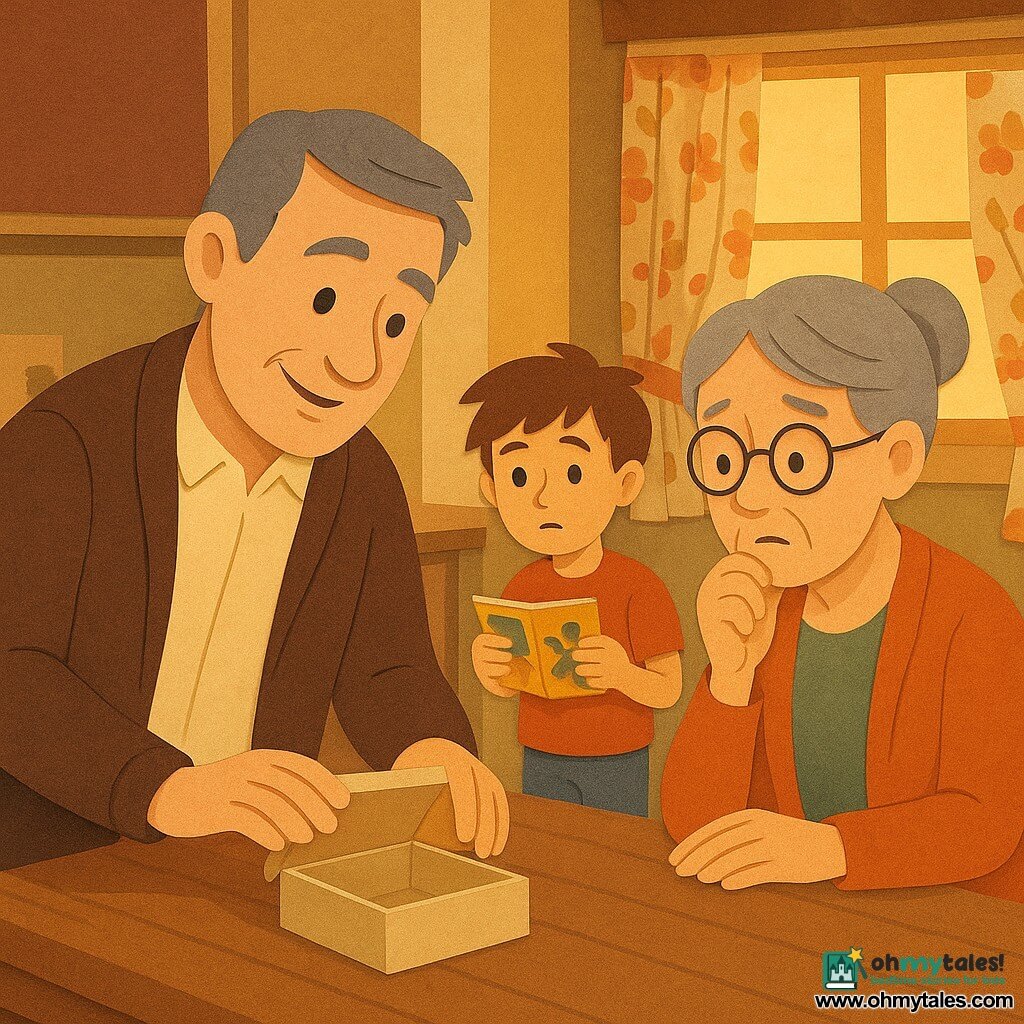
Mr. Park checked his watch and smiled at the bright morning on Maple Lane. The sun made the leaves look like little coins. He was sweeping outside his small blue house when Mrs. Gomez hurried up, holding a wrapped box carefully.
"Mr. Park!" she said. "It's gone. The Golden Acorn is missing."
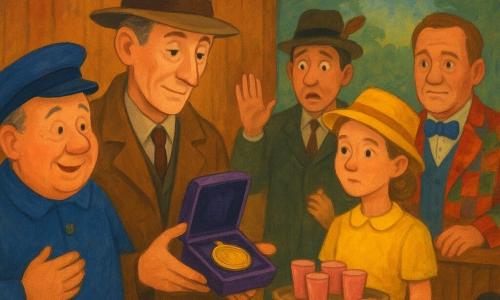
Mr. Park gently set down his broom. He knew the Golden Acorn trophy. It was small and shiny, with a little maple leaf carved on the base. It sat in the town hall every year until Good Neighbors Day. Everyone on Maple Lane took turns caring for it.
"Tell me everything," Mr. Park said, folding his hands. He liked to listen first.
Mrs. Gomez took a deep breath. "I brought it home last night to clean the base," she said. "I left it on my kitchen table when I went to bed. This morning, the box was empty. The window lock was fine. I asked my cat, Tibbles, and he only blinked."
Mr. Park knelt and looked at Mrs. Gomez's shoes. He noticed three tiny mud specks and a small, torn leaf stuck to the sole.
"Hmm," he murmured. "Did you hear anything? Any footsteps or voices?"
"Just the kettle when I boiled water," she said. "And the radio. Nothing strange."
Mr. Park smiled kindly. "We'll solve this together. Can you show me the table?"
They walked inside. Mr. Park studied the table, the chair, the windows, and the box. He touched the air gently, like he was asking the room to remember.
"The box was here," Mrs. Gomez said. "But now it's empty."
"Good," Mr. Park said. "Thank you. Let's ask a few neighbors. Sometimes things have a simple answer."
He took a pencil and a small notebook from his pocket. Not that he needed it for everything, but he liked writing clues down. He believed that careful notes helped the brain see patterns.
"First," Mr. Park told Mrs. Gomez, "no one should move anything until we check for clues. Can you think of anyone who knew you had the trophy?"
Mrs. Gomez thought hard. "Only the Maple Lane helpers and the town hall staff. And Mr. Lee from the bakery—he said he'd bring muffins for Good Neighbors Day."
"Good. We'll visit them," Mr. Park said. "Let's start down the lane."
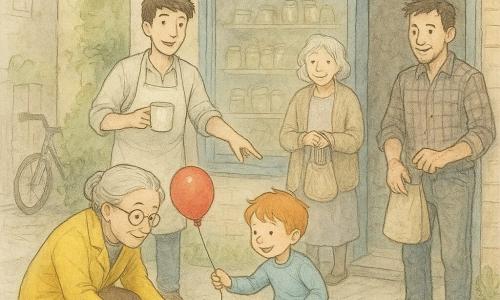
They set off. On Maple Lane, neighbors were bringing potted flowers and painting signs. Mr. Park greeted everyone with a soft, steady voice.
"Has anyone seen a small, shiny acorn?" he asked.
"Not me," laughed Mrs. Parsons as she watered her petunias. "But I saw a squirrel with shiny eyes yesterday. Could it be a squirrel?" she teased.
Mr. Park smiled. "A good thought. Squirrels like shiny things, but we will look for clearer clues."
Chapter Two: Little Clues, Big Questions
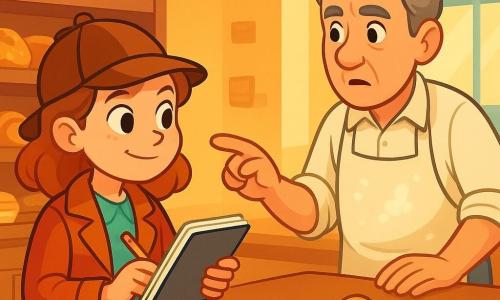
Mr. Park and Mrs. Gomez went to the bakery. The bell above the door jingled.
"Good morning," said Mr. Lee, wiping flour on his apron. "You found a clue?"
"Thank you for the muffins offer, Mr. Lee," Mr. Park said. "Did you see anything last night?"
Mr. Lee shook his head. "I closed early and went home. But I did see a trail of crayon marks near the park swing this morning. Maybe the children were drawing."
"A trail of crayon marks," Mr. Park repeated, writing it down. "Can you show us?"
They followed a faint line of blue and red to the small park. On the ground were smudges of crayon and a tiny torn page from a comic book. Near the bench, someone had dropped a small paper bag with a sticker showing a smiling fox.
"That's from the library's story hour," said Mr. Park. "Maybe someone was here last night or early this morning."
"Could the trophy have been moved to keep it safe?" Mrs. Gomez asked.
"Possible," Mr. Park said. "Let's ask at the library."
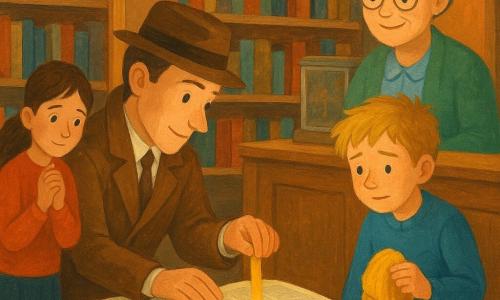
At the library, the librarian, Ms. Patel, was shelving books with careful hands.
"Ms. Patel," Mr. Park said, "did anyone bring a box or a shiny object yesterday?"
She tapped her chin. "Last night, the story hour kids left quickly. One boy, Sam, had mud on his shoes and a folded comic. He said he was helping his sister with a surprise."
"Did he say what the surprise was?" asked Mr. Park.
"No," said Ms. Patel. "But I remember he borrowed a book about acorns."
Mr. Park wrote down "acorn book" and "boy with mud." He liked to put clues side by side, like sorting colored beads.
"Did Sam say where he was going?" Mrs. Gomez asked.
"He went toward Maple Lane," said Ms. Patel. "I think he planned to meet someone."
"Thank you. One more question—" Mr. Park paused to be polite, "—did you notice any broken locks or open windows at the hall?"
"No," said Ms. Patel. "Everything looked the same."
They walked back, feeling a little closer to an answer. On the way, Mr. Park stopped to watch two children building a tall tower of empty cans.
"Do you like puzzles?" he asked them.
"We love puzzles!" the girl said.
"Can you look carefully around the lane for anything shiny? Cans, boxes, or little leaves? You can tell me what you find," Mr. Park suggested. He believed that curious eyes made good helpers.
The children dashed off eagerly. Mr. Park and Mrs. Gomez visited the town hall next. The mayor, Mr. Benson, was calm and glad to help.
"We keep the trophy in a locked display," he said. "I brought the key over last night. It was on the nail as usual." He took them to the hall and showed the key. It had a small notched edge and a red ribbon tied to it.
"Did you take the ribbon off?" Mr. Park asked.
"No," said Mr. Benson. "It is as it was. But I do remember leaving a note in the hall for the Good Neighbors Day schedule."
Mr. Park peered at the note. On the back was a smudge of blue crayon and three tiny brown dots like mud. The dots matched the marks on Mrs. Gomez's shoe.
"Interesting," Mr. Park said softly. "Someone touched this note after visiting Mrs. Gomez."
"Who would carry a note and a comic?" Mrs. Gomez asked.
"People who plan surprises," Mr. Park said. "Let's talk to Sam."
Chapter Three: Questions and Patience
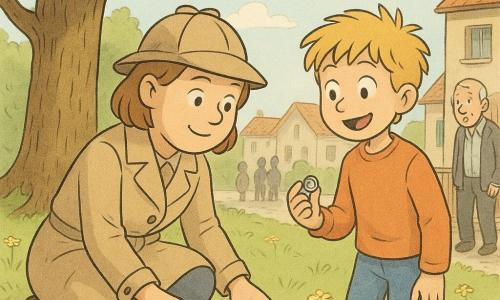
They found Sam near the park, carefully arranging leaves into a crown. He had mud on his sneakers and a comic book folded in his pocket.
"Hello, Sam," Mr. Park said. "I hear you were helping your sister."
Sam looked up. "I was! Isabelle wanted to make a display for Good Neighbors Day."
"Did you see a trophy last night?" Mr. Park asked gently.
Sam shook his head. "No. But I saw Mrs. Gomez's box when I was with Isabelle. She asked if I could help carry it to the hall because she wanted to tuck it under a table so it would be safe while she cleaned the base."
"Where did you put it?" Mrs. Gomez asked, surprised.
"I thought under the bench by the swings was safe," Sam said. "It was rainy yesterday and the bench was dry because of the little roof. I left the box there and came back to get it in the morning, but... someone had opened it."
Mr. Park's eyes narrowed with friendly focus. "Did you see anyone else near the bench?"
Sam bit his lip. "I saw Mr. Lee walking by. And there was a person with a red hat who I think was carrying a bag."
"Did you notice anything else?" Mr. Park asked.
Sam blinked. "There were crumbs on the bench. And a little sticker—like the fox one from my bag."
"Thank you, Sam," Mr. Park said. "You did well. Let's check the bench."
They walked to the bench. The seat had tiny crumbs and the fox sticker stuck to the wood. Under the bench, the ground was soft with mud. Mr. Park crouched and looked closely. He saw three small marks in the mud—two were shoe prints, and one was a small triangle, like from a boot's sole.
"Hmm," he murmured. "These prints are fresh. The triangle could be from a gardener's boot."
"Mr. Park," said a voice, "I was just here trimming the ivy." It was Mr. Green, the gardener, with dirt under his nails and a wide smile.
"Did you see the bench earlier?" Mr. Park asked.
"I trimmed around it this morning," said Mr. Green. "Someone left a paper bag with muffins. I moved the bag to keep the rain off them. The bag had a sticker of a fox—my granddaughter loves those, so I put it in my cart."
Mr. Park wrote this down. He liked to make each clue a small dot and then connect them. A pattern began to appear: the comic, the fox sticker, the muffins, the mud, the bench.
"Isabelle!" a voice called. A small girl with pigtails skipped up. She held a paper lantern shaped like an acorn. "I wanted the trophy to be part of our acorn display," she said. "We thought it would look pretty."
"Where did you put the box?" Mr. Park asked gently.
Isabelle pointed to the bench. "Sam put it there. It was under my drawing of a tree. When I went to the hall to get the base, it was gone."
"Did you see anyone take it?" Sam asked.
"No," Isabelle said. "But I saw a squirrel that looked very interested."
Mr. Park smiled at the squirrel comment. He then asked, "Who would like to help look in the places we've spoken about? We'll search together calmly."
"Oh! I can check the bakery," said Mr. Lee. "I might have moved the bag."
"And I'll check by the hall again," said Mr. Benson. "Maybe I put the trophy in a different box."
Mr. Park felt the gentle pulse of neighbors working together. "Let's share what we've found and make a plan," he said.
They listed clues: the empty box at Mrs. Gomez's table, crayon smudges, mud and triangle prints, fox sticker, comic page, muffins, and the children's plan. Each item was small, but together they made a picture.
"Who had both a bag and the key?" Mr. Park asked. "We must be kind in asking, but we need to know if someone moved the trophy to keep it safe."
Chapter Four: A Kind Question
Mr. Park walked to Mr. Green's shed. The gardener was cleaning tools.
"Mr. Green," Mr. Park said, "we found a fox sticker and a muffin bag by the bench. You moved the bag—thank you. Did you notice a shiny object inside?"
"No shiny things," Mr. Green said. "Just crumbs. But my granddaughter, Rosa, sometimes brings things and hides them in my cart. She thought she found treasure last week."
"Could Rosa have moved the trophy to keep it safe without telling anyone?" Mr. Park asked.
He smiled, not accusing. People sometimes acted quickly to help and forgot to tell others. Mr. Green's face changed. He wiped his hands.
"Rosa!" he called, and a small girl with pasty hands and pink hair ribbons ran up, hugging a stuffed squirrel.
"Did you take something shiny?" Mr. Park asked kindly.
Rosa's eyes blinked. She looked down at her hands. "I took something I found," she said. "It was shiny and lonely under the bench. I thought it looked sad, so I put it in my little wooden box."
"Where is your box?" Mrs. Gomez asked softly.
Rosa pointed to the shed. Mr. Green opened the box carefully. Inside lay the Golden Acorn trophy, wrapped in a small handkerchief with a blue crayon mark.
Mr. Gomez let out a small laugh of relief. "Rosa, you must tell when you move something that doesn't belong to you," he said.
Rosa's eyes filled. "I didn't mean to make anyone worried. I just wanted to keep it safe."
Mr. Park knelt and looked at her. "You wanted to help, and that's kind. Next time, tell an adult where you put it, so everyone knows. Helping and telling is a good teamwork."
Rosa hugged the trophy and whispered, "I'm sorry."
"Thank you for bringing it back," Mrs. Gomez said, hugging her. "We are glad everyone is safe."
Mr. Park wrote the final notes. The triangle boot print? It came from Mr. Green's rubber boots. The fox sticker came from the muffin bag Mr. Green had moved. The comic page belonged to Sam, who had been with Isabelle. The blue crayon smudge matched the handkerchief in which Rosa had wrapped the trophy. Each small clue fit together, like puzzle pieces.
"Everything points to kind intentions," Mr. Park said quietly. "A child acted to help, neighbors moved things to protect treats, and adults cleaned and carried items. No one meant to hide the trophy."
Chapter Five: Good Neighbors Day
Back at the hall, they placed the Golden Acorn on its velvet stand. The town set the table for the day. Children hung acorn lanterns, and neighbors baked pies. The sun leaned warm on Maple Lane.
"How shall we explain this?" Mr. Benson asked. He looked relieved and thoughtful.
"Simply and kindly," Mr. Park said. "We will tell the truth: the trophy was moved to keep it safe, and Rosa found it and wrapped it in a handkerchief. Everyone did their part. The important lesson is to tell others when you try to help."
They all nodded. Mr. Park stepped forward with a calm, steady voice.
"Neighbors of Maple Lane," he said. "The Golden Acorn is back. It was moved so someone could keep it safe, but they forgot to tell anyone. We solved the mystery by noticing little things and asking kind questions. Let us celebrate being curious, careful, and honest."
The crowd clapped. Rosa blushed but smiled. Sam and Isabelle grinned, proud to have helped. Mr. Park felt a pleasant warmth in his chest. Solving the case was never just about finding things; it was about listening, asking, and helping the community feel safe.
Later, while everyone enjoyed muffins, Mr. Park sat with Mrs. Gomez and Rosa. "Do you know what made the difference?" he asked.
"What?" Rosa asked, nibbling a muffin.
"Listening, asking gentle questions, and putting clues together without blaming," Mr. Park said. "You were brave to bring the trophy back. That shows honesty."
Rosa's eyes shone. "I will tell next time."
"That is a good plan," said Mrs. Gomez. "And we'll make a little card where anyone who moves the trophy can write where they put it."
"Good thinking," Mr. Park said, smiling.
As the sun set, Maple Lane felt like a puzzle solved by many hands. The Golden Acorn gleamed under the hall's lights. Mr. Park strolled home, pleased with the quiet rhythm of the lane—the kind where neighbors help and speak kindly.
He made one more note in his little book: Observations + Questions + Patience = Answers. He folded the paper and tucked it into his pocket, ready for the next small mystery that needed a calm mind, warm heart, and curious eyes.