Chapter 1: The Missing Jar
Maya Bell liked quiet details.
She liked the way a shoe left a tiny line of dust, the way a person held a bag, the way a “hello” could sound brave or bashful. Maya was a young detective, and she carried a small notebook, a pencil, and a calm smile. People said she noticed things that other people walked right past.
This morning, the Sunnybrook Market felt extra bright. Baskets of apples shone like red marbles. A bell above the door went “ding” in a cheerful way. It should have been an easy day.
But Mrs. Larkin, who ran the jam table, looked like she was trying not to frown too hard.
“The Honey-Apple Jam Prize Jar is gone,” she said. Her voice stayed gentle, but her hands kept smoothing her apron, again and again. “It's for the kids' reading contest. Everyone puts their name in. We draw one name at the end. Now the jar is missing.”
Maya leaned closer to the jam table. She did not touch anything yet. First came looking.
The table was neat. Too neat. The place where the jar usually sat was a clean circle on the cloth, like a moon shape. Next to it was a little sticky mark, shiny and pale gold.
“Was the jar full?” Maya asked.
“Full of folded name slips,” Mrs. Larkin said. “And one blue ribbon tied around the lid.”
Maya wrote: Jar. Name slips. Blue ribbon. Sticky mark.
Around them, the market went on. People laughed. A child carried a loaf of bread like it was treasure. No one looked scared. Mrs. Larkin gave a small sigh. “I don't want to blame the wrong person,” she added.
Maya nodded. “Integrity,” she said softly, as if she were reminding herself. “We stick to facts.”
She looked around the area. Three people were close enough to have seen something.
Mr. Pine, the baker, was stacking muffins into a tall tower. He wore flour on his sleeves like white clouds. He kept glancing at the jam table, then quickly looking away.
Tessa, who delivered flowers, was arranging bright daisies in metal buckets. Her hands moved fast, but her eyes were careful. She had a roll of blue ribbon on her cart for tying bouquets.
And Jonah, the market helper, was sweeping the floor with a wide broom. He was humming. Every now and then he stopped and nudged something into his dustpan, as if he wanted the floor to be perfect.
Maya lifted her notebook. “I'm going to ask a few questions,” she said. “Not because I think you're bad. Because I want the truth to be clean.”
Mrs. Larkin nodded. Her shoulders relaxed a little, as if “clean truth” sounded like something safe.
Maya began with the ground. A detective's eyes often started low.
Under the jam table, she saw a tiny piece of blue ribbon. It was short, like it had been snipped. It rested beside a faint line in the dust, as if something had been dragged.
Maya did not pick it up yet. She only looked and thought.
A missing jar. A ribbon piece. A sticky mark. A faint drag line.
She wrote one more line in her notebook: Who had blue ribbon? Who had sticky hands? Who had time?
Then she looked up, ready to watch faces and hands as much as words.
Chapter 2: Watching Words and Hands
Maya walked to Mr. Pine first. His muffins smelled warm and sweet.
He kept stacking, but his fingers were clumsy today. A muffin slipped. He caught it too fast, almost squashing it.
“Good morning,” Maya said.
“Morning,” Mr. Pine answered. He smiled, but his smile stayed small. His eyes flicked to her notebook.
Maya studied his sleeves: flour. And a tiny smear of something shiny on his thumb—could be butter, could be honey.
“Did you see the prize jar this morning?” Maya asked.
Mr. Pine cleared his throat. “I saw it earlier. When I brought over a jar of my cinnamon spread. Mrs. Larkin was busy. Then I went back to my oven.”
Maya listened for the shape of the story. It had a clean beginning and end. No extra bumps.
“Did anyone walk past the jam table while you were near it?” she asked.
He paused a beat too long. “Lots of people,” he said. “It's a market.”
Maya nodded. True, but also too wide. Sometimes a wide answer hid a small detail.
She looked at his cart. A roll of string. Paper bags. A little box marked “Labels.” No blue ribbon.
“Thank you,” Maya said. “Please keep doing your muffins. They look like a yummy tower.”
Mr. Pine's shoulders dropped a little, like he was glad to be useful at something.
Next, Maya walked to Tessa's flowers. The daisies seemed to grin. Tessa's cart was covered in tools: scissors, twine, and a bright roll of blue ribbon.
Maya noted Tessa's hands: clean, but with green stems stains. No sticky shine.
“Hi, Tessa,” Maya said.
Tessa smiled quickly. “Hi, Detective Maya.”
“Did you use blue ribbon today?” Maya asked.
Tessa lifted the roll. “Always. Blue is my happy color.”
Maya kept her voice calm. “Did you walk by the jam table?”
“Yes,” Tessa said. “I delivered a small bouquet to Mrs. Larkin's friend. The friend was waiting near the jam.”
“Do you remember what time?” Maya asked.
Tessa's eyes moved up, like she was looking at a clock in her mind. “Right after the bell rang at nine. I remember because my watch beeped.”
Maya wrote: Tessa passed at 9:00. Watch beep.
“Did you notice anything strange?” Maya asked.
Tessa tilted her head. “The jar was there. I saw the blue ribbon on the lid. It was tied in a bow. I thought it was cute.”
That mattered. If the jar was there at nine, then it went missing after nine.
Maya thanked Tessa and moved on.
Jonah was still sweeping. He stopped when he saw Maya. His cheeks were pink from working hard.
“Jonah,” Maya said, “can I ask you a couple questions?”
“Sure,” he said. He held the broom upright like a tall friend.
Maya watched his shoes. The bottoms had a little sticky dirt clinging to them. It looked like dried jam, pale and shiny.
“Where have you been sweeping?” Maya asked.
“Everywhere,” Jonah said proudly. “Mrs. Larkin likes the floor clean. I started near the door, then the fruit, then the jam table, then—”
He stopped. His mouth stayed open a tiny bit.
“Then what?” Maya asked gently.
Jonah swallowed. “Then I went to the back hall for a minute. To get more dustpan bags.”
Maya noticed his hands. One finger had a faint sticky mark. Not much, but enough to catch light.
“Did you see the prize jar when you swept by the jam table?” Maya asked.
Jonah blinked. “I think so,” he said. “I mean—yes. It was there. And then later I didn't see it.”
His words wobbled like a chair on uneven ground. Maya stayed kind. Kids and grown-ups both got nervous when they felt watched.
Maya glanced down at the broom. A strip of blue ribbon was caught around one bristle, like a little flag.
Maya pointed, not accusing, just noticing. “That ribbon—where did it come from?”
Jonah's eyes went wide. “I—I don't know,” he said. “Maybe from the flower cart? Sometimes ribbon falls.”
That was possible. But Maya had seen the ribbon piece under the jam table too.
Maya took a slow breath. A good detective did not jump. A good detective built steps.
She returned to the jam table and finally picked up the ribbon piece using a clean napkin. It felt smooth. It looked like it had been cut, not torn.
She looked at the sticky mark on the tablecloth. It smelled like honey and apple.
Maya turned to Mrs. Larkin. “Who else knows where you keep extra jars and ribbons?” she asked.
Mrs. Larkin frowned in thought, then shook her head. “No one. The prize jar is special. I bring it from home.”
Maya tapped her pencil on her notebook. The market felt sunny, but the mystery had a shadow of questions.
She needed one more kind of clue: a memory so clear it could snap the story into place.
Chapter 3: The Person with the Precise Memory
Maya walked the market slowly, as if she were counting steps. She listened to sounds: the bell “ding,” the scrape of a crate, the soft thump of a bag set down.
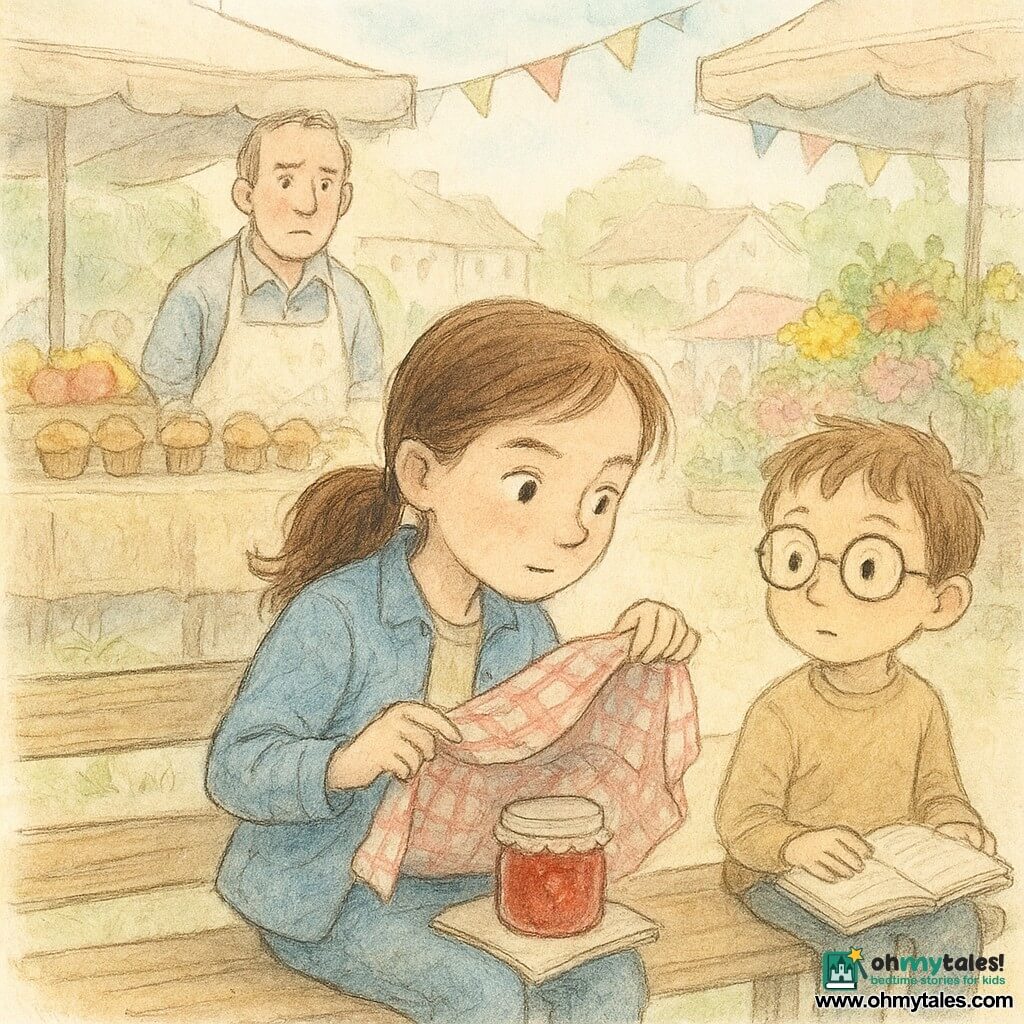
Near the reading contest sign, she noticed a boy sitting on a bench with a book open on his knees. He was small, maybe six, with big glasses and a serious face. His lips moved as he read, as if the words were tiny marching ants.
Maya knelt a few steps away, so she wouldn't startle him. “Hi,” she said.
The boy looked up. His eyes were sharp, like he saw letters in the air. “Hello,” he said.
“I'm Maya,” she said. “I solve puzzles. What's your name?”
“Eli,” he said. He held his place in the book with a finger.
Maya pointed gently at the reading contest sign. “Are you entering?”
Eli nodded. “I like lists,” he said. “And rules. And facts.”
Maya's heart gave a small hop. Facts were her favorite too.
“Eli,” she said, “did you happen to see the prize jar near Mrs. Larkin's jam table today?”
Eli's face brightened, not with excitement, but with certainty. “Yes,” he said. “I remember exactly.”
Maya leaned in, careful. “Tell me what you remember. Start with where you were.”
Eli lifted his finger from the page and pointed. “I sat here at 9:02. I know because the library clock across the street chimed at nine, and then my dad tied my shoelace, and it took two minutes. Then I started reading.”
Maya blinked. That was very exact.
Eli continued, his voice steady. “At 9:07, Mrs. Larkin brought the prize jar from the side shelf and put it on the table. She tied the blue ribbon into a bow. The bow had two loops. One loop was longer.”
Maya felt the story shift inside her, like a puzzle piece sliding into the right spot. If Mrs. Larkin put the jar out at 9:07, then Tessa saying she saw it at 9:00 could not be right. Or maybe Tessa had mixed up the time.
Maya asked, “How do you know it was 9:07?”
Eli adjusted his glasses. “Because at 9:05 a lady dropped oranges and said ‘oops,' and everyone helped. That took two minutes. Then Mrs. Larkin put the jar out.”
Maya pictured it. People stooping, oranges rolling, laughter, a quick kind moment. That seemed real. It also meant many eyes were on the area—good for finding witnesses.
“Did anyone touch the jar after she put it down?” Maya asked.
Eli nodded once, like a judge. “Yes.”
Maya kept her voice soft. “Who?”
Eli pointed with careful aim, not waving, not guessing. “Jonah. He came with the broom. He swept near the table. His broom hit the table leg. The jar wobbled. He grabbed it fast.”
Maya's mind clicked. A jar wobbling could leave a sticky mark if jam had leaked from under the lid. Jonah could have gotten sticky on his finger, and the broom could catch ribbon.
But wobble did not mean steal.
“What happened next?” Maya asked.
Eli took a breath. “Jonah looked at the jar. He read the label out loud, but very quietly. Then he set it back. Then he kept sweeping.”
Maya wrote: 9:07 jar set out. Jonah grabbed when it wobbled. Looked at it. Set back.
Eli's memory was a spotlight.
“Did you see the jar leave the table?” Maya asked.
Eli nodded again. “Yes. At 9:13.”
Maya's pencil paused. “Tell me.”
Eli's voice stayed calm. “Mr. Pine came over holding a tray with muffins. The tray was covered with a cloth. He leaned close and said, ‘Excuse me.' He reached near the jar. But I couldn't see his hand because of the cloth.”
Maya pictured Mr. Pine's flour sleeves, his nervous glances. Still, nervous did not mean guilty.
Eli added one more detail, the kind that made a detective's thoughts snap straight. “Then I heard a soft clink, like glass touching wood, from inside the tray area. And Mr. Pine walked away to his stall. His cloth was lower on one side after that.”
Maya's stomach fluttered, not with fear, but with focus. This was the bascule, the turning point—the precise memory that changed the path.
Now Maya had to do the most important thing: check facts with kindness and integrity.
She stood, thanked Eli, and walked back toward the muffins.
Chapter 4: A Clean Truth and a Name Washed
Maya did not run. Running made people panic, and panic made facts messy.
Mr. Pine was handing a muffin to a customer. His smile looked more natural now, but his eyes still darted.
Maya waited until the customer left. Then she spoke in a quiet voice, so the market could stay calm.
“Mr. Pine,” she said, “I need to look at your tray and cloth.”
His face turned the color of plain dough. “Why?”
Maya kept her tone steady. “Because someone with a very precise memory saw something. And because I want to clear names, not smudge them.”
Mr. Pine swallowed. He set the tray on his table.
Maya did not grab the cloth. She held out her napkin-covered ribbon piece instead. “This was under the jam table,” she said. “I also saw ribbon on Jonah's broom. And there was a sticky mark on the tablecloth. That could come from a wobble.”
Mr. Pine stared at the ribbon. “I didn't take it,” he blurted. Then, after a second, he added, “Not to keep. Not like stealing.”
Maya's eyes stayed on his hands. His fingers were clean except for a small shiny patch near his thumb.
“Tell me the whole thing,” Maya said. “From the start.”
Mr. Pine let out a long breath, like he had been holding it all morning. “I saw Mrs. Larkin bring out the jar,” he said. “And I thought of last year.”
Maya waited.
“Last year,” Mr. Pine continued, “my niece entered the contest. She loves reading. But her name slip got stuck to another slip because the jar was sticky. When they drew the name, her slip didn't fall out. She cried. I felt awful.”
Maya pictured it: a small disappointment that felt huge.
“So today,” Mr. Pine said, “when I saw the jar wobble and Jonah's finger get sticky, I worried again. I thought, ‘What if the slips stick? What if a kid loses a fair chance?'”
Maya nodded slowly. “What did you do?”
Mr. Pine rubbed his floury sleeve over his forehead. “I had just baked fresh muffins. I took my tray and cloth and I… I slipped the jar under the cloth for a minute. I carried it to my stall so I could wash it. I know it sounds wrong.”
“It sounds like hiding,” Maya said gently, “even if your reason was to help.”
He winced. “Yes. I should have told Mrs. Larkin. But she looked busy, and I didn't want to bother her. I thought I'd be quick. Wash it, dry it, bring it back. Clean and fair.”
Maya reached for the cloth now. Mr. Pine did not stop her.
Under the cloth, the prize jar sat on the tray, safe and unbroken. The blue ribbon was there too, though the bow was messy. A short snip was missing—matching the piece Maya found.
Maya felt relief bloom like a warm light. The jar was not gone. The contest was not ruined.
But there was still one more job: make the truth clear, and make sure no one's name stayed dirty.
Maya carried the jar back with Mr. Pine walking beside her, looking smaller with each step. Jonah trailed behind, eyes worried, broom held low.
At the jam table, Mrs. Larkin pressed a hand to her chest. “Oh! There it is!”
Maya set the jar down carefully. “We found it,” she said. “No one is in trouble. But we do need to sort the facts.”
She turned to Mr. Pine. “Tell Mrs. Larkin what you told me.”
Mr. Pine's voice shook at first, then steadied. He admitted he moved the jar without asking. He explained last year's stuck slips. He held up his hands. “I wanted to make it fair. I chose a bad way.”
Mrs. Larkin's eyes softened. “You should have told me,” she said. Her voice was firm but not harsh.
“I know,” Mr. Pine said.
Maya looked at Jonah next. “Jonah, you did not steal it,” she said. “Eli saw you grab it when it wobbled. That's all.”
Jonah's face loosened, like a knot coming undone. “I thought I'd be blamed,” he whispered.
“You won't,” Maya said. “Because we check the truth. We don't guess.”
She opened the jar. Inside, the folded name slips looked fine, but Maya noticed a few were stuck together near the bottom. A tiny smear of jam clung to the glass.
Mrs. Larkin peered in. “Oh dear. It is a bit sticky.”
Mr. Pine lifted his chin. “Let me wash it the right way,” he said. “With you watching. And I'll dry it completely. And we can put the slips in a clean bowl while we do.”
Mrs. Larkin nodded. “That sounds fair.”
Maya smiled. “That sounds like integrity,” she said.
They moved to a sink area behind the stall, where everything stayed in view. Mrs. Larkin poured the slips into a clean metal bowl. Maya watched as Mr. Pine washed the jar with warm water, careful hands, and no secrets. Jonah helped by holding a towel. Tessa offered a fresh piece of blue ribbon and trimmed it neatly, so the bow had two loops, one slightly longer—just like Eli remembered.
When the jar was dry, Maya helped Mrs. Larkin drop each name slip back in, one by one. They shook the jar gently so nothing stuck.
Back at the table, Mrs. Larkin faced the small crowd that had gathered. “There was a mix-up,” she said. “But the jar is clean, and the contest will be fair.”
A few people clapped. Someone laughed in relief. The market's sunny feeling returned, as if it had been waiting just behind a cloud.
Mr. Pine looked at Jonah. “I'm sorry your name almost got dragged into my mistake,” he said.
Jonah managed a smile. “I'm just glad it's okay,” he said.
Maya wrote one last line in her notebook: Solution—jar moved to wash; no theft; fairness restored.
Then she drew a neat line under it, the way she liked to end a case.
Eli wandered over with his book. He looked at the clean jar and nodded once, satisfied.
Maya leaned down to him. “Your memory helped,” she said.
Eli pushed his glasses up. “Facts help,” he replied, and went back to his bench.
As the day went on, kids dropped their folded slips into the jar, giggling and hopeful. The blue ribbon shone like a calm sky.
And when people spoke about the mystery later, they didn't say, “Who took it?” anymore.
They said, “Maya solved it fairly.”
Most important, Jonah's name was washed clean, and so was the jar—ready for a fair draw, and a happy ending.