Chapter 1: The Missing Medal
Detective Miles Carter liked three things: tidy notebooks, warm tea, and puzzles that could be solved with calm thinking.
On Tuesday morning, a puzzle walked right into his little office above the bakery.
Mr. Pippin, the town's nicest mail carrier, stood in the doorway holding his cap in both hands. His cheeks were pink, like he had hurried.
“Detective Carter,” he said, “I need help. Everyone thinks I did something I didn't do.”
Miles offered the chair by the window. “Sit. Tell me what happened.”
Mr. Pippin sat, looking as if his chair might float away. “The Golden Acorn Medal is gone. It was going to be given at the Sunnybrook Fair today. I was asked to deliver it to the fair hall, but… it never arrived.”
“The Golden Acorn Medal,” Miles repeated, writing the words neatly. “And people think you kept it?”
Mr. Pippin nodded, eyes shiny. “They say, ‘You had it last.' And I did. For exactly five minutes. I'm careful, Detective. I count letters for fun.”
Miles glanced at the baker downstairs through the floor vent. The smell of cinnamon buns drifted up. Nothing scary here, just a serious problem.
“Let's use logic,” Miles said gently. “If you're innocent, we can prove it. Start at the beginning. Where did you pick it up?”
“At the Town Museum,” Mr. Pippin said. “Curator Lila handed me a small velvet box. I put it in my mail bag, in the special pocket with the button. Then I cycled straight toward the fair hall.”
“Did you stop?”
“Only once,” Mr. Pippin said quickly. “At the fountain, because my shoelace got caught in the pedal. I fixed it. Then I rode on.”
Miles tapped his pen. “Who saw you at the fountain?”
Mr. Pippin thought. “Nina from the lemonade stand. And a man with a big camera. He was taking photos of ducks.”
Miles stood and put on his coat. “All right. We'll follow the path of the medal. We'll look, we'll ask, we'll listen. And we'll keep our minds clear. Ready?”
Mr. Pippin swallowed. “Yes, sir.”
They went downstairs into the bright morning. Outside, Sunnybrook was busy with fair-day excitement: ribbons on lampposts, paper flags, and a marching band warming up by playing the same note again and again.
Miles smiled a little. “That band is practicing perseverance,” he said.
Mr. Pippin managed a tiny smile, too. “They're practicing one note very bravely.”
Miles pointed to the museum first. “Let's confirm the start.”
At the museum, Curator Lila met them by the front steps. Her hair was in a neat bun, and her keys jingled like little bells.
“I already told the mayor,” she said, “I gave Mr. Pippin the medal box at nine sharp.”
Miles held up his notebook. “May I ask a few precise questions?”
Curator Lila nodded.
“Was the box sealed?” Miles asked.
“It had a silver ribbon,” she said. “I tied it myself.”
“Any marks on the ribbon? A sticker, a stamp?”
She blinked. “A tiny owl sticker. It's our museum logo.”
Miles wrote: owl sticker.
“And after you tied it,” he asked, “where was it kept before Mr. Pippin arrived?”
“In the display room safe,” she said. “Only I have the key.”
Miles thanked her. He looked at Mr. Pippin. “So the medal left the museum in a velvet box with a silver ribbon and an owl sticker.”
Mr. Pippin nodded firmly. “That's right.”
Miles turned toward the sunny street. “Now we follow the rest of your morning—step by step.”
Chapter 2: Clues on a Bike Path
They walked to the fountain in the town square. Water sparkled, and coins shone at the bottom like sleepy stars.
Nina, the lemonade seller, was setting up her table. She wore a yellow hat with a lemon pin.
“Miles!” she called. “Want a free sample? It's fair day!”
“Later,” Miles said. “First, a mystery. Nina, did you see Mr. Pippin here this morning?”
Nina leaned forward. “Yes. He was wrestling his shoelace like it was a snake.”
Mr. Pippin coughed. “It was just… very long.”
Miles asked, “Did you see anyone near his bike? Anyone close enough to touch the mail bag?”
Nina squeezed her eyes shut, thinking hard. “I saw the camera man. And I saw Mrs. Bramble with her fluffy dog. And I saw… oh! I saw a kid drop a balloon, but that doesn't count, right?”
Miles nodded. “Every detail can count, but we'll be careful. Nina, did you notice anything odd about the mail bag?”
Nina snapped her fingers. “It was open for a second. Mr. Pippin reached in to check the pocket, like he was making sure something was still there.”
Mr. Pippin looked upset. “I did. I was worried.”
Miles put a steady hand on Mr. Pippin's shoulder. “Worry is normal. We just need facts.”
He looked around the fountain. On the stone edge was a small scrap of silver ribbon, caught under a pebble.
Miles picked it up carefully. “Mr. Pippin,” he asked, “does this look like the ribbon from the box?”
Mr. Pippin's eyes widened. “Yes. That's it. Same shine.”
Nina gasped. “So it got opened here?”
“Maybe,” Miles said. “Or the ribbon was torn later and dropped here. We need more.”
He looked at the ground near the fountain. A bicycle track curved away toward the fair hall, and beside it were two sets of footprints—one from a shoe with a zigzag sole, and another from a boot with a circle pattern.
Miles pointed. “Mr. Pippin, your shoes—zigzag?”
Mr. Pippin lifted a foot. “Yes.”
“And the boot prints?” Miles asked.
Nina shrugged. “Lots of people wear boots.”
Miles's pen moved fast. Boot prints, circle pattern.
A man with a large camera walked by again, camera hanging from his neck. He had a hat with a feather stuck in it, as if he wanted to look fancy.
Miles stepped in front of him politely. “Excuse me. Were you here this morning taking photos of ducks?”
The man's smile was quick, but his laugh came out in short bursts. “Heh—ha! Yes! Ducks are… very important. Ha-ha.”
It sounded like a nervous laugh, the kind that tries to hide a wobble.
Miles stayed calm. “Did you see Mr. Pippin at the fountain?”
The man nodded too fast. “Sure. Shoelace trouble. Funny. Heh.”
“Did you take any photos around that time?” Miles asked.
“Only ducks,” the man said, still laughing. “Just ducks. Lots of ducks.”
Miles tilted his head. “May I see one photo? Sometimes backgrounds help.”
The man hugged his camera closer. “Oh—no, no. Battery is… shy.” He laughed again, sharp and quick. “Heh!”
Miles did not accuse him. In Sunnybrook, accusing without proof was like dropping a pie: messy and rude.
“All right,” Miles said. “Thank you.”
As the man hurried away, Miles watched his boots. Circle pattern.
Mr. Pippin whispered, “Do you think he took it?”
“I think he knows something,” Miles said. “And the ribbon tells us the box was opened at some point. Now, we need to find where the medal went.”
They followed the path toward the fair hall. On the way, Miles stopped by a trash bin near the park gate. Something glinted inside: a tiny owl sticker, stuck to a crumpled napkin.
Miles lifted it with two fingers. “Here's our museum owl.”
Mr. Pippin breathed in. “So the box was opened near the park!”
Miles nodded. “We're getting closer. Let's go to the fair hall. And then… we look for one clear thing that explains the whole story.”
Chapter 3: The Clear Picture Turn
The fair hall was busy but friendly: bright banners, tables of crafts, and the smell of popcorn. At the front was a small stage with a shiny stand where the Golden Acorn Medal should have rested.
It was empty.
Mayor Tully stood nearby, looking serious but not angry. “Detective Carter,” he said, “we must find the medal before the ceremony. The whole town is watching.”
Miles nodded. “We will. And we will be fair to Mr. Pippin.”
Mr. Pippin stood very straight, as if his spine was holding up his courage.
Miles asked the mayor, “Who has been near the stand today?”
“A lot of helpers,” the mayor said. “And the photographer, Mr. Quill. He offered to take pictures for the ceremony.”
“Mr. Quill,” Miles repeated. “Feather in hat?”
“Yes,” said the mayor. “Odd laugh. But nice enough.”
Miles's eyes moved over the hall. He noticed a small table set up for photos: a chair, a painted forest background, and a sign that said: “Fair Day Portraits! Smile!”
Behind the table, Mr. Quill was adjusting his camera. He saw Miles and jumped a little.
Miles walked over with Mr. Pippin beside him. “Mr. Quill,” Miles said, “I found a piece of silver ribbon at the fountain and an owl sticker by the park. Those belong to the medal box.”
Mr. Quill's laugh came out again. “Heh! Wow! You find… stickers! Ha!”
Miles kept his voice soft. “I'd like to see your photos from this morning.”
Mr. Quill shook his head. “No need. Really. Just ducks.”
Miles glanced at the camera screen, which was turned away. “If it's only ducks, there's no harm. A clear picture can turn confusion into understanding.”
Mr. Quill swallowed. His hands fumbled, and his feather wobbled.
Mr. Pippin whispered, “My stomach feels like a washing machine.”
Miles murmured back, “Breathe. We're close.”
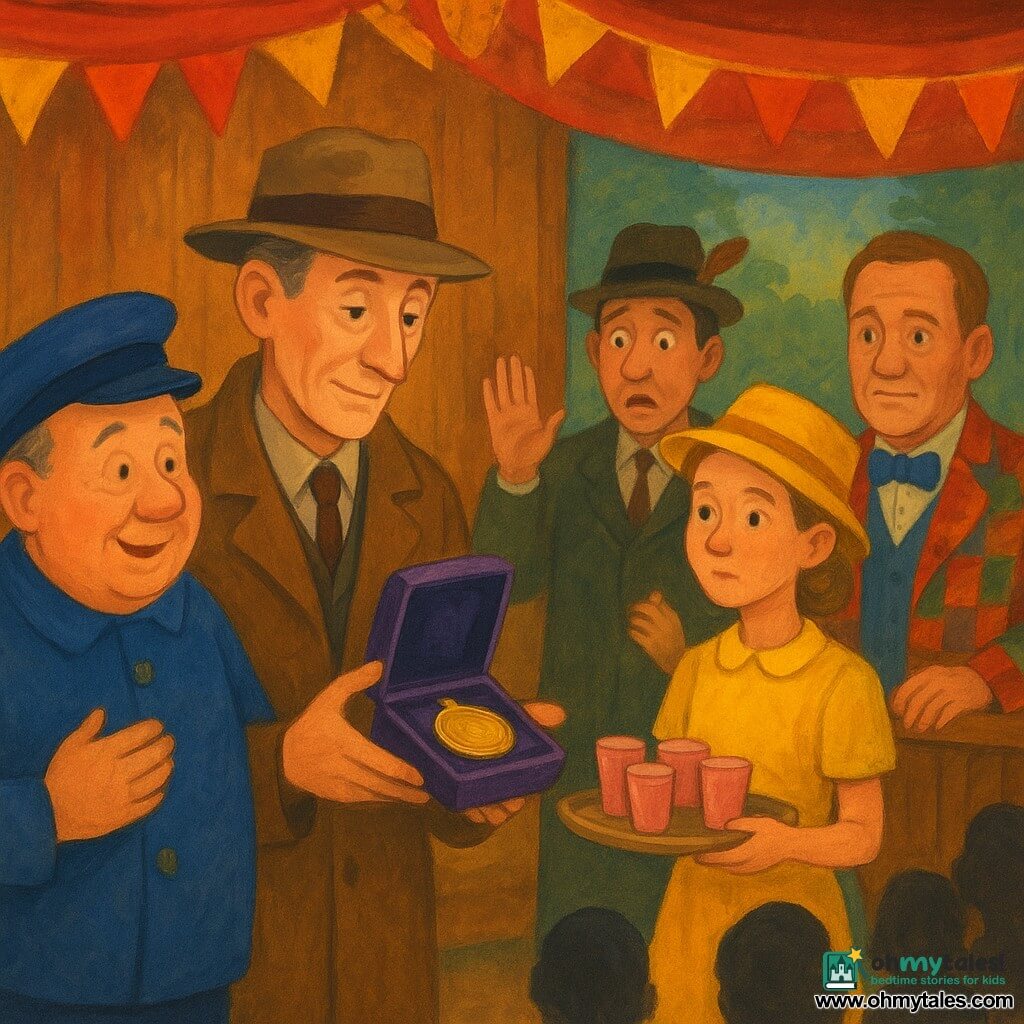
Then Nina appeared, carrying a tray of lemonade cups. “Detective! I remembered something!”
Miles turned. “Go on.”
Nina said, “When Mr. Pippin checked his bag at the fountain, the camera man was standing behind him. Not duck-side. Bag-side.”
Mr. Quill let out a nervous laugh so fast it sounded like hiccups. “Heh-heh-heh!”
Miles looked at Mr. Quill. “Mr. Quill, did you open the box?”
Mr. Quill's face went pale. He blurted, “I didn't steal it! I just… I just borrowed it!”
Mayor Tully blinked. “Borrowed the medal?”
Mr. Quill nodded quickly. “For a photo! The medal is shiny. Shiny things make good pictures. I thought I could take one perfect shot and put it back before anyone noticed. But then the ribbon tore, and the sticker fell off, and I panicked.”
Miles said, “Where is it now?”
Mr. Quill pointed toward the photo booth background. “Behind the painted forest. I hid it because I didn't want to be yelled at.”
Miles stepped behind the backdrop. There, wrapped in a handkerchief, was the velvet box. The silver ribbon was missing, but the box was safe.
Miles opened it carefully. Inside lay the Golden Acorn Medal, bright as a drop of sunlight.
Mr. Pippin made a small sound, half laugh and half sigh. “Oh… thank goodness.”
Mayor Tully crossed his arms. “Mr. Quill, that was not a wise choice.”
Mr. Quill's shoulders drooped. “I know. I'm sorry. My laugh does that when I'm nervous. It's like my mouth trips.”
Miles closed the box. “Mistakes happen. But we fix them by telling the truth.”
Mr. Quill nodded. “I'll tell everyone. And I'll apologize to Mr. Pippin in front of the whole hall.”
Miles glanced at Mr. Pippin. “Would that help clear your name?”
Mr. Pippin nodded, eyes wet again, but this time in a good way. “Yes. I just want people to know I didn't take it.”
Miles held up the medal box. “Then let's finish this the right way.”
Chapter 4: Proof, Perseverance, and a Shared Smile
Before the ceremony, Miles asked for a short moment on stage. The mayor agreed.
The fair hall quieted. Even the marching band stopped practicing their one brave note.
Miles spoke clearly, but not too loudly. “We found the Golden Acorn Medal. Mr. Pippin did not steal it. The evidence shows the box was opened after he left the museum. A piece of ribbon was left at the fountain, and the owl sticker was found near the park gate. Those clues led us here.”
He turned slightly and nodded to Mr. Quill.
Mr. Quill stepped forward, his feather trembling. He laughed once—small and nervous—then took a deep breath and stopped.
“I took it,” he said. “Not to keep. I wanted a photo with the medal because it's shiny. I opened the box at the fountain while Mr. Pippin fixed his shoelace. I shouldn't have. I got scared when the ribbon tore, so I hid it. I'm sorry.”
The room was silent for one heartbeat. Then Mayor Tully said, “Thank you for telling the truth.”
Mr. Pippin stepped forward, hands clasped. “I accept your apology,” he said. “But please, next time, ask. I would have held the box for you. Carefully. Very carefully.”
A few people chuckled kindly.
Miles watched Mr. Pippin's face. The tight worry lines were easing.
Mayor Tully lifted the medal box. “And now, as planned, we will honor the winners. But first, I want to honor someone else.”
He gestured to Mr. Pippin. “Mr. Pippin has served Sunnybrook with honesty for years. Today he was blamed too quickly, and he stayed calm. That takes strength.”
Mr. Pippin's ears turned red. “Oh my.”
Miles leaned toward him and whispered, “Perseverance. You didn't run away. You came for help.”
Mr. Pippin whispered back, “And you didn't stop asking questions.”
The ceremony continued. The Golden Acorn Medal was placed on its stand, shining again, right where it belonged.
Later, when the crowd thinned, Mr. Quill approached Miles and Mr. Pippin with two printed photos in his hands.
“I… I took pictures of ducks,” he said, trying a normal laugh and almost managing it. “But I also took one of the fountain. By accident.”
He handed the photo to Miles.
The image was clear: Mr. Pippin bent over his shoelace, Nina at her table, and behind them Mr. Quill's own hand reaching toward the open mail bag pocket.
Mr. Quill sighed. “The camera saw what I didn't want to admit.”
Miles nodded. “A clear picture can be a kind of truth. It helps us stop guessing.”
Mr. Pippin looked at the photo. Then he looked at Mr. Quill. “Next time you feel nervous,” he said, “you can laugh, but you can also tell someone. It's easier.”
Mr. Quill smiled, this time without the hiccup-laugh. “I will.”
Outside, the sun was lower, and the paper flags fluttered like tiny wings. Miles walked Mr. Pippin to his bicycle.
Mr. Pippin patted the special pocket with the button. “I'll keep delivering mail,” he said. “And I'll keep counting letters for fun.”
Miles closed his notebook. “And I'll keep solving problems with logic.”
Mr. Pippin hesitated, then grinned. “Detective Carter… would you like that lemonade sample now?”
Miles pretended to think very hard. “I must consider the evidence,” he said. “The evidence suggests… yes.”
They each took a cup from Nina's tray. The lemonade was sweet and sharp, like a happy surprise.
Mr. Pippin lifted his cup. “To persistence,” he said.
Miles clinked his cup lightly against it. “To truth.”
They shared a smile—simple, warm, and sure—while the fair buzzed on around them, bright as the medal itself.