Chapter 1: The Missing Medal
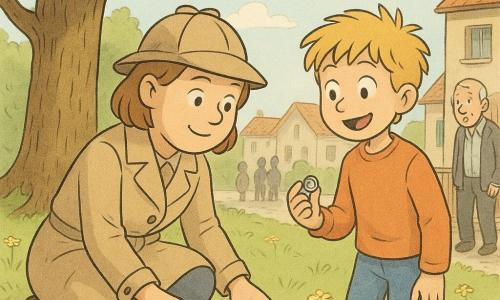
Detective Miles Carter liked quiet mornings. They helped him notice small things: a shoeprint that was slightly crooked, a mailbox left open, a smile that looked brave but tired.
Today, the morning was not quiet.
The Sunnybrook School Fair was starting in two hours, and the principal's face was the color of warm milk—pale and worried. She stood in the hallway beside a glass case that was now empty.
The Golden Acorn Medal was gone.
It wasn't a huge treasure. It was about the size of a cookie, bright gold-colored, with an acorn on the front and a ribbon the color of autumn leaves. But it mattered. Every year, the medal was given to a student who showed kindness and courage. The whole school loved it. Parents took photos. Kids clapped until their hands stung.
Now there was only a rectangle of clean space inside the case, like a missing tooth.
Miles did not rush. He did what he always did first: he looked, he listened, and he checked how people felt.
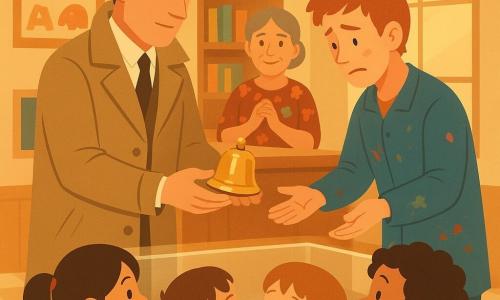
Principal Hartley rubbed her hands together. “I'm sorry to pull you in so early,” she said. Her voice was steady, but her eyes kept flicking to the empty case. “I locked the case last night. I'm careful. I always am.”
“Being careful is a good habit,” Miles said. “Let's stay calm. Missing things often have simple reasons.”
A janitor, Mr. Dune, stood nearby with a mop. He looked upset too, the way someone looks when they worry they will be blamed for rain.
A teacher, Ms. Lane, was holding a clipboard so tightly her knuckles were white. A parent volunteer, Mr. Bixby, had paint on his fingertips, like he had been decorating signs. And a student helper, Ben, stood on his tiptoes, trying to see into the empty case without touching it.
Miles kept his notebook closed. He didn't want to write down guesses yet. Guessing too early was like running in the wrong direction—tiring, and not helpful.
He walked closer to the glass case.
The lock was not broken. That was the first important fact.
There were no scratches around the keyhole. Another important fact.
Miles bent down and looked at the floor. A few crumbs of glittery paper lay near the wall, as if a decoration had been trimmed there. He saw a faint line in the dust, like something light had been dragged a short distance.
He straightened and took a slow breath. “I have a question,” he said, not to accuse anyone, but to understand. “Why would someone take the medal today? Why not any other day?”
Principal Hartley swallowed. “Because today, the whole school will be looking for it. The fair begins with the medal ceremony.”
Miles nodded. If someone wanted attention, today was perfect. If someone wanted to cause trouble, today was perfect too. But he had learned something else over the years: sometimes people do the wrong thing because they are trying to fix a feeling.
He looked at the people again, carefully. Who seemed angry? Who seemed scared? Who seemed distracted?
Mr. Dune kept glancing at his cleaning cart, as if it had answers. Ms. Lane stared at the empty space like she was trying to remember a dream. Mr. Bixby's jaw was tight, but his eyes were kind. Ben looked like a kettle ready to whistle.
Miles held up one finger. “Before we talk, we protect the scene,” he said. “That's a detective's word for ‘be careful.' No touching the case, no sweeping this corner yet.”
Mr. Dune froze. “I won't sweep a speck,” he promised.
Miles finally opened his notebook. “Now, tell me the timeline. When did you last see the medal?”
Principal Hartley answered right away. “Yesterday afternoon. I checked it before I left.”
Ms. Lane nodded. “I saw it too, around three.”
Mr. Bixby lifted a hand. “I was here late putting up banners. I walked by around six. I'm pretty sure it was still there.”
Ben's eyes widened. “I walked past at seven with my mom. I saw the case. I didn't look closely, but I think the medal was there.”
That narrowed it. Miles wrote: LAST SEEN: 7 PM? He drew a small box around the question mark.
He turned his attention to the lock. “Who has keys?”
Principal Hartley's shoulders drooped. “I do. Ms. Lane does. Mr. Dune does, for cleaning.”
Mr. Dune's mouth opened, then closed again, like a fish surprised by a question.
Miles watched him kindly. “Having a key doesn't mean you used it,” he said. “We're just making a list.”
He knelt again and studied the dust line. It was faint, but it told a story: something small, maybe a box, had been slid a short way, then lifted. The medal itself wouldn't make a line. A container might.
He glanced toward the door leading to the gym. A balloon ribbon lay on the floor, looped like a sleepy worm.
Miles smiled a little. “Good news,” he said. “This does not look like a smash-and-grab. That means we have time, and we can solve it the careful way.”
Ben whispered, “The careful way is the best way.”
Miles heard him. “Exactly,” he said.
Then Miles asked the reader, quietly, as if the reader stood beside him: What would you check next—who had the key, who was here late, or where the dust line leads?
Miles chose the dust line.
It pointed toward the trophy shelf around the corner, where sports cups shone like tiny moons. And beside that shelf stood a tall rolling cart used for fair supplies.
Miles walked toward it. His steps were slow. Not sneaky. Slow, because he didn't want to miss a clue.
A new smell drifted through the hallway.
Fresh popcorn, warm and buttery.
The fair was waking up.
And somewhere in this cheerful school, a golden medal was not where it should be.
Chapter 2: Clues in Plain Sight
The rolling supply cart was stacked with paper plates, streamers, and a box labeled FACE PAINT. A few feathers stuck out from another box, like a chicken had sneezed in there.
Miles didn't open anything yet. First, he observed.
On the cart's metal handle, there was a smear of blue paint, and next to it, a tiny gold sparkle. Miles touched neither. He simply looked and wrote: BLUE PAINT + GOLD SPARKLE ON CART HANDLE.
He followed the cart's wheel tracks. They were easy to see in the dust, two lines like train tracks. The tracks came from the art room and went toward the gym.
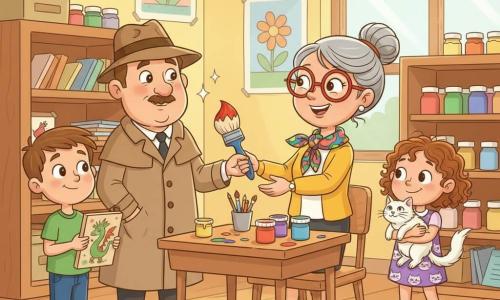
Miles turned to Mr. Bixby. “You were decorating. What were you using?”
Mr. Bixby held up his fingers. “Paint. Glitter glue. Tape. The whole sticky universe.”
“Blue paint?” Miles asked.
Mr. Bixby nodded. “Yes. Blue for the ocean booth.”
Miles made another note. The cart could have been moved while decorations were happening. That didn't mean Mr. Bixby stole anything. It meant the hallway had been busy. Busy places hide mistakes.
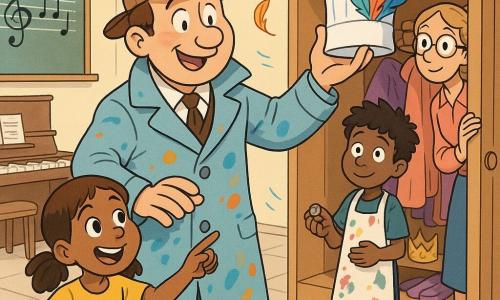
Miles stepped into the art room. The lights were off, but morning sun made bright squares on the floor. The tables were covered with dried paint palettes and paper scraps. In the corner, a large cabinet stood open a crack.
Miles listened. He heard only distant music from the gym and the soft squeak of a mop in the hallway.
He opened the cabinet gently.
Inside were boxes: yarn, construction paper, craft sticks. And on the middle shelf, there was an empty spot with a ring of dust around it, like something round had sat there.
Miles's eyes narrowed, not from anger, but from focus. A round object. About the size of a cookie.
He leaned closer. The dust ring had a tiny mark in it, like a corner had pressed against it—a box corner, not a medal curve.
So maybe the medal had been inside a small box.
Miles stepped back. He didn't want to imagine wild stories. He wanted to find one true path.
He returned to the hallway and found Ms. Lane near the empty case. Her face still looked tight, but her shoulders had dropped a little, as if Miles's calm was helping her.
“Ms. Lane,” Miles said, “why is the medal so important to you?”
She blinked, surprised by the question. “Because the children… they believe in it. It's a symbol. They try to be kind all year because they want to be worthy of it.”
Miles nodded. “That's a good reason.”
He asked another why, softly. “Why might someone feel they need to take it?”
Ms. Lane hesitated. “Some children… and some adults… feel left out. Or they worry they won't be seen.”
Miles wrote: FEELING LEFT OUT?
A laugh echoed from the gym—happy, bright. It made the hallway feel even more serious by comparison.
Miles walked toward the gym doors and paused. He watched as volunteers moved tables. Kids hung paper fish for the ocean booth. A popcorn machine popped in a corner like tiny fireworks.
Then he spotted someone who didn't fit the pattern.
Near the stage curtains stood a woman holding a bundle of ribbons. Her eyes were on the ceiling, not on what she was doing. She tied a knot, then forgot she had tied it, and tried to tie it again. The ribbon twisted into a sad pretzel.
She looked distracted. Not sneaky-distracted. More like “my brain is somewhere else” distracted.
Miles watched for a moment. He didn't want to embarrass her. But distracted people sometimes leave important things in odd places.
He walked over calmly. “Good morning,” he said. “I'm Detective Carter. You seem busy.”
The woman jumped a little. “Oh! Yes. Busy. Always busy.” She gave a small laugh that sounded like it had tripped. “I'm Nora. I'm helping with the stage.”
Miles kept his voice friendly. “Nora, have you seen a small gold medal? The Golden Acorn?”
Her eyes widened. “The medal? No, I—” She looked down at the ribbons, then up again, as if her thoughts were slippery. “I haven't seen it. Should I have?”
“Not necessarily,” Miles said. “But I'm going to ask you a careful question. Were you here last night?”
Nora nodded quickly. “Yes. I had to fix the curtain rope. It kept tangling. Tangling loves me.”
Miles glanced at the curtain rope. It did look tangled, like it enjoyed being difficult.
“Did you move any supplies?” he asked.
Nora tilted her head. “I moved a cart from the art room. It was in the way. I pushed it into the storage hall. I think.”
“I think,” Miles repeated in his mind. That was a word detectives noticed. It meant memory wasn't firm.
“Where is the storage hall?” Miles asked.
Nora pointed to a side door that led to a narrow corridor used for extra chairs, folded tables, and boxes nobody wanted to throw away.
Miles thanked her and walked toward that door.
The corridor smelled like cardboard and old paper. The light was dimmer. But it wasn't scary. It was just quiet, like a library shelf that had fallen asleep.
Miles saw the supply cart parked halfway down. Next to it was a stack of folded posters. On top of the posters sat a small shoebox with a lid slightly off.
Miles's heart didn't race. He didn't grab. He simply observed.
The shoebox had a strip of blue paint on one side.
And stuck to the lid was a tiny star-shaped sticker, the kind teachers used.
Miles held his notebook open and, for the reader, listed the clues like puzzle pieces on a table:
1) The lock wasn't broken.
2) People with keys include the principal, a teacher, and the janitor.
3) The cart was moved from the art room.
4) A distracted helper named Nora moved it last night.
5) A shoebox with blue paint sits near the cart.
Now came the important part of detective work: not jumping to the ending.
Miles asked himself: If the medal is in that box, why would it be there?
He lifted the lid carefully.
Inside was not the medal.
Inside were costume pieces: a fox mask, a paper crown, and a bag of shiny gold buttons that looked like coins if you squinted. At the bottom lay a card that said, in neat handwriting: “KINDNESS SKIT PROPS.”
Miles let out a quiet breath. Not disappointment—just another step.
He set the lid back and looked deeper into the corridor.
At the far end was a door marked OFFICE STORAGE. It had a small window.
Through that window, Miles saw something new.
A flash of autumn-colored ribbon.
Not a ribbon on a poster. Not on a costume.
A ribbon hanging from a hook, as if someone had placed it there on purpose.
Miles's mind clicked. That ribbon color matched the Golden Acorn.
The story shifted, just like that—because of one new observation.
Chapter 3: The New Observation
Miles approached the OFFICE STORAGE door. He didn't yank it open. He tried the handle first.
Locked.
He didn't panic. He didn't feel angry. A locked door wasn't a wall; it was a question.
He walked back toward the gym, letting the clues settle.
If the medal ribbon was inside storage, then the medal might be there too. But how did it get in? And why?
Miles returned to the main office. Principal Hartley was on the phone, her voice gentle now, telling someone not to worry. When she hung up, she looked at Miles as if he carried either a storm or a sunrise.
“I saw something,” Miles said. “A ribbon that looks like the medal's ribbon, behind a locked storage door.”
Principal Hartley pressed her hand to her chest. “Oh. That sounds… promising and scary at the same time.”
“Promising,” Miles said firmly. “Not scary. We're solving this.”
He asked, “Who has the key to that storage room?”
Principal Hartley frowned. “I do. And Ms. Lane. Mr. Dune, for inventory.”
Miles nodded. Again: keys do not equal guilt. Keys equal access.
He continued with the careful why. “Why would the medal be placed there? That room is not where the medal belongs.”
Ms. Lane stepped in, hearing the last part. Her eyes moved between Miles and the principal. “Unless someone hid it,” she said, then quickly added, “Or unless someone put it somewhere safe.”
“Safe,” Miles repeated. He liked that word.
He turned to Mr. Dune, who had entered quietly, mop in hand like a white flag. “Mr. Dune, did you put anything in storage last night?”
Mr. Dune shook his head hard. “No, sir. I was waxing the gym floor until eight. Then I went home. I'm careful with keys. I hang them right here.” He pointed to a hook board in the office.
Miles looked at the hook board. Three hooks. Three labels: PRINCIPAL, TEACHER, JANITOR.
The janitor hook was empty.
Mr. Dune blinked. “That's… strange. That's my key.”
Principal Hartley's eyebrows rose. “Are you sure you didn't take it home?”
Mr. Dune looked hurt, then worried. “I never do. I always—” He stopped. He took a slow breath, like Miles would. “I always try to. But last night was busy. The fair makes my brain run laps.”
Miles leaned in, eyes sharp but kind. “Let's not blame your brain. Let's track facts. When did you last remember having the key?”
Mr. Dune stared at the hook board as if it might speak. “After lunch. I remember hanging it up. Then I got called to clean up glitter in the art room.”
Glitter again. Always glitter.
Miles wrote: JANITOR KEY MISSING. LAST REMEMBERED: AFTER LUNCH. CALLED TO ART ROOM.
Ms. Lane covered her mouth. “Could someone have taken the key?”
Miles nodded once. “Possibly. Or it fell. Or it was borrowed and not returned.” He looked at Principal Hartley. “Let's open the storage room with your key. Carefully.”
They walked together down the corridor. The school sounds faded behind them. The storage hall waited quietly.
Principal Hartley unlocked the door. The lock clicked with a small, polite sound, like it was saying, “Finally.”
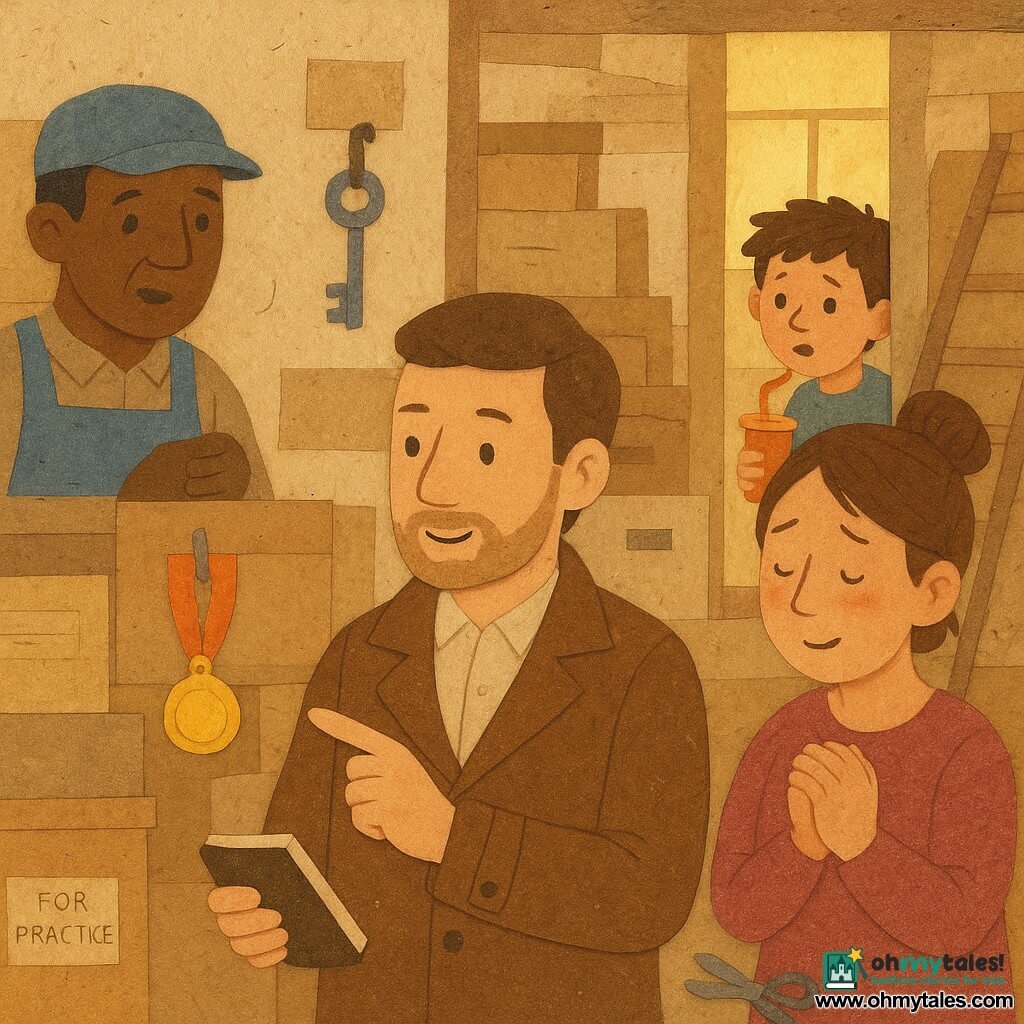
Inside, the room was cramped with boxes and folders. A ladder leaned against the wall. On a hook near the door hung a ribbon—autumn colored—attached to the Golden Acorn Medal.
It was there.
Not smashed. Not bent. Not harmed.
Miles felt the tension in the group loosen like a knot coming undone.
But the mystery wasn't finished. Miles still needed the why.
The medal was hanging beside a paper sign that read, in marker: “DO NOT FORGET!”
Beneath the sign was something else: Mr. Dune's key, placed neatly on a shelf.
Ms. Lane exhaled. “So someone took the key, brought the medal here, and returned the key.”
“Or,” Miles said, “someone took the key by accident, moved the medal for a reason, and then tried to fix their mistake.”
He turned the medal over. Taped to the back was a sticky note with three words:
“FOR PRACTICE TODAY.”
Miles's eyes moved to the ladder and then to the ceiling vent above the door. The vent was slightly open. A thin thread of ribbon was caught on one corner, as if it had brushed past.
Miles's thoughts lined up like books on a shelf.
Practice. Stage. Nora fixing curtain ropes. A vent open. A medal moved to keep it safe?
He returned to the gym. Nora was still by the stage, still tying ribbons like they were trying to escape.
Miles approached her slowly, so he wouldn't startle her again. “Nora,” he said, “I found the medal. It was in office storage. There was a note: ‘For practice today.'”
Nora's face went pale, then pink, then pale again. “Oh no,” she whispered. “Oh no, no, no.”
Miles kept his voice steady. “Tell me what happened. Start with why.”
Nora pressed her hands together. “I'm supposed to help with the ceremony. I wanted to practice hanging the medal on the ribbon stand on the stage. I didn't want to mess up in front of the kids.”
Miles nodded. That made sense. People who care often want to do things right.
Nora rushed on. “I asked Mr. Dune for the key to the case yesterday. He was carrying boxes. He didn't hear me well. I think he thought I asked for tape. He pointed to his cart and said, ‘Take it.' I grabbed the key ring that was on the cart—because I was distracted—and I opened the case.” Her voice cracked a little. “I meant to put it back right away.”
Miles watched her face. She looked truly upset, not pretending. She looked like a person who had stepped on someone's foot and wished time could go backward.
“What changed?” Miles asked.
Nora swallowed. “A kid ran by with a balloon. The balloon popped. I jumped. The medal slipped out of my hand and skittered. I panicked. I didn't want it to get scratched. So I put it in office storage, on the hook, and I left myself a note: ‘Do not forget.' Then the fair plans kept pulling me around. I forgot. I forgot the forgetting!”
Miles let the silence sit for a second, not to make her feel worse, but to let the truth be fully heard.
Then he said, “Thank you for telling me. You tried to be careful, and you also learned a new kind of careful.”
Nora blinked, tears shining but not falling. “I didn't steal it,” she whispered.
“I know,” Miles said. “Stealing hides. You came forward. That's courage.”
He led her back to the office, where Principal Hartley and Ms. Lane waited.
Nora admitted what happened. She apologized. She promised she would never take a key without checking and never move an important item without telling someone right away.
Principal Hartley's face softened. “I'm glad the medal is safe,” she said. “And I'm glad you're honest.”
Ms. Lane nodded too. “Next time, ask for help. Practicing is smart, but practicing with a team is safer.”
Miles turned to the reader again, as if the reader stood by the doorway: Did you notice how the clues fit? The unbroken lock, the moved cart, the distracted helper, the ribbon in the window—each one pointed, not to a villain, but to a mistake that could be fixed.
And now, the last part of the case remained: making things right.
Chapter 4: The Thank-You Visit
By the time the fair began, the Golden Acorn Medal sat proudly in its glass case again. This time, Principal Hartley added one extra step: a simple checklist taped inside her planner.
Miles approved. Checklists were not boring. They were brave in a quiet way.
In the gym, kids laughed at the fish booth and lined up for popcorn. The ocean posters waved gently from the walls. The stage curtains finally hung straight, as if they had decided to behave.
Miles didn't stand in the spotlight. He watched from the side, like a lighthouse that didn't need applause.
Nora helped with the ceremony, but she didn't do it alone. Ms. Lane stood with her, and they practiced once more behind the curtain, calmly, with time to breathe.
When it was time, Principal Hartley opened the glass case in front of everyone. The medal caught the light and shone. A murmur of excitement ran through the crowd like a friendly breeze.
Miles looked at the faces in the room. He saw relief, joy, and curiosity. No one looked scared. The mystery had been solved without shouting, without blaming, without making anyone feel small.
After the ceremony, Nora approached Miles with a paper cup of lemonade. Her hands still trembled a little, but her smile was real.
“I want to say thank you,” she said. “You didn't make me feel like a bad person.”
Miles accepted the lemonade. “You're not a bad person,” he said. “You're a person who had a busy brain and made a mistake. The important part is what you do next.”
Nora nodded. “Next time, I'll slow down. I'll ask. I'll double-check. And I'll return keys right away.”
“That's prudence,” Miles said. “It's a detective skill, too.”
Later, Principal Hartley invited Miles to the office for a proper thank-you visit. On her desk sat a small envelope.
Inside was a hand-drawn card from Ben and a few other students. It showed Detective Miles with a magnifying glass the size of his head, looking at a trail of glitter that led to a smiling medal.
Under the drawing, in wobbly letters, the children had written: THANK YOU FOR FINDING KINDNESS.
Miles felt something warm in his chest. Not pride, exactly. More like comfort. The kind you feel when a puzzle piece clicks into place.
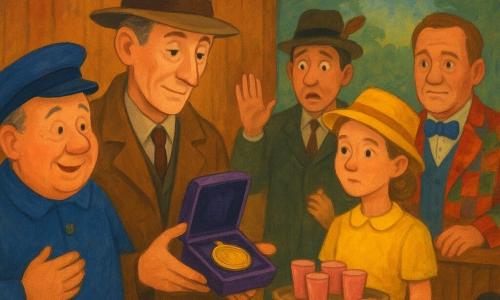
Principal Hartley offered him a small wooden acorn, carved smoothly. “Not the medal,” she said quickly, smiling. “Just a token. For your desk.”
Miles held it up. It was simple, plain, and perfect.
“I'll keep it,” he said. “It will remind me that big problems often hide in small details.”
As he left the school, he noticed the hallway had been cleaned. The dust line was gone. The cart was put away. The glitter, somehow, still sparkled in one corner, because glitter always wins a little.
Miles paused by the glass case one last time. The Golden Acorn Medal gleamed behind the locked door, safe and ready for next year.
He tapped his notebook gently and slipped it into his pocket.
Another case solved with careful eyes, calm questions, and the most important tool of all: understanding why.