The Bakery Wakes
The bakery woke up before the town did, like a sleepy cat stretching and yawning. Light leaked through the windows in a soft gold band, and the bell above the door whispered as if not to wake anyone else. Mr. Thomas pushed open the heavy front door and breathed deeply. The air smelled of warm wood, lemon oil on the counter, and the faint memory of last night's cinnamon. He always called that first breath his weather check — it told him how the day might feel.
Today he had a special order. A note from the school read: “For the Harvest Party — forty sweet rolls and one braided celebration loaf.” The school wanted everything for the last bell before autumn, when leaves orange themselves like slices of apricot. Mr. Thomas set the note on the counter and ran a finger along the edge of the paper, thinking of smiling children, sticky fingers, and tiny voices saying thank you.
He put on his apron, the one with the faded flour handprints like little moons. He turned on the oven, listening to the low hum as it warmed — like a kettle beginning to sing. He lined up his ingredients on the counter like soldiers: sacks of flour, glass jars of sugar, a small tin of salt, a jar of live yeast that bubbled faintly when he tapped it, eggs that sat in a neat row like sleepy birds, and butter wrapped in paper like a secret.
Mr. Thomas loved the order's promise. He loved making things that made days better. He also loved the way baking taught patience. It was like growing a story with hands: measure, mix, wait, watch. He measured carefully — cups and grams becoming exact companions — because bread is a patient engineer: too much of this or too little of that, and the plan changes.
He cracked the first egg into a bowl. The yolk looked like a small sun. He mixed flour and water and touched the flour. It felt like soft sand on a beach, ready for footprints. He sprinkled yeast into warm milk and watched for tiny stars to form — the yeast waking up, the first small promise of rise. That morning felt like a beginning stretched out, and Mr. Thomas hummed a tune as he worked, his hands already learning the language of dough.
The Dough Learns to Stretch
Mixing was a conversation. Mr. Thomas spoke in pushes and folds. Flour dusted the air like tiny clouds when he stirred; the bowl became a small planet of white and gold. He added sugar — just enough to feed the yeast — and the yeast began to breathe, making small, lively bubbles like fish below surface water. “Hello,” he said, patting the side of the bowl. “Grow for us.”
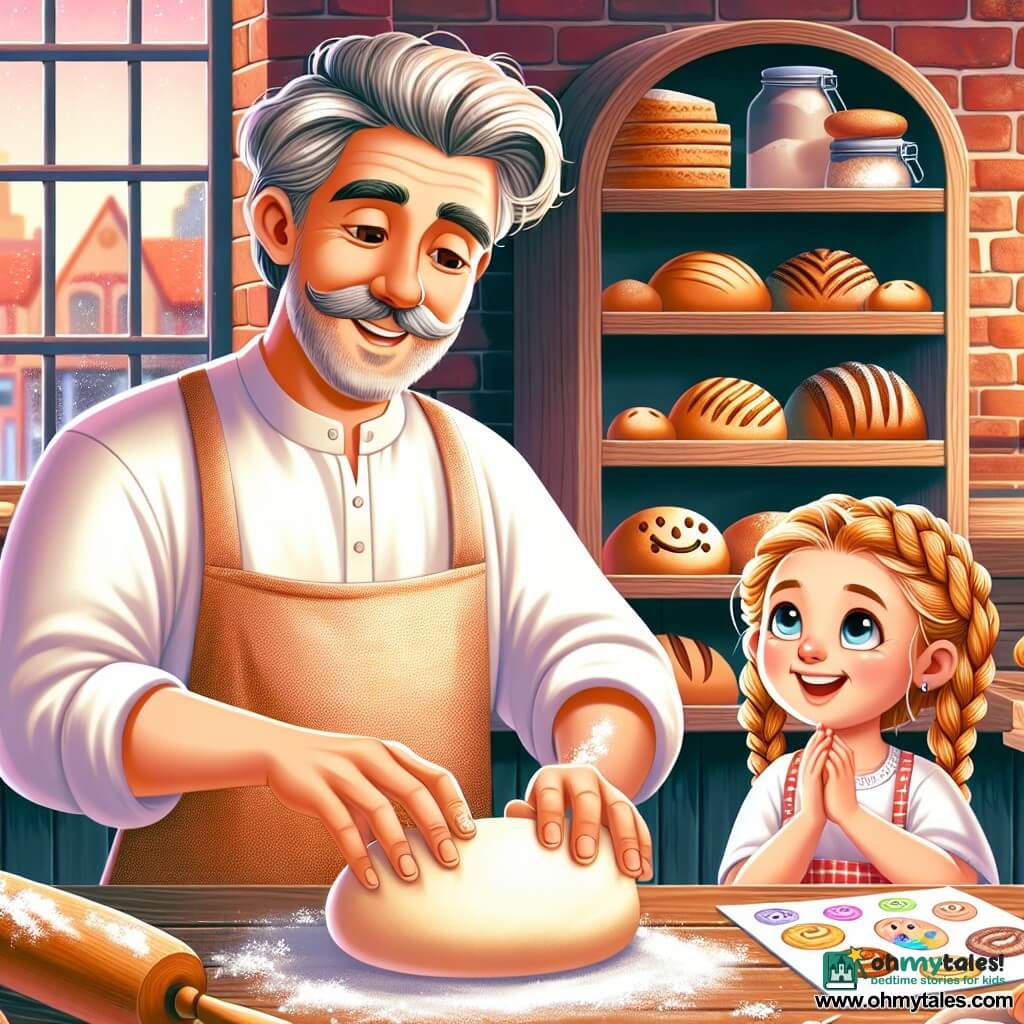
Kneading was the slow secret of bread. He folded the dough over itself, pressed with the heel of his hand, turned, and folded again. The dough changed. At first it was sticky, clinging like a shy friend who did not wish to be let go. Then it smoothed, warmed, and stood up to being stretched. Mr. Thomas watched for a window: when a little piece of dough could be stretched thin without tearing, the gluten had learned to hold itself together. He loved that moment — a small miracle from flour and water and steady hands.
But things do not always go according to plans. When he checked the bowl for the sweet rolls, the dough looked tired. It had not risen much. Mr. Thomas frowned and checked his tools. The milk had been warm, not hot. The yeast should have woken up into a bubbly dance, but it had snoozed. He could have panicked, but he had patience tucked like a blanket around his shoulders.
He warmed the milk a touch more and fed the yeast a spoonful of sugar to coax it. He wrapped the bowl in a towel and tucked it near the warm oven, like placing a baby in a cozy bed. While waiting, he cleaned the countertops, counting the jars and making sure the whiskers of flour would not make anyone sneeze. He used the time to plan: forty rolls, but also a braided loaf. The braid would need more time to rest between moves so it would not fight back when in the oven.
A neighbor dropped by with a jar of late summer honey — a gift for the school cakes. Mr. Thomas smiled and told the neighbor about the sleepy yeast. “Sometimes,” he said, handing over a small plate of dough bits for taste, “you wait. You fix small things. And then you try again.” The neighbor tasted and nodded. The dough, after a longer nap, slowly puffed up like a little pillow. Persistence worked the same way in dough as in days: keep caring, keep doing.
The Shape of Celebration
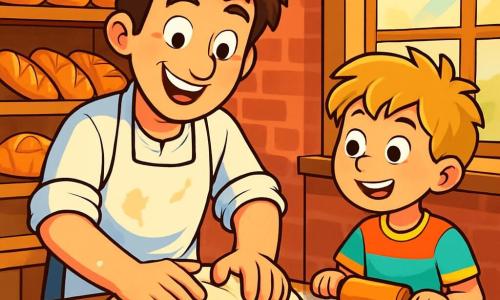
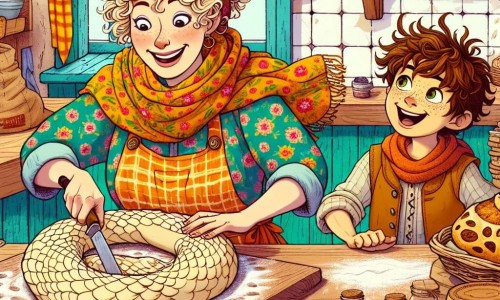
Shaping the rolls was like drawing with dough. Mr. Thomas rolled and twisted, pinched and plaited. For each roll, he made a soft round, cupped it, and tucked the seam underneath so the top would show like a moon. For the special braided loaf, he divided the dough into three ropes and braided them with slow hands. The braid looked like a river winding through fields, each strand folding into the next.
He explained to himself as he worked, words as simple as instructions: “Don't squeeze too hard. Let the dough breathe. Give it space to rise.” He would say this even when no one was listening, because words help the hands remember.
He placed the shaped bread on trays dusted with flour. He brushed some with milk for shine, some with egg for golden gleams. For the sweet rolls, he tucked in a dot of jam — raspberry like little red hearts — and sprinkled a few oats on top for a rustic look. The bakery smelled of butter, sweet jam, and the soft scent of time. The bell above the door chimed as the postman dropped off a note: the party would start earlier than expected. Mr. Thomas felt the familiar flutter in his chest, not of fear but of careful attention. The schedule tightened like a string.
Then a slip: a tray of rolls shivered as Mr. Thomas slid them into the oven and one nudged another out of shape. He took a breath, a slow kind that steadied hands. He shaped the roll again and learned to slide the tray with one hand steadying the rack. Mistakes in baking are part of learning. He smiled at the rolls, rearranged them, and closed the oven door. Patience would do the rest.
The Oven's Quiet Magic
The oven was like a cave that taught heat how to be gentle. Mr. Thomas watched through the small window as the rolls grew and the braid curved and puffed. Crusts formed like thin shells, and little steam whispers escaped through the cracks. He learned how heat could make sugar caramelize until a top turned amber, how a short burst of steam at the beginning made a crust thin and shiny, while a slower time inside made a bread that was soft as a bedtime story.
He timed everything being careful, counting minutes the way one counts stars. He pulled the first tray out and the bakery filled with the soft crackle of crusts cooling. The rolls smelled of butter and sugar and a little of cinnamon — a scent that made the town imagine pockets full of warm things. He placed the braided loaf on the counter and tapped it with a knuckle. The sound told him the crumb inside had baked through: a hollow, confident note.
There was still one challenge. The school wanted the braid to be not only pretty but to feed many mouths without crowding the trays. Mr. Thomas had to slice it just right. He cooled the loaf, letting the steam do its slow retreat, and then cut a sample slice. It looked perfect — light, with small holes like a map of warmth. He smiled, thinking of the hands that would hold these slices.
When everything was baked, he made a small glaze for the sweet rolls and brushed it on like a lullaby. Tiny seeds and sugared sprinkles were added with gentle fingers. Each jar, each plate, each tray was wrapped and labeled with care. Mr. Thomas packed them as if tucking sleeping children into a row of tiny beds.
The Party Light and the Lesson Left Behind
The walk to the school was cool and smelled of fallen leaves and an approaching evening. Mr. Thomas carried the boxes carefully, supporting the bottom as if it held fragile treasure. At the school gym, lights were strung like captured stars and children practiced a song with nervous giggles. Teachers arranged tables with cloths as bright as sunflowers.
When the trays were opened, a hush and then a chorus of delighted voices followed. Little fingers reached for the rolls, and small mouths made small delighted noises. The braided loaf was passed down the table like a long, golden river. Children learned to wait their turn and to say please and thank you. Mr. Thomas watched from the doorway as the party unfolded — a dozen tiny hands working together to distribute bread, a chorus learning to share.
A little girl came up and offered Mr. Thomas a drawing of a loaf with smiley faces on every slice. “Thank you,” she said, voice small and earnest. “My grandma says your bread tastes like hugs.” Mr. Thomas felt warmth that had nothing to do with ovens. He sat for a moment and told the children a short, soft story about yeast as tiny adventurers that needed rest and sugar and proper sunshine of warmth to set off. The children listened as if learning a magic trick.
When the last crumb was gone and the party wound down in a gentle way, Mr. Thomas walked home under a sky that smelled like a pressed flower. He felt tired but full, like a bread fresh from the oven that had cooled into contentment. He thought about the sleepy yeast, the dough's stubbornness, the slip of the tray, and the steady hands that kept going. He had learned again what he had always known: patience and small fixes make the big celebrations possible.
That night, back in his quiet bakery, he washed his bowls and set them to dry. The shelves gleamed faintly in the moonlight, and the smell of butter hummed softly in the corners. He folded his apron and placed it on a chair. Before turning off the lights, he looked at a small jar of yeast on the shelf and patted it gently.
“Good work,” he whispered to the quiet room. “We kept trying.”
Outside, the town settled under a blanket of stars, and Mr. Thomas walked home thinking of tomorrow's orders, of recipes to try, and of the next gentle lesson dough would teach him. He closed his eyes knowing that the best part of his job was not only making bread, but making sure that each loaf and roll carried a little of his patience, a pinch of kindness, and enough warmth to help someone end their day with a small, satisfied smile.