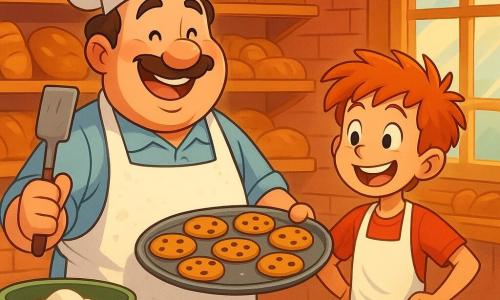
Chapter 1: The Early Light
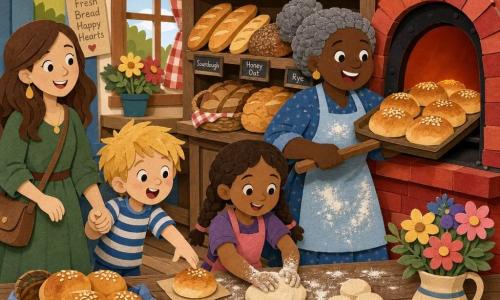
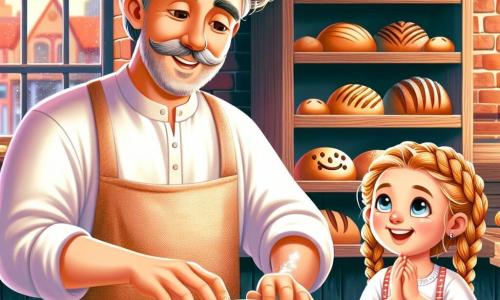
Mr. Bram woke before the sun, because the bakery liked to whisper awake long before the town did. He padded across cool wooden floors, the slippers soft under his feet, and opened the bakery door to a small, warm sigh. The oven blinked like a friendly eye, the metal shelves yawned, and flour dusted the air like a soft, pale snow. He smiled; every good smell of baking made him smile as if small suns were rising inside his chest.
"Good morning, old friends," he said to the oven, to the long wooden table, to the dough bowls. The dawn slipped in through the windows, painting the brass scales gold, and the bakery began to fill with quiet music—the clink of a spoon, the hush of a cloth, the gentle thud when a heavy sack of flour was set down.
Mr. Bram had been a baker for many years. His hands knew the language of flour and water, of salt and time. He could tell, by the way dough moved under his fingers, whether it wanted a little more rest or a little more kindness. Tonight—this morning—he had a task that tasted like a riddle: a sticky dough that refused to obey the neat rules of his usual loaves.
He brewed coffee, the dark steam curling into the air, and set a wooden bowl on the table. Outside, the town was still sleepy; inside, the bakery felt like a small planet where heat, smell, and soft light made everything gentle. Mr. Bram rolled up his sleeves, the ones that always smelled faintly of cinnamon and morning, and put his hands into the dough.
The dough greeted him like a living thing. It clung to his palms, silky and heavy, like a cloud that had forgotten how to float. He laughed softly.
"Ah," he said. "We'll figure this out. We always do."
He had to adjust the dough's hydration—how much water it held compared to flour. That idea was simple in his head: too much water, too sticky; too little, too tight. The trick was patience and small changes. He set a small note on the board: "Hydration mission—today." The bakery hummed approval.
By the time the sky lightened into a hopeful blue, Mr. Bram had shaped the first loaves, placed them gently on their trays, and slid them into the oven. The smell of warm crust was a promise, a beginning. He smiled at it, because every good smell of baking made him smile, and because smiles are like yeast—if you give them warmth and time, they grow.
The market would open soon. The town would pour through its lanes with baskets and bright umbrellas, and the bakery would join the chorus of morning sounds. But first, the dough waited, and Mr. Bram watched it breathe, learning the way it wanted to be helped.
Chapter 2: The Market Morning
The market woke like a chorus of small bells. Stalls arranged in neat rows, banners bright as birds. The fishmonger called out about silver fins, the fruit seller stacked apples like red moons, and the spice woman arranged her jars until they looked like rainbows. Mr. Bram pushed his cart out, its wheels creaking happily, and the bakery's warm breath followed him into the street.
"Fresh bread!" he called, and the words floated across the cobbles. People turned. Children ran with coins in their hands. The smell of his rolls wrapped the square like a blanket, and every nose in town tilted toward him.
An old woman came forward. "Your morning rolls," she said, placing a small paper bag on the table. "They help my knitting."
"Thank you," Mr. Bram said, smiling. He smiled because the smell of baking warmed him, and because he liked being part of people's mornings. Each loaf felt like a small kindness.
As the market chestnut stall popped with their little fires and the flower seller arranged her bouquets, Mr. Bram noticed a young boy lingering by the spice jars, eyes round as saucers.
"Hello," the boy said, stepping closer. "My name is Sam. I like bread. I like watching bakers. Can I help?"
Mr. Bram's laughter was like the clink of a spoon. "Of course," he said. "Are you early?"
"Very," Sam answered. "My mum says I'm a morning bird."
Sam smelled of pavement and excitement. He watched every movement as if he were learning a new language of hands. Mr. Bram handed him a tray.
"Here, you can carry these," he said. "Careful—warm."
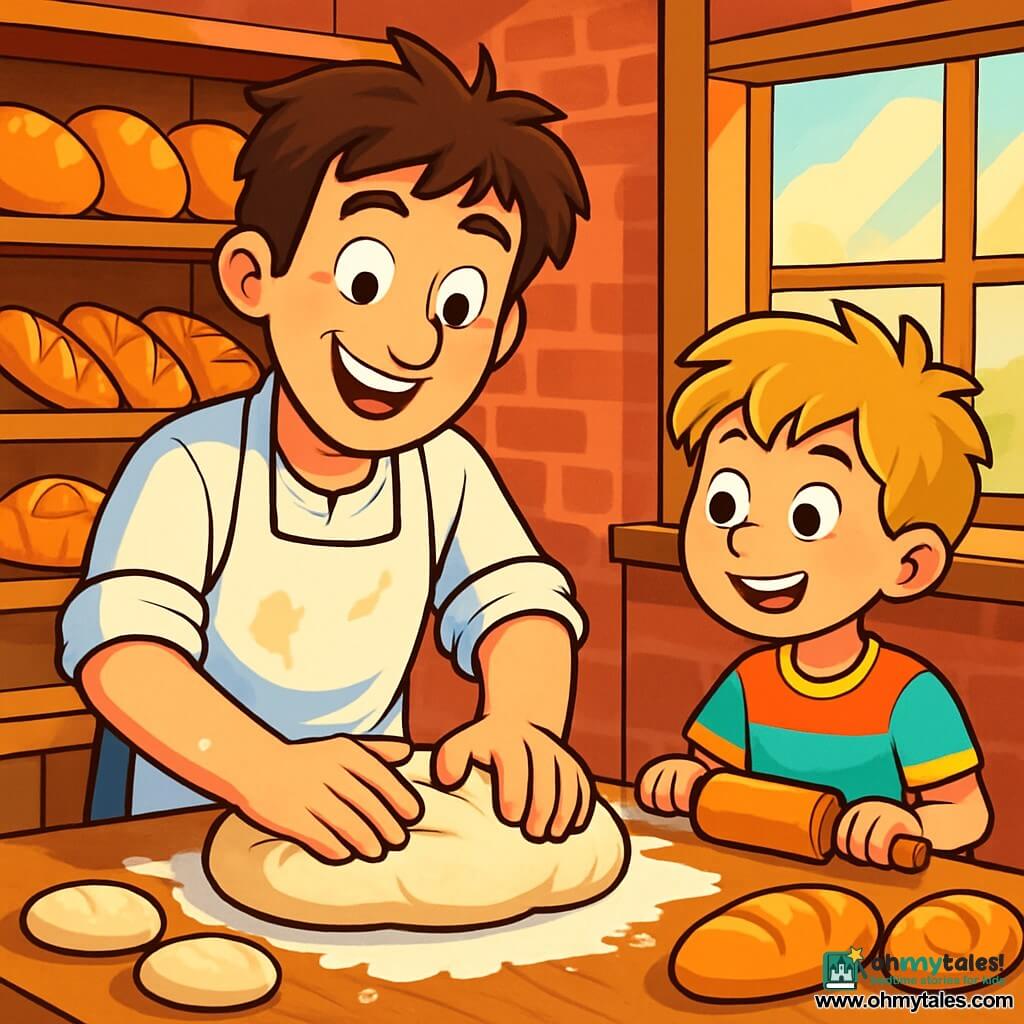
Sam took the tray as if it were treasure. He watched Mr. Bram's hands shape a knot of dough, his fingers pressing, lifting, folding. People clustered close, comparing prices, laughing. The market sang. Mr. Bram talked while he worked, because teaching through doing was how he liked to share secrets.
"See this dough?" he said. "It is sticky. That means it has more water than usual."
Sam peered. "It's… clingy."
"Yes," Mr. Bram said. "Sticky dough can be good. It makes bread with soft holes and a tender crumb. But it can be tricky to shape. We adjust it a bit. Sometimes we add flour to take heartbreak away from the stickiness. Sometimes we let it rest so the water can relax into the flour, a little like letting a shy friend warm up to the room."
Sam listened as if each word were honey. Mr. Bram showed him a simple trick: wet the hands slightly so the dough wouldn't stick, then perform a gentle fold. The dough folded back like a thick ribbon. An older woman at the stall smiled; a child giggled. The town kept moving, but the moment felt special, like a secret recipe passed between two people.
As the morning warmed and the market thrummed, the bakery's table filled with small questions. A cart of oranges rolled by releasing citrus suns of smell. The spice woman—whose jars chimed like small rounds of bells—offered a pinch of something that smelled of warm rain and nutmeg.
"Try this," she said. "A little for your bread."
Mr. Bram accepted politely, his nose already knowing what to trust. He smiled at every good smell of baking, and this was a new song: something with spice could lift the bread into a small dance, a flavor that hummed around the crust.
But there was a problem waiting back at the bakery: the sticky dough had decided, in its sticky way, to be stubborn. Mr. Bram felt a small tug in his chest. He liked things that worked, especially when mouths depended on warmth and comfort. He glanced at Sam, who had his hands clasped in quiet readiness.
"Back to the bakery, then," Mr. Bram said. "We have a little mission."
Sam nodded as if ready for adventure. The market's bustle faded as they walked toward the bakery, the scent of possibilities following them home.
Chapter 3: The Apprentice and the Dough
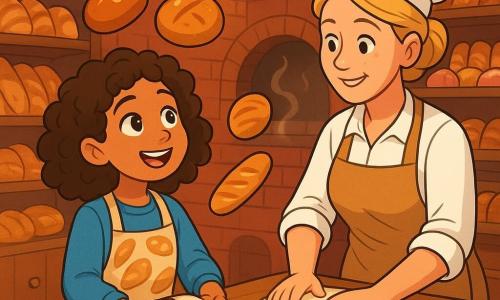
Back inside the bakery, sunlight spilled across the floor, making patterns like braided dough. Mr. Bram set the sticky bowl on the table and called, "Let us begin properly."
Sam perched on a low stool, watching every fold and turn. Mr. Bram spoke in a calm, steady voice, always the kind of voice that made nervous things feel safer.
"First lesson," Mr. Bram said. "Hydration. That word means how much water you use compared to flour. If you use more water, the dough feels wetter and becomes very sticky. That can give you a light, airy bread, but it makes shaping hard. If you use less water, the bread becomes denser and easier to shape. Bakers measure it with numbers sometimes, but you will learn to feel it."
Sam watched the way Mr. Bram pinched the dough. He pressed and felt the tacky surface. "So it's like making a soup thicker or thinner," Sam offered.
"Exactly," Mr. Bram said. "You can thicken it with flour, or let it sit so the flour drinks the water. That rest is special. It is called an autolyse—don't worry about the big name. Think of it as giving the dough time to relax."
Sam repeated the word with a grin. "Autolyse."
"Autolyse," Mr. Bram agreed. "And we use folds to build strength. When dough is sticky, we don't force it; we coax it. We fold it gently, like tucking a blanket around a child."
They worked in quiet rhythm. Mr. Bram wet his hands slightly and performed a series of folds—lift, stretch, fold—each motion a small kind of magic. Those folds helped the gluten catch hold, forming a network that would trap air and make the bread rise. He explained how gluten was like a net inside the dough, catching the tiny bubbles that yeast made as it slept, so the bread could become light and airy.
"Yeast is a tiny helper," Mr. Bram said. "It eats some of the sugars in the flour and makes bubbles. Those bubbles need a net to grow in. That's the gluten's job."
Sam's eyes were wide. "So water and flour are like team players."
"Always," said Mr. Bram. "But sometimes teams need coaching."
They adjusted the dough little by little. Mr. Bram taught Sam to sprinkle tiny bits of flour along the sides and to fold gently, testing after each small change. He showed him how a dough might be sticky in the morning but kinder after a short rest. He told stories of bakers who had failed their first time and later made the most beautiful loaves, because patience and repetition were part of baking.
A clock ticked. The town outside continued its music. Mr. Bram and Sam worked, the bakery full of soft noises and the scent of yeast. Each fold was a sentence, each rest a paragraph in the loaf's story.
"How do you know when it's ready?" Sam asked at one point.
"By feel, a baker's sixth sense," Mr. Bram said, smiling. "Also by the dough's skin. It should feel like a soft pillow that holds its shape. And the window—when you poke it gently, it should spring back slowly, not disappear."
They tried again. They were patient. With each small change, the dough listened and altered its mood. It became less clingy, more willing to be touched. Sam's hands were a little floury, his face dusted with a constellation of white. He smiled when dough finally let him shape it into a neat round. Mr. Bram smiled at that smile, because every good smell of baking made him smile, and because teaching a willing apprentice is like watching a loaf come alive.
Their work was steady, but the day had one more surprise waiting on the counter: a new spice mix from the spice woman, tied with a ribbon. Mr. Bram had promised to try it. He untied the ribbon, and the jar released a smell that tumbled into the room like laughter—warm and bright and more fragrant than he expected.
Chapter 4: The Spice Surprise
The spice jar was small but full of character. Mr. Bram unscrewed the lid and inhaled. A carnival of scents rolled out—cinnamon, cardamom, a whisper of orange peel, and something unexpected that smelled like sun-warmed honey. The mix was more fragrant than he had imagined, like a secret that had decided to shout.
Sam leaned in. "It smells like a story," he said.
"It does," Mr. Bram agreed. "A bold, friendly story."
He sprinkled a little into a dough, thinking it would be a gentle touch. But the spice was bold; it puffed and danced in the air, slipping into the bread like a bright note in a song. The bakery's aroma shifted. For a moment it felt as though the whole room had been tipped into an orange grove during a carnival.
"Too much?" Sam asked, eyes wide.
Mr. Bram cupped his hands and sniffed. He laughed softly. "Maybe. It's very lively. But sometimes, when something is too strong, we can balance it."
He explained that spices can change a recipe's voice. A pinch too much makes the bread sing at the wrong time; a whisper too little leaves the song unfinished. Bakers listen to flavors as they listen to the dough—attentively and kindly.
They tried an idea. Mr. Bram rolled out a few small loaves and brushed their surfaces with a thin wash of milk to soften the spice's flash. They sprinkled a dusting of flour like powdered snowfall, which coaxed the spice into the loaf instead of letting it shout. Sam helped, his hands careful and sure.
Outside, the market's laughter carried in. A child held an orange, biting into it as if it were the sun. The spice smell mingled with fruit and fresh herbs, and the town seemed to take a long, satisfied breath.
"Sometimes things surprise us," Mr. Bram said, turning the loaves. "The right thing is to try, to adjust, and not to throw it away at the first surprise. You learn more when you fix mistakes than when nothing goes wrong."
Sam thought on this, then nodded. "Like when I fell off my bike and kept trying."
"Exactly," Mr. Bram said. "Baking is the same. Keep trying. Adjust small bits. Ask for help. And taste, gently—always taste."
They learned to temper the spice. They used a little extra flour and a longer bake time for some loaves, and a short, sweet roll for others. The spice no longer shouted; it hummed in the crumb, like a friendly tune. Sam tasted a small piece and closed his eyes. "It tastes like the market in the morning," he said.
Mr. Bram smiled so that his whole face warmed. He smiled at every good smell of baking, and now at the new flavor that had pushed them to think and to try. The small mishap with the spice had become a lesson about listening and balancing, about not fearing strong things but guiding them.
They placed the loaves in the oven. The heat hugged the dough like a blanket. The spice's fragrance settled into the bread, making it glow. The oven hummed its soft song, and the bakers watched the window and the little rise of each loaf. Perseverance was the quiet companion in the room—steady, patient, assured.
Chapter 5: The Warm Neighborhood
When the loaves came out, they were golden like friendly suns. The crust crinkled delicately, releasing steam that smelled of toasted sugar and soft spice. Mr. Bram smiled, and the smile felt like butter on hot toast—simple, right, perfect.
They loaded the cart and returned to the market. The town drifted toward them, drawn like moths to light. Sam carried a basket carefully, offering taste to those who wanted it. The spark of his pride made his eyes shine.
Word spread through the narrow streets. People followed the scent; shopkeepers leaned out of their doors, customers paused mid-steps. The bakery's smells braided with the flower seller's roses, the fruit seller's citrus, the spice woman's jars, until the whole neighborhood seemed wrapped in a soft, warm blanket.
Mr. Bram looked at the faces around him—sleepy-eyed parents, grinning children, the old woman who loved bread for her knitting—and felt something thick and gentle swell in his chest. This was what he baked for: to make mornings softer, to stitch small joys into people's days.
"Thank you," the old woman said, taking a fragrant roll. "This will sit with my tea."
"Thank you," said a mother, kissing a crumb from her child's cheek. Sam watched these exchanges like a catalog of quiet victories.
They had fixed the sticky dough by being patient and kind to it. They had learned that hydration was not a problem to fear, but a quality to guide—sometimes by adding a breath of flour, sometimes by letting time do its work so the flour could drink and settle. They had balanced the wild spice into harmony. Most of all, they had practiced perseverance—small, repeated efforts building toward a warm, satisfying result.
By late morning, the market settled. The sun climbed higher and the town hummed in a comfortable rhythm. Mr. Bram and Sam sat on the bakery's stoop for a moment, each with a small slice of warm bread and a soft cup of tea. The steam fogged the air like a whisper.
"You did well," Mr. Bram said, handing Sam a napkin.
Sam's grin folded around his bread like a friend. "I want to learn everything," he said.
"You will," Mr. Bram said. "In time. Hands learn slowly. The dough will teach you patience if you listen."
They watched the street. People moved like notes on a staff, each step a small song. The bakery's oven cooled to a satisfied hum. The spice woman waved, her jar now half-empty. The flower seller arranged a new bouquet. The neighborhood smelled of warm bread, a scent that made faces gentler and mornings softer.
As the sun began to lean toward afternoon, Mr. Bram turned the sign on the door to 'Closed' for a short while. He enjoyed the hush. He looked toward Sam and the boy's floury hands, and he felt the day's work settle into something like a storybook ending—soft, bright, comforting.
He smiled then, as he always did when a good smell rose and filled the air. It was a smile that tasted like crust and honey, like the first bite of a fresh roll. The town would sleep later, contented, and in the evening windows, people would remember the morning's warmth.
"See you tomorrow?" Sam asked.
"Yes," Mr. Bram said. "We will have more dough to coax, more smells to welcome, and maybe a spice or two to be surprised by. Remember—small steps, small changes, and patience. Baking is a gentle kind of bravery."
Sam nodded, pocketing the lessons as a baker pockets recipes in his mind. They cleaned the table slowly, the way one closes a book at the end of a beloved story. The bakery's windows caught the late light, and the whole lane seemed to inhale.
When Mr. Bram turned off the last lamp, he paused and took a deep breath. The smell of bread lingered in the doorway like a promise. He smiled—because every good smell of baking made him smile—and he knew that tomorrow the neighborhood would wake to the same comforting scent, as if the town itself were wrapped in a blanket of warm, golden bread.