Chapter 1: Pipkin and the Brass Compass
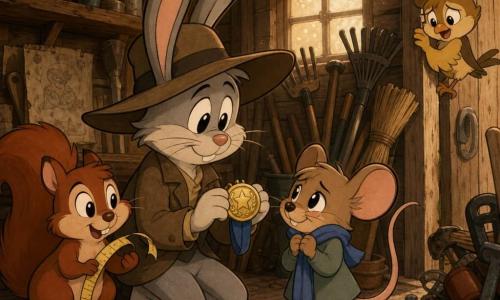
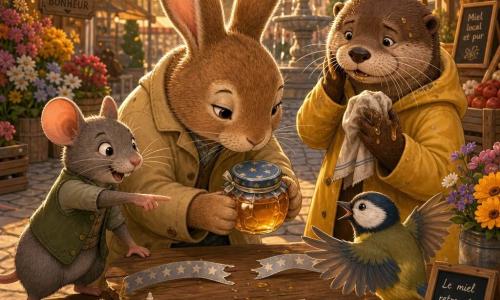
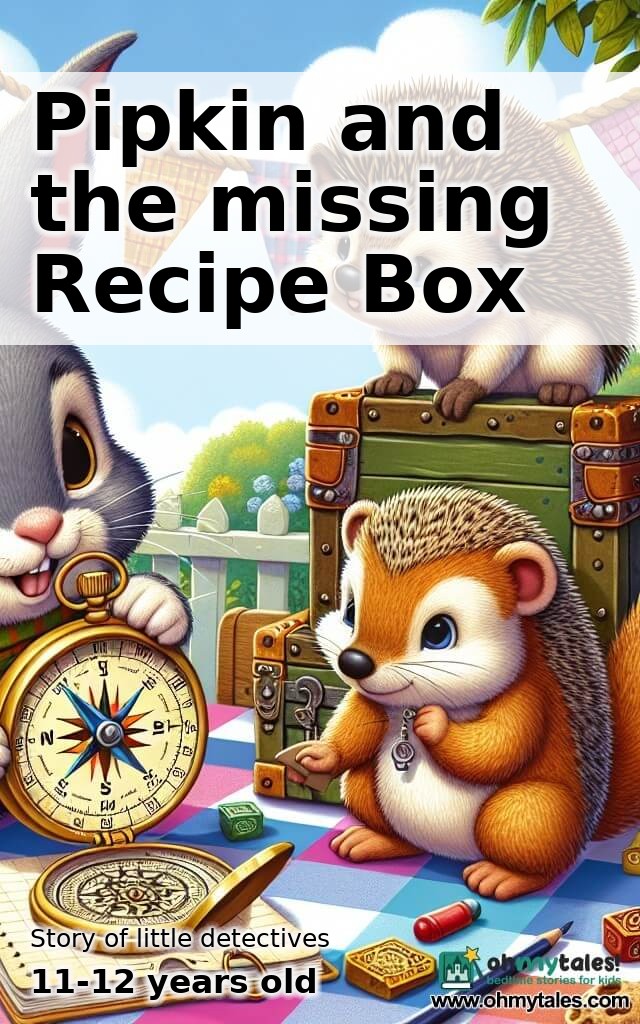
Pipkin was not the sort of rabbit who sat still when something was interesting. His ears had a habit of twitching toward mysteries like weather vanes catching a breeze, and his paws, well, they liked to be useful. On the morning of the Maple Street Harvest Fair, Pipkin had already stacked napkins, lined up jars of jam like tiny soldiers, and tasted precisely one peanut cluster for quality control. (It was excellent, in case anyone asked.)
The community garden behind the school hummed with the kind of busy that makes you feel taller just for being there. Tomatoes blushed. Banners fluttered. Someone's radio played sunny music that made the watering cans sing along. Long tables were set with checked cloths, and at the center of everything sat a wooden box with a bright red ribbon tied in a bow on its lid.
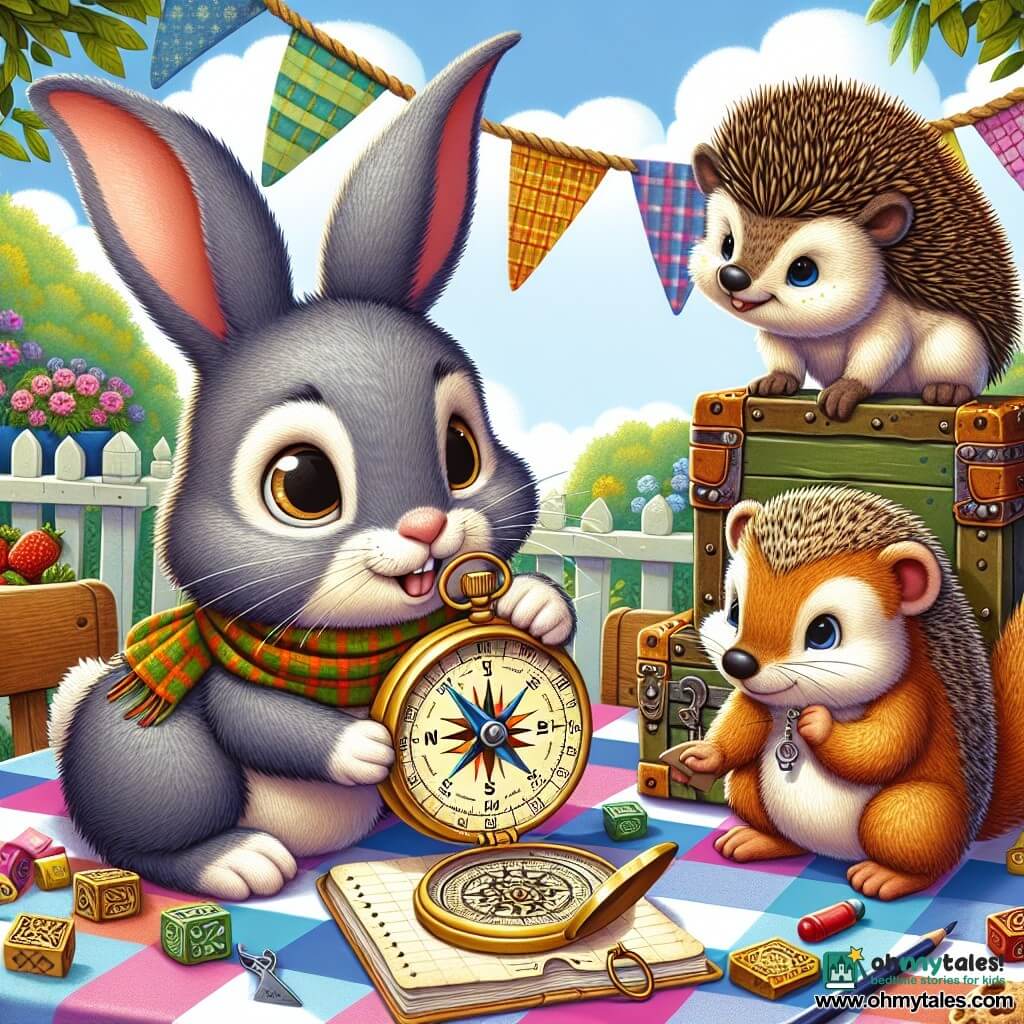
“That's the Recipe Box,” said Gran Fern, who was, in Pipkin's opinion, the most sensible rabbit in the world. Her fur had turned the soft gray of early morning, and her whiskers curled like commas when she smiled. “Everyone's favorites are inside. Sharing makes a feast, and a feast makes a village.”
She dug in her gardening smock and pulled out something small and round—a brass compass, the kind with a tiny glass eye. It fitted into her palm like a secret. The needle inside flickered, and the N at the top was painted a brave red.
“For me?” Pipkin breathed.
“For when paths twist,” Gran Fern said, pressing it into his paw. “It points north, but it also points your mind. If you ever feel lost, watch which way the needle won't stop wanting to look. Take your time. Check twice. You've got a good head under those ears.”
Pipkin tucked the compass into his vest pocket, patting it once, just to be sure. The brass felt cool and important. He turned toward the Recipe Box to have another look—it made him think of cinnamon and stories—but someone called his name.
“Pipkin! Could you help me tie this balloon?” Zadie the squirrel was halfway up a pole, a rainbow balloon string tangled around her tail. Pipkin hopped over and untied her with a gentle twist, knotting the balloon so it bobbed properly over the lemonade stand.
“Thanks,” Zadie grinned. “Today's got a shine to it, doesn't it?”
“It does,” Pipkin agreed, and his ears twitched again, catching laughter, the clink of jars, the silver squeak of a wheelbarrow.
By midmorning the garden smelled like bread and basil and sunshine. Pipkin did one more check of the tables. The Recipe Box sat proudly between the pies and the pickles. He was just thinking about where to hang a “Welcome” sign when dark clouds puffed their cheeks to the west.
“Quick, covers!” called Mr. Boggs, a stout toad in a striped apron. “A sprinkle's coming.”
Everyone bustled. Cloths were flipped, trays slid under tents, jars gathered. Pipkin went to check the center table—and stopped.
The Recipe Box with the red ribbon was not there.
At first he thought it might be hiding under the table, like when carrots play shy. He lifted the cloth. Dust. He checked the pie table. No. He checked the jam line. No box, no ribbon.
“Gran Fern?” Pipkin called. Gran Fern was tying down a corner. She looked up, eyes calm.
“It was right here,” Pipkin said, pointing at the empty place on the table. His voice came out smaller than he meant it to. “The Recipe Box is gone.”
Gran Fern's whiskers made a thoughtful comma. “Then we must find it before the judging at noon,” she said. “Let your compass point your mind, Pipkin.”
Pipkin's paw pressed his pocket. The brass compass felt like a promise. Around him, the garden crackled with little clues—footprints in dirt, the squeak of a wheel, a stray ribbon thread. If you were reading this story and standing in Pipkin's paws, what would you notice first? The wind? The tracks? The faces of friends?
Pipkin took a breath. Mystery, he told himself, is only a story you haven't finished reading yet.
Chapter 2: Two Stories, One Squeak
“Attention!” Pipkin called, not too loudly—no point in worrying small children or big goats. (Sweet Pea the goat did worry easily, especially about whether rules allowed her to be both helpful and slightly nibble-y.) “Has anyone seen the Recipe Box? Red ribbon. Wooden lid. Friendly shape.”
Zadie dropped to the ground, tail a question mark. Hank the hedgehog rolled over from under a bench, a button stuck to his quill like a medal. Mr. Boggs straightened his apron. The Robin twins fluttered down from the maple, their heads moving like punctuation.
“I saw it!” Zadie said immediately, paw in the air. “I saw Mr. Boggs pushing it. He was going toward the compost heap. Right—” she pointed behind the bean teepee—“that way.”
Mr. Boggs's eyes went round as saucers. “What? Me? Compost is for peels and rinds, not recipes. I might have been pushing something, but—”
“I saw something else,” Hank interrupted, wrinkling his nose thoughtfully. “I was by the herb bed, and I saw a tall shadow carrying a box with a ribbon. It was going toward the shed. That way.” He pointed exactly the opposite direction.
Two witnesses. Two directions. Pipkin's ears wondered why.
“Anyone else?” Pipkin asked gently.
The Robin twins piped, “We heard a squeak, like eeee-eee, and a clatter, like clink-clink!” The first Robin twin added, “And I smelled cinnamon!” The second added, “No, dill!”
“It could have been both,” Pipkin said, because kitchens often smelled like teams of flavors getting along.
He looked at Mr. Boggs. The toad frowned in a slow, careful way. “I did take the wheelbarrow to fetch more plates,” he said. “And the wheel does squeak. It's on my list to oil, but the oil can has gone and hid under something. Tools are shy, you know.”
Pipkin glanced at the sky. The clouds were grumbling but not spitting yet. There was time if he was clever. He patted his pocket, feeling the compass. He also had a stub of pencil and a small notebook—because mysteries liked to be written down so they couldn't wriggle away.
He looked at Zadie. “Tell me exactly where you were when you saw Mr. Boggs.”
“Up the pear tree, halfway,” Zadie said. “I was hanging a banner.”
“And you, Hank?”
“By the rosemary bush,” Hank said. “I was picking a leaf to sniff. It helps me think.”
Pipkin scribbled. Two witnesses, two posts. Compost heap east of the bean teepee. Shed west past the roses. A squeaky wheelbarrow, a clink. Smells that argued but could both be true. And somewhere, someone carried the Recipe Box. It seemed like two stories at once—but what if it was one story with two views? If you were Pipkin, what question would you ask next?
He tapped his pencil against his teeth. One detail kept poking his mind: the squeak. “Does anything else squeak besides the wheelbarrow?” he asked.
“The stage steps squeak,” said one Robin twin.
“And the carrot juicer,” said the other.
“The juicer goes more like eee-ggg,” Zadie said, wiggling her paws.
Pipkin smiled. He had the shape of the day in his head now: a circle of tables, a sky thinking about sprinkling, friends moving fast. He flipped open his notebook to a fresh page, drew a quick map with a square for the stage, a rectangle for the shed, a loopy spiral for the compost heap, and little X's for where Zadie and Hank had been. Then, slowly, he drew an arrow east and an arrow west. Beside them, he wrote: N?
He pulled out the brass compass. The needle jittered, then rested with its red N pointing toward the school's brick wall. “North is that way,” he said aloud. “Which makes the compost heap east, and the shed west.”
The needle didn't argue. There was something wonderful about having a small, stubborn direction in your pocket.
“Let's follow the squeak,” Pipkin decided. “But let's also collect clues. Eyes open, noses curious, ears ready.”
As they set off, Pipkin looked back at you, the reader, as if you were walking alongside. “What would you look for if you were me? Footprints? Ribbons? The way the wind blows? Keep your list in your head. We're going to need it.”
Chapter 3: East, West, and a Ribbon Thread
Pipkin led the way past the bean teepee. The beans were half ladders, half jungle, and Sweet Pea the goat was eyeing them like a poet eyes a rhyme. “No nibbling,” Pipkin whispered, and Sweet Pea pretended she had never met a bean in her life.
The path forked: east toward the compost heap, which was a neat mountain smelling kindly of earth and orange peels; west toward the shed, a low building with a blue door and a proud padlock. Pipkin's compass needle said north. His nose said cinnamon (barely) and damp leaves (loudly). His ears said squeak—farther now, like a story rolling away.
“Look,” Hank said, pointing to the dirt by the rosemary. A small red thread lay curled on the ground like a whisper. Pipkin crouched and picked it up. It had a shine to it like a ribbon. A little further along, a prickly rosemary sprig held another red thread snagged on its tip.
“The ribbon's been this way,” Pipkin said. He glanced toward the shed.
“But I saw Mr. Boggs going that way,” Zadie insisted, pointing east.
Pipkin didn't argue. He looked at the ground, at the marks other feet and wheels had left. There were thin lines where someone had dragged a folding chair. There were soft round patches where rain had once kissed the dirt. And there were sturdy, lopsided wheel tracks, the kind a wheelbarrow makes when one wheel is a bit more enthusiastic than the other.
“Three spoke marks, then a smudge,” Hank observed. “It leans to the right.”
“You'd make a fine detective,” Pipkin said, and Hank blushed through his prickles.
The wheel tracks went both directions, because wheelbarrows are friendly with all paths. But the threads pulled Pipkin west. He followed them past the rosemary, where bees worked like tiny engines, and past the roses, where petals had dropped like confetti. One bright petal was stuck to something small and silver in the dirt.
“The corner of a card,” Zadie said, plucking it up. It had a smudge of flour on one side and faded handwriting on the other: “Aunt Poppy's…”
“—Cinnamon Twists,” Hank read, peering close. The smell of cinnamon wasn't arguing anymore. It was waving.
Pipkin knelt by the blue shed door. Close to the bottom, where a bit of light slid under, he could see a thin, white dusting like a line of snow. Flour. It must have sifted out when the box brushed the door.
“If the Recipe Box is in the shed,” he said, “why is the shed locked?”
“Ms. Lark keeps the key,” said Mr. Boggs, rubbing his chin. “She's at the stage practicing announcements.”
Pipkin stood, thinking. He looked east toward the compost heap. A few scraps of ribbon-less dirt, a carrot peel like a smiley mouth, the faintest garden smell of dill, because the dill bed was that way. He looked west at the shed and the red threads. He looked at his map. He thought of what Zadie and Hank had said.
If you were Pipkin, what would you wonder now? He wondered: How can two different directions both be true? He wondered: What makes a squeaky wheel sound like it's here when it is actually there? He wondered: Why would someone lock the Recipe Box into the shed without telling anyone?
It would be easy to say, “Someone took it on purpose.” But easy stories weren't always true stories. Pipkin looked at the sky. A sprinkle fell on his nose and ran cool into his whiskers.
“Let's split our clues,” he said. “Zadie and Hank, see if you can find Ms. Lark and the key. Mr. Boggs, come with me to ask the Robin twins exactly what they heard and when. If we keep sharing what we notice, the story will stop trying to hide.”
Sharing. Gran Fern's voice sounded in his head: Sharing makes a feast, and a feast makes a village. Pipkin patted his compass once. The needle was steady. His mind felt steered.
Chapter 4: Which Way Was Which?
The Robin twins were perched on the edge of the small outdoor stage, practicing bowing. They bowed together. They bowed opposite. They bowed like they were two sides of a seesaw. They liked to turn everything into a duet.
“What time did you hear the squeak?” Pipkin asked, flipping open his notebook. He clicked his pencil. “Were you facing the shed or the compost heap?”
“Ten minutes before the sprinkle,” said the first twin, fluffing a feather. “We were facing the lemonade table.”
“That points north,” said the second twin, whose head always moved like a compass needle trying to decide if it enjoyed directions too much.
“Did you hear eeee-eee from the right or the left?” Pipkin asked.
“Right,” said one. “Left,” said the other.
Mr. Boggs sighed. “Twins,” he said, and then, “No offense.”
“None taken,” they chimed.
Pipkin drew a little stage on his map. He marked an arrow for the twins' eyes. He drew a tiny ear near the lemonade table. The squeak, heard from opposite directions by two birds who switched sides as naturally as breathing, was not a reliable arrow, exactly. But the time was helpful.
“Where were you then, Mr. Boggs?” Pipkin asked gently.
“Fetching plates,” Mr. Boggs said. “I saw the clouds and worried for the recipes, so I asked Ms. Lark for the shed key—”
Pipkin's ears perked. “You had the key?”
Mr. Boggs nodded. “I put the Recipe Box in the shed so it wouldn't get damp. Then I put the key on a hook by the potting bench and took the wheelbarrow to the compost heap because the lettuce trimmings were starting to visit flies.”
East and west, both in the same breath. Pipkin's pencil hung in the air like a dragonfly.
“Then,” Mr. Boggs continued, “I came back and—” He frowned. “I meant to tell Ms. Lark where the box was, but Sweet Pea knocked over the watering can and I—” He made an apologetic hand-flip. “It was all a muddle.”
Pipkin's mind clicked into place like a drawer closing. “Zadie,” he said as she and Hank hurried up with Ms. Lark in tow, “from your tree, facing south, your right is west, isn't it? When you pointed to Mr. Boggs going ‘that way'—”
“—I must have been pointing west without realizing,” Zadie finished, slapping her forehead. “I always mix up left and right when I'm upside-down.”
“And Hank,” Pipkin said, “you saw a tall shadow with a ribbon going west. The ribbon threads agree. Mr. Boggs did take the box west to the shed. Then the squeak the twins heard was the wheelbarrow, but if they switched places—”
“—we heard it from opposite sides,” the twins sang.
Ms. Lark, a graceful bird in a blue scarf, jingled a ring with a hook. “Except for one problem,” she said. “There's no key on this. The shed key is missing.”
Pipkin looked down. Between his feet, on the dirt by the potting bench, a small round chew mark decorated a bit of string. The end was damp, as if it had been taste-tested.
“Sweet Pea,” Pipkin called.
The goat looked up from pretending to admire a wheelbarrow. She had a piece of green string dangling from the corner of her mouth like a bold idea trying to escape.
“Did you borrow a string that happened to be attached to a key?” Pipkin asked kindly.
Sweet Pea lifted her chin. She did not want to be in trouble. “‘Borrow' is such a strong word,” she said in a tiny voice. “I thought it was a noodle.”
Pipkin hid a smile. “Can you show us where you put your noodle?”
Sweet Pea led them with a prance that said she hoped this would end well. Behind the watering can, under the bench, was the key, wearing a small bite mark but otherwise fine.
“Hurrah!” Zadie cheered.
“Not so fast,” Hank said, pointing with a careful paw to the blue door. “There's something else.” Under the door, the flour line was thicker now. A thin edge of a card peeped out more boldly. And from the crack, a damp, buttery smell threaded into the air. Cinnamon and vanilla. And something leafy, too. Dill.
Pipkin's pencil wrote by itself: Both smells. That means the box is in there.
“Let's open it,” Ms. Lark said, sliding the key into the lock.
“Wait,” Pipkin whispered, because his mind had just noticed a puzzle-piece. If Mr. Boggs put the box in the shed and left the key on a hook, why was the box right up against the door like a puppy? Why was flour dusting the threshold as if the box had been pushed under to make sure the door closed? Who had closed it? Was anyone inside?
“Hold on,” Pipkin said firmly. “Listen.”
They all stilled. For a moment, the garden was a held breath. Then, from inside the shed, came a sound: a small tap-tap, and the softest hum, like someone singing to keep themselves brave.
If you were Pipkin, what would you do? Knock? Whisper? He did both.
“Hello,” Pipkin said through the crack. “Is anyone in there?”
There was a muffled Startled noise. Then a voice, small as a button: “I didn't mean to be locked in.”
“Who is it?” Ms. Lark asked, key hovering.
“Me,” said a voice that sounded like clover and hiccups. “Dot.”
Dot was the youngest rabbit in Pipkin's after-school club. She was excellent at listening and terrible at remembering her shoelaces. She must have gone into the shed to—what? Hide from the sprinkle? Help? Pipkin's heart did the twisty flip it did when two puzzle pieces fit.
“Stand back from the door, Dot,” Pipkin called. “We're opening it now.”
The key turned with a satisfying click.
Chapter 5: Inside the Blue Shed
The blue door swung open. Dot blinked in the light, her whiskers damp with one tear (just one, because she had been very brave). She had one paw on the Recipe Box like a captain with a hand on the wheel.
“I went in to get towels to cover the pies,” she said in a rush. “Then the door closed, and it was stuck. I thought if I kept the Recipe Box near me, it wouldn't be lonely. I hummed so it would know I was here.”
“Good thinking,” Pipkin said, because sharing courage matters too.
“And me,” Mr. Boggs said, “I should have checked the door. I am very sorry, Dot. And I ought to have told Ms. Lark about the box.” He patted his apron, and something rustled. “Oh, would you look at that—I wrote myself a note to remember, but I put it in my apron and then forgot my apron had a pocket.”
Ms. Lark took a towel from Dot's arms and draped it over the box like a hug. “Thank you for holding steady,” she said. “Now, let's get this back where it belongs.”
“Wait,” Pipkin said. He wasn't quite done. He wanted to understand the story right to the last period. He looked at Dot. “What did you see and hear when you came in?”
Dot thought, her nose making little circles. “I heard the squeak of the wheelbarrow,” she said. “I saw Mr. Boggs put the box on the shelf. Then I saw a drop of rain, and I thought, I should cover it more. When Mr. Boggs left, I dragged the box by the door so it wouldn't be too far away when we carried it. Then the door closed and… um… Sweet Pea,” Dot added, glancing at the goat, “you stood on the mat and the mat slid and the door thunked shut.”
Sweet Pea's ears drooped. “I'm sorry,” she said, so tiny even ants leaned in to hear.
“It's all right,” Pipkin said. “We're okay. We found each other.” He crouched so his eyes were level with Dot's. “You did two clever things without anyone telling you: you moved the box close to help, and you hummed to stay calm. That helped us find you. Smells and sounds can be signposts, too.”
He turned to the others. “And that explains our clues. Zadie saw Mr. Boggs going west because her right was west from the tree. Hank saw a ribbon thread by the rosemary on the west path. Mr. Boggs went back east to the compost heap, and the squeak happened then. The twins heard it from opposite sides because they switched places. And the flour dust by the door came from Dot pulling the box forward so it would be quicker to carry.”
“A single story,” Ms. Lark said, “told by a group.”
Pipkin felt his notebook smile in his pocket. His compass, tucked beside it, bumped the edge of the paper like it wanted to be recorded too. He pulled both out. On a clean page he wrote, Case of the Missing Recipe Box: Found. Underneath, he wrote, Directions matter. Check where everyone is standing. Share what you notice.
He looked at you again, because you had been walking with them the whole time, haven't you? “Did you guess it?” he asked, whispering just for you. “What clue was your favorite? The ribbon thread? The flour snow? The squeak that moved?”
“Let's put the box back,” Ms. Lark said. “Gently. The judges will be here in ten minutes.”
“Wait,” dot piped up, paw raised. “What if next time it rains? We should make copies of the recipes, so they're not all in one place. Sharing is also about multiplying, right? Like when you cut a pie and there's the same amount of pie but more pieces.”
“I love the way you think,” Hank said.
Pipkin beamed. “We can do both. Let's share the recipes so no one person is holding the whole feast. If we have a second notebook, and maybe a third, the recipes can live in different hands and still belong to all of us.”
“Agreed,” said Ms. Lark. “We'll call it the Many Pages Plan.”
Sweet Pea danced. “I can carry one notebook—if it's allowed for goats to carry books without nibbling them.”
“It is allowed,” Ms. Lark said, “and also encouraged.”
They marched the Recipe Box back to the center table like a small parade. Zadie hung a fresh ribbon with a neat bow. Mr. Boggs oiled the wheelbarrow in a ceremony that involved applause. The clouds, perhaps flattered by all the attention to detail, decided to move along without fully crying.
Gran Fern appeared with a plate of sliced apples and a twinkle that suggested she had been watching and trusting all along. She handed out slices. “To sharing,” she said.
“To sharing,” everyone echoed. Pipkin bit into his apple, which tasted like thanks.
Chapter 6: Case Closed, Pages Open
At noon, Ms. Lark tapped the microphone. “Welcome to the Maple Street Harvest Fair,” she announced. Her voice rang with a cheer that made even the scarecrow straighten. “Thanks to everyone who helped this morning. Our recipes are safe, our pies are proud, and our friends are finer than fine.”
The judges—three neighbors with trustworthy smiles—tasted muffins and nodded at pickles. The kids' table had a competition for the most creative sandwich. The winner was the Robin twins with a “Left-Right Delight,” which tasted equally good no matter which side you began. Sweet Pea's salad disappeared in good minutes, and no one could prove she had not accidentally eaten a napkin. (She hadn't. She would never. But she worried about it for three and a half minutes and needed three pats and one carrot slice to feel better.)
Pipkin set up a copying station with three notebooks, each with a cover in a different shade of garden green. Hank wrote carefully, his letters tidy. Zadie invented a quick system: read a recipe, pass it left, then right, so everyone wrote one piece and no one hand got tired. Mr. Boggs dictated Aunt Poppy's Cinnamon Twists with such drama that the letters smelled like sugar. Dot printed labels and stuck them with joy.
“Make sure you share your best secrets,” Gran Fern said. “Good food tastes better when the whole village can make it. Good ideas, too.”
Someone started a song about how tomatoes feel when they finally turn red. Grandparents danced with grandkids. The sun came out as if it had been hiding on purpose just to make its entrance dramatic. Pipkin's ears relaxed into the music.
When things settled, Ms. Lark leaned over to Pipkin. “How did you think to check where everyone was standing?” she asked softly.
Pipkin looked at his brass compass. The needle wobbled, then settled, like it was listening. “Gran Fern said the compass points my mind,” he said. “It helped me remember that east and west can look different from different trees. And that sharing what we see makes a stronger map than any one of us can draw.”
“Wise rabbit,” Ms. Lark said.
“Hungry rabbit,” Pipkin corrected, and they laughed. He filled a plate with things he could name and things he couldn't yet. It's important to be brave in your taste buds and your thoughts.
Afternoon drifted toward evening. The fair's songs softened. The banners sighed. Sweet Pea found a sun-warmed patch near the bean teepee and dozed. The Recipe Box sat like a guest of honor, surrounded by its new friends: three green notebooks. Anyone could read. Everyone did.
Pipkin took a last slow walk around the garden, the brass compass warm in his pocket, the way treasures get warm when you carry them near your heart. He climbed onto the stage and looked down at the map in his head. Shed west, compost east, stage north of lemonade, rosemary guarding the middle. He looked back at you, because you had been on the paths too.
“If you were here,” he said softly, “what would you copy from the Recipe Box? What would you share? Sometimes the most important clue is the one you offer. That's how mysteries solve themselves into stories.”
Gran Fern sat beside him, her paws folded like she was holding something you couldn't see. “Do you know what I liked best?” she asked.
“The apple slices?” Pipkin guessed.
“That everyone told their pieces,” Gran Fern said. “You listened. You asked. You held space for everyone to be right together.”
Pipkin's cheeks warmed. “It helped to draw a map,” he admitted. “And to have a compass.”
He pulled out his notebook—the same one that had sketched the path of the squeak and had written Directions matter. He flipped to the last page. He wrote, Case closed. And then, because he was a rabbit who liked second endings, he added, Recipes open.
He held the book for a moment, feeling the way words can hold a day so it doesn't slip away. Then he closed the notebook with a soft click, the kind of click that sounds like a drawer finding its place, like a door opening, like a small brass compass settling into a pocket, ready for the next path to twist.