Morning of Painted Light
Pip the rabbit woke up to a sky that looked like a bowl of candy. Soft stripes of rose, lemon yellow and pale blue stretched across the morning, and tiny white clouds drifted like cotton puffs. Through the window of his little burrow, Pip could see the village square already waking: a bell at the church tower chimed, bakery ovens sent out warm, yeasty smells, and children's laughter bounced between the hedges.
Easter had arrived. It was the day that the whole village, from the oldest baker to the tiniest mice, came alive with colors and treats. For Pip, Easter was a flutter in the chest, a secret-keeping sparkle behind the whiskers. He had been planning for this day all week: painting eggs, hiding surprises, and delivering them with care. Pip loved the small things that made Easter special — the soft nests of straw, the clinking of tiny tin buckets carried by children, the way daffodils nodded as if they were listening.
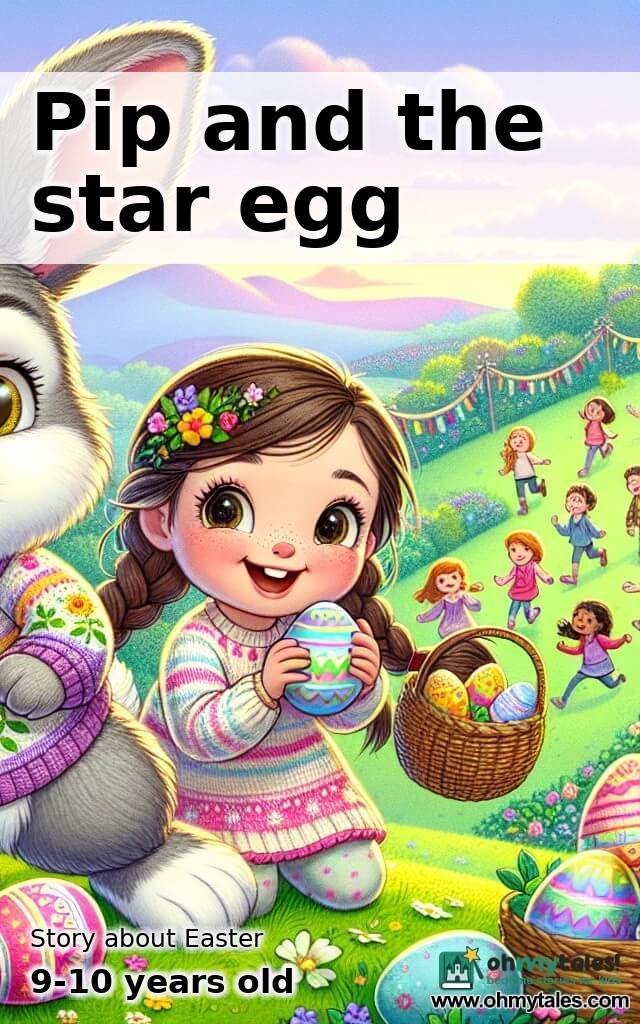
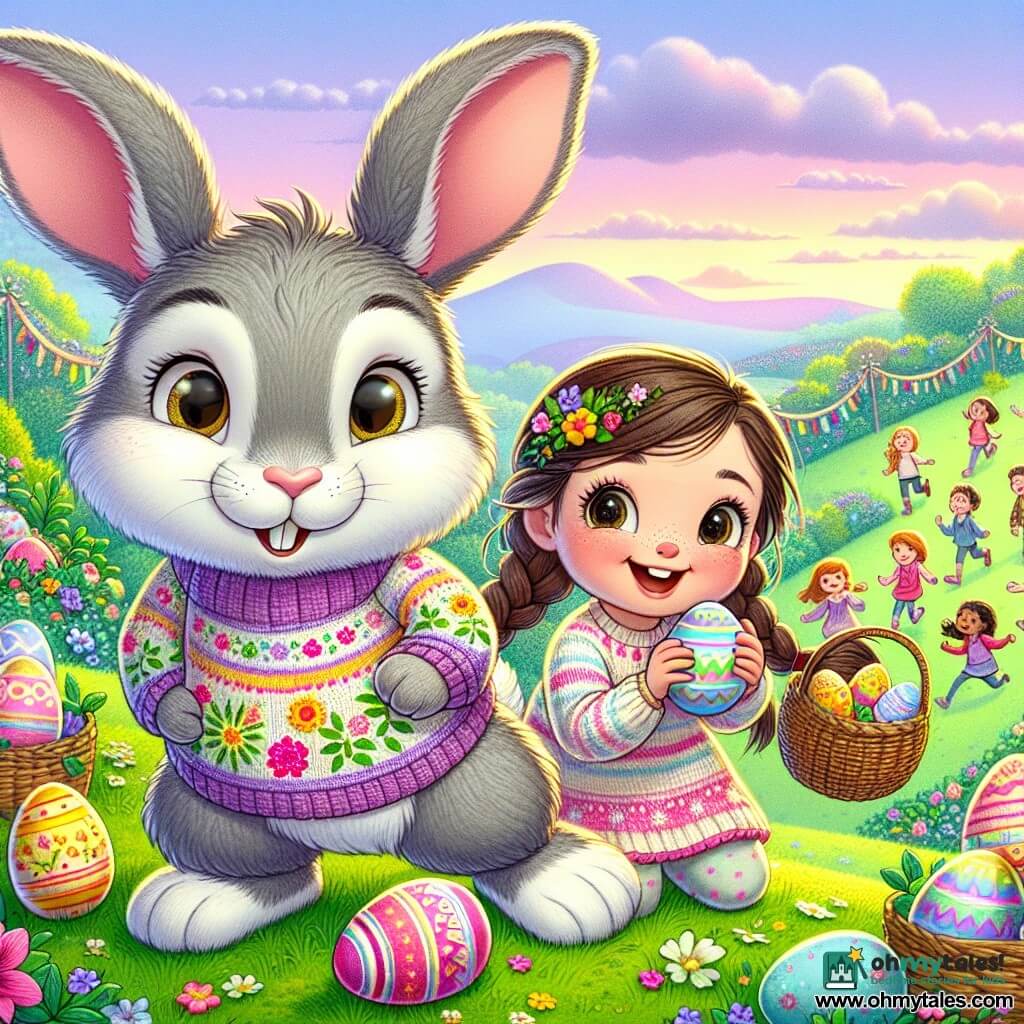
Pip stretched his long ears and hopped into his knitted sweater. It was a sweater of many pockets, each with a little ribbon stitched on, and inside those pockets he kept tiny treasures: a spool of green thread, a pebble the shape of a crescent moon, and a folded note that said “Remember to smile.” Today, his sweater pockets would also hold painted eggs, ribbons, and the map of hiding places he had drawn on a scrap of paper.
In the square, the Easter market buzzed like a friendly beehive. Stalls draped in bunting sold honey cakes, spicy orange marmalade, and baskets woven from willow. Children clustered around a table where Mrs. Finch painted chicks and bunnies on paper cups with careful strokes. A band of fiddlers began to tune, their instruments glittering in the sun.
“Good morning, Pip!” called Mrs. Finch, smiling in a way that made her feathers ruffle. “Your eggs this year? I hope they're full of surprises.”
Pip bowed, which made his whiskers twitch. “They'll be bright as lanterns,” he said. He liked to use color the way other rabbits used carrots — with enthusiasm and purpose. His paint pots were lined up in his burrow like soldiers: crimson, sapphire, emerald, buttercup, and the special one he mixed himself — a shimmering violet that caught the light and seemed to wink.
Near the fountain, children were making nests from moss and straw, and Mr. Thistle, the gardener, was stringing garlands of fresh leaves between the lampposts. Pip helped him loop a ribbon. Together, they threaded paper bunnies and little chocolate eggs into the garland, each one swaying and tapping like a tiny bell as people passed.
Everything felt ready. Pip felt the kind of thrill you get when you stand at the top of a hill and the whole view stretches open before you. He thought of the children's faces when they found an egg painted like a tiny planet or a little poem tucked inside. He thought of the sun warming his fur and the scent of butter from the bakery. It promised to be a day that would sparkle in memory for a long time.
But just as Pip bent to tuck a painted egg into his pocket, a breeze rushed through the square, playful and bold. It brushed the pages of his map and tipped his basket. One bright, blue ribbon flew up like a small kite and landed on the head of a passing goose. Pip hopped after it, laughing as the goose honked in polite surprise.
“Oh, Pip,” said Mrs. Finch. “Mind the ribbons. They do like to roam.”
Pip tied the ribbon back, bent to check his basket, and felt the warm, steady beat of excitement in his chest. Today would be full of colors, of tiny surprises and soft laughter. But as he tucked the basket under his arm and looked at the path that led through the wildflower meadow, he saw something new: a faint shimmer hovering like a dust mote in the air, right above the hedgerow. It looked ordinary at first — just a twinkle of light — but then it seemed to breathe. For a heartbeat, Pip wondered if it was a reflection from a window, or a glint from a coin, or maybe a stray star come down to taste the day.
He reached out a paw. The shimmer pirouetted and pulsed, and a tiny, bell-like sound tickled his ear. Pip smiled. “Hello there,” he whispered. “Are you an Easter sparkle?”
The little light pulsed again and drifted toward his ear, like someone bowing politely. It felt warm, like a pocket of sunlight. Pip tucked it gingerly into his pocket, where it hummed like a small, contented bee. He didn't know what magic it was, but he had a feeling that this Easter was about to be a story with an extra twist.
With the sparkle tucked safely, Pip hopped toward the hill where he would paint, humming a tune the fiddlers had begun to play. Children waved, the baker handed him a warm bun to go, and the whole village seemed to sway gently with the promise of something bright and new.
The Great Egg Paint and the Spill
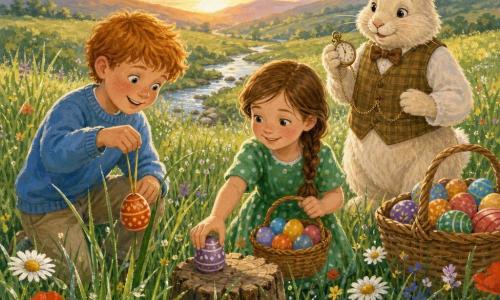
Pip's painting hill was a patch of ground under an old apple tree. The tree leaned as if it had once whispered secrets to the moon, and its roots made perfect benches. The grass smelled sharp and green, and buttercups nodded their yellow heads like tiny suns.
Pip set up his paints on a wooden box and arranged the eggs in rows, like little sleeping planets. He had chosen the eggs carefully: some speckled like robin eggs, some pale as milk, some large and proud. Each egg had a name in Pip's head. “Marten,” he said to a sky-blue one. “Daisy,” he sang to a freckled one. “Button,” he chuckled at a small, plump egg near the edge.
Around him, children came for lessons in wobble-painting and splatter-splendour. Pip taught them how to hold a brush like you hold a friend's hand — steady, gentle, with trust. He guided fingers, showed them how to swirl, and watched their faces light up with every new color that bloomed.
The little sparkle in his pocket ticked like a tiny drum. Sometimes, when Pip moved his paw, the sparkle sneezed out a glittering puff and left a trail of shining dust on his fur. The children giggled and tried to catch the stray specks, which floated through the air and landed on cheeks like confetti.
“Pip!” called Lila, a girl with braids like sausages. “Can you paint mine like the sunrise?”
“Of course,” Pip said, pleased. He dipped his brush into a golden paint and swirled a crescent of peach across the egg. The paint glowed, and the egg felt like a small world waking up.
The day was perfect, so perfect that even time seemed to stop to watch. But then, somewhere between a laugh and a song, a gust of wind whooshed down the hill with mischief written across it. It was as if the sky itself had decided to stir the pot. The gust knocked over the wooden box of paints, setting pots clinking like tiny bells. Paint splashed, and for a moment it seemed as if a rainbow had slipped into a tumble. Brilliant colors leapt out and began to race across the grass.
“Oh no!” cried Pip, but the voice in his mouth was a mix of worry and a spark of something else — the kind you get when an adventure appears in the guise of a problem. He reached for the flying pots, his paws skidding over the slick grass. A bottle of shimmering violet rolled toward the edge of the hill, with a trail of twinkling dots behind it — dots that looked suspiciously like they had been touched by the pocket-sparkle.
Pip lunged. He caught the violet just as it was about to tip over a nest of painted eggs. His paws were a mess of color: a streak of buttercup on one whisker, a dab of emerald on the tip of his tail. He was relieved, but then he realized something else. The sparkle in his pocket was slipping out, attracted to the violet paint like a moth to a flame. It drifted out and settled on the paint's surface, where it shivered and — to Pip's astonishment — dove right in.
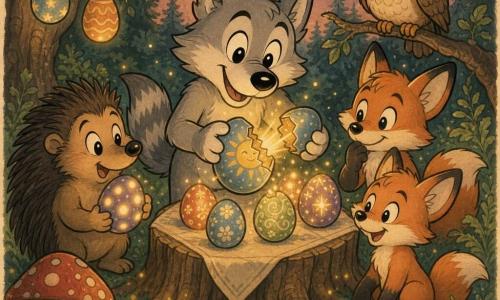
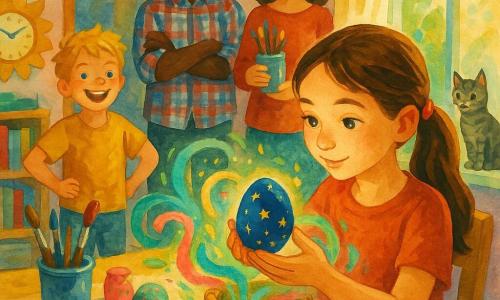
For a second there was a hush. The paint glowed brighter, and the little sparkle bobbed beneath the surface like a fish playing in a lantern. The paint pool shimmered and gave a contented sigh. Then, with a pop that sounded almost like a small chuckle, it formed a tiny, twinkling pattern on top of the violet, and a little, painted egg rolled free from the mess. The egg had never had a shell like this before. It was not merely violet; it had a hundred tiny stars inside it, and the stars moved like they were telling a story.
“Look!” Lila pointed. “It's a star egg!”
Pip blinked. The violet egg pulsed, and small motes of light drifted up like tiny lanterns. He lifted it gently, feeling warmth through the shell. Inside, when he put his ear close, he could hear a soft melody — the kind that makes you want to hum along without knowing the tune.
“It must be an Easter egg,” said Mrs. Finch, coming over with her paint-splattered apron. “One for the heart.”
Children crowded around, eyes wide like the moon. Some whispered that the sparkle in Pip's pocket had found a wish it liked. Others insisted it was the hill itself, giving them a gift. Pip didn't know which was truer, only that the star egg felt special, as if it contained a promise.
The gust of wind, perhaps pleased with itself for stirring things up, settled down and left the hill tidy in a surprisingly neat way. The pots had tipped but not scattered. The children clapped for Pip's quick paws and the painterly miracle that had happened. Pip, still streaked with paint, felt a proud warmth expand his chest.
But all celebrations have a ripple, and the ripple came that afternoon. As Pip tucked the star egg safely into a pocket to keep it warm, he noticed his basket — the one with all the other newly painted eggs — was light. A gentle panic fluttered inside him. He looked around. The basket had been at his feet when the gust came. Now it sat across the hill, empty. There were tracks in the grass — small, beetle-like prints and a trail of tiny chocolate crumbs.
“Someone's taken them?” Lila whispered.
Pip felt his whiskers pull flat. Not one, not two, but dozens of eggs were gone: the ones he had painted for the hunt, the ones meant for old Mr. Gorse who liked his eggs plain, the ones he had promised to the schoolchildren. The empty wicker looked so lonely against the green.
“Follow the crumbs,” Mrs. Finch advised, and so they did. The path led away from the hill, winding through the meadow where the buttercups bowed, and toward the hedgerow on the edge of the village where the wildflowers grew tall and secretive. The sparkle, which had been quiet in Pip's pocket, throbbed once like a heartbeat and then grew brighter, as if it wanted to help.
Pip gathered the children, and together they set off. The sunlight spilled over them like honey, and the world seemed to wait with bated breath for what would happen next.
The Missing Basket and the Secret Thief
The trail of crumbs led them to a narrow path lined with harebells. Pip's heart thudded, a steady drum. The path twisted between hedges, and the air smelled faintly of mint and old stories. The closer they came to the hedgerow, the cooler the shadows felt, as if the world had folded in on itself to make room for something secret.
“They couldn't have gone far,” Pip said, though his voice was smaller than he wanted it to be.
The children tiptoed, careful not to scare the small authors of the missing eggs. One by one, they reached a small clearing where the grass grew short and a ring of stones lay like a forgotten circle. It looked like a place for telling tales, or for making promises. In the middle of the circle sat a family of hedgehogs. They were rolling in the sun, using their tiny snouts to search for breakfast.
“Good morning,” said Pip, bending down to greet them. “Have you seen any eggs?”
The hedgehogs looked up with sleepy eyes. One of them, a hedgehog with an unusually bright quill, sniffed the air. “We saw something sparkly go by,” the hedgehog said in a small, squeaky voice. “A ribbon, and then a rush of color, and a rustle in the branches.”
“Maybe they took a shortcut through the hedgerow,” Lila guessed.
Pip followed the hedgehogs' pointing noses until the path narrowed and the leaves grew thicker. The sparkle in his pocket chimed softly, like a small bell that told him to trust his feet. Pip pressed on, and soon they reached a hollow at the base of an old elder tree. Smoke made little curls above a tiny doorway, and from inside came the sound of something bustling and humming, as if someone was making a tea cozy out of sunshine.
“Hello?” called Pip. “We're looking for some eggs.”
The door creaked open, and out hopped a family of squirrels. They wore little scarves and looked terribly important. One of them, a young squirrel with a tail like a plumed feather, held something behind his back.
“Good morning,” said the squirrel, officer-like. “What brings you to our door?”
Pip explained about the missing basket, the painted eggs, the crumbs. The squirrels looked apologetic and also a little surprised. “We saw something shiny,” they said. “A small, mischievous breeze carried it. It wasn't us.”
As they peered into the hedgerow deeper, a shadow scurried past — quick and striped, with bright eyes like buttons. It darted between tree roots and paused on the other side of a low log. The children gasped. It had a tail like a paintbrush and whiskers that curled like commas. Pip hardly dared to breathe.
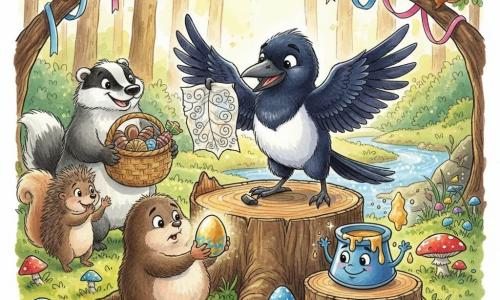
There, curled up in a hollow beneath a carpet of moss, was a badger. But not just any badger: his fur shimmered with flecks of paint, and his claws were stained in every color of Pip's pots. Around him, hidden like a treasure trove, lay dozens of painted eggs, all neat and perfect, stacked with great care. The badger looked up, surprised but not mean, and his eyes were watery.
“Hello,” he said softly. His voice was deep and gentle, like a bell under a blanket. “I didn't mean to take them. I am… new here.”
Pip's whiskers twitched. The badger's name was Bram, and he had moved to the village only a few weeks ago. He was shy and loved to collect shiny things. Bram explained that he had found the basket at the edge of the hedgerow and, thinking the eggs had been abandoned, had carried them to his hollow to keep them safe. He had meant to return them before the hunt, but then his paws had gotten messy with paint and he had fallen asleep. Bram looked at the eggs with such tenderness that Pip felt something like understanding bloom.
“But these were for everyone,” Lila said, a little disappointed.
Bram's ears drooped. “I am sorry. I wanted to make a surprise. I thought I could decorate each egg and make them more beautiful.”
Pip crouched and looked Bram in the eye. The badger's fur had tiny flecks of violet — the same violet that had made the star egg. Bram reached for one of the eggs and cradled it like a bird.
“I always wanted to give everyone something,” Bram confessed. “In my old place, I had no one to share with. Here, I saw color and laughter, and I wanted to add to it.”
Pip felt his heart stretch with warmth. He remembered the star egg in his pocket, humming gently. He thought of the way the badger had cared for the eggs, how he had stacked them like treasures. The problem had a simple fix if they worked together.
“We can share the surprise if you help us hide the eggs,” Pip suggested. “You can help make the hunt extra special. The village likes surprises that are tidy and kind.”
Bram's face brightened as if a lamp had been lit. He nodded eagerly. Together, they formed a plan. The squirrels fetched baskets, the hedgehogs carried a few eggs tucked safely in their spines, and the children helped steady ladders and place eggs in secret nooks. Bram, with his careful paws, painted delicate vines and tiny moons onto some eggs, while Pip and the children tucked notes inside others — small poems, jokes, and kind wishes.
The work felt like weaving a tapestry: each hand added a thread. The villagers, once worried, returned with smiles and extra ribbons. Mrs. Finch offered warm buns, and Mr. Thistle supplied lavender sprigs to scent the nests. Even the goose, who had once worn Pip's ribbon, came to help by honking encouragements that sounded like music.
As the sun dipped lower and the shadows lengthened, the basket was no longer empty. It bulged with new eggs, some painted by Bram's careful paws, some by Pip, and some by the children whose grubby fingers made them perfectly imperfect. The star egg remained safe in Pip's pocket, humming an extra bright note as if it were pleased with the teamwork.
“Thank you,” Bram said, his voice small but honest. “I was afraid you would be angry.”
Pip shook his head. “Easter is about sharing and finding new friends. You didn't mean harm, and you helped fix it.” He slipped a small ribbon onto Bram's ear, which made the badger beam like sunrise.
When they finished, the hedgerow looked like a secret garden of wonders. Eggs hid in teacups, in crooks of tree roots, under petals of flowers, and behind painted stones. Little notes peeped from nests, telling whoever found them to be bold or kind or brave. The sparkle in Pip's pocket burst out once more, releasing a trail of glitter that wrapped around the hedgerow like a promise.
They walked back to the square together, the basket balanced between them. The village bells chimed again as if to say, “All is well.” Children skipped ahead, their pockets full of plans and their heads full of possibilities. Pip felt a warm glow settle in his belly, like a cup of hot cocoa. Today's misstep had become a bridge.
The Bright Parade and a Promise of Spring
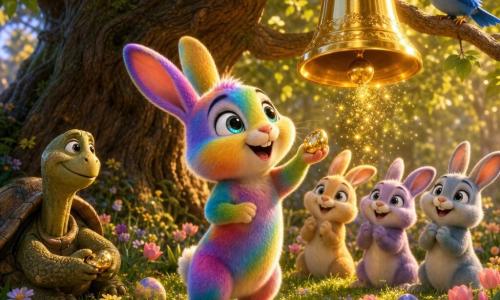
Morning came like a promise kept. The square was a riot of color, with bunting snapping in the breeze and stalls spilling out ribbons and treats. The children gathered, cheeks pink with excitement and hands eager for the hunt. The elders sat on benches nibbling biscuits and nodding their approval. Pip felt his heart thrum in a steady, comfortable rhythm.
“Ready?” he asked, and the children yelled a chorus of yeses that echoed off the rooftops.
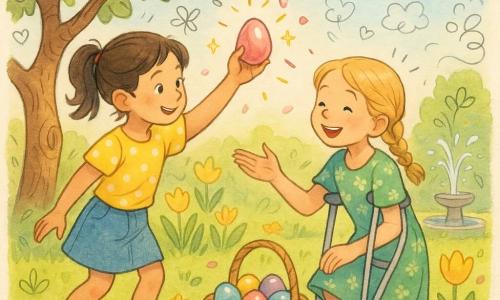
Pip held the basket high and announced the start of the hunt. He had hidden the eggs with care: some were easy, for the littlest ones, and others measured to make searching a gentle challenge. The rules were simple — find one egg, then help someone else find another. The children's eyes sparkled as they dashed off, and the square filled with the soft patter of small feet.
As Pip watched, he thought of Bram, of the suspicious little gust that had started everything, and of the sparkle that had danced into his day. He reached into his pocket and, with a smile, placed the star egg gently on the wooden table beside the fountain. The egg glowed, and a hush fell over the crowd as if the whole village felt the warmth of something gentle and new.
A small boy with freckles found the star egg first. He held it like a secret and listened. The star egg hummed a tune that made him smile wider than he had that morning. He tucked it carefully into a nest made by Mrs. Finch and shared a cookie with a friend. The tune seemed to make sharing easier — a warm seasoning added to kindness.
Pip joined the hunt, skipping along and helping the children. He pointed out a nest under a gardener's hat, lifted a petal to reveal a cheeky stripy egg, and tucked a tiny note into a tiny shell that told whoever found it to “tell someone you like their laugh today.” The hunt was full of squeals and happy gasps. Each found egg was celebrated as if it were a small miracle.
In the middle of the festivities, a parade formed. It began with a little girl playing a flute, then a boy beating a drum made from an old biscuit tin, and soon it swelled into a procession of everyone carrying something that mattered to them — a knitted chick, a shiny pebble, a daisy chain. Bram walked with them, a shy smile tugging at his cheeks. He held a small painted egg wrapped in ribbon and every so often gave it a little polish with his paw.
The parade wound through the village, past the bakery with steam curling like lace, past the pond where frogs sang their low, squishy songs, and up the hill where the apple tree watched like a grandparent. People stopped to clap and sing. Pip spotted his sweater, pockets bulging with small gifts, and he pranced a little, feeling light as a feather.
At the top of the hill, they all gathered. Children danced, older folk swayed, and even the geese formed a sensible line and honked in time. Bram stepped forward and told a few shy words about how he had meant well and how he had learned that keeping surprises is good, but sharing them is better. The crowd cheered, as if they had been waiting to bless him with belonging.
Then, with a flourish, Pip did something that made everyone laugh: he opened his sweater pockets and let out a scatter of tiny treasures — threads, pebbles shaped like moons, tiny folded notes that laughed like crinkled leaves. He reached into his pocket where the sparkle had been and pinched it with two fingers. It popped gently, like a soap bubble, and showered the sky with a soft, shimmering dust. The dust settled on people's hair, on the grass, on Bram's painted claws. It made the world look as if someone had sprinkled sugar over it.
“This sparkle,” Pip said, smiling, “is for always remembering to make Easter bright — not just with eggs, but with sharing.”
Children touched their cheeks and felt the glitter tickle like tiny feathers. Lila turned to Pip. “You know,” she said, “this is the best Easter ever.”
Pip felt warm all over. He had set out to make a day of color, and he had ended with an afternoon full of small, golden moments — songs with friends, hands helping hands, and a badger who had found a home.
The festival finished with a picnic. Blankets spread like patches of countryside, and the scent of jam and warm bread filled the air. People shared stories of past Easters, of pranks that went right and ones that went slightly sideways. Bram, who had once been shy, told a silly story about a time he had painted a pebble to look like a button and then lost it in his own pocket. Everyone laughed, and the laughter sounded like bells ringing.
When the sun began to sink, painting the clouds in the same candy colors Pip had seen that morning, the villagers lit lanterns. The lanterns bobbed and glowed like small moons. Pip looked around at the faces lit by soft light — smiling, flushed, content. The star egg's little hum had faded into a gentle silence. Pip's whiskers twitched, and he felt the happiness settle into the bones of the village like a cozy blanket.
Bram walked up to Pip and handed him a little painted stone. “For your sweater pocket,” he said. “To remember that you helped me learn.”
Pip accepted it gratefully and slipped it into the pocket with the moon-shaped pebble. He tapped his paw against Bram's shoulder, which made the badger laugh in a baritone chuckle.
“Thank you for helping, Bram,” Pip said. “For everything.”
“You too,” Bram replied. “For giving me a chance.”
The lanterns floated up, and the sky folded over the village like a great, soft hand. Stars winked awake, and the sparkle from the morning seemed to echo in them, a little trail of light that moved across the heavens. The children lay back and watched the stars, each of them holding a story they had found that day.
Pip hopped to the top of the hill once more and looked out at the sleeping village. He thought of the painted eggs, the spilled paint, the missing basket, and the friendships that had been stitched like new fabric. He felt proud, like someone who has sewn a patch onto a favorite sweater. It would keep the sweater whole.
As he turned to go home, Lila hugged him tightly. “Best Easter ever,” she whispered.
Pip smiled. “Best Easter yet,” he replied. He hopped home under the soft glow of lantern light, his sweater pockets warm with pebbles and painted stones, and his heart full of a shining, gentle glow.
In his burrow, he tucked one more ribbon into his pocket and whispered a small wish to the quiet room. Outside, the village slept, dreaming in colors. Spring stretched its long, green fingers, and Pip, the rabbit who loved to paint, knew that the brightest thing he could ever create had been made not by his paws, but by the kindness he helped share.
And if you listen quietly, on soft mornings when the daffodils nod and the air smells like fresh bread, you might hear the faint echo of a star egg's hum — a little tune that reminds everyone to be generous, curious, and bright.