Chapter 1 — The Pebble Map
Tommy loved small things. He loved the tiny loop of a snail's trail, the whisper of a feather, the way light pooled in a puddle. But most of all he loved pebbles. He carried them in his pockets like good luck, lined them on windowsills, and, every morning of spring, he made paths with them across the garden.
On the morning of Easter, the garden was a patchwork of pale sun and damp soil. Tulips stood like little flags. The air smelled of fresh bread from Mrs. Linton's kitchen and of newly cut grass. Tommy knelt by the old oak and pressed a pebble into the dirt. Then another, and another, until a neat, winding trail glittered between the daisies. He smiled. The pebbles were his map. They helped him remember where he'd been and where he might go.
"Don't lose the map," his mother called from the kitchen. "And come in when it rains!"
Tommy waved a hand. He had plans. Today was the village Easter treasure hunt, and Tommy—ten years old and quick as a thought—intended to find every chocolate egg before anyone else. He tucked a flat, smooth stone into his pocket—its edge fit his thumb like a promise—and set off following his own pebble trail.
Chapter 2 — The First Clues
The village green was alive. Banners flapped, children chased ribbons, and laughter echoed off the bakery wall. Near the fountain, a large basket of painted eggs sat on a lace cloth. The hunt would begin in an hour, but eggs were everywhere: hidden in crooks of trees, balanced on the fence post, secreted under leaves. Some shone like jewels; some were wrapped in glittering foil.
Tommy followed his pebble map into the crowd. He did not rush. He remembered last year, when he'd dashed and dropped three eggs in puddles, and had to be patient while his mother dried them with a cloth. Patience, he thought, was like waiting for melted chocolate to set—if you hurry, it crumbles.
A paper tucked under a blue egg caught his eye. It read: To find the golden nib, follow the smallest footprints. Tommy knelt and edged a pebble toward the paper, a breadcrumb for his thoughts. Nearby, tiny prints—no bigger than a coin—crossed the grass. They were not human. They looked like rabbit prints, but with a faint gleam at the edge of each pad, as if someone had dusted them with sugar.
"Who left these?" whispered Mira, a friend with a braid that swung like a pendulum. She crouched beside him.
"Let's find out," said Tommy, smiling. He laid pebbles along the tiny trail. Each pebble felt warm under his fingers, as if it had soaked up sunshine and laughter. The pebbles stopped at a small hole beneath the rosebush where a single chocolate coin glinted. Attached was a note: For those who wait, the hill will sing.
"Hill will sing?" Mira laughed. "Do hills sing now?"
Tommy grinned. "Only the patient ones listen."
Chapter 3 — The Singing Hill
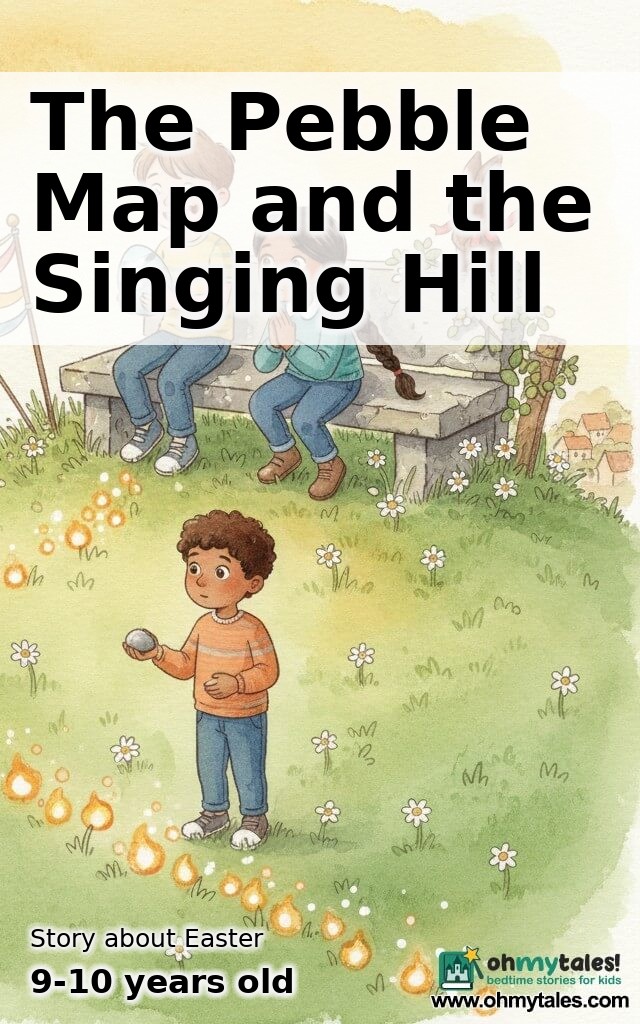
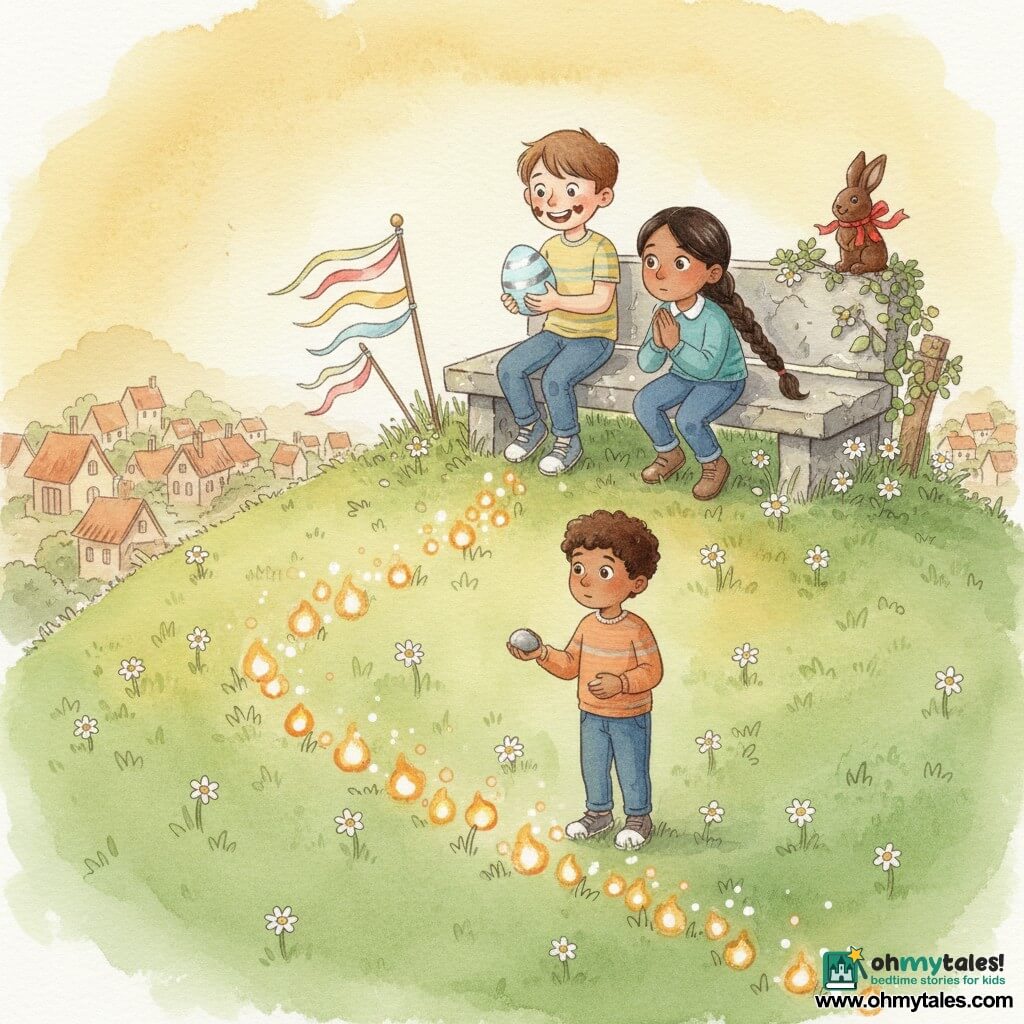
The village hill rolled gentle as a sleeping cat, and at its peak stood the old stone bench where storytellers once sat. Tommy and Mira climbed slowly, following pebbles like a secret handshake with the earth. Along the way, they passed nests of painted eggs tucked among ferns, each egg wrapped in colors that looked like the inside of a talebook.
At the top, wind teased the ribboned flags, and the view of the town unfurled—roofs like patchwork, the river silvering in the distance. Tommy set his pebbles in a neat semi-circle and waited. He closed his eyes and listened. At first there was only the ordinary music of spring: a robin's trilling, a distant cart, the hush of children. Then, faint and soft as cotton, the hill began to hum.
It was not a sound of words but of small things aligning—stems leaning, blades of grass rubbing, a pebble or two settling into place. The hum grew into a melody that made the hair on Tommy's arms stand up. He opened his eyes. On the bench lay an egg unlike the others: pale blue with silver streaks, and when he picked it up he felt a warm, patient heartbeat where his hands touched the shell.
"Maybe we should wait longer," Mira whispered, eyes wide.
Tommy smiled and placed the egg gently back on the bench. He set a pebble beside it, as if giving the hill a name. They sat and watched the clouds for a while, and because they waited, the hill gave them something else: a trail of tiny lights—no bigger than candle sparks—that hopped down the slope.
The lights led them to a fence hidden by honeysuckle. There, perched on the post, sat a rabbit-shaped chocolate with a ribbon tied around its neck. Tucked beneath was a scroll that read: To the patient go the glimmers. To the kind, the key.
Tommy felt the truth of it. Patience had not been empty waiting; it had been listening, watching, keeping the pebble map neat so no step was forgotten. He tucked the scroll into his pocket and wrapped his hand around the ribboned rabbit like holding a promise.
Chapter 4 — The Dance of the Farandole
Sun dipped toward the horizon, and the village green grew orange and warm. The treasure hunt was over—the children counted their eggs like pirates dividing treasure, and the adults brought out trays of hot cross buns and steaming chocolate milk. Tommy's pockets were full of small finds: a stripe-yellow egg, a cracked shell with a note inside singing of kindness, the ribboned rabbit, and his pebble map, which now had new stones added by curious hands.
As the light thinned, an old fiddler tuned his instrument near the fountain. His bow stroked the strings, and the notes spilled out like spilled stars. Someone started tapping a rhythm, then another joined—steps light, then stronger. Slowly, without anyone saying much, a line began to form. Someone took Tommy's hand, someone else took Mira's, and he felt a pebble warm against his palm—his map had become a chain of small lights.
"Ready?" a child asked.
"Yes," Tommy said, and his voice felt the way a ribbon feels when it's tugged into place.
They began to dance. It was not a showy dance with steps written in schoolbooks but a farandole, a wandering line of linked hands, children and parents and grandparents all looping and twirling around the green. Laughter bubbled; shoes tapped rhythm on the cobbles. The line wound around the fountain, around the bunting poles, past the old oak where Tommy had placed his first pebble that morning. Each turn, each careful pause, felt like another small stone laid down in the world.
At one moment, the lights the hill had given earlier flickered across the grass like shy fireflies, and for a breath the village seemed made of little sparkles. Tommy looked at the faces around him—Mira's smile, his mother's proud eyes, strangers who now held hands—and felt something wide and tender inside him. Patience had brought them here, a steady two-stepped kindness that tied everyone together.
When the music slowed, the farandole wound to a gentle stop beneath the oak. The fiddler played one last soft note that trembled in the air like a bird deciding where to go. Everyone cheered; children hugged one another. Tommy set his palm on the old bark and felt the pebble in his pocket, warm and small as a secret.
"Same time next year?" Mira asked.
"Yes," Tommy said, already imagining the next trail of pebbles he would lay down. He reached into his pocket and gave a pebble to a little boy who had been watching with bright, hungry eyes. The boy tucked it into his fist like it was treasure.
They walked home under strings of lanterns bobbing like lantern-flowers. Chocolate crumbs dotted Tommy's chin. The village smelled of cake and woodsmoke. In his heart, the pebble map lay folded and full. Easter had been more than chocolate and ribbons; it had been the gentle lesson of waiting, of listening to the small songs the world whispered if you kept still enough to hear. And as the moon rose, the music in his head hummed softly, the memory of the farandole winding through him like a ribbon, patient and bright.