Chapter 1: Dawn on the Quiet Street
The morning was soft as cotton wool. Dew tickled the grass and the streetlamps still hummed faintly when Milo stepped outside with his basket. He was ten, with a mop of brown hair that never quite obeyed, and a smile that liked to hide little plans. Today was Easter, and the whole town felt like a secret waiting to be opened.
Milo's house sat at the end of a row of pale houses with painted doors. Every Easter, his grandmother made dozens of chocolate eggs, wrapped in shiny foil the colour of rainbows. This year she could not hide them all—her hands were tired from gardening and knitting—but she had pressed a hot cocoa-stained recipe card into Milo's palms and said, “Share the smile, quiet as a rabbit.”
So Milo had become a secret-hider. He tiptoed past sleeping hedges and quietly closed doors behind him, carrying the basket cradled like a treasure chest. He loved the smallness of the morning: the way sounds were softer, the smell of toast and orange peel rising from houses, and the thought that at noon his town would burst into laughter.
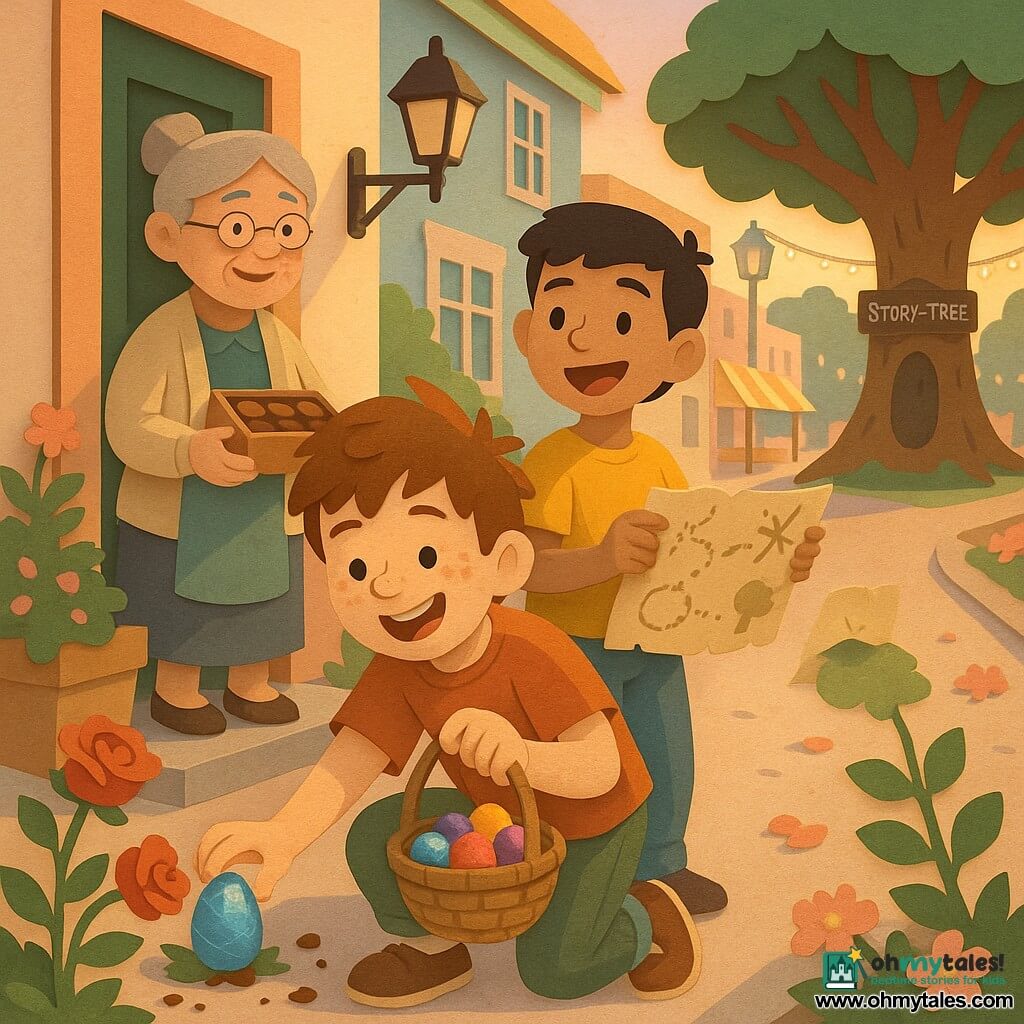
He knelt by the rosebush in Mrs. Patel's front garden and tucked a small blue egg among the damp leaves. It gleamed like a tiny planet. Mrs. Patel liked things neat, but she also liked surprises. Milo imagined her bright eyes when she found it and felt his chest blossom warm and light.
As he walked on, a little breeze curled around him, carrying the scent of baking and something else—an almost-music, like bells spun from sunlight. Milo paused. For a blink, the whole street seemed to hold its breath, and he smiled, because he believed in small miracles.
Chapter 2: The Playground Map
His next stop was the park. The old oak there was called the Story-Tree, carved with initials from many Easters before. Milo loved that tree as if it were an old friend with pockets. He scanned the playground with detective eyes and spotted three bright socks hanging on the slide. That was where children left little clues when they wanted the world to play.
Milo crouched to hide an egg inside a hollow in the tree. He whispered, “For anyone who needs a laugh,” and pressed the egg snug into the brown comfort. A robin hopped down and cocked its head as if it understood. Then a bigger idea took shape like the curl of a ribbon.
He drew a map—a wobbly, cheerful map—on the back of a grocery receipt. The map showed the bench shaped like a whale, the lamppost that leaned like an old friend, and a flowerbed that smelled like lemon balm. He left a tiny heart in one corner and a note that simply said, “Follow colour.”
Milo imagined children and grown-ups finding the map and following it like a treasure hunt. He pictured their footsteps lining up like drumbeats, their voices threading together. Hope felt like that—small footsteps towards something bright.
The swing creaked behind him. “Milo!” called a voice. It was Ben, his neighbour, rubbing sleep from his eyes. Ben loved chocolate almost as much as climbing trees. “What are you doing?” he asked, breath puffing in the morning air.
“Just hiding things,” Milo said, showing the receipt-map. Ben's grin was a sunburst. “Can I help?” he asked. Together they made the map into a little mystery, folded like a secret, and tucked it inside the hollow of the Story-Tree too.
Chapter 3: The Market of Tiny Wonders
The town market was waking up. Stalls uncurling like flowers, vendors arranging baskets of eggs and bunches of tulips, and the baker laughing with flour on his nose. Milo loved the market because everything there felt possible. Today, his basket grew lighter as he hid eggs under a teacup at Mrs. Kline's stall, inside a pair of woolly gloves by the toy stand, and beneath a pile of bright scarves.
“Hidden for someone special,” he said to each egg, as if that would help it glow when found. People came by, chatting and choosing jam jars and daffodils. Some paused to read the grocery receipt map pinned to a lamppost and their eyes lit up like matches. Children clustered, following its wobbly arrows, and their laughter turned the market into a carnival.
Milo watched a little girl named Rosa follow the map with her father. She sniffed the air like a detective. At each stop she found a tiny treasure and hopped exactly like a puppet. When she reached the swing, she found the egg Milo had left for anyone who needed a laugh. Her joy popped out like bubbles.
“You found it!” said the father, smiling at the flour-dusted crowd. Rosa held the egg as if it were an important secret. Milo felt a soft swell of pride. The map was doing what he had hoped—it was drawing people together in a line of bright expectations.
Ben, sticky with jam from a past habit of sneaking tastes, tugged Milo's sleeve. “There's a place we haven't looked,” he said, his eyes wide. “The old greenhouse!”
Chapter 4: Where Glass Becomes a Rainbow
The greenhouse smelled of wet earth and new light. It belonged to Mr. Abram, a man who kept strange plants and stories that curled like vines. The glass panes caught the sun and shattered it into a thousand colours. Milo and Ben slipped inside, and the world tilted upside down in a good way—leafy shadows made theatres on the floor, and little droplets hung like tiny planets on the ferns.
Milo crept between pots and left a golden egg near a plant with tiny bells. When he placed it down, for a second the bell-plant chimed, not with sound but with light. The egg blinked like someone winking. Milo felt the same warm buzz that his grandmother had promised: a small spell that made ordinary things feel extraordinary.
Ben found another egg hidden in a teacup beneath a fern and did a little quiet victory dance. “We should hide more every year,” he whispered. “It's like planting surprises.”
They tiptoed out, careful not to wake the greenhouse cats, and handed the last few eggs to Mr. Abram with a note that read, “May these whole your garden with giggles.” Mr. Abram's eyes crinkled. He put the eggs on his windowsill, where rain and sun could play with them all afternoon.
As they walked back, Milo felt the town breathing differently. Everywhere there were small tokens of joy, and people were moving closer—an old woman handing a child a tulip, teenagers comparing foil colours, neighbors swapping stories. Hope was in the air, not heavy but light, like dandelion fluff ready to float.
Chapter 5: The Night the Colours Came Home
By evening the town glowed. Lamps were turned on and fairy lights twinkled in windows. Milo's grandmother had invited everyone to the square for hot chocolate and songs. The chocolate eggs had been found, shared, and unwrapped. Children compared hidden treasures, adults traded stories, and the sky stretched wide and velvet above them.
They gathered around a bonfire that smelled like toast and old blankets. Milo sat close to his grandmother, his basket empty now but his heart full. She pressed his hand and said, “You gave them hope.” Milo looked out over the crowd and thought of the map, the greenhouse, the robin, and the little bells. He felt like a kite tethered to all those smiling faces.
As the stars blinked awake, someone began to hum an old tune. The melody was thin at first, then whole as a bowl of berries. Voices joined in, and the notes folded like blankets around everyone. Milo leaned his head back and closed his eyes.
In the soft hush of sleep, colours came. Not just any colours, but the ones that belong to mornings: the pink of warm toast, the green of new leaves, the blue of the shiny eggs, the golden sparkle of chocolate. They swirled around Milo like a playful storm and settled in his dreams as ribbons and confetti. He saw faces smiling, hands reaching, little acts of kindness branching into big trees. Hope hummed through the colours.
When he woke the next morning, his room smelled faintly of cocoa and flowers. The dream of colours lingered like a secret shade on the world. Milo knew the town would remember this Easter for its brightness and small wonders. He also knew that next year he would hide more eggs, map more places, and invite the town to a new kind of treasure hunt.
He padded downstairs to his grandmother's kitchen. She handed him a warm mug and another recipe card, blank this time. “Make a new map,” she said, and Milo laughed. He dipped his pen into the blue ink and began to draw, thinking of where to hide the first egg: somewhere ordinary, waiting to become magic.
Outside, a robin hopped on the windowsill and sang a short, clear note. It sounded like tomorrow, and it sounded like hope.