Chapter 1: The Paint Pot That Sneezed
Pip was a young magpie with shiny black feathers and a white belly like a splash of milk. He loved two things more than anything: collecting glittery treasures and being busy.
And today, the forest clearing was busy.
Easter was coming, which meant the Burrow Market would turn into a bright, giggly place filled with ribbons, painted eggs, and the most important tradition of all: the Great Spring Thank-You.
It was not a “say one tiny thank you and run away” kind of thank-you. It was a whole celebration—every creature brought something they were grateful for, even if it was small, like “warm mud” or “a stick that doesn't snap.”
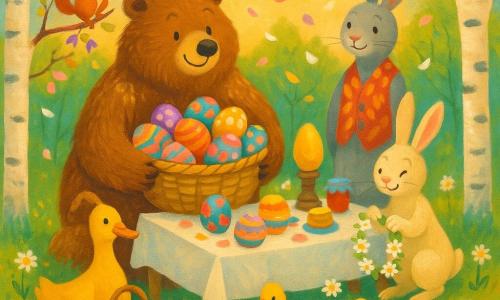
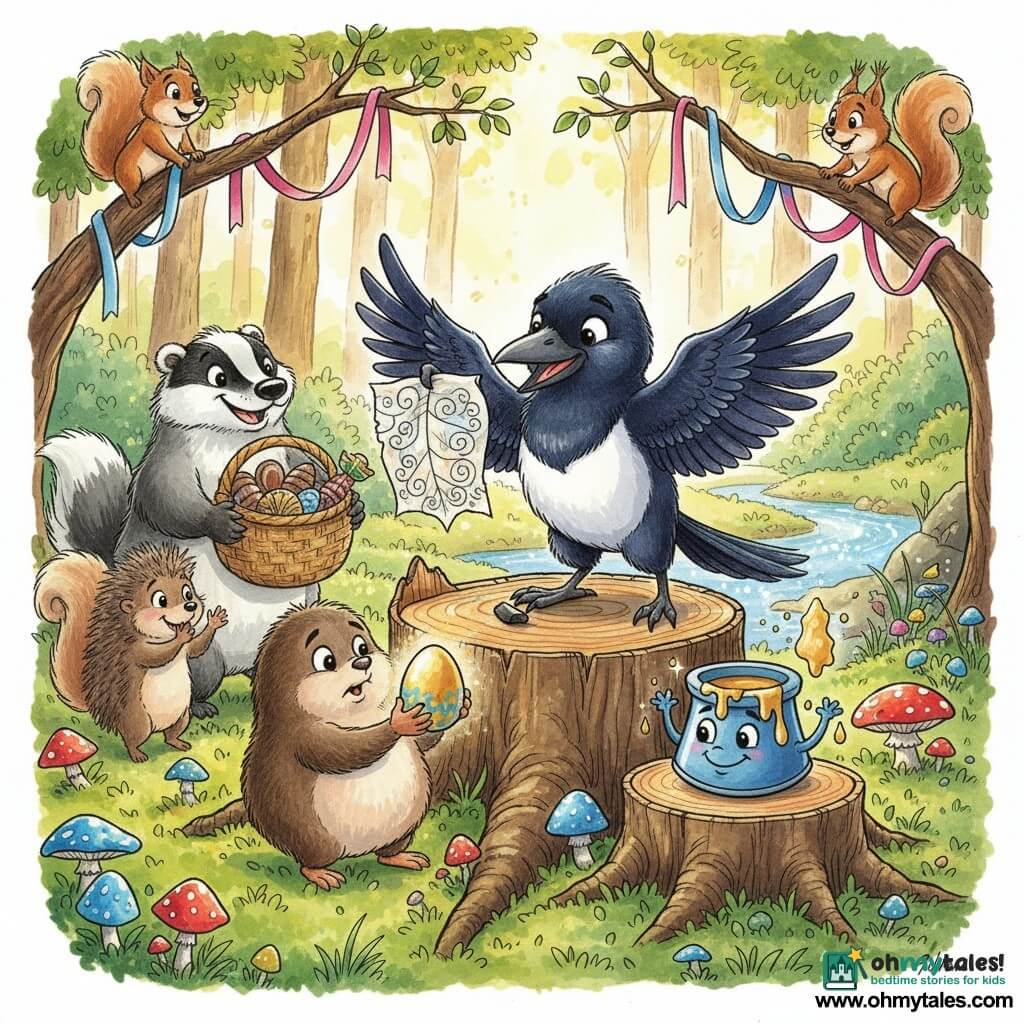
Pip fluttered down onto the long crafting table made from a fallen log. Around it, squirrels dragged baskets of leaves, mice carried tiny jars of berry dye, and a hedgehog rolled in a spool of twine like it was the best present in the world.
Pip cleared his throat in a very important way.
“Time to make the decorations sparkle!”
He plopped his treasure pouch onto the log. Out tumbled bottle caps, a silver button, and one perfect, smooth pebble that looked like moonlight.
A badger (who was definitely not human, thank you very much) pushed a clay pot of paint closer. “Try not to drop your shinies into the paint this time, Pip.”
“I have learned from my past,” Pip said, puffing up.
At that exact moment, the paint pot went—ACHOO!
Pip jumped so high he nearly head-bonked a branch. A blue blob of paint splattered across the log, and the pot wobbled as if it had just laughed at its own sneeze.
Everyone froze.
The hedgehog blinked. “Did… the paint sneeze?”
The paint pot wiggled. “I'm sorry,” it said in a tiny voice that sounded like bubbles popping. “Pollen tickles.”
Pip leaned in. “Paint doesn't talk.”
“This one does,” the pot replied. “I'm called Puddlepot.”
The squirrels whispered in a pile. The mice squeaked in a circle. The badger rubbed his eyes like he expected the pot to turn back into normal, quiet paint.
Pip, however, felt his heart do a happy drumroll. He loved ordinary things that turned out to be a little magical.
Puddlepot hiccuped, and a few drops of golden paint floated into the air like fireflies. They didn't fall. They hovered, shimmering.
Pip's beak opened in awe. “You're… glitter paint.”
“I'm helpful paint,” Puddlepot said proudly. “If you ask nicely.”
Pip's feathers ruffled with excitement. “Then help us make the brightest Easter decorations ever!”
Puddlepot's lid tipped like a polite bow. “Only if you promise something first.”
“What?”
“That you won't just make things pretty,” Puddlepot said. “You'll make them grateful.”
Pip paused. “Make them… grateful?”
“Decorations can remind creatures to notice good things,” Puddlepot said softly. “The sun. Friends. A safe hole to sleep in. Even a simple seed.”
Pip glanced around at the busy clearing—the teamwork, the laughter, the piles of colors ready to become something wonderful. His chest warmed.
“I promise,” Pip said. “Pretty and grateful.”
Puddlepot glowed, and the hovering golden drops twirled in the air, as if they were clapping without hands.
Chapter 2: The Egg That Wouldn't Stay Still
The next morning, Pip found a basket full of plain eggs waiting by the log table. Not chicken eggs—no chickens lived here. These were smooth, speckled stone eggs, gathered from the riverbank, perfect for painting and hiding.
Pip loved hiding things. He was a magpie. Hiding was practically a sport.
He placed one stone egg in front of Puddlepot. “Ready?”
“Ready,” said Puddlepot, sounding like a spoon stirring honey.
Pip dipped a twig brush into the paint. The golden paint slid onto the egg like sunlight sliding across water. Pip added stripes, dots, and tiny stars. The egg looked like it had swallowed a sunrise.
Then the egg… wiggled.
Pip froze. “Did it—”
The egg wiggled again, stronger, and rolled off the log.
“Hey!” Pip flapped after it.
The egg rolled fast, bumping over roots and skittering between mushrooms like it knew exactly where it was going. Pip chased it, hopping and fluttering, his treasure pouch thumping against his side.
“Stop!” Pip called. “You're supposed to be hidden later, not now!”
The egg rolled under a fern, then popped out the other side and zoomed downhill toward the stream.
Pip swooped low. The egg veered left at the last second, as if teasing him.
“You're an egg,” Pip panted. “You don't get to have jokes.”
The egg rolled into a patch of spring flowers—purple bells and yellow starbursts—then stopped dead, as if it had fallen asleep.
Pip landed beside it, breathing hard.
The egg sat perfectly still.
Pip narrowed his eyes. “Nice try.”
From behind him, Puddlepot's voice drifted faintly, as if carried by the breeze. “Some eggs like adventure.”
Pip picked up the egg carefully. It felt warm, like it had been sunbathing.
“Are you magic too?” Pip whispered.
The egg gave a tiny wiggle in his claws, like an answer.
Pip carried it back toward the clearing. Along the way, he noticed things he usually hurried past: a snail patiently crossing a leaf like it was a bridge, a robin singing as if it had swallowed music, the stream sparkling with bright, silly confidence.
Pip's chase had pulled his eyes open wider.
He arrived at the log table and set the egg down. “This egg tried to escape.”
Puddlepot hummed. “Maybe it's telling you something.”
“What could an egg possibly tell me?”
Puddlepot's lid tilted again. “That Easter isn't only about finding things. It's also about noticing them.”
Pip stared at the wiggly egg. “Noticing… like being grateful?”
“Exactly,” Puddlepot said. “A thankful heart has good eyesight.”
Pip thought about that. He thought about the robin's song, the snail's slow bravery, the stream's sparkle. He thought about the way everyone in the clearing worked together without being asked twice.
He touched the egg gently with one claw. “Okay,” he said. “If you want adventure, I'll give you one. But later. At the right time.”
The egg stayed still, as if it agreed.
Chapter 3: The Ribbon Wind and the Lost Chocolate
Two days before Easter, the clearing was bursting with decorations. Paper flower chains hung between trees. Painted eggs waited in baskets. A huge sign made of leaves and twigs read: THANK YOU, SPRING!
Pip added the final touch: a ribbon archway, bright pink and sky-blue, tied to two sturdy branches.
Puddlepot watched proudly from the log. “Look at all that color.”
Pip beamed. “I did the knots myself. Only three of them turned into tangles.”
Then—whoosh!
A gust of wind rushed through the clearing like an excited puppy. It grabbed the ribbons and yanked them free. The archway snapped loose, and the ribbons flew upward, curling and spinning.
“No!” Pip squawked.
The ribbons danced into the air, trailing like streamers at a party. The wind carried them over the bushes, over the stream, and toward the hill where the chocolate stash was kept.
Yes. The chocolate stash.
The forest creatures didn't have shops, but they did have a clever tradition: cocoa pods from the far, warm valley were traded each year for jars of honey and bundles of herbs. Then the beavers, who were excellent at careful work, pressed and mixed and cooled the cocoa into small chocolate eggs and squares.
They were wrapped in shiny leaf foil. They were precious. They were definitely not to be used as accidental wind decorations.
Pip chased the ribbons, flapping hard. Behind him, a chorus of squeaks and chittering rose as other creatures noticed the ribbon escape.
Pip swooped over the hill and gasped.
The ribbons had landed right beside the chocolate stash—an open basket full of foil-wrapped chocolate eggs—because a curious chipmunk had been counting them and left the lid off.
The wind, still excited, blew again.
Foil eggs tumbled out like shiny marbles.
“Oh no oh no oh no,” Pip muttered, dive-bombing toward the rolling chocolate.
He landed and started scooping eggs back into the basket with frantic wing flaps. “Stay! Stay in the basket!”
A chocolate egg rolled away, heading for a puddle.
Pip ran after it. “Not the puddle! Chocolate is not a water sport!”
He skidded to a stop just in time to grab it with his claws. The foil crinkled. The egg was safe.
Pip's heart thumped with relief.
From the hilltop, he could see the clearing below—everyone working, trusting that things would be ready. Pip looked at the scattered ribbons, the almost-lost chocolates, the mess he had to fix.
He swallowed.
This was his job. He was the sparkly helper. The busy one. The “I've got it!” magpie.
He gathered the ribbons and tied them around his waist like a very dramatic belt. Then he picked up the chocolate basket, which was heavier than it looked.
As he trudged back, the wiggly golden-painted egg in his pouch gave a tiny bump, as if reminding him to breathe.
Pip reached the clearing and set down the basket.
“I'm sorry,” he said, voice small. “The ribbons escaped and nearly made the chocolate go swimming.”
The badger blinked, then chuckled. “Well, at least you caught it before it became hot cocoa.”
The hedgehog waddled closer and patted Pip's foot. “You saved the chocolate. That's heroic.”
Pip's feathers loosened a little. “I should have tied the knots better.”
Puddlepot spoke gently. “You can fix knots. And you can learn. But don't forget to be grateful too.”
Pip glanced at the chocolate basket, safe and shiny. He looked at the creatures who didn't yell at him, only helped. Warmth spread through him again.
“I'm grateful,” Pip said quietly, “that everyone is… nice about mistakes.”
The clearing, for a second, felt brighter—not because of paint or ribbons, but because gratitude had stepped into the middle like a friendly lantern.
Chapter 4: The Secret Story of the Golden Egg
That evening, Pip sat on a branch above the clearing, watching the sunset smear the sky with peach and pink. The decorations below rustled softly. The air smelled like bark and blossoms and something sweet—someone was testing chocolate treats.
Puddlepot had been placed safely under a leaf awning near the log table. Pip fluttered down to sit beside it.
“Puddlepot,” Pip whispered, “why is Easter such a big deal?”
Puddlepot's paint shimmered faintly in the dim light. “It's a spring celebration. A reminder.”
“A reminder of what?”
“That after cold days, warm days return,” Puddlepot said. “That empty branches grow leaves again. That stories don't end where winter wants them to.”
Pip thought of the snow that had covered the forest not long ago, making everything quiet and hard. He remembered huddling in his nest, wishing for color.
“And the eggs?” Pip asked. “Why eggs?”
Puddlepot sounded pleased, like a teacher who gets a good question. “Eggs are little promises. They say, ‘Something new can happen.' Even if you can't see it yet.”
Pip pulled the wiggly egg from his pouch and set it on the log between them. The golden paint glowed softly.
The egg wiggled once, then rolled a tiny circle, as if it was showing off.
Pip laughed. “This one really likes being a promise.”
“It's a special egg,” Puddlepot said. “Not alive, not like a bird egg. More like… a story egg.”
“A story egg?” Pip leaned closer.
Puddlepot lowered its voice. “Long ago, a magpie like you found a plain stone egg by the river. He painted it to thank spring for bringing back the worms he liked to eat.”
Pip blinked. “That's… very specific.”
Puddlepot continued. “He hid it for others to find, and each creature who found it added one tiny mark—a dot, a line, a star—something that meant ‘thank you.' Over time, the egg remembered all those grateful moments. It became… wiggly with joy.”
Pip stared at the egg as if it had suddenly become a tiny treasure chest.
“So it wiggles because it's full of thank-yous?”
“Yes,” Puddlepot said. “And this year, it chose you.”
Pip's throat felt tight, in a good way. “Me? But I'm messy. I lose ribbons. I drop shiny things into paint.”
Puddlepot's lid tipped. “You also chase problems until you fix them. You notice beauty. You promised to make things grateful.”
The egg wiggled, as if it agreed again.
Pip placed one claw on the egg. “Okay,” he whispered. “Then I'll do it properly. I'll hide you where someone who needs a thank-you can find you.”
Puddlepot glimmered. “That's the spirit.”
Pip looked out over the clearing. Tomorrow was Easter. Tomorrow the forest would sparkle and laugh and sniff out chocolate like detectives.
And Pip had one more thing to prepare.
His drawing.
He hadn't told anyone yet, but he had started a big picture on a smooth sheet of birch bark—something to hang at the Great Spring Thank-You. It wasn't finished. He wanted it to be a surprise.
He tucked the egg back into his pouch and fluttered off, feeling like the night sky was cheering him on with its stars.
Chapter 5: The Hunt, the Thanks, and the Drawing
Easter morning arrived like a bucket of bright paint spilled across the world.
Sunlight poured through the trees. The ribbons were re-tied—extra tight this time. Painted eggs sat in clever hiding spots: under mushroom caps, inside hollow logs, behind clumps of moss.
Pip had hidden the special golden story egg in the gentlest place he could think of: beside the old stump where the shy mole liked to sit alone and listen to the ground.
The chocolate eggs were hidden too, each wrapped in leaf foil that flashed when the light hit it. The clearing smelled like fresh grass and sweet cocoa and excitement.
The Easter Hunt began with a whistle made from an acorn cap. The creatures dashed off in all directions, laughing and calling out.
“I found one!” yelled a squirrel, holding up a purple egg.
“Chocolate!” squeaked a mouse, doing a tiny happy dance.
Pip flew above, watching like a proud, sparkly manager. He guided a lost rabbit—no, not a rabbit, that would be too close to a “Easter Bunny” story. This was a hare, and definitely not human—back toward the trail when it got turned around.
Then Pip spotted the mole near the stump, peeking out cautiously.
The mole's nose twitched. “I… I don't usually hunt,” the mole murmured to nobody in particular. “I'm not fast.”
Pip landed softly on the stump. “You don't have to be fast,” Pip said. “Sometimes the best things are found slowly.”
The mole looked surprised to see him, then gave a shy nod.
The mole shuffled closer to the stump—and there, tucked in a pocket of moss, was the golden egg.
It glowed like a tiny sunrise.
The mole gasped. “Oh! It's beautiful.”
The egg wiggled warmly, as if it recognized gentle hands.
The mole held it carefully. “What do I do with it?”
Pip's voice softened. “Add a mark,” he said. “A thank-you mark. Anything that means ‘I'm grateful.'”
The mole thought hard. Then, with a small charcoal stick, the mole drew a simple shape on the egg: a tiny door.
Pip tilted his head. “A door?”
The mole's eyes shone. “I'm grateful for my burrow,” the mole whispered. “For having a safe place. For quiet.”
The egg wiggled twice, like a happy nod.
Pip felt something swell in his chest—bigger than pride, bigger than glitter. Gratitude, shared, felt like a warm blanket.
Soon, the hunt ended. Baskets were full. Wrappers crinkled. Chocolate was divided fairly, even when someone found more than they expected.
Then came the Great Spring Thank-You.
Everyone gathered under the ribbon archway. Puddlepot sat on the log table like an honored guest. Pip hopped up onto the stump, cleared his throat, and announced, “Time for thank-yous!”
One by one, the creatures spoke.
“I'm grateful for new leaves,” said a squirrel.
“I'm grateful for friends who help me untangle twine,” said the hedgehog, giving Pip a meaningful look.
“I'm grateful for streams that keep singing,” said an otter.
“I'm grateful for warm stones,” said the lizard.
When it was Pip's turn, he looked at all the faces—fur and feathers and whiskers and bright eyes.
“I'm grateful,” Pip said, “for everyone who makes this forest feel like home. For second chances. For spring coming back. And… for magic that reminds us to notice.”
Puddlepot's golden paint shimmered, and the ribbon archway seemed to glow.
Pip took a deep breath. “I have one more thing.”
He fluttered down and pulled out a large sheet of birch bark from behind the log. It was his drawing—unfinished, but ready to be finished right now.
The picture showed the clearing, the trees, the ribbon archway, and lots of little creatures holding eggs and laughing. But one corner was blank, penciled with light outlines only.
Pip held up a piece of charcoal. “I started this drawing earlier,” he said. “But it needs something.”
He looked at the crowd. “It needs our thank-yous.”
So the creatures came forward, one at a time, and Pip added their symbols into the blank corner: a leaf, a stream swirl, a warm stone, a twine loop, a tiny burrow door.
Last of all, Pip drew the golden story egg, shining in the center, with small marks all around it—dots and lines and stars—like a necklace of gratitude.
When he finished, he stepped back.
The drawing looked alive. Not magical like a talking paint pot, but magical in a different way: it held a moment everyone wanted to keep.
Pip's beak curved into a grin. “There,” he said. “Now it's complete.”
The forest cheered—softly, loudly, and in every squeaky, chirpy, snuffly way possible.
And as sunlight danced through the ribbons, Pip felt thankful, all the way down to his shiny toes.