Chapter 1: Warm-Up Notes and Wooden Pegs
Mara lived above a bakery where the morning air always smelled like buttery crescents and sleepy cinnamon. She was a singer and a musician—a soloist—meaning most of the time she stood on her own, holding a song the way you hold a lantern in the dark: carefully, so it doesn't go out.
On Saturday, sunlight slid through her window like a slow melody. Mara stretched, hummed one long note, and listened to it wobble, then settle. That was her first lesson of the day: your voice is like a kite. If you pull too hard, it fights. If you guide it gently, it flies.
She packed her small guitar, a bottle of water, and a cloth bag filled with wooden clothespins. The clothespins were for her sheet music—because windy places loved to steal paper. Mara had learned that the hard way when a gust once carried her favorite song right into a puddle. The puddle had not given it back.
Before leaving, she did a quiet warm-up: lips buzzing, tongue twisters, and soft “mmm” sounds that felt like rubbing velvet. She didn't want to wake the whole building. Being a soloist didn't mean being loud all the time. It meant choosing when to shine, like a firefly that knows the best moment to blink.
Outside, the street was already busy with weekend feet and bicycle bells. The Saturday market waited at the end of the lane, where voices mixed together like soup: a little sweet, a little salty, and full of surprises.
Chapter 2: The Saturday Market Stage
The market was a bright patchwork quilt laid across the square. Stalls wore striped awnings. Apples blushed in piles. A fish seller clinked ice like tiny chimes. Someone tested a squeaky toy that sounded suspiciously like a duck who had stubbed its toe.
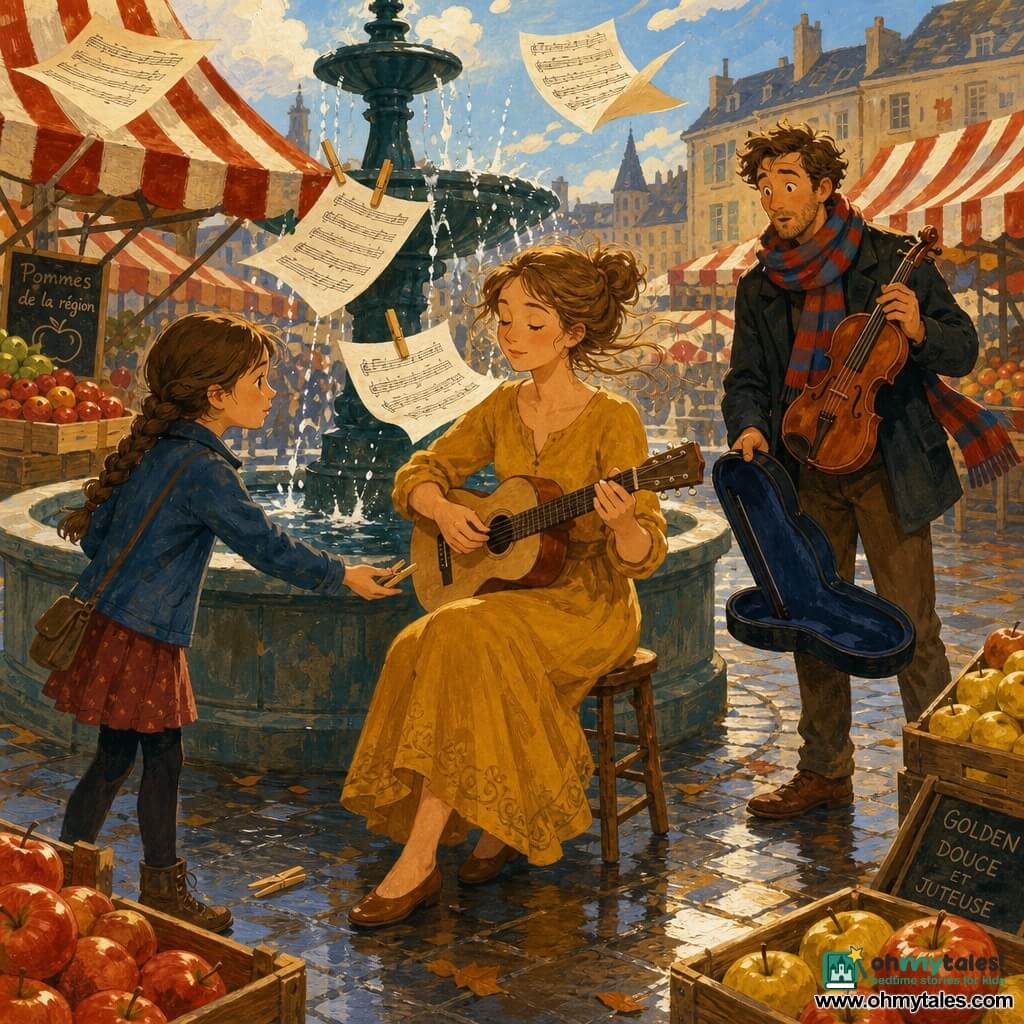
Mara found her usual spot near the fountain, where the water made a gentle shushing sound, like the world saying, “Not too fast.” She unfolded a small music stand and clipped her sheet music with clothespins—one at each corner, like little wooden guardians.
A breeze tried to tug the pages. The clothespins refused. Mara nodded at them as if they were brave knights. “Good job,” she whispered.
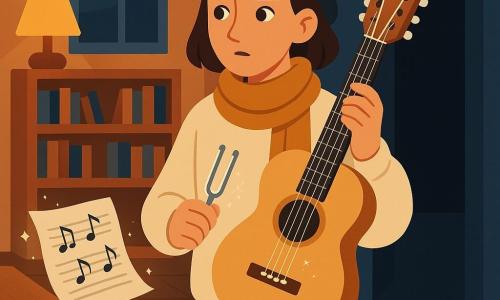
She tuned her guitar, twisting the pegs until the strings stopped arguing and started agreeing. Tuning, she often thought, was a kind of friendship. You listened, you adjusted, you listened again. Attention was not just looking. It was noticing.
Before she played, she took a careful breath—low and deep, like filling a balloon in her belly, not her shoulders. That helped her voice stay steady. Then she began with a soft song, one that sounded like warm tea.
People slowed. A little boy holding a bunch of carrots paused. A woman choosing flowers smiled without even noticing she was smiling. Mara kept her voice clear but gentle, letting it float above the market like a paper boat on a calm stream.
Between verses, she spoke a few words, so the kids nearby could understand her work without getting a whole lecture.
“A singer doesn't just sing,” she said. “She listens—first to herself, then to the space, then to the people. If I sing too loudly, I cover up the fountain. If I sing too quietly, you can't hear the story. So I try to fit my sound like a cozy scarf.”
A man buying cheese chuckled. “Best scarf I've ever worn,” he said, and his moustache wiggled like it was laughing too.
Mara's cheeks warmed, but she kept her pride small and tidy in her pocket. A soloist could be humble and still be brave. Those two things were not enemies. They were neighbors.
Chapter 3: The Great Page-Flip Trouble
By late morning, the wind woke up fully and started showing off. It swirled around the stalls, sniffing at bread, teasing paper bags, and spinning a napkin into a tiny ghost.
Mara began a faster tune, a cheerful one with a bouncing rhythm. Her fingers danced on the strings. Her voice hopped like a sparrow.
Then the wind made its move.
The top page of her sheet music lifted, flapped, and tried to flip early—like a student shouting the answer before the question. One clothespin held tight, but another slipped off with a small “clack!” and fell to the ground.
Mara kept singing, because stopping in the middle of a song can feel like tripping while running. But inside her mind, she was counting: one, two, three—where's the next line?
A tiny pause crept into her melody, like a hiccup.
Near the fountain, a girl about ten watched closely. The girl had a serious face, the kind that looked as if it could solve riddles in its sleep. She tiptoed forward, picked up the fallen clothespin, and held it out.
Mara reached the end of a phrase and took it—smoothly, as if the song had planned it. “Thank you,” she whispered.
The girl whispered back, “Wind is a sneaky thief.”
Mara's eyes smiled. “Yes. But we can be sneakier.”
She clipped the clothespin back on, then added two more for safety. Her sheet music now wore clothespins the way a camper wears extra buttons—ready for trouble.
Mara began again, and this time she changed something. She watched the wind's pattern. She noticed how it pushed hardest right after someone walked past with a big bag, and how it softened when the clouds covered the sun. She timed her page turns during the calmer moments.
It felt like playing a duet with the air.
After the song, she spoke softly to the small crowd. “This is part of the job,” she said. “A musician prepares, but also adapts. You can't tell the wind what to do. You can only pay attention and work with what you have.”
The serious-faced girl nodded as if she were storing the idea in a safe place.
Then a new problem arrived—this one wearing a scarf and holding a violin case.
A street performer stepped up nearby and started playing loudly, fast and flashy, like a firecracker. People turned. The fountain seemed quieter. Mara's song felt like a candle next to a spinning spotlight.
Mara's fingers froze for a moment. Not from anger, but from thinking.
She could try to be louder. She could compete. Or she could choose another way to shine.
She took a breath that tasted like pears and decided: gentle can be powerful too.
Chapter 4: A Song That Listens Back
Mara waited until the violinist finished his loudest piece. Then she stepped closer to the fountain, where the water's hush could cradle her sound.
She clipped her music extra tight—clothespins lined up like tiny teeth—and began a new song, slower and softer, with space between the notes. It was the kind of melody that made you lean in without realizing.
Her guitar sounded like rain tapping a window. Her voice floated like a feather falling in a quiet room.
At first, people didn't notice. Then they did—because calm can be a magnet when everything else is noisy.
The violinist, surprised, lowered his bow. His eyebrows lifted. He listened.
Mara didn't glare at him or try to win. She simply kept her song steady, and she watched the crowd the way a gardener watches seedlings: patiently.
A toddler stopped fussing and stared at the fountain bubbles. A dog lay down, sighing like an old grandpa. Even the fish seller clinked his ice more softly.
When Mara reached the chorus, her voice warmed and brightened. It didn't shout. It glowed.
The violinist stepped closer after the last note faded. “That was… different,” he admitted.
Mara nodded. “Different can be useful.”
He cleared his throat. “I thought if I played bigger, I'd get more attention. But you made people quiet. How?”
Mara tapped one clothespin with her fingertip. “I paid attention. To the space. To the mood. To what people needed.”
The serious-faced girl chimed in from the front, as if she'd been waiting for her moment. “Also, she used anti-wind technology.”
Mara laughed—softly, so the laughter didn't break the calm. “Very advanced,” she said, lifting the clothespins like trophies.
The violinist smiled at the girl, then at Mara. “May I join you? Not to compete. To blend.”
Mara considered. A soloist could still share. Being humble didn't mean staying alone; it meant making room.
“If you listen first,” Mara said, “yes.”
So they tried a simple tune together. Mara played gentle chords, leaving gaps like open windows. The violin slid into those gaps like a ribbon in the wind, but kinder this time.
They didn't hurry. They didn't rush the ending. They let the music breathe.
Coins clinked into Mara's open case—small thanks from strangers. But the best reward was the look on people's faces: softer, as if the music had smoothed their wrinkles from the inside.
When the last note faded, the market seemed to exhale.
Chapter 5: The Park That Learned to Whisper
After the market, Mara packed up. She gathered her clothespins one by one, making sure none were left behind. Attention, she thought, is also remembering the small tools that help you do your work.
The serious-faced girl waved. “Good luck, Song Lady!”
Mara waved back. “Good luck, Wind Detective!”
The violinist walked off in the other direction, practicing quiet bows in the air, like he was learning a new language.
Mara carried her guitar toward the park nearby. The afternoon had turned golden and slow. Leaves trembled like tiny green hands clapping without sound.
She sat on a bench and let her fingers rest. Performing wasn't only about making noise; it was also about knowing when to be still. A musician's ears needed rest the way feet needed shoes.
Children played farther away, their laughter bouncing like rubber balls, but even that began to soften as parents called, “Time to go,” and “One more turn on the swing.”
Mara took out a small cloth and wiped her guitar, careful around the strings. Each string, she knew, was like a friend who told the truth. If you treated it roughly, it complained. If you treated it kindly, it sang.
As the sky changed into a cooler color, the park quieted. The birds practiced their evening whispers. The fountain at the market was far away now, but Mara could still imagine its shushing sound.
She hummed a final tiny melody—no words, just a gentle line that felt like a blanket.
And the park, as if it had been listening all day, settled into calm. The last skateboard rolled away. The last dog stopped tugging at its leash. Even the wind seemed to tiptoe.
Mara stood, shouldered her guitar, and walked home with her clothespins rattling softly in her bag—little wooden reminders that music wasn't only about big notes.
It was about careful listening, steady breathing, and paying attention to the world, so the world could feel safe enough to listen back.