Chapter 1: The Clear Voice in the Hallway
Miles had a clear singing voice. Not the kind that boomed like a drum, but the kind that rang like a small silver bell—bright, tidy, and warm.
He was a singer and musician, which meant he did two jobs at once. He used his voice to tell a story, and he used instruments to paint the air with sound. Tonight he had an important visit: the children at Maple Street Library were having a bedtime concert. Soft songs, gentle rhythms, the kind that made thoughts yawn and curl up.
Miles packed his guitar, his little shaker, and a notebook of lyrics. He even packed a tiny bottle of honey for his throat. “A voice is like a lantern,” he told himself. “You have to keep it lit.”
But when he opened his guitar case, his smile slipped.
His capo—the small clip that helped him change the guitar's sound without changing his finger shapes—was gone. Without it, the songs would sit in the wrong place for his voice. Too low, too high, too twisty. Like trying to wear shoes on the wrong feet.
Miles looked under the sofa. Under the rug. Inside the pockets of his jacket. Nothing.
He took a slow breath. “All right,” he said, speaking kindly to himself, as if he were a worried kid. “A musician doesn't just perform. A musician solves problems.”
Still, this problem felt like a pebble in his shoe.
Miles knew what he had to do next: ask for help.
Chapter 2: A Mystery in the Kitchen
He went to the kitchen, because kitchens were good places for thinking. They smelled like cinnamon and clean plates, and the refrigerator hummed a steady note, like it was practicing.
His neighbor, Mrs. Patel, was there, returning a mixing bowl she had borrowed. She was small and quick, with eyes that noticed everything.
“Miles,” she said, “you look like someone who just dropped a cookie.”
“My capo is missing,” Miles admitted. “And I'm playing tonight.”
Mrs. Patel set the bowl down softly. “Then we hunt,” she declared, as if missing capos were dragons and she had a broom-sword.
Miles's friend Jonah arrived too, carrying a loaf of bread in a paper bag. Jonah was a drummer who could tap a rhythm on anything: tables, railings, even his own knees. “What's the emergency?” he asked, already tapping a curious beat.
Miles explained. And then, right there between the kettle and the fruit bowl, the kitchen became a planning room.
They searched with gentle care, because musicians learn to treat objects like teammates. Mrs. Patel checked drawers. Jonah checked under chairs. Miles checked the top of the fridge, where dust gathered like quiet snow.
No capo.
Mrs. Patel tilted her head. “Tell us about your work,” she said. “Maybe the answer is hiding in the story.”
Miles blinked. “My work?”
“Yes,” she said. “A singer and musician's work is not only singing. It's remembering, listening, noticing.”
So Miles told them, as they looked.
“A singer warms up,” he said. “Not just the voice. The whole body. You breathe in low, like filling a balloon in your belly. You loosen your jaw. You hum softly. If you rush, your voice can feel tight, like a knot.”
Jonah nodded. “And a musician practices parts slowly, right?”
“Right,” Miles said. “You don't wrestle a song. You get to know it.”
Mrs. Patel opened a drawer and pulled out a rubber band. “Could this pinch the strings the way your capo does?” she asked.
Miles tried it around the guitar neck, careful not to squeeze too hard. The sound changed a little, but not enough. “It's clever,” he said, grateful. “But it won't hold for a whole concert.”
Jonah's tapping slowed. “So we need the real thing,” he said.
Miles sighed, but he made it a quiet sigh, like a page turning. “Thank you for helping,” he said. “Even if we don't find it, I'm glad I'm not searching alone.”
Mrs. Patel smiled. “Gratitude,” she said, as if it were an ingredient. “It makes everything rise.”
Chapter 3: The Cat, the Cabinet, and the Clue
Just then, a soft thump came from the pantry cabinet.
Miles's cat, Miso, slipped out with the sneaky pride of someone who had done something “interesting” and wasn't sure whether it would be praised.
“Miso,” Miles said, narrowing his eyes with gentle suspicion. “Where have you been?”
Miso blinked slowly, as cats do, like tiny sleepy kings.
Jonah crouched and pointed. “Look—string!”
A thin ribbon of cloth trailed from behind a stack of cereal boxes. Mrs. Patel moved the boxes carefully. “Ah-ha,” she whispered.
Behind them was Miso's secret treasure spot: a crinkly wrapper, two shiny buttons, and—yes—a black capo, tucked like a stolen jewel.
Miles laughed, a short bright sound. “Miso,” he said, “you wanted to start your own band, didn't you?”
Miso flicked his tail, which was not an answer but felt like one.
Miles picked up the capo and clipped it gently onto his guitar neck. He strummed. The chord landed perfectly, like a pillow under a tired head.
“There it is,” Jonah said. “That's the right color of sound.”
Miles turned to Mrs. Patel and Jonah. “I could have panicked,” he admitted. “But you helped me stay calm. Thank you.”
Mrs. Patel wagged a finger at Miso. “And you,” she told the cat, “must return borrowed items.”
Miso yawned, clearly pleased with the attention.
Then Miles glanced at the clock. “I should go,” he said. “But first…”
He walked to the sink and rinsed Mrs. Patel's bowl, even though it was already clean. He dried it carefully, because gratitude wasn't only something you said. It was something you did.
Jonah hefted his bread bag. “We'll walk with you,” he said. “Musicians travel in packs. Like…friendly wolves with instruments.”
Miles chuckled. “Yes,” he said, “but quieter wolves.”
Chapter 4: The Bedtime Concert
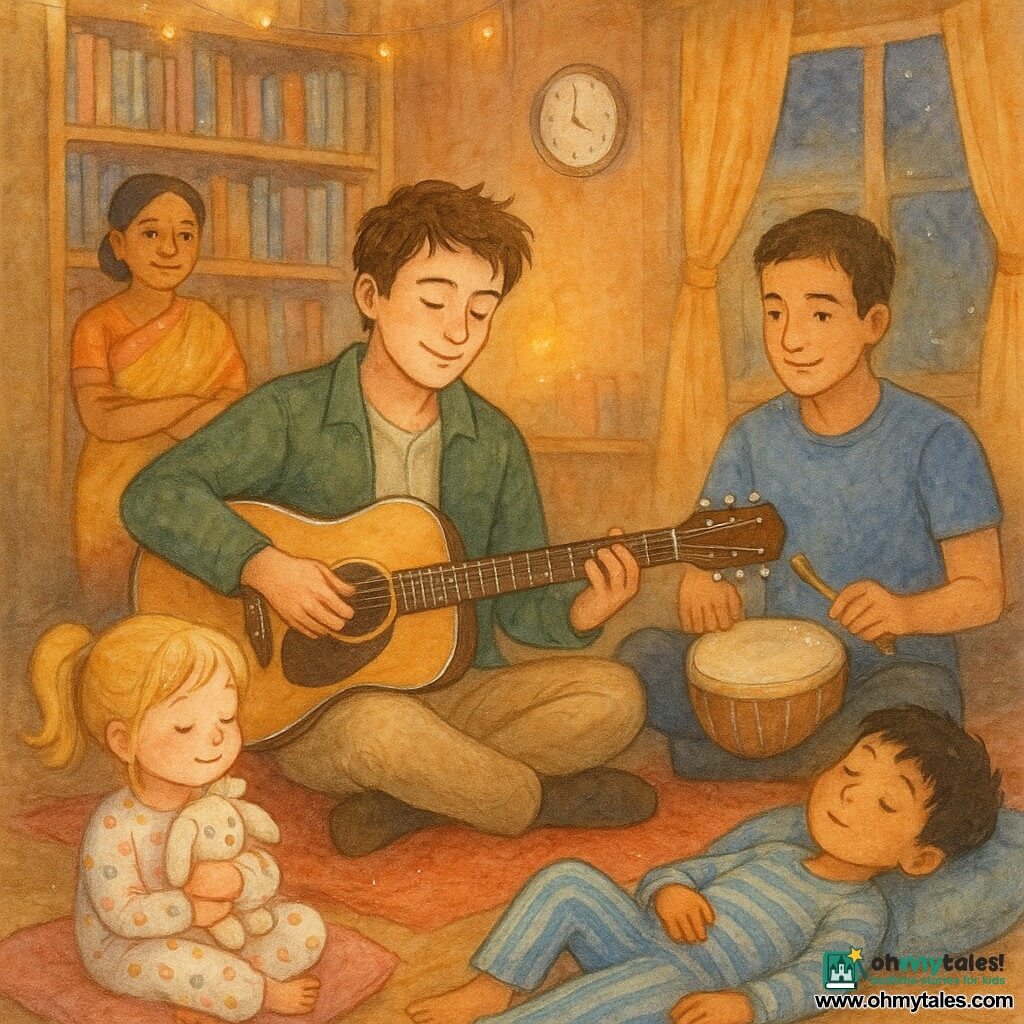
At the library, the lights were low and golden. Pillows were scattered like little clouds. Kids in pajamas sat with stuffed animals tucked under their arms. Even the bookshelves looked sleepy, standing tall like gentle giants.
Miles sat on a small rug and set his guitar on his knee. Jonah sat nearby with a soft brush drum, the kind that whispered instead of shouted. Mrs. Patel stood at the back, arms folded, smiling like someone who knew the ending would be good.
Miles spoke first, because a musician's job was also to guide the room.
“When you sing,” he told the children, “you're not just making noise. You're making meaning. Your breath is the wind. Your voice is the kite. And the song is where it flies.”
A boy raised his hand. “Do you ever mess up?”
Miles grinned. “All the time. But here's the secret: musicians practice so mistakes become teachers, not bullies. If I play a wrong note, I listen. I adjust. I try again.”
A girl hugged her stuffed rabbit. “How do you keep your voice clear?”
Miles placed a hand on his chest. “I drink water. I rest. I warm up. And I don't try to shout over life. I let the song do the work.”
Then he clipped on the rescued capo, and the guitar brightened, as if it had been waiting to speak in its favorite voice.
He began to play.
Jonah brushed a gentle rhythm, like rain tapping a window. Miles's clear voice floated above it, smooth as milk and light as steam from cocoa. The melody curled around the children's shoulders.
Between songs, Miles thanked the librarian for the cozy space. He thanked Jonah for the soft drums. He thanked Mrs. Patel for her clever searching. “Music,” he said, “is made of people helping people.”
The children listened, eyes heavy, smiles small and safe.
One little kid whispered, “It feels like the song is petting my brain.”
Miles laughed quietly. “That's a very good description,” he said. “We try to make music that is kind.”
Chapter 5: A Warm Goodbye and a Soft La La La
After the last song, the room stayed quiet for a moment, the way it does when a candle has just been blown out and everyone still sees the glow.
Miles packed up slowly. Jonah stretched his hands. “Good show,” he murmured.
Mrs. Patel came closer and handed Miles a small jar. “Honey,” she said. “For your lantern voice.”
Miles's throat tightened, but not in a bad way. “Thank you,” he said. “I'll remember this.”
Outside, the night air was cool and clean. The streetlights made round pools of gold on the sidewalk. Miles walked home with his guitar on his back, feeling the happy tiredness that comes after doing your best.
At his door, he turned to Jonah and Mrs. Patel. “I'm grateful,” he said simply. “Not just because you helped me find my capo. Because you reminded me I don't have to do everything alone.”
Mrs. Patel patted his arm. “That is also part of the job,” she said. “A musician listens. A musician connects.”
Inside, Miso greeted him with an innocent face. Miles clipped the capo onto a hook high on the wall.
“No more pantry concerts,” he told the cat.
Miso purred, which sounded like a tiny engine humming a lullaby.
Miles washed his hands in the kitchen sink, feeling the warm water slide over his fingers. Then he hummed, very softly, so the house would settle into sleep like a blanket falling into place.
And before the last light went out, his clear voice whispered a gentle ending, airy as a feather drifting down:
“La la la.”