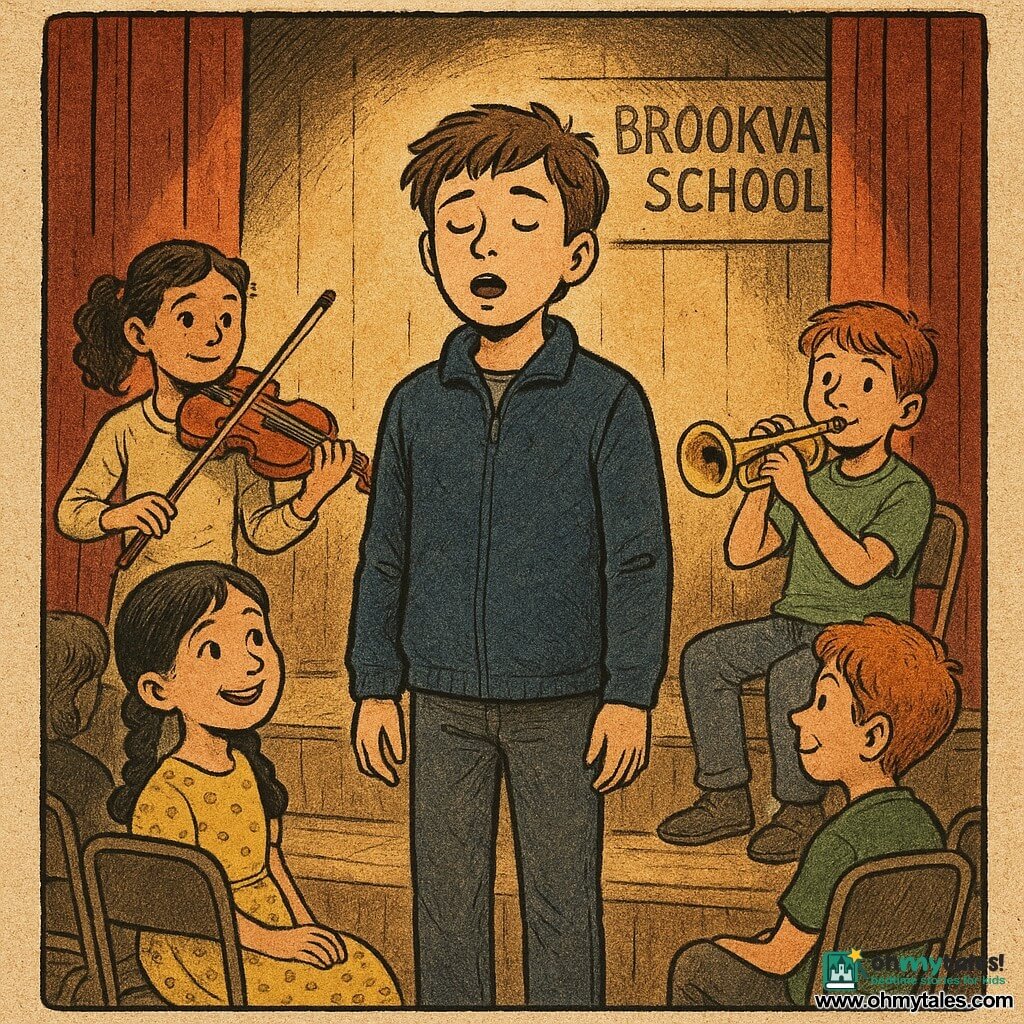
Chapter 1: Warm Tea and Quiet Notes
Leo held his scarf close as he stepped into the chilly evening. The sky was a deep blueberry color, and the streetlights looked like small moons.
“Big rehearsal tonight?” Mrs. Dimple from next door called, waving a grocery bag like a friendly flag.
Leo smiled. “Big rehearsal. Big responsibility.” He patted his throat gently, as if it were a tiny pet that needed care.
Because Leo wasn't just going to sing tonight—he was going to lead a song with the student orchestra at Brookvale School. And a singer's voice, he had learned, was like a candle: bright and beautiful, but it needed protecting from strong wind.
At home, he did his voice routine the way some kids polished their bike chains.
He poured warm water into a mug, added honey, and watched it swirl like golden paint. “Cheers,” he whispered to his voice, then sipped slowly.
Next came the gentlest of stretches: shoulders up, shoulders down. Neck side to side. A quiet yawn that opened his mouth like a small cave.
Then he began his vocal warm-ups, soft as bedtime.
“Mm-mmm-mmm,” he hummed, letting the sound tickle his lips.
He slid the notes up and down like a kid on a playground slide. “Woo… wooo… wooo…”
He tried a silly one too, because laughter helped him relax. “Brrr-brrr-brrr,” he trilled his lips until they buzzed like a tiny motorboat.
Leo's little sister, Mina, peeked around the doorframe, her eyes bright. “Are you practicing to talk to dolphins again?”
“I'm practicing to sing with humans,” Leo said, grinning. “But dolphins would be impressed.”
Mina tiptoed closer. “Why do you do those funny sounds?”
Leo tapped his chest. “Because my voice is made of muscles and air and careful habits. Warm-ups wake it up nicely—like stretching before a soccer game.”
Mina nodded as if this was a very serious secret. “So your voice doesn't get grumpy.”
“Exactly,” Leo said. “A grumpy voice cracks.”
He packed his water bottle, a small pack of throat lozenges, and his music folder. He also packed something you couldn't see: patience. Because music didn't like to be rushed.
Before leaving, he stood by the window and took a calm breath in through his nose, out through his mouth. The breath felt like a feather brushing the inside of his ribs.
“Ready,” he told himself. “Soft breath. Tall posture. Kind ears.”
Outside, the night waited like a quiet audience, and Leo walked toward the school, humming gently so his voice could keep stretching its wings.
Chapter 2: The Orchestra of Many Nerves
The music room at Brookvale School smelled like pencil shavings, polished wood, and a little bit like excitement.
Chairs were set in a half-moon. Music stands stood up like metal birds. Students were arriving with instrument cases—some shiny, some taped, some covered in stickers.
Ms. Rios, the music teacher, clapped her hands once. “Welcome, Brookvale Orchestra! Let's tune our brains first—then our instruments.”
Leo waved to his friend Nia, who carried a violin like it was made of glass.
“You look calm,” Nia whispered.
Leo made a face. “That's my outside. My inside is doing cartwheels.”
Nia laughed. “Same.”
In the front row, Toby polished his trumpet mouthpiece and said, “If I squeak tonight, I'm blaming the air.”
“You can't blame the air,” said Kiki with her flute. “The air is innocent.”
“The air is suspicious,” Toby insisted.
Ms. Rios raised an eyebrow. “Air is our teammate. Treat it well.”
Leo stood near the piano, where he would sing his part. He set his folder down carefully. The song they would play was called “River of Stars,” and it floated between soft and strong, like a boat that sometimes had to row and sometimes could glide.
Ms. Rios pointed to Leo. “Before we begin, our singer will lead us in a quick warm-up.”
Leo's ears went hot. He glanced at all those faces, all those instruments waiting like curious animals.
He swallowed, then remembered: warm tea, soft breath, kind ears.
“Okay,” he said. “Let's wake up our voices gently.”
He demonstrated first. “Hum like you're tasting chocolate. ‘Mmm.'”
The orchestra kids, even the ones who didn't sing much, hummed. The room filled with a warm, fuzzy sound, like a blanket being shaken out.
“Now,” Leo continued, “let's do a siren—quietly. Like a tiny ambulance for ants. ‘WooOOOooo.'”
Giggles popped up, but the notes rose and fell, and the giggles turned into sound.
Ms. Rios nodded. “Good. Remember, singers aren't just loud. They're controlled.”
Leo added, “And drink water. Your vocal cords like being… not crunchy.”
“Not crunchy!” Mina's voice called from the doorway—she'd slipped in and sat on the floor, hugging her knees.
Leo blinked. “Mina!”
Ms. Rios smiled. “We have a tiny audience member. Welcome.”
Mina whispered loudly, “I'm learning!”
Leo tried not to laugh. “Great. Lesson one: stand tall, like a tree. Not stiff—just tall.”
The students adjusted their posture. Shoulders relaxed. Chins lifted slightly. It looked as if the whole orchestra had grown an inch.
Ms. Rios lifted her baton. “Now we tune. Listen carefully. Listening is part of music-making.”
Toby played an A on his trumpet. Nia matched it on her violin. The sound was like two flashlights pointing at the same spot.
Leo listened with his whole face, as if his ears were bigger than normal. That was another thing singers did—listened hard, so they could fit their voice into the music, like a puzzle piece that didn't force its way in.
“All right,” Ms. Rios said softly. “Let's begin. River of Stars, from the top.”
Chapter 3: A Crack in the River
The first run-through started beautifully. The strings shimmered like spiderwebs in morning light. The flutes sounded like wind through leaves. The drums were gentle, like distant footsteps.
Leo waited for his entrance, counting beats in his head. One, two, three, four… breathe.
He began his line, and his voice floated out—clear, warm, and steady.
Then, in the middle of a long note, it happened.
A tiny crack.
It wasn't a huge disaster. It wasn't a falling-off-a-stage crack. It was more like a pencil snapping in a quiet room. Still, Leo felt it like a pebble in his shoe.
He stopped singing, startled.
The orchestra wobbled, then Ms. Rios brought them to a smooth halt with her hands. “Pause,” she said kindly, like she was catching a falling cup before it shattered.
Leo's cheeks burned. “Sorry.”
Nia leaned over. “That note was mean anyway.”
Toby whispered, “I heard it threaten you.”
Leo exhaled. “I don't know why that happened. I warmed up.”
Ms. Rios walked closer, her voice calm. “Cracks happen. They're not a sign you're bad. They're a sign your voice is a living instrument.”
“A living instrument,” Leo repeated.
“Yes,” Ms. Rios said. “A trumpet can be cleaned. A violin can be tuned. A voice needs rest, water, and smart technique. Did you feel any tightness?”
Leo touched his throat. “A little. Like I was trying to push the note instead of letting it ride on my breath.”
Ms. Rios nodded. “Exactly. Singing is not yelling on pretty notes. It's breath plus shape. Breath is the river. Your words are the boat.”
Mina raised her hand like she was in class. “So if the river is small, the boat bumps?”
Ms. Rios beamed. “That is a wonderful way to say it.”
Leo chuckled, then grew serious. “What should I do?”
“First,” Ms. Rios said, “take a sip of water. Second, relax your shoulders. Third, let's do a gentle exercise—no forcing.”
Leo drank. The water felt cool and clean, like a little snowflake sliding down.
Ms. Rios said, “Everyone, let's help our singer. Put your instruments down for one minute and breathe together.”
The orchestra kids set their instruments carefully on their laps or stands. The room became quiet, but not empty—quiet like a pond that still held fish.
Ms. Rios counted softly. “In for four… hold for two… out for six.”
Leo breathed. The air filled him slowly. When he let it out, his chest softened, and the tightness faded like a knot being untied.
“Now,” Ms. Rios said, “Leo, try this: a light ‘ng' sound, like the end of ‘song.' Keep it easy.”
Leo sang, “Nnnng,” letting the sound buzz behind his nose. It felt gentle, like a purr.
“Good,” Ms. Rios said. “Now slide it up and down, like a tiny skateboard.”
Leo did. “Nng—nng—nng…”
His voice stayed smooth. No crack.
Toby whispered, “The ants' ambulance is back.”
Leo smiled. “And it's obeying the speed limit.”
Ms. Rios lifted her baton again. “Let's try your line once more. Remember: the river carries you.”
Leo stood tall, tree-not-stiff. He imagined breath as a wide, calm stream. He let the note sit on the breath instead of pushing it uphill.
He sang the line.
This time, it flowed—steady and bright, like a star reflected in water.
Nia's violin joined him, and the sound wrapped around his voice like a friendly scarf.
When the phrase ended, Ms. Rios nodded once. “There. That's musicianship: noticing, adjusting, and trying again.”
Leo felt something warm in his chest that wasn't embarrassment anymore. It was pride—the quiet kind, the kind that helps you grow.
Chapter 4: The Night Concert and the Shared Song
An hour later, the seats in the small school auditorium filled with parents, grandparents, siblings, and a few neighbors who came because they liked music and also because the cookies at Brookvale events were legendary.
Behind the curtain, the student orchestra waited in a hush. Instruments gleamed under the stage lights. Leo could hear the audience murmuring like a gentle ocean.
Nia squeezed his hand. “If you crack, I'll play louder and cover it.”
“That's sweet,” Leo said, “but please don't attack the audience with violin.”
Toby lifted his trumpet and whispered, “If you crack, I will dramatically faint.”
“Please don't,” Leo said. “Ms. Rios will make you do extra scales.”
Toby shuddered. “I will remain awake.”
Leo checked his voice the way you check your pockets for your keys. He swallowed once, sipped water, and did the smallest warm-up: a quiet hum that felt like a cat curled up inside his chest.
Ms. Rios stepped in front of the orchestra and spoke softly. “Remember what we practiced. You are not competing. You are cooperating. Make one beautiful thing together.”
The curtain opened.
Lights warmed Leo's face. The audience became a sea of silhouettes with shining eyes. Leo saw Mina in the front row, sitting very straight, as if her posture could help.
Ms. Rios raised her baton. The orchestra began.
The music moved like a night river. Strings rippled. Flutes glittered. The trumpet, thankfully, did not squeak.
Leo waited, breathing with the beat. He listened—really listened—to the way the instruments fit together. A musician, he realized, wasn't someone who tried to be the loudest. A musician was someone who learned when to step forward and when to make space.
Then came his entrance.
Leo sang, and the words drifted out into the auditorium like soft lanterns.
He didn't push. He didn't chase the note. He rode his breath like a boat. He shaped each word carefully, as if it were made of paper and could tear if he grabbed too hard.
And he told the story of the “River of Stars” so clearly that even the back row seemed to lean in.
In the middle section, Ms. Rios had arranged a fun surprise: the orchestra made a “rain” sound. The percussionists rubbed their hands together. The strings tapped lightly on their instruments. The flutes breathed air without pitch, like wind.
It sounded like a storm far away—safe, gentle, and dreamy.
Leo smiled while singing. He felt the orchestra around him, not behind him. They were a single creature with many hearts, many hands, and one shared rhythm.
When the final note arrived, Ms. Rios held the silence for a breath. That quiet moment sparkled, as if the last sound was still floating in the air.
Then the audience applauded—claps like warm popcorn popping.
Leo bowed with the orchestra. His shoulders relaxed, and his smile felt honest.
Backstage, the students bubbled with excitement.
“We did it!” Nia said.
“And I did not faint,” Toby said proudly.
Mina ran up to Leo. “Your voice wasn't crunchy at all!”
Leo laughed. “Thank you. I'll keep it uncrunchy.”
Ms. Rios gathered them for a final moment. “Tonight you learned something important,” she said. “Practice isn't punishment. It's care. It's how you show love to your craft.”
Leo thought of his warm tea, his humming, his careful breathing, his listening ears. He thought of that crack and how it didn't end the music—it taught him.
Creativity, he realized, wasn't only about making new things. It was also about making brave choices again and again: trying, adjusting, and sharing.
Chapter 5: A Soft Goodbye and a Thank You
Later, Leo walked home under a sky full of stars that looked like tiny notes scattered on dark paper.
Mina skipped beside him, humming the melody. “Do singers always have to take care of their voices?”
Leo nodded. “Yeah. Because our instrument is part of us. If I stay up too late shouting, or if I don't drink water, my voice gets tired. If I rest and warm up, it stays strong.”
Mina considered this. “So your job is singing… and also taking care.”
“Exactly,” Leo said. “Singers practice songs, but also practice breathing, posture, and clear words. Musicians do the same in their own ways. Violinists take care of their strings. Drummers take care of their rhythm. Everyone listens to everyone.”
At home, Leo brushed his teeth, then stood by his bed. His room was dim and calm, the kind of calm that feels like a slow lullaby.
He did one last tiny warm-down, barely louder than a whisper. “Mmm,” he hummed, letting the sound settle. Like dust glittering down after a dance.
He placed his music folder on his desk. The paper inside looked ordinary, but he knew it held a world of sound.
From the hallway, Mina called, “Good night, Maestro!”
Leo chuckled. “Good night, Tiny Audience.”
He slid under his blanket. The fabric felt cool and smooth, like a quiet stage curtain.
He closed his eyes and imagined the orchestra again: all those students, all those different instruments, working together like a team of friendly fireworks—bright, but careful.
And before sleep came, Leo whispered the last line the way he had sung it—soft, steady, grateful:
“Thank you, audience.”