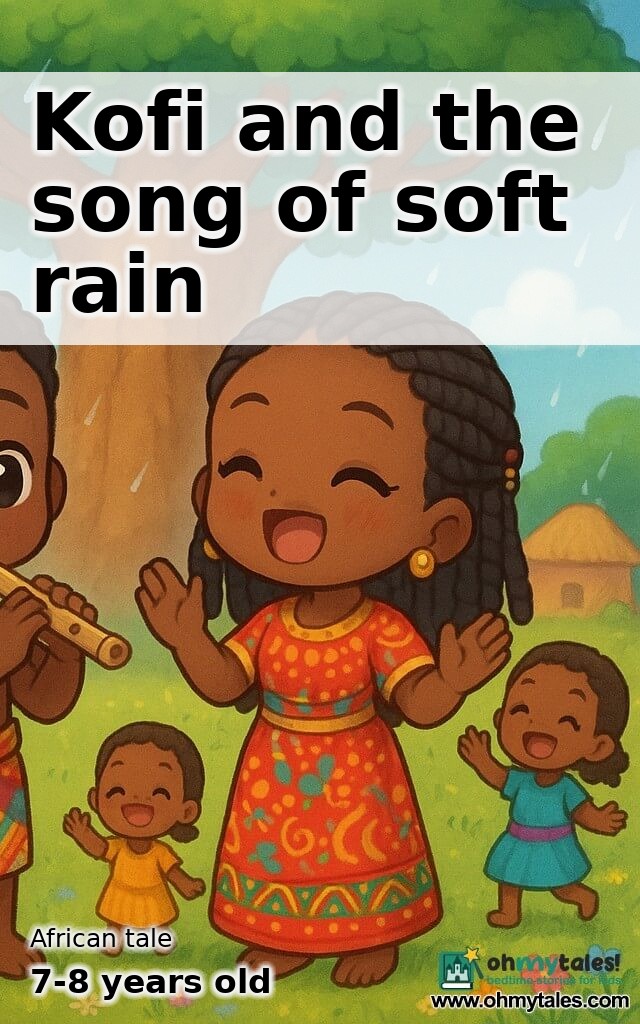
Chapter One: The Village of Painted Pots
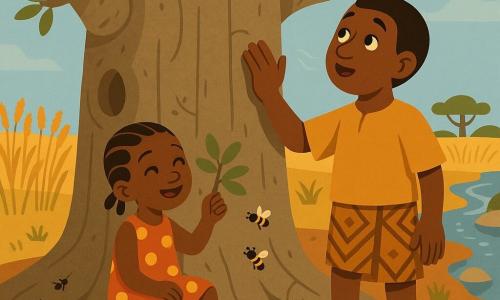
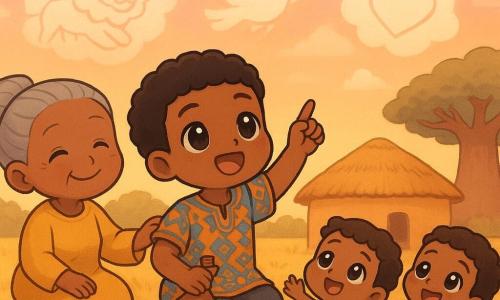
In the village of painted pots, where houses smiled like sunflowers and the market hummed like a friendly drum, lived Kofi. He walked with the steady steps of a man who listens to his heart like a talking drum. Kofi loved two things most: his small flute made of bamboo and the stories his grandmother stirred into the night like porridge. Those stories were sweet and slow and they spoke of a song older than the baobab tree.
One warm morning, when the sky was a bright calabash of blue, the elders called a meeting. People gathered barefoot and bright-eyed. Women tied scarves that flashed like birds. Children balanced on shoulders, peeking.
"The rains are restless," said Elder Nana with a voice as soft as worn cloth. "The fields thirst and the little ones' shoes are dusty. Long ago, there was a song that calmed the rain, a song of soft rain. Who will learn it and sing it again?"
Kofi felt the drum of chance beat inside him. He stepped forward, not because he was the bravest, but because his heart was wide like the river at the rainy season. "I will learn the song," he said, his voice small but sure. The village clapped like rain on roofs.
Awa, the gardener whose laugh smelled of fresh mint, tied her basket under her arm. "I will come with you," she said. Her eyes were quick and kindly, like a weaver's shuttle. "Songs are like gardens. They grow best when shared."
So Kofi and Awa set off with jars of water and sweet cassava, the village's hopes tucked into their pockets like seeds. They walked toward the river, where the River Sisters were said to live. The River Sisters were not sisters like the women in the village, but a circle of voices inside the river: a splash that giggled, a ripple that hummed, and a bubble that sang. They kept songs safe under the dancing water.
Kofi played his flute as they walked. The tune hopped like goats and worried the birds until they joined, so that the path itself began to sing with them. The sun leaned over the fields, curious, and the wind followed like a friendly child.
Chapter Two: The River's Secret
When they reached the river, it was a ribbon of silver, and the River Sisters rose in little waves to listen. They were clever as the mongoose and gentle as new bread. Kofi knelt by the bank and offered his flute. "We want the song of soft rain," he said. "Our village needs it."
The River Sisters spoke, each voice a different liquid color. "Why should we share our song?" asked the ripple, which sounded like a bell. "Songs are like fish; they swim away easily," bubbled the bubble. "They can be kept if hands are kind," laughed the splash.
Awa put her palm on the river's edge, feeling the cool secret. "We will promise," she said simply. "We will share the song with everyone, not keep it in one pocket. We will teach the children and the elders and the ones who mend roofs. We will use it to bring people together, not to make someone shine alone."
Kofi bowed his head. "We will sing it softly and often, until it becomes part of our village breath."
The River Sisters whispered among themselves, a soft chorus like rain on leaves. Finally, the ripple leaned close and gave them a line—a thread of melody, little and shining. "This is the first drop," it said. "Come back for the next. You must show us that what you promised grows like a shared meal."
So Kofi learned the first part: a slow, round note that sounded like a raindrop taking a breath. It fit his chest like a warm stone. Awa hummed, and the tune tasted like mango. They thanked the River Sisters and promised to return.
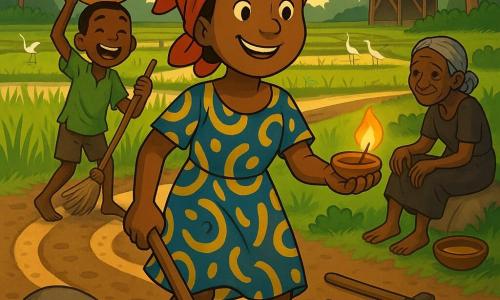
On their way home, Kofi practiced with the careful patience of someone knitting a scarf. A child stopped to listen and clapped. An old woman tapped her foot. The tune began to move through the village like a gentle breeze, curious and kind. People began to meet each other's eyes more. A man who had been stubborn about sharing his maize offered a little to a neighbor. A girl who feared the market learned to sell her woven bracelets with a smile. The song was already doing its small wonders.
Chapter Three: The Journey of Many Hands
The next day the River Sisters asked for more. "You must learn the middle of the song," sang the splash. "But to join it, you need many hands." They pointed toward the hill where the old mill stood and where the baobab tree spread its wise arms.
Kofi and Awa climbed the hill with baskets heavy with kindness. Along the way, they met people who brought what they had: a pot of stew, a mat to sit on, a child's bottle of honey. "We brought our melody," a baker said, handing over the smell of fresh bread. "We brought our patience," a carpenter added, offering his steady hands. The offerings were small and warm. Each gift was like a bead threaded onto a string. Together they became a necklace heavy with care.
"Songs grow when they are fed with deeds," said Awa, tying a ribbon to the baobab. "We will gather our neighbors and practice."
So under the baobab tree, they all sat in a ring of smiling faces. Kofi played the river's first drop. Awa taught the pattern of answers and echoes. Children clapped in rhythm. Elder Nana hummed the old call that began each village day. A shy man who had never sung a full verse sang along, and his voice found its place like a lost pebble in a stream.
"Louder with your heart, softer with your hands," Awa teased, and the group laughed. "Sing as if you are stirring porridge: steady, gentle, round."
The River Sisters heard the voices mixing like different spices. "The song loves to be shared," bubbled the bubble, pleased. They sent another thread of melody—a middle line that was playful as a frog and soft as mud. Kofi learned it. This part of the song taught them to listen to each other, to leave space where other voices could bloom.
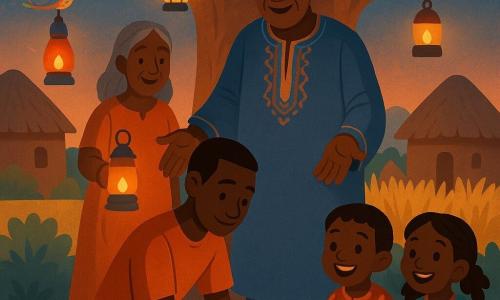
At dusk, when the first purple of evening touched the earth and the village smoke braided with stars, Kofi stood by the baobab and felt the song settle into his bones. He saw how the village faces had changed: people walked more together, their steps matching like a woven cloth. Even the market seemed kinder, as if the stalls had learned to lend each other spoons.
But the River Sisters had one more test. "To keep the last part, you must heal a small worry in your village," they sang. "Bring a problem and fix it with many hands."
The worry was simple: the old bridge near the millet field had a loose plank that frightened children crossing to the school. Kofi and Awa gathered the boys who ran like wind and the women who stitched like rain. They fixed the bridge with laughter and song. When the last nail was tapped, a child ran across and giggled like a bell. The village breathed out together, and the River Sisters, pleased, gave the final drop of the song—a soft, settling hum that sounded like rain falling into a cupped hand.
Chapter Four: The Song of Soft Rain
The night before the festival to sing for the fields, Kofi could not sleep. He sat outside his hut, holding the flute like a small moon, and he thought of the River Sisters and the baobab and all the hands that had helped. His village had changed into a patchwork of kindness, each square sewn with care.
When morning spilled honey across the ground, the whole village gathered in the clearing. There were pots tipped for stew, mats spread like stage cloths, and a circle of faces bright as new beads. Elder Nana stepped forward and gave Kofi the blessing of the elders: "Sing with the village in your heart," she said. "Sing as if the rain is a friend that forgot the way here."
Kofi lifted his flute. He remembered the first drop from the river, the playful middle from many voices, and the hush of the last part. He breathed in like a man learning to paint the sky. "Listen," he said gently. "This song is for all of us."
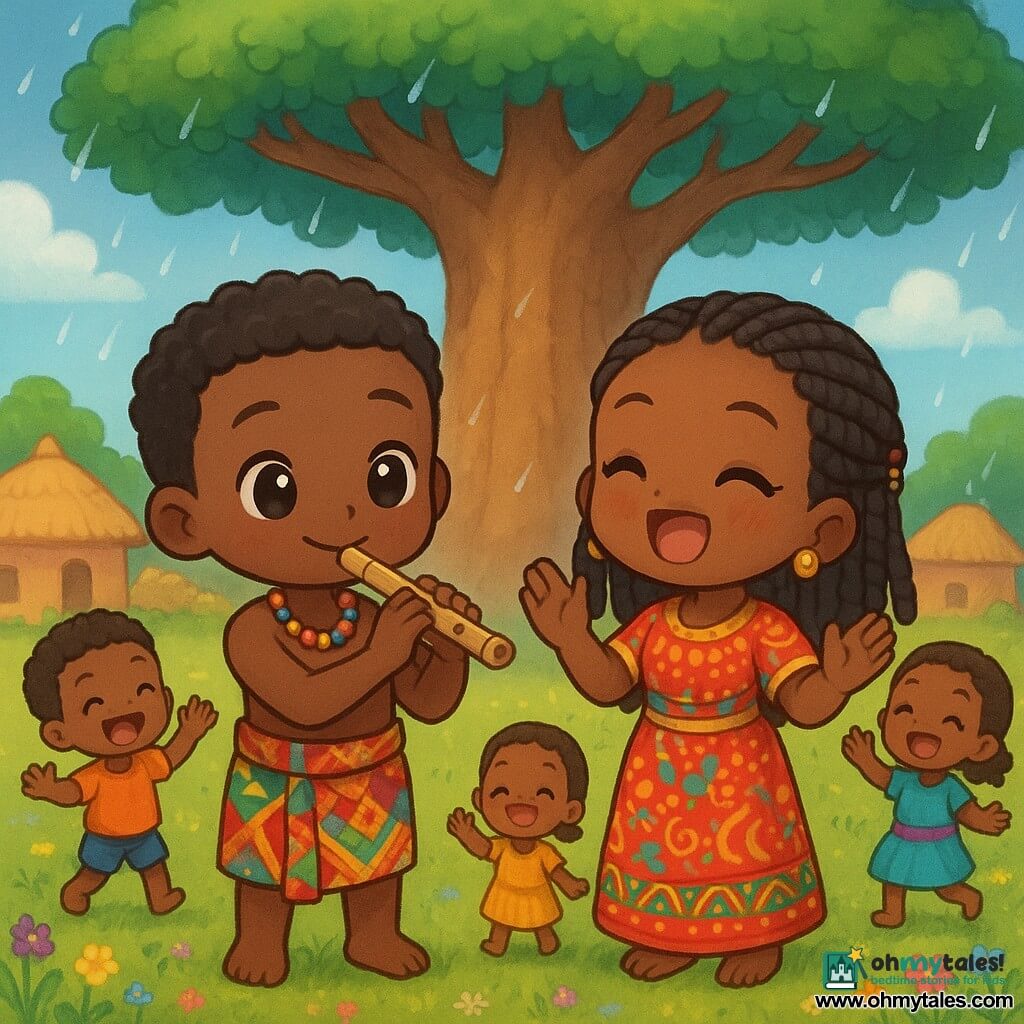
They began together. Kofi's flute made the first slow note. Awa answered, her voice a ribbon. Then the children chimed, the elders echoed, the bakers hummed, the carpenter's hands beat a steady rhythm against his knee. Each voice fit into the song like a stick fitting into a fire—safe and warming. The music rose and circled, a scarf of sound wrapped around the village.
Outside the clearing, the sky listened. Clouds, shy at first, leaned closer. The song carried over the millet and the cassava, over the hills that bent like listening animals. The River Sisters, far in their cool water, pulsed with joy and sent a gentle mist as applause. The clouds sighed, remembering the tune from before memory. Then, like a great kettle finally given water, the sky opened its lid.
Rain swept down, soft as millet flour, singing on tin roofs and turning the dust into perfume. Children danced, spinning like tops, their laughter joining the song. The rain tapped on painted pots and ran in glad lines down the paths. People shared buckets and umbrellas without fuss, passing them with smiles. Even the man who had been most proud of his own store of grain opened it a little and poured out into the communal store, because the rain made everyone remember they were part of the same story.
After the shower, the air smelled like painted wood and promise. Puddles kept the sky's reflection, and the village looked like a necklace of bright beads. Kofi played one last soft note and the River Sisters answered with a sparkle. Elder Nana clapped slowly, like a drum finishing its story. "You have done more than learn a song," she said. "You taught us to share it."
Awa hugged Kofi, her laughter ringing like a bell. "The song spread because hands helped," she said. "Songs and kindness grow the same way."
From that day, the song of soft rain became part of the village's morning and evening. They sang it at planting and at harvest, when new babies arrived and when an old one slept quietly. Visitors who passed through the painted-pot village learned to sing a line and leave a gift. The River Sisters' melody flowed through everyone, not kept by any single voice.
Kofi found that the song had changed him. He walked lighter, as if he carried a small patch of sky in his pocket. He had learned that songs are not shells to hide; they are bridges to build together. When the sun played hide-and-seek with the clouds, the village no longer worried. They had a way to call the rain, but more importantly, they had learned how to call to one another.
And so the village lived, warmed by shared songs and soft rain, a place where every cup was filled and every laugh was heard. The baobab kept their stories, the River Sisters kept their songs, and people passed the melody from mouth to mouth until even the children who had been babies at the first singing could hum it with full voices—gentle, steady, and ready to give it away. The moral sang itself softly: when we share what we know and work with many hands, the world answers with kindness, like rain answering a good song.