Chapter 1: The Drums of Ndala
Long ago, in the wide golden heart of the savanna, lay the village of Ndala. It was a place where the sun painted the earth with warm honey, and the tall baobab trees whispered ancient secrets with the wind. The drumbeats of Ndala echoed across the hills, calling everyone to rise with the dawn.
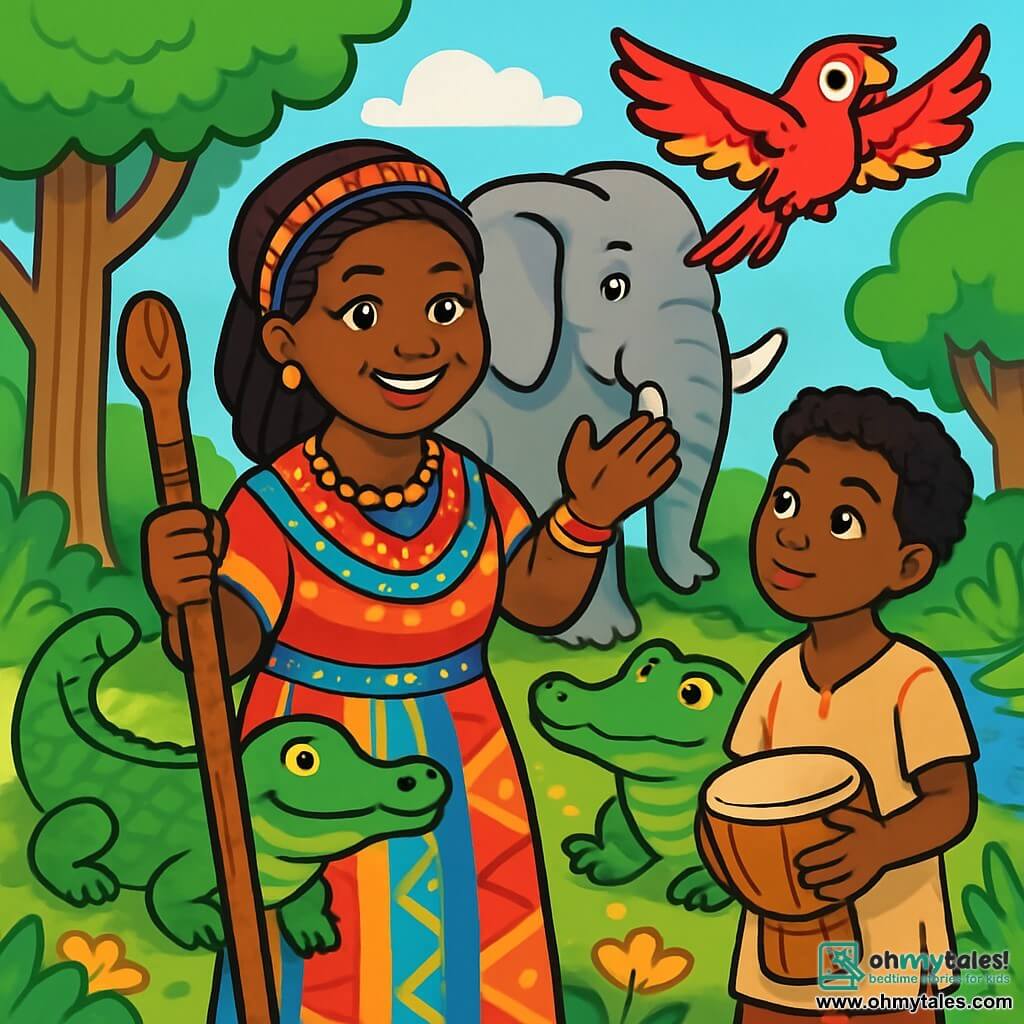
Ndala was led by Chief Amara—a woman as wise as the old river and as strong as the thorny acacia. Her eyes sparkled like the first morning stars, and her laughter rolled over the grasslands like distant thunder. Amara wore a cloak made of woven reeds, with beads that sang with every movement.
Every villager trusted Amara. She knew the secret songs of the birds, the medicine of roots, and the stories that shaped their world. Her heart, they said, was a calabash, holding enough kindness to feed the whole savanna.
One bright morning, as the golden sun yawned over the hills, the peace of Ndala was broken. Mosi, the village's herder, rushed to the center, his face twisted with worry.
“Chief Amara!” he called, his voice trembling like a leaf in a storm. “The river—the life of Ndala—has stopped flowing! The fish have vanished, and the crops wilt with thirst.”
Villagers gathered, their voices buzzing like bees. Without the river, the maize would die, the goats would thirst, and the drums would beat no more. Amara's heart tightened. She knew that justice and harmony were woven together, and that this trouble was a knot she must untie.
Amara raised her staff high. “We must seek the truth, not quarrel in the dust,” she declared. “I will find the river's story. Let the ancestors guide me.”
Chapter 2: Into the Whispering Forest
Amara set out before the sun touched the tops of the baobabs. She carried her staff, a satchel of dried fruit, and a small drum to call for help. The villagers watched her go, hope flickering in their eyes.
She followed the dry riverbed, its cracked surface like the scales of a sleeping serpent. Birds circled above, calling warnings in voices sharp as thorns. Soon the land changed—grass gave way to the tangled embrace of the Whispering Forest.
As Amara entered, the shadows danced around her, and the air tasted of secrets. She had heard the legends—creatures of dreams and mystery lived here: the two-headed chameleon, the laughing wind, and the wise Leopard who never slept. The forest whispered in a language only the brave could hear.
Amara pressed on, her heart steady as the sun. She remembered her grandmother's words: “Listen to the land, and it will sing you the truth.”
Suddenly, the branches before her quivered. Out leapt a small, spotted creature—a Jackal, with clever eyes that gleamed like polished nuts.
“Chief Amara!” Jackal greeted, bowing low. “Why do your sandals stir the dust of our forest?”
Amara answered, her voice clear as spring water. “The river no longer brings life to our village. I seek its story, so justice and harmony may return.”
Jackal's tail flicked with mischief. “Many paths cross in this forest, but truth is the straightest. Beware—others may wish to keep the river's secret hidden.”
With that, Jackal darted into the shadows. Amara pondered his words, then continued, her feet light on the leaf-littered earth.
Night crept in, painting the woods with indigo and silver. Amara found a giant baobab, its roots like the arms of a mother, and rested beneath its shelter.
As the stars spilled across the sky, Amara tapped her drum once, calling for guidance. In her dreams, a great Leopard appeared, its fur dappled with moonlight.
“Justice is the river that nourishes all,” Leopard rumbled. “But when some drink too deeply, others go thirsty.”
Amara awoke with new resolve. The answer lay ahead, hidden deeper in the forest's heart.
Chapter 3: The Council of Creatures
At dawn, Amara walked deeper, where the trees grew so thick their shadows clung together. She followed the dry river's ghost, watching for signs. Suddenly, she heard a chorus of voices—sharp, deep, and low.
Ahead, a clearing opened where animals of all kinds gathered: Elephant, Parrot, Hare, and the wise old Crocodile, with scales like carved jade. They sat in council, debating with the seriousness of elders beneath the storytelling moon.
Amara stepped into the ring, and the animals fell silent. Elephant spoke first, his voice slow as the growing of mountains.
“Chief Amara, why do you seek us in the deep green shadows?”
Amara stood tall. “Our river is lost. Ndala's fields cry for water. I ask: Who has stolen the river's path, and why?”
Crocodile's eyes shimmered. “Long ago, the river's waters were shared. But now, quarrels have twisted the roots of harmony. Some animals, forgetting justice, built a dam of logs and stones, hoarding the flow for themselves.”
Parrot squawked. “Yes! They blocked the river at its source, thinking only of their bellies, not the thirst of others!”
The council argued, voices rising and falling, as fierce as the wind before rain. Fox accused Otter, Otter blamed Porcupine, and soon confusion clouded the clearing.
Amara raised her staff, her voice ringing above the noise. “Justice is not the property of the strong, but the right of all. Water must flow for every creature, great and small.”
The animals quieted, shame flickering in their eyes. Crocodile bowed his head. “Chief Amara, you speak truth. But how can we undo what greed has tangled?”
Smiling gently, Amara replied, “Like unwinding a rope, we must work together, each loosening a knot.”
Chapter 4: Breaking the Dam
With Amara leading, the animals journeyed to the river's source—a sparkling spring hidden beneath a circle of old trees. There, they saw the dam: a wall of branches, mud, and stones, built by the animals who wished for more than their fair share.
The river trembled behind the barrier, eager to run free. The dam was a symbol—a reminder that when justice is blocked, life withers.
Amara gathered the creatures. “If we break this dam together, the river will return, and with it, harmony and abundance.”
The animals set to work. Elephant pulled heavy logs with his strong trunk. Crocodile loosened the stones. Hare darted between branches, pulling at twigs. Even Parrot sang encouragement from above, her colors bright as hope itself.
Sweat beaded on every brow, but as the sun reached its peak, the dam began to crumble. At last, with a mighty push from Elephant, water burst forth in a silver arc, splashing and laughing as it raced down the hill.
The river sang its old song, weaving through the savanna, kissing the roots of thirsty trees, filling the bellies of grateful animals. Far away, in Ndala, the villagers saw the water's glimmer and danced with joy.
Amara knelt by the flowing river, cupping cool water in her hands. She smiled at the animals and said, “Let us promise: the river belongs to all who depend on it. When we share, we thrive; when we hoard, we suffer.”
The creatures nodded, their hearts lighter. Justice, like the river, must flow freely.
Chapter 5: Harmony Returns to Ndala
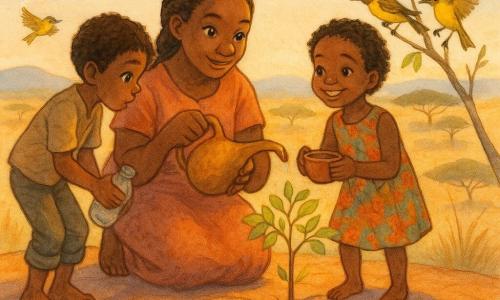
Amara journeyed home, the river singing beside her. The villagers rushed to greet her, their eyes wide with wonder. Children splashed in the water, women filled their gourds, and goats drank deep, their tails wagging.
Mosi, the herder, bowed before Amara. “Chief, you have brought life and justice back to our land.”
Amara lifted him up, laughing. “No one chief can do it alone. The land is wise when its people are just.”
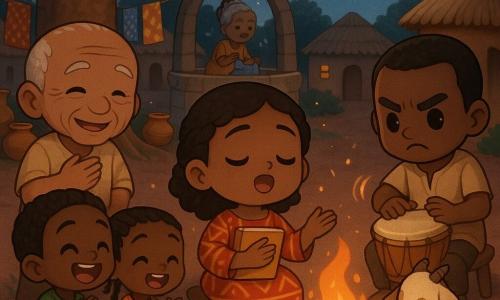
As dusk painted the sky in gold and purple, the villagers gathered for a feast. Drums boomed, feet stomped, and voices sang the story of Amara's journey. Under the watchful eyes of the ancestors, everyone gave thanks for the river's return.
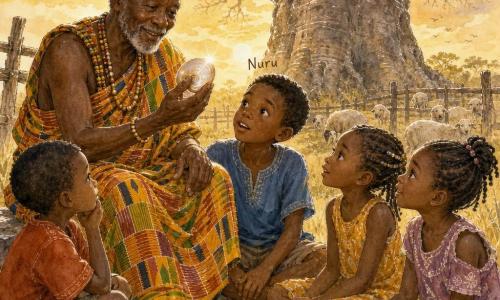
Later, as the stars blinked above, Amara sat beneath the great baobab. She told the children, “Justice is like water: it must be shared, or it turns to dust. Fairness makes our roots strong, and together we can face any drought.”
Little ones snuggled close, listening. Amara's story echoed into the night, a gentle wind carrying wisdom across the savanna.
And so, in the village of Ndala, justice and harmony flowed like the river, nourishing every heart and binding the people together—just as the baobab's roots hold the earth firm, no matter how wild the storm.