The Morning of Small Things
In the courtyard where the baobab kept time with its slow, patient heart, a woman named Amina sat with a notebook on her knees. The courtyard was a patchwork of sunshine and shade, of narrow paths worn smooth by slippers and goats' hooves. Pots sang with the smell of stew, and children's feet tapped like small drums. Amina liked small things: the soft scrape of a pen, the secret of a hummingbird's wing, the way a phrase could wake up a whole story.
Amina was studious as a dry leaf clings to a branch. She loved to learn, and she loved to listen. The elders had asked her to prepare a song for the full-moon night, a song to thank the ancestors and to remind the village of who they were. It was an honor like warm millet bread—soft and heavy and shared. She pressed her pen to paper and promised that she would make a song that would fit everyone's heart.
"Listen," her mother said, handing her a cup of tea that smelled of ginger and memory. "A song is like a net. If you make holes too small, some voices get caught. If the holes are too wide, the song slips away. Make the net true."
Amina smiled and wrote the word true in the margin. She rose and walked the courtyard. Today she would gather voices like beads for a necklace. Today she would make a net that held everybody.
The Lesson of the Goat and the Drum
First, she visited Kofi the drummer, who lived under a rusted roof that laughed with rain. Kofi's drum beat stories into the night. He tapped the skin with the backs of his fingers and said, "A song must have a heartbeat. Without it, we are birds with broken wings."
Amina listened. She tapped the rim of a clay pot and matched Kofi's rhythm. He taught her a rolling beat that sounded like the rain walking across the plain. "Give it a place to land," Kofi said. "Let it rest in the belly."
Next, a young goat bleated at Amina. Not a lesson in words but a lesson in stubbornness. The goat nibbled at the corner of her notebook, chasing a scrap of paper as if it were a dancing leaf. Amina laughed and learned that a song that never changes is like dry rope—hard and easy to break. "Let the tune bend," she whispered. "Let it chew at the edges."
She wrote the drum in the first line, and at the bottom she wrote the goat—soft and surprising. In the courtyard, rhythms moved like rivers; you could step over them or be carried along. Amina practiced the beat until her hands felt warm and full.
The Voices of the Courtyard
Amina then sat by the well where women washed cloths in blue and gold. The cloths told stories with their stains, and the women hummed while their hands worked. Each hummed a tiny different tune, like leaves that were the same tree but wore different shapes.
Old Nana Yaa came close. Her voice was like warm millet, full and grainy. "Song must hold our names," she said, tracing Amina's palm with a wrinkle. "We are many. You cannot forget the broken ones, the children, the quiet men."
From the boys kicking a torn ball came a shout that sounded like a bell. From a trader who had come from the next village came a phrase in a new tongue, bright like a bead of glass. Amina learned to be a collector. She listened to the way the rain spoke, to the way the market bargained, to how the moon hummed over the clay pots at night.
There was a quarrel too—two cousins arguing about who had the prettiest goat. They stamped and threw words like dry leaves. Amina sat between them and taught them a short chorus to sing together; their voices tangled, then found a way to smile. The song she stitched gathered these voices: the hum of Nana Yaa, the bell of the boys, the glass-sound of the trader, the quick snap of the cousins. Each voice was a bead on her string.
When strangers came at dusk—travelers with skins of stories—Amina welcomed them. She learned that the trader's phrase and Nana Yaa's lullaby could sit side by side like two different cups on the same table. Her notebook filled with phrases, like the courtyard filled with evening. She made little marks to remind her where each voice belonged.
The Night of Doubts and the Elders' Smile
The night before the full moon, Amina sat under the baobab and a wind like a storyteller stirred the leaves. The village glowed with lamp oil and expectation. Her notebook was heavy with songs, and yet a small worry crept like an ant: could one song hold all these voices without breaking?
She went to the hut where Elder Kojo slept. His eyes were soft like old leather, and his memories were long rivers. He listened, chewing the end of a reed, and said, "A song is not a box, Amina. It is a house with many doors. Open each door, and let the people come in. The first line belongs to the ancestors, the second line to children; the rest is for those who are still learning."
"But what if they do not like the way I stitch their words?" Amina asked, small as a grain between his hands.
Kojo smiled with all his teeth, slow as the moon rising. "Then your song will teach them how to listen. Tolerance is the glue. Remember: to accept is not to lose yourself. It is to hold another's story like a warm cup."
She thought of the goat who nibbled her paper—and laughed. If the goat could nibble, people could say their voices too. She straightened her back and rewrote parts of the chorus, letting each line breathe.
The next morning, the courtyard prepared itself like a strong pot. Women braided their hair with beads that tinkled, men wrapped bright cloths, children ran with shadows at their heels. Amina smoothed her skirt and tied the notebook to her chest like a bird's egg, careful and proud.
When the elders gathered, they sat in a circle like the sun's own teeth. The moon climbed and the baobab watched. Amina stood where the smell of fire and roast meat met the air and began.
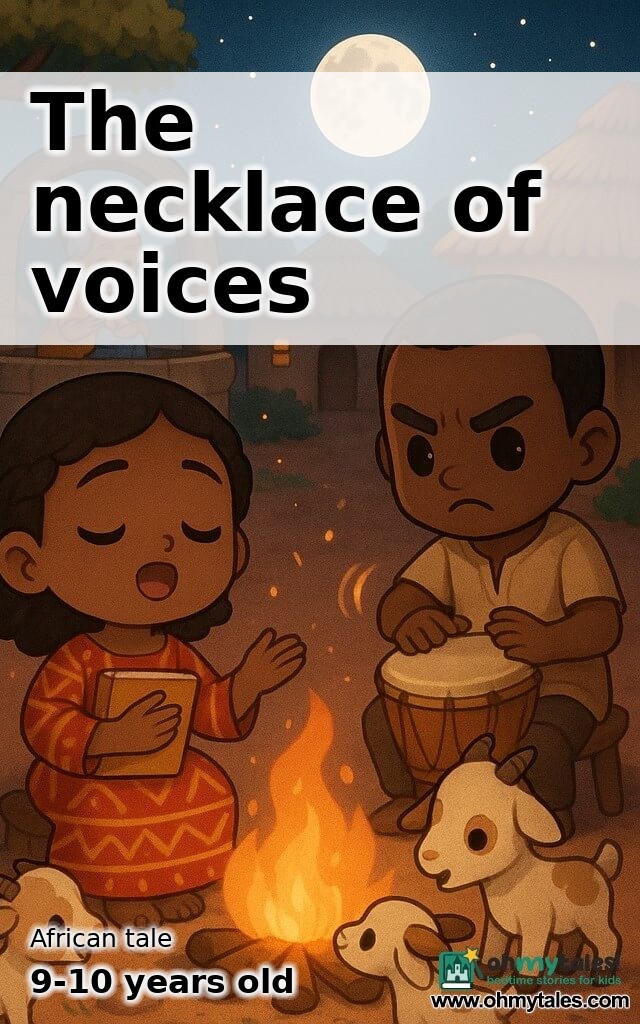
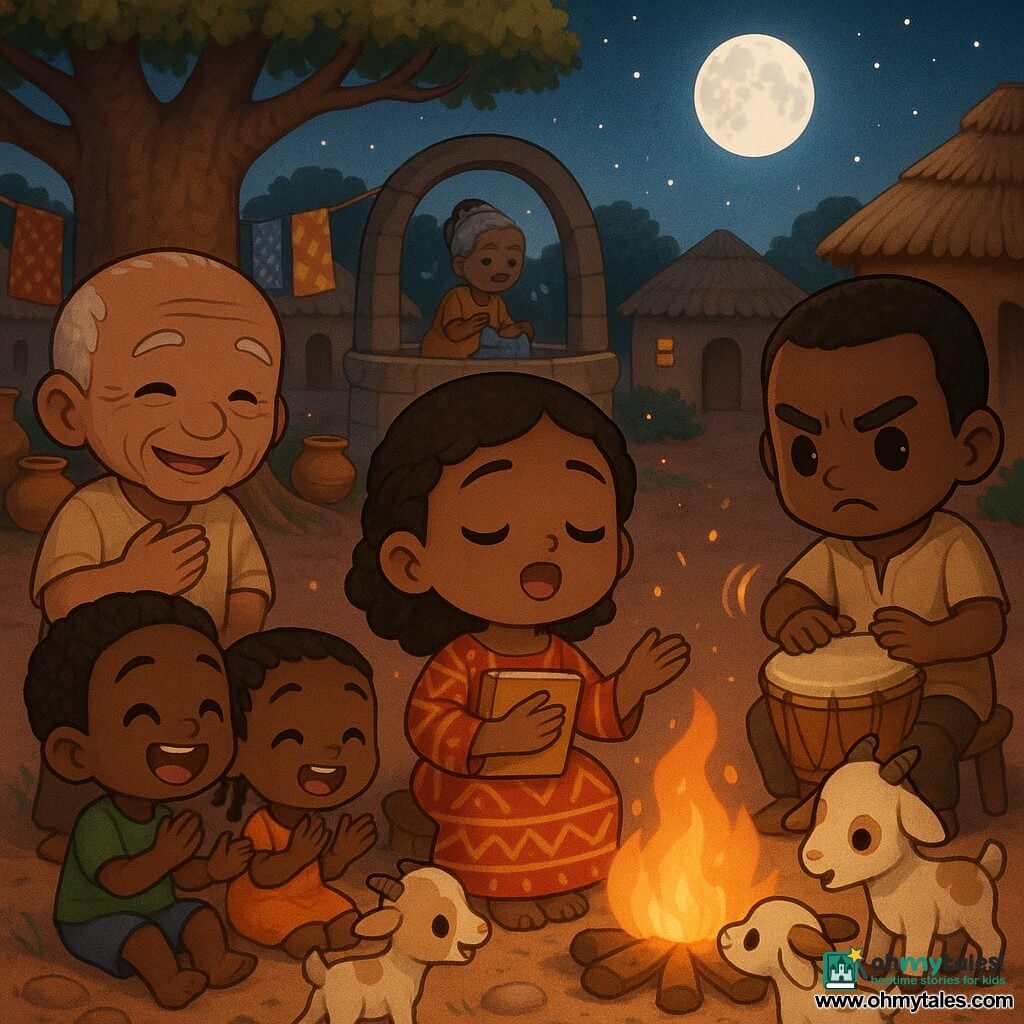
She sang the drum Kofi had taught her, a slow rain that turned into a river. She moved into the cousins' chorus, which carried the quarrel away like smoke. Nana Yaa's lullaby folded into the trader's bright phrase; they did not fight, they answered. Amina opened doors in the house of her song—doors of laughter, doors of sorrow, doors of stories nobody had sung in a long while.
At one point, the children began to clap in their own rhythm, and the elders joined, surprised, then smiling. The trader hummed in his new tongue, and the goats bleated in time, because sometimes even goats want to be part of a song. The courtyard turned into a necklace of voices. Amina's net held, warm and strong.
When she reached the last verse, she spoke it softly, so that it would be heard more in hearts than in ears. "We are many beads on one string," she said between notes, "each different, each shining. When one bead falls, the necklace is not whole. When one voice is silenced, the song is not complete. Let us keep the doors open."
After the song, the elders rose like slow thunder and began to clap. Their applause rolled across the courtyard and came back as laughter. Elder Kojo took Amina's hand and pressed it to his chest. "You taught us to listen," he said. "You taught us to keep doors open."
She looked out at the faces: some were wrinkled like dried fruit, some smooth as new leaves; some had dark lines of sorrow, others bright as the trader's beads. None were left out. The song had fit like a well-made bowl.
That night, they lit the fire. The flames flapped like bright birds and the smoke braided into the sky. People sat close, and the fire's light knitted them together. They passed roasted yams and cups of sweet tea. Laughter began like a small ring, then another, until the courtyard buzzed with it.
Elder Kojo took one dried string of seeds—laughed seeds used for counting—and handed it to Amina. "For you," he said. "You made us a necklace. Wear it when the night is thick."
Amina hung the seed string around the elders' fire, and everyone leaned in. The laughter came in little bursts, then in long waves, breaking over each face like soft waves on sand. It felt like a chain of tiny suns. Around the fire, hands held hands, and voices braided together.
When the laughter circled the baobab and the stars leaned closer, they called it at last: the necklace of laughter around the fire. It was warm, and it fit everyone.
Amina leaned back and let the music of the courtyard settle into her bones. She had learned to stitch the many into one and to hold different voices without losing herself. The elders' smiles were like lamps left burning to guide travelers.
As the night folded into the cool breath of dawn, Amina whispered to the baobab, to the sleeping goats, to her notebook: "A song must always leave a door open." The baobab rustled and seemed to agree.
And in the morning, when the sun came to sweep the courtyard, the people walked as if they carried a small light inside them—an understanding like a sweet seed: that when we make room for many voices, the song grows wider, and the world grows kinder.