Chapter 1: The Girl and the Great Rock
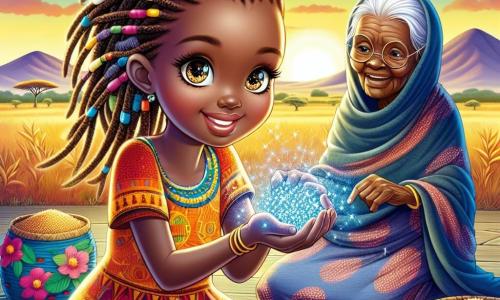
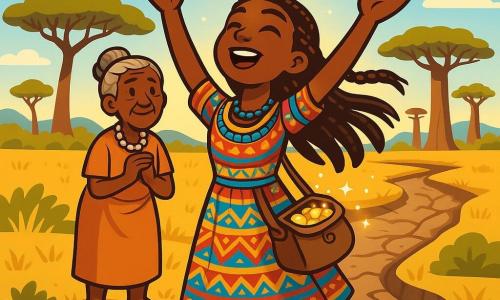
In the sun-kissed heart of Africa, where the savanna rolls like a golden sea and the sky is as wide as a grandmother's smile, there lived a young woman named Amira. Amira was known for her curious eyes, bright as the morning star, and her gentle hands, always ready to help. She lived in a small village where every child, goat, and baobab tree knew her name.
One dawn, as the world was still wrapped in a sleepy blanket, Amira climbed the ancient rock that watched over her village. This rock, called Lion's Rest, stood high and proud, its flanks warmed by a thousand suns and cooled by a thousand moons. From its crest, Amira could see the entire savanna: the herds of zebra painting stripes across the grass, the rivers curling like silver snakes, and the acacia trees stretching their arms to the sky.
Amira sat quietly, her favorite gourd of water by her side, and listened to the whispers of the wind. The rock told stories to those who listened. It spoke of the days when elephants danced, and the rains fell like laughter. Today, it told Amira a secret: “If you plant a tree on my back, little one, you will give shade to many and your kindness will grow roots deeper than I.”
Amira's heart beat like a drum. “A tree?” she wondered aloud, her voice soft as a feather. “But nothing grows here but lizards and moss!” Still, the idea took root in her mind, as stubborn as a seed in dry earth. She looked at her empty hands and then at her gourd. She knew what she must do.
Chapter 2: The Search for the Seed
Amira hurried back to the village, her feet barely touching the ground. She asked the elders, whose hair was as white as the clouds, “Where can I find a seed that will grow strong upon Lion's Rest?” The elders smiled, their eyes twinkling with the knowledge of many seasons.
“The seed you seek is guarded by the Weaverbirds,” said Old Mama Sissoko, her voice rustling like palm leaves. “They live in the tallest acacia, just beyond the river. But remember, child, Weaverbirds love their seeds. You must ask with respect.”
Amira thanked the elders and set off, her gourd swinging at her side. The savanna was alive with sound: the laughing hyenas, the chattering monkeys, the distant cough of a lion. Amira walked, her shadow stretching long and thin behind her, until she reached the great acacia, crowned with a hundred hanging nests.
She greeted the Weaverbirds with a song, her voice carrying like sweet smoke through the branches. “Weaverbirds, weaverbirds, I ask for a seed, not for me, but so all may be freed—from the sun's hot gaze and the hunger for shade!” The Weaverbirds, curious and clever, listened. They saw the kindness in Amira's eyes and the determination in her heart.
With a flutter of wings and a cheerful chirp, the eldest Weaverbird dropped a single, shining seed into Amira's waiting hand. “Take it, child who sings to the wind,” the bird said. “But remember, a seed alone needs more than wishes to grow.”
Chapter 3: The Climb and the Challenge
Amira returned to Lion's Rest, clutching the precious seed. The rock gleamed in the afternoon sun like a lion's back, hot and unyielding. She pressed the seed into a small crack, whispering a promise: “Grow strong, little one. Give shade and hope to all who pass.”
But the earth was hard, and the sun fierce. Day after day, Amira climbed the rock, carrying her gourd filled with water. She poured a little over the seed each morning and sang songs of rain and rivers. The days were long, and sometimes her arms ached, but Amira never forgot the rock's promise.
As the rains delayed and the rivers shrank, water became as precious as gold. The villagers watched as Amira shared her last drops with the stubborn seed. Some shook their heads, saying, “Why waste your water on a dream?” But Amira smiled and replied, “A tree's shade is for everyone, even those who doubt.”
Slowly, a tiny green shoot poked its head above the rock. It was small, but it stood proud, trembling in the wind. Amira cheered, and the birds joined in, their songs weaving through the air like ribbons. The rock, too, seemed to hum with happiness beneath her feet.
Chapter 4: The Long Dry Season
The dry season came, harsh as a lion's roar. The sun bit the earth, and the rivers curled up and hid underground. The villagers grew worried, and the animals wandered far for water. Amira's little tree bent under the heat, its leaves curling like shy fingers.
One morning, Amira climbed Lion's Rest and found her gourd nearly empty. She knelt by the tree, her heart heavy as a rain cloud, and wept. “How can I help you, little tree, when I have so little left to give?”
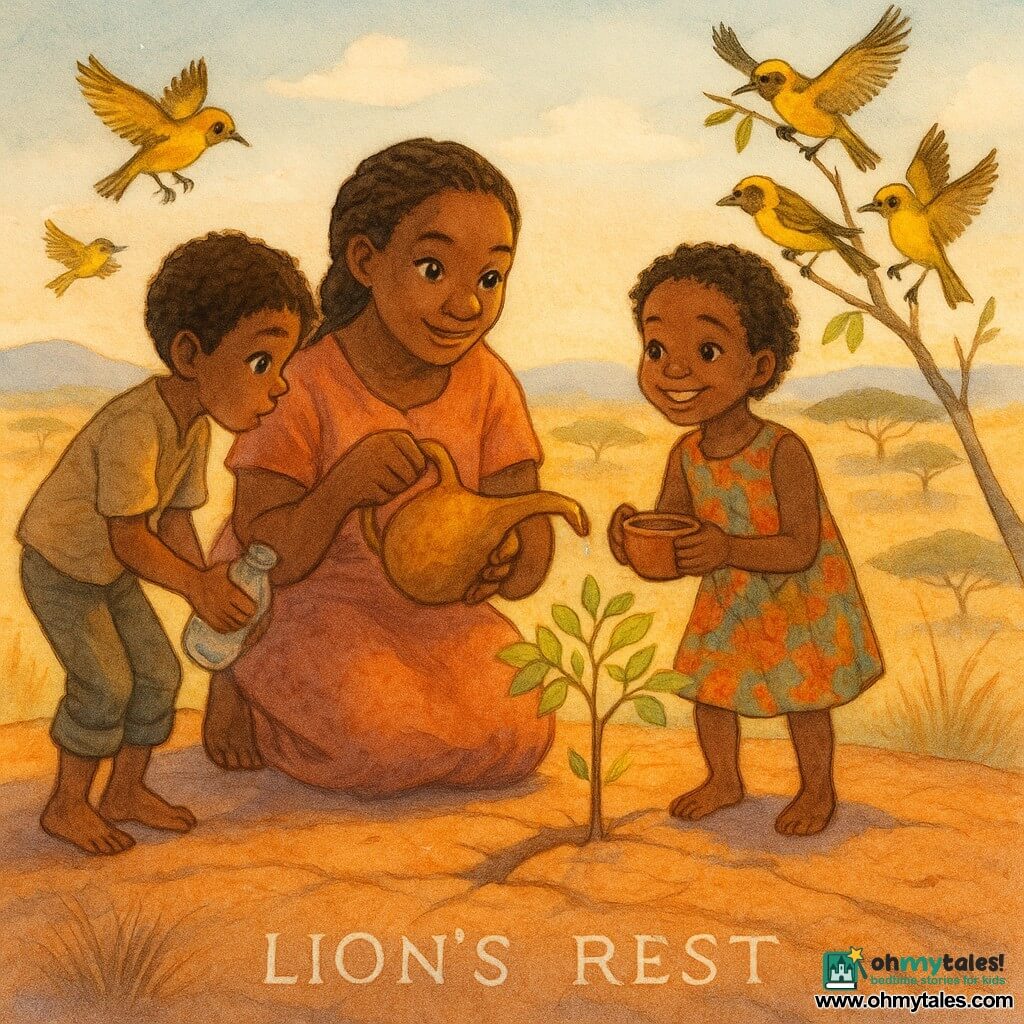
Just then, the children of the village appeared, their faces bright as mangoes. They brought their own tiny gourds and cups, filled with what little water they could spare. “We will help you, Amira!” they sang. “Your tree will be our tree. Your dream is our dream.”
Day after day, the villagers came, each bringing a drop, a trickle, a splash. The tree drank up their gifts, its roots stretching deep into the rock, its stem growing thicker with each act of kindness. The rock seemed to smile, proud to wear a crown of leaves at last.
Chapter 5: The Tree of Many Shadows
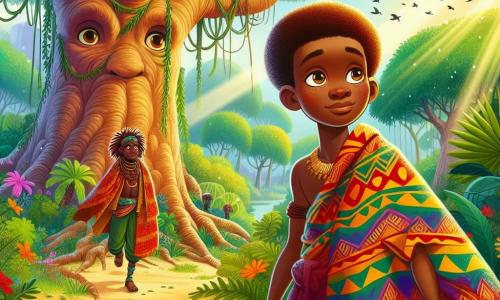
At last, the rains returned, drumming on rooftops and turning the savanna green as emerald cloth. Amira's tree stretched tall and strong, its branches wide enough to shelter a whole family of monkeys—or a circle of laughing children.
Under the tree's shade, the villagers gathered. They shared stories and meals, their voices rising like flocks of birds at dawn. Amira filled her gourd from the river, now swollen and happy, and poured it at the tree's roots as a thank you.
One evening, as the sun melted into the horizon, painting the world in orange and gold, Amira found her gourd empty. She walked to the river, dipping it in the cool water, watching the ripples dance like children's laughter. She filled her gourd and smiled, her heart as full as the moon.
The tree on Lion's Rest became a symbol for the village—a reminder that even the smallest seed can grow into a shelter for many, and that when people share what little they have, miracles root themselves in the hardest stone.
And so, under the great African sky, the tree stood, and its shade belonged to all.