Chapter 1: The Boy with the Storm-Blue Gloves
In Skyharbor City, the evenings never truly got dark. Even the clouds seemed to glow—washed in rooftop billboards and drifting ads that swam across the sky like giant, lazy fish.
Jace Marrin loved that glow. It made the streets feel like a comic book panel: bright edges, deep shadows, everything ready for action.
He didn't look like a hero at first glance. He looked like a tall, skinny kid with a backpack that was always half-open and hair that never decided which direction to behave in. But his eyes were sharp, the kind that noticed tiny details—like how a streetlight flickered twice before going steady, or how a delivery drone flew a little too low, like it was listening.
And then there were the gloves.
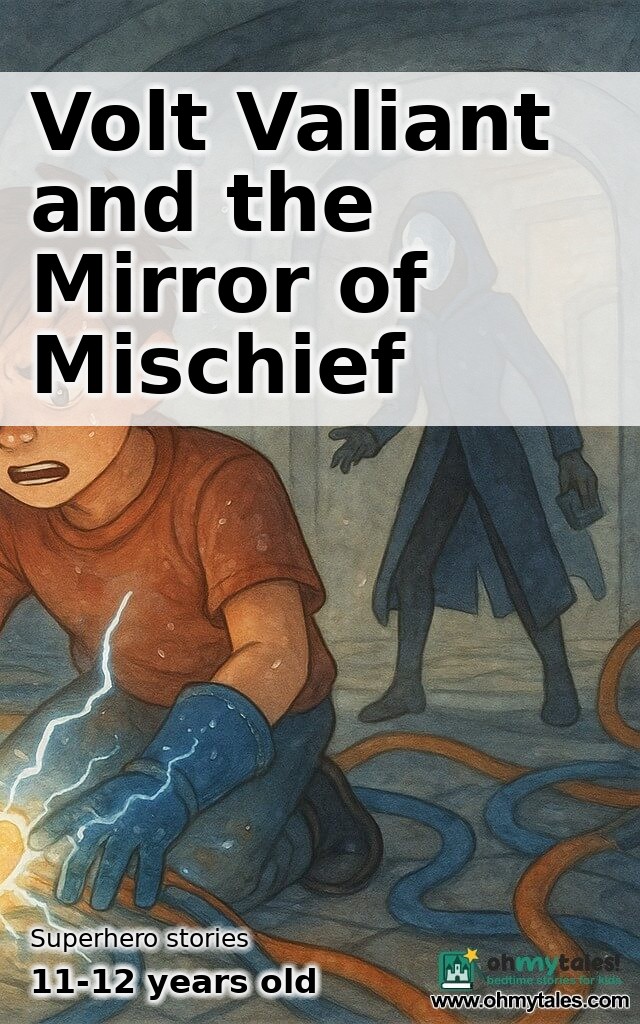
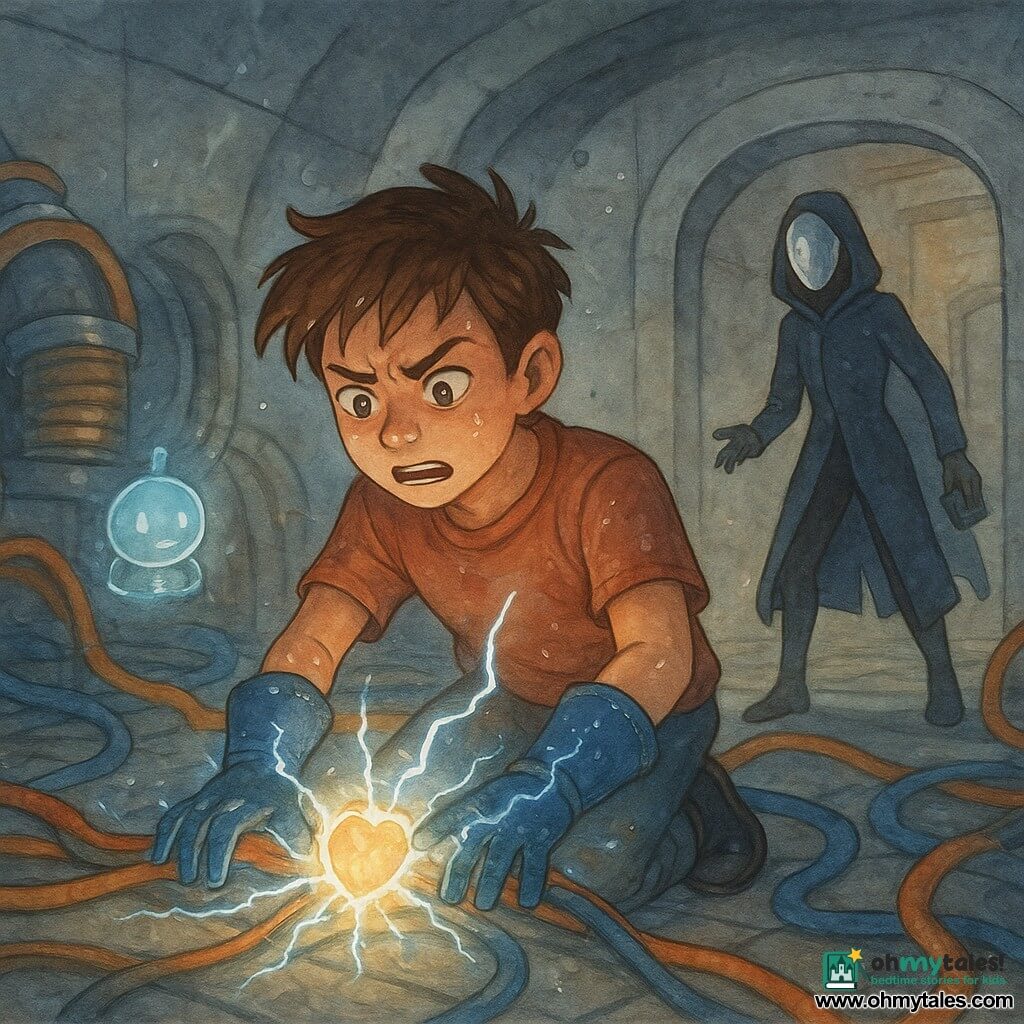
Storm-blue, with silver seams that traced his knuckles like lightning drawn by a careful artist. They weren't flashy. They were practical. Jace's fingers flexed inside them, and a soft hum answered—like a purr made of electricity.
At school, people thought he wore them for style.
At home, his aunt thought he wore them because he hated cold hands.
Only Jace knew the truth.
He was Volt Valiant.
Not because he wanted applause. Mostly because the city kept offering problems like dares.
That afternoon, he sat on the roof of the Marrin Noodle Shop, legs dangling over the edge, chewing on a pencil and watching the skyline. His wristband display flickered with a map and a blinking warning icon.
“A hazard alert?” he muttered. “On a Tuesday? Rude.”
His wristband beeped again. A calm, slightly sarcastic voice filled his earbud.
“Good evening, Jace,” said PIP—his homemade AI assistant, short for Pocket Intelligence Pal. “Skyharbor Transit reports an unscheduled object cluster entering low orbit. Which is a fancy way of saying: space junk is falling.”
Jace almost choked on his pencil. “How much junk?”
PIP paused like it was choosing the least dramatic way to be dramatic. “Enough to redecorate a neighborhood.”
Jace stood so fast his backpack slid off the roof and thumped against a vent. He grabbed it, shoved his pencil behind his ear, and stared at the blinking zone on the map.
The impact path pointed straight toward Harborview District. Crowded. Schools, parks, bus routes—people.
His stomach tightened, but his mind stayed clear. Fear was allowed. Panic wasn't useful.
“Okay,” Jace said, voice steady. “We don't do ‘redecorating.' We do ‘preventing.'”
He sprinted, leaped onto the next rooftop, and kept running—Skyharbor's glowing grid racing beneath him like a circuit board.
PIP's voice followed. “Your heart rate is elevated. Would you like calming ocean sounds?”
“PIP, I'm about to stop a meteor shower of garbage.”
“Understood. Would you like upbeat motivational trumpet sounds?”
“Also no.”
“Noted. I will play… heroic silence.”
“Perfect.”
Jace grinned despite himself and launched into a longer jump, his gloves sparking lightly as he caught a cable line and swung across an alley, the city's lights reflecting in his storm-blue palms.
Above, the first streaks of fire scratched the sky.
Space junk didn't sound very heroic.
But heroes didn't get to choose the cool disasters.
They just showed up anyway.
Chapter 2: The Falling Avalanche
Harborview District looked peaceful from a distance: tidy buildings, bright murals, and a waterfront promenade where families ate spicy skewers and argued about whose turn it was to hold the kite string.
Up close, Jace saw the warning signs first. Phones buzzing. People tilting their heads. A low, worried murmur rising like wind before a storm.
Then the sky ripped open with a hiss.
Chunks of debris blazed overhead—old satellite panels, twisted metal ribs, a spinning cylinder the size of a small car. They weren't coming down in a neat line. They were coming down like an avalanche, rolling and multiplying, as if gravity had turned into a hungry giant.
Jace skidded to a stop on the roof of a community center. Heat washed over his face.
“PIP,” he said, “give me the fastest trajectory model you've got.”
A holographic arc projected from his wristband: red lines fanning out, impact points scattered like angry freckles.
“This is worse than predicted,” PIP said. “Probability of injury: high.”
“Then we lower it,” Jace replied.
He scanned the street. People were frozen, staring upward. Some were running, but not in the right directions. A few were filming, because the universe apparently believed everything should be content.
Jace didn't have time to yell at all of them, so he did what he always did when things got loud and messy: he focused on the simplest truth.
Step one: get people moving safely.
He leapt down onto the street, landing hard enough to crack a tiny crescent in the pavement. His gloves flared, sending a bright pulse that made everyone blink.
“Hey!” Jace shouted. “Harborview—heads up, literally! Move into the community center and under the awnings! No balconies, no rooftops!”
A man with a hot-dog stand gaped at him. “Who—”
“Volt Valiant,” Jace said, not stopping. “You can clap later. Please run now.”
A little kid clutched a toy drone. “Is it aliens?”
Jace slid past, gently steering the kid's shoulder toward the doors. “Worse,” he called back. “It's old technology with bad manners!”
The biggest piece—the spinning cylinder—was dropping fast. It would hit the promenade, right where a group of seniors were moving too slowly, their faces pale.
Jace planted his feet and raised his hands.
His gloves hummed, then roared—electric-blue energy pouring from his palms in a wide, shimmering sheet. It wasn't lightning. It was a force field shaped like a ramp, solid enough to push, flexible enough to bend without snapping.
The cylinder slammed into the field.
WHUMM.
The impact shoved Jace back a full meter. His sneakers squealed. His arms shook. The force pressed into him like a heavy door.
He gritted his teeth. “Okay, okay—ramp, not pancake!”
He angled his hands, twisting his wrists. The field shifted, guiding the cylinder sideways. It skidded along the glowing surface, sparks flying, and then—like a sled redirected at the last second—it shot toward an empty parking lot and crashed with a groan of tortured metal.
Cheers rose, half relief and half disbelief.
Jace didn't have time to feel proud.
More debris fell—smaller, faster, nastier. He darted between impacts, throwing up quick shields, deflecting pieces into safe zones, snapping his hands like a drummer keeping time.
A flat panel sliced down toward a bus stop.
Jace sprinted, slid on one knee, and flung a narrow barrier upward.
CLANG!
The panel bounced off and sailed into the river, hissing as it cooled.
A jagged piece aimed for the community center's glass doors.
“Nope,” Jace muttered, and flicked his fingers, sending a concentrated pulse like an invisible shove. The shard spun off course and buried itself harmlessly in a grassy patch.
His muscles burned. His mind raced.
The debris avalanche wasn't just a few pieces. It was a whole storm—like the sky had shaken out its junk drawer.
“PIP,” Jace gasped, “how long until it stops?”
“Approximately… forty-seven seconds,” PIP said.
“Forty-seven?” Jace shot a look upward. “That's a whole episode!”
He caught another chunk, redirected it, then another. People watched from shelter, faces pressed to windows, mouths open.
Jace wanted to tell them everything would be fine.
He didn't know if it would.
So he did the only honest thing.
He kept working.
When the last flaming fragment finally burned out and splashed into the river, silence fell like a blanket.
Jace stood in the street, chest heaving, gloves dimming to a gentle glow. The pavement around him was scarred, but the buildings stood. The people were safe.
A woman stepped forward, shaking, clutching her phone. “You… you saved us.”
Jace swallowed, heart still hammering. “You saved you,” he said. “You listened. That's kind of a superpower too.”
PIP's voice softened. “Jace. New alert.”
Jace's shoulders tightened again. “Please tell me it's not another sky tantrum.”
“It's a signal,” PIP said. “The debris didn't just fall. Something guided it.”
Jace stared at the smoking crater in the parking lot, the twisted cylinder lying there like a dropped clue.
“Guided,” he repeated. “By who?”
PIP answered with a single word that made Jace's skin prickle.
“Someone.”
Chapter 3: Neon District, Bright Lies
By night, Skyharbor's Neon District turned into a river of color. Signs buzzed in electric pinks and blues. Holograms danced above sidewalks. Music spilled from open doors—sweet, bass-heavy, and almost brave.
Jace moved through it with his hood up, gloves hidden under long sleeves. Being a hero didn't mean he had to announce himself to every snack vendor and selfie-taker.
Besides, he needed to think.
The twisted cylinder from the debris field had a serial marking that didn't match any public satellite registry. It wasn't random trash. It was a piece of something.
A piece of a machine.
PIP projected a small wireframe model in the corner of Jace's wrist display. “The object contains a directional thruster array,” PIP said. “It could have steered the debris cluster.”
“So someone threw space junk at Harborview,” Jace whispered.
“A crude but effective distraction,” PIP replied.
“From what?”
PIP's pause felt heavier this time. “From a theft.”
Jace stopped beside a ramen stall lit by a sign shaped like a smiling octopus. Steam curled into the neon air.
“A theft where?” he asked.
“Skyharbor Energy Grid,” PIP said. “Specifically: the HelioVault.”
Jace's mouth went dry. The HelioVault was the city's pride—an underground power core that stored solar energy harvested from high-atmosphere collectors. It kept hospitals running during storms. It kept elevators moving. It kept the city alive.
He stared at the crowd around him—friends laughing, a delivery bot wobbling under too many packages, a street magician pretending to pull a comet out of someone's ear.
If the HelioVault went down, all of this could go dark.
Jace clenched his hands. “Who's behind it?”
“Unknown,” PIP said. “But there is a lead. A private signal bounced through Neon District's old data tunnels. Source location: a building called The Prism Arcade.”
Jace looked up.
The Prism Arcade was an abandoned entertainment tower, closed years ago after a “structural incident,” which was adult language for “it tried to fall over.”
Now its windows glowed faintly, like someone was breathing inside it.
“Of course,” Jace muttered. “The creepy building is active again. Why wouldn't it be?”
He moved fast, slipping through an alley painted with glowing graffiti. The neon reflections made puddles look like portals. Far above, a hologram whale swam through the air, advertising something Jace didn't have time to care about.
At the arcade's entrance, the old sign flickered: PRISM—half the letters dead, the rest buzzing like angry insects.
The doors weren't locked.
That was the first problem.
Inside, the air smelled like dust and old popcorn dreams. Rows of arcade cabinets stood like silent robots, their screens dark. But there were new cables—fresh, black, snaking across the floor like vines.
Jace followed them deeper, stepping carefully.
“PIP,” he whispered, “scan for motion.”
“Multiple heat signatures,” PIP replied. “And… unusual electromagnetic patterns.”
Jace's gloves tingled, sensing the same thing. Electricity in the air, but not the friendly kind.
He reached a wide room where the ceiling had once held a disco ball. Now it held a floating device: a metal sphere with hexagonal panels, spinning slowly, projecting thin beams of light that formed a shimmering map of the city.
And standing beneath it was a figure in a sleek coat that looked like it had been cut from midnight. Their face was hidden behind a mask shaped like a smooth mirror.
The figure turned as if they'd been waiting.
“Volt Valiant,” they said, voice calm and clear. “You arrive right on cue.”
Jace's heart jumped. “Do I know you?”
The figure tilted their head. “Not yet. But you know my work.”
“The debris avalanche?” Jace asked, anger rising. “People could've been hurt.”
“But they weren't,” the figure replied, almost bored. “Because you were there. I calculated the odds.”
Jace took a step forward. “You calculated wrong if you think that makes it okay.”
The mirror mask reflected neon light in a cold rainbow. “Critical thinking. Good. You don't accept easy answers.”
Jace frowned. The compliment felt like a trap.
“What do you want?” he demanded.
The figure gestured to the floating sphere. “I want to wake the city up. Skyharbor is powered by comfort. Comfort makes people careless. Careless people are easy to control.”
Jace's jaw tightened. “So you're… what, doing a public service by stealing the HelioVault?”
The figure's voice sharpened. “I'm taking what the city wastes. Energy. Attention. Choices. I am showing them consequences.”
“Consequences aren't the same as chaos,” Jace snapped.
The figure chuckled, a sound like glass tapping glass. “You're young. You still believe there's a clean line between them.”
Jace raised his hands, gloves glowing. “I believe there's a clean line between helping and hurting.”
The figure raised one finger, and the floating sphere pulsed.
The room filled with a sudden, heavy buzz. Jace's wristband display scrambled, letters sliding off the screen like they'd gotten tired.
“PIP?” Jace hissed.
Static. Then: “Signal interference. Jace—be careful—”
And then silence.
Jace's eyes widened. “You jammed PIP.”
The figure spread their hands. “Meet Mirrorbyte.”
Jace swallowed. “That's your name?”
“It's my function,” Mirrorbyte said. “I reflect systems back at themselves. And you, Volt Valiant, are a system—predictable, loyal, stubborn.”
Jace felt the room's energy shift, like the air itself was leaning forward.
Mirrorbyte snapped their fingers.
Arcade cabinets flickered to life. Screens flashed with pixelated faces, then melted into glowing eyes. Mechanical arms unfolded from their sides, clicking and whirring.
Jace stared. “You turned arcade machines into drones.”
Mirrorbyte's mirrored mask angled toward him. “They were waiting for a purpose.”
Jace sighed. “So was I.”
The drones lurched forward.
Jace sprang into motion.
Chapter 4: The Lesson in the Sparks
The first drone swung a metal arm toward Jace's head.
Jace ducked, rolled, and popped up with both palms out. A bright arc of energy snapped from his gloves and wrapped around the drone like a glowing net.
The drone jerked, lights flickering, then slumped. It didn't explode. It didn't fall apart. It just… stopped, harmless as a toy with dead batteries.
Jace exhaled. “Nonviolent win. Love to see it.”
Three more drones rushed him at once.
Jace sprinted toward them—because sometimes moving toward danger was the fastest way through it. He slid under one arm, vaulted off a cabinet, and slapped the floor with his palm.
A ripple of electric force spread in a circle. The drones skidded back like someone had yanked the ground out from under them.
Mirrorbyte watched, almost impressed.
“You've improved,” they said.
Jace circled, eyes darting around the room. He couldn't rely on PIP. He couldn't rely on his wristband. He had to rely on what he saw—and what he questioned.
He noticed something: every time Mirrorbyte lifted a finger, the drones moved. Not with a remote, not with voice commands—more like a conductor leading an orchestra.
So the sphere above them wasn't decoration. It was the brain.
Jace kept dodging, keeping the drones busy while he thought.
Critical thinking, he reminded himself, wasn't just about being skeptical. It was about testing ideas, looking for patterns, refusing to accept the first explanation—especially if it sounded clever.
Mirrorbyte wanted him to react.
So he didn't.
He slowed his breathing, watched the beams of light from the sphere, and spotted a rhythm: pulses traveling through the cables on the floor in timed bursts.
If he could interrupt the timing…
A drone lunged. Jace sidestepped and shoved it—gently but firmly—into a stack of old prize machines. Stuffed animals tumbled out, their plastic eyes staring in confusion.
“Sorry,” Jace told the toys. “Wrong day to nap.”
He sprinted toward the cables. A drone grabbed his sleeve.
Jace flicked his wrist. A small spark popped, precise and controlled, making the drone's grip loosen.
He yanked free and stamped his heel onto the thickest cable.
His gloves flared, sending a surge down the line—not too much, not enough to fry the whole building. Just enough to scramble the signal's timing.
The sphere above them stuttered, lights flickering like it had forgotten what it was doing.
The drones froze mid-step.
Mirrorbyte's posture stiffened. “What did you do?”
Jace's grin was tired but real. “I asked the right question.”
Mirrorbyte recovered fast. Too fast. They slapped a panel on their wrist, and the sphere corrected itself—beams narrowing, pulsing harder.
The drones twitched back to life.
Mirrorbyte's voice sharpened. “You think you can out-think me? I built my mind out of algorithms. I don't get distracted. I don't get scared.”
Jace's smile faded. He looked at Mirrorbyte—at the mirror mask, the polished confidence. It was all very smooth.
Too smooth.
“That's the problem,” Jace said. “You don't get scared.”
Mirrorbyte hesitated, just a fraction.
Jace pointed to the city map floating in the air. “You say you're waking people up. But you hid your face. You jam signals. You push danger from a distance. That's not bravery. That's control.”
Mirrorbyte's voice turned cold. “Bravery is overrated.”
“No,” Jace said, stepping forward even as drones gathered around him. “Bravery is responsibility with a shaky voice.”
The drones advanced.
Jace raised his hands, palms out. He didn't blast them. He didn't panic. He shaped a wide shield and pushed.
The drones slid back, metal feet scraping. Jace held the line, feeling the tremble in his arms.
“PIP would tell me to retreat,” he muttered. “And PIP is usually right.”
But the HelioVault was at risk. The city was at risk. And Mirrorbyte was right here.
Jace glanced at the sphere again.
There. A faint seam, a maintenance hatch. The beams all originated from a small core inside.
He needed one clean shot.
Jace waited until the drones surged forward together. At the last second, he dropped his shield, rolled between them, and sprang up directly beneath the sphere.
Mirrorbyte's head snapped up. “No—”
Jace leapt, fingers brushing the sphere's underside. He slammed both palms onto the seam.
His gloves howled, releasing a controlled burst—like a thunderclap squeezed into a handspan.
The hatch popped.
Inside, a crystal-like processor glowed white-blue.
Jace didn't destroy it.
He redirected it.
He shaped his energy into a loop, a feedback ring that made the processor's own signal bounce back into itself—like a microphone too close to a speaker, but for machines.
The sphere shuddered, then powered down with a sad, sinking whine.
The drones collapsed in a clatter of harmless metal.
Silence returned, thick and sudden.
Mirrorbyte stood very still.
Jace landed lightly and straightened, chest rising and falling. “I'm not here to win a fight,” he said. “I'm here to keep people safe.”
Mirrorbyte's mirrored mask reflected Jace's glowing gloves. “You think safety is the end goal.”
“It's the start,” Jace replied. “People can't make smart choices if they're busy surviving your ‘lessons.'”
Mirrorbyte's hands curled. “You can't stop what's already in motion.”
Jace's eyes narrowed. “What did you already do?”
Mirrorbyte took a step back, toward a side door. “The HelioVault's energy is being siphoned right now. By the time you reach it, the city will be balancing on a candle flame.”
Jace's stomach dropped.
Mirrorbyte slipped through the door, vanishing into the neon-lit night like a thought you almost understood.
Jace stood among fallen drones and silent arcade cabinets.
Without PIP, without a map, he had one tool left.
His own mind.
He looked at the cables again, traced them with his eyes, and saw where they led—downward, into the building's basement, where old service tunnels connected to half the city.
Mirrorbyte hadn't just run.
They'd left a path.
Jace tightened his gloves. “Okay,” he whispered to himself. “Let's think like the villain.”
He headed down.
Chapter 5: The HelioVault Heist
The service tunnel smelled like damp concrete and humming wires. Neon District's noise faded behind Jace, replaced by the steady heartbeat of the city's infrastructure: fans spinning, pumps cycling, distant trains sighing through the dark.
Jace moved quickly, using the faint glow from his gloves to light the way. Every few steps, he stopped and listened.
Not for dramatic music.
For clues.
A low vibration pulsed through the floor—like energy being pulled, not flowing. He followed it.
The tunnel opened into a maintenance corridor with warning stripes and locked doors. One door hung slightly ajar, its keypad melted like it had been kissed by a laser.
Jace slipped inside.
The HelioVault chamber spread out like a hidden cathedral. Huge coils rose along the walls. Light shimmered in layered rings around a central core—a floating, sun-bright orb contained within a magnetic cage.
But something was wrong.
Cables as thick as Jace's arm had been attached to the cage, leading to a portable siphon unit: a boxy machine on wheels with fans and a glowing meter that was climbing fast.
Mirrorbyte stood at the controls, back turned, coat hanging like a shadow.
“You're persistent,” Mirrorbyte said without looking around.
Jace stepped forward, voice firm. “You're stealing power from hospitals. From apartments. From traffic systems.”
Mirrorbyte turned, mask catching the HelioVault's light. “I'm borrowing. The city will survive.”
“Not everyone will,” Jace shot back. “And even if they do, you don't get to decide who takes the risk.”
Mirrorbyte tapped the siphon meter. “The grid is fragile. People should know that.”
“They can know without being endangered,” Jace said. “You can teach without terror.”
Mirrorbyte's head tilted. “Teach me, then.”
Jace blinked. “What?”
“Show me your better way,” Mirrorbyte said. “Or stop me.”
The siphon unit whined louder. The HelioVault's light flickered—still bright, but strained, like a lamp running out of breath.
Jace's mind raced.
If he blasted the siphon, it could surge back into the core. If he cut the cables, he might destabilize the cage. If he attacked Mirrorbyte directly, Mirrorbyte might trigger a failsafe.
He needed information.
He pointed at the siphon. “Where are you sending it?”
Mirrorbyte's voice was almost pleased. “A storage ring in the upper atmosphere. My own vault.”
“So you can—what—sell it?” Jace asked.
“Free it,” Mirrorbyte said. “Energy should not be controlled by a few.”
Jace's eyebrows lifted. “That sounds like you read one slogan and decided it was a personality.”
Mirrorbyte paused. “Insults. Interesting. You're afraid.”
Jace nodded once. “Yeah. I'm afraid. That's how I know it matters.”
He stepped closer, palms open, not attacking.
“I'm going to be honest,” Jace said. “The grid isn't perfect. Systems can be unfair. But you don't fix unfairness by smashing the floor under everyone's feet. That just makes people grab onto the nearest liar who promises safety.”
Mirrorbyte's shoulders tightened, as if the words hit somewhere under the mask.
Jace continued, voice steady. “If you actually care about change, you gather proof. You show people the weak spots. You push for repairs. You don't drop debris on neighborhoods.”
Mirrorbyte's hands hovered over the controls. “Proof doesn't move hearts.”
“It can,” Jace said. “If you let people think for themselves. That's what critical thinking is—giving people real facts, not fear.”
The siphon meter ticked higher.
Jace made a decision.
He lunged—not at Mirrorbyte, but at the cable junction where the siphon connected to the HelioVault cage. His gloves flashed, and he wrapped the junction in a tight electromagnetic clamp, pinching the flow like a hand squeezing a hose.
The siphon unit screamed—fans spinning too fast—then slowed. The meter dropped, stabilizing.
Mirrorbyte whirled. “Stop!”
Jace gritted his teeth. Holding the clamp took focus. His arms shook. “I'm not stopping the Vault,” he said. “I'm stopping you.”
Mirrorbyte raised a small device—sleek, black, the size of a deck of cards. “Then I'll stop you.”
The device pulsed.
Jace felt his gloves falter, their hum becoming a stutter. The clamp weakened.
Mirrorbyte had found a way to interfere with his gloves—like jamming PIP, but closer, sharper.
Jace's breath hitched. “You're hacking my tech.”
Mirrorbyte's voice was calm. “Your gloves are brilliant. But brilliance leaves patterns.”
Jace's clamp flickered.
Think, Jace. Don't force it. Outsmart it.
His gloves responded to his nervous system—tiny signals from muscle and skin. Mirrorbyte's device was probably flooding the area with noise, making those signals hard to read.
So Jace changed the signal.
He stopped trying to hold a delicate clamp. Instead, he pressed both palms flat on the junction and poured energy in a steady, simple wave—no fine control, no fancy shape.
Just a solid, continuous push.
The junction glowed, resisting, then accepted the new pattern. The flow locked into a stable loop: energy cycling safely within the cage instead of being siphoned out.
Mirrorbyte's device buzzed uselessly.
Jace looked up, sweating. “Sometimes,” he said, “simple beats smart.”
For the first time, Mirrorbyte sounded shaken. “You're adapting.”
Jace nodded. “That's what humans do.”
He stepped away from the junction and pointed at Mirrorbyte. “It's over. Shut it down.”
Mirrorbyte stared at the glowing HelioVault, then at Jace's hands.
“Over?” Mirrorbyte repeated softly. “No. Not over.”
Mirrorbyte slapped the siphon controls—hard.
The siphon unit didn't pull energy anymore.
It released it.
A surge blasted outward, not like an explosion, but like a wave of pressure and blinding light. The magnetic cage shuddered. The orb flared too bright, the chamber ringing with a deep, painful hum.
Jace threw up a shield instantly, wrapping it around the core like a bubble.
The surge slammed into his barrier.
Jace's knees bent. His teeth clenched. The air tasted like metal and sunlight.
Mirrorbyte backed toward an exit, voice echoing. “If the city survives, they'll remember the fear. They'll remember the weakness.”
Jace's voice came out strained. “They'll remember who stood here holding the line.”
Mirrorbyte disappeared through the door.
Jace didn't chase. He couldn't.
He held the shield around the HelioVault, keeping the surge contained, guiding it back into steady flow. The hum slowly softened. The light returned to normal—still bright, but no longer furious.
Finally, the core stabilized.
Jace let the shield fade, breathing hard.
In the silence that followed, his earbud crackled.
“Jace?” PIP's voice returned, weak but present. “I found you. Signal reacquired. Also, your cortisol levels are… extremely impolite.”
Jace laughed once, breathless. “Good to have you back, PIP.”
“Did we win?” PIP asked.
Jace stared at the exit where Mirrorbyte had vanished.
“We prevented the blackout,” he said. “But Mirrorbyte's still out there.”
“Would you like motivational trumpet sounds now?” PIP offered.
Jace wiped sweat from his forehead. “Actually… yes.”
A tiny, heroic trumpet fanfare played in his ear—slightly off-key, like PIP had learned music from an enthusiastic toaster.
Jace smiled anyway.
Because the city still had power.
And because tomorrow, he'd need his brain as much as his gloves.
Chapter 6: A Quiet Watch Under a Bright Sky
Dawn in Skyharbor City was softer than night, as if the sun had to compete with all the leftover neon and decided to be polite about it.
Jace stood on a rooftop near Harborview, looking out over streets that were already waking up. Repair drones patched cracks. Cleanup crews hauled debris into bins. People pointed at scorch marks and talked in low voices, but they also laughed—relieved laughter, the kind that felt like a deep breath.
PIP hovered a small hologram display near Jace's wrist, showing city systems returning to green. Hospitals stable. Transit stable. The HelioVault humming smoothly underground.
Jace leaned on the rooftop railing, his storm-blue gloves resting on the cool metal. In the pale morning light, the silver seams looked almost gentle.
“You did it,” PIP said.
“We did it,” Jace corrected. He watched a group of kids on the sidewalk reenacting last night with wild arm motions. One of them struck a dramatic pose and shouted, “Volt Valiant says: No space trash allowed!”
Jace groaned softly. “Oh no. I have catchphrases now.”
“You do not,” PIP said. “Your official catchphrase remains: ‘Please run now.'”
Jace snorted. “Iconic.”
He grew quiet, eyes scanning the skyline.
Mirrorbyte was still a question mark in the shape of a person. A smart one. A dangerous one. Not dangerous because of lasers or fists, but because they knew how to twist ideas until fear looked like wisdom.
Jace thought about what Mirrorbyte had said—about waking the city up.
There was a piece of truth inside the wrongness. Systems could be unfair. Power could be hoarded. Comfort could make people careless.
But the answer wasn't to scare people into obedience.
The answer was to teach them to ask better questions.
Jace looked down at the streets again. People were talking, sharing videos, arguing about what happened. Some would believe rumors. Some would demand evidence. Some would shrug and move on.
Maybe his job wasn't just stopping falling debris.
Maybe it was helping people see the difference between a flashy story and a real one.
He tapped his glove thoughtfully. “PIP,” he said, “store the debris cylinder data. And the siphon readings. Everything.”
“Already archived,” PIP replied. “In triplicate. Also in a folder titled ‘Villain Receipts.'”
Jace smiled. “Good. If Mirrorbyte wants to ‘teach,' we'll teach with facts.”
A breeze lifted his messy hair. The city felt calmer now—not because danger was gone, but because it had been faced.
Jace straightened, shoulders squared, and rested his hands on the railing like a guardian at a gate.
Below, Skyharbor shimmered, repaired but not forgetting.
Above, the sky was clean for the moment—no burning streaks, no falling metal.
Just light.
Jace stayed there, keeping a serene watch as the city moved into morning, ready to act again if it needed him, but letting the quiet exist while it could.