Chapter 1: The Man with the Star-Thread Cape
Nova Harbor never really slept. It only changed outfits—morning fog like a gray hoodie, noon sunlight like a bright jacket, night neon like a glittering scarf.
On the roof of the Harborlight Museum, an adult man stood balanced on the edge as if gravity had signed a peace treaty with him.
His name was Orion Quill.
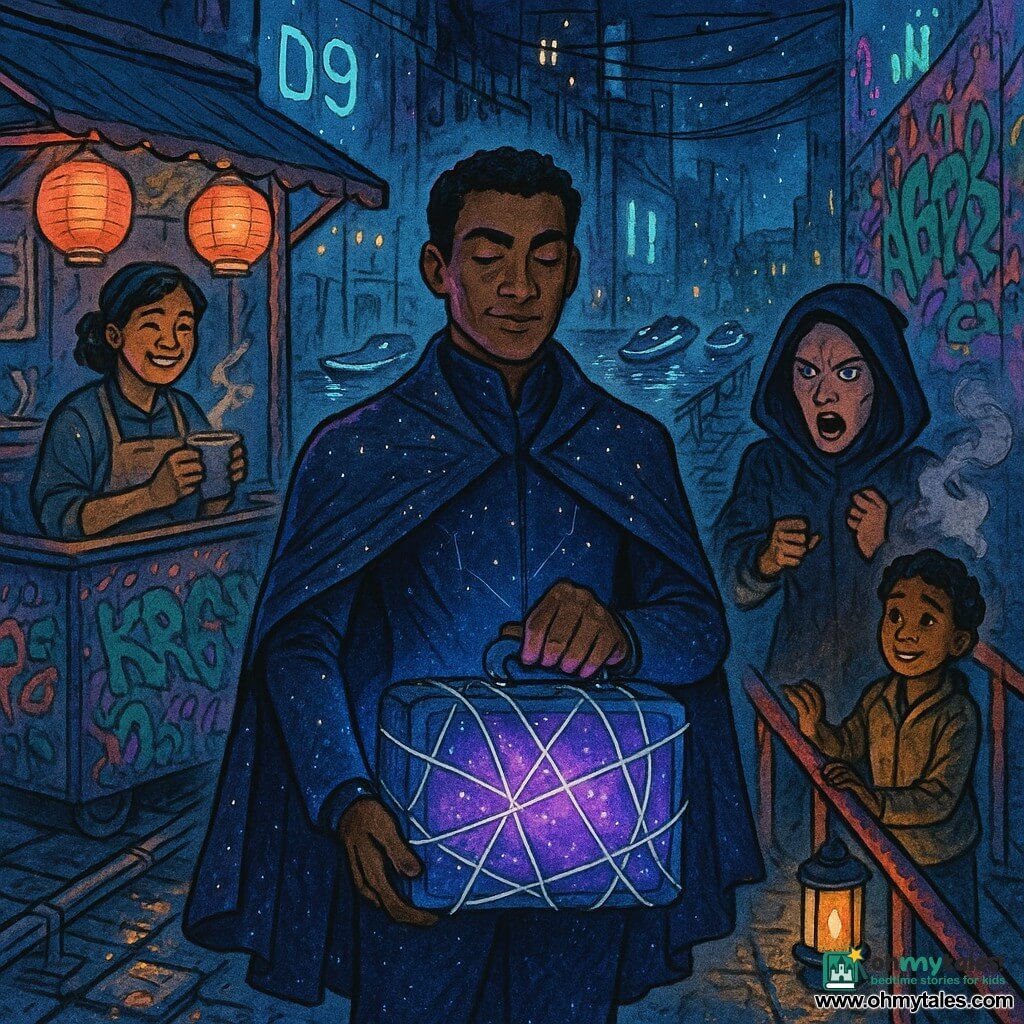
He looked like someone who'd stepped out of a comic panel and into real air: tall, broad-shouldered, with warm brown skin and a sharp, thoughtful face. A thin silver scar cut through one eyebrow like a lightning bolt that had decided to stay. His hair was black and tightly curled, shaved on the sides, and it lifted in the wind as if it had its own opinion. Over his street clothes he wore a sleek suit of midnight-blue fabric traced with faint starry lines—threads that shimmered when he moved, like constellations sliding across cloth. His cape wasn't a dramatic sheet. It was a short, smart drape, woven from “star-thread” that could stiffen into a wing or curl into a shield.
Down below, the city hummed: delivery drones, rooftop gardens, sky-trains threading between towers.
Orion tapped the side of his ear. “Mina? Give me the scoop.”
A calm voice answered through his comm. “Scoop delivered. Power fluctuations spreading in a spiral pattern from Dock District Nine. Streetlights are doing the blink-blink, like they're practicing for a concert.”
Orion grinned. “Streetlights aren't the only ones who can shine.”
He leapt—not down, but forward—his cape stiffening into a glider. Wind pressed his cheeks. The city rushed toward him in crisp lines and glowing dots.
As he rode the air currents, Orion's eyes narrowed. “This isn't random,” he murmured. “A spiral… that's a signature.”
Mina replied, “Signature of who?”
Orion's voice turned serious, but not grim. “Of someone who likes taking what isn't theirs.”
A billboard-sized holo-ad flickered and died mid-smile. A row of traffic signals blinked confused colors, like they were trying to remember the rules.
Orion banked toward Dock District Nine, and his star-thread suit pulsed softly—like it was listening.
He wasn't just a hero with a cape.
He was a hero with a plan.
Chapter 2: Blackouts and Bright Ideas
Dock District Nine smelled like salt, metal, and fried noodles from late-night carts that refused to close. The canal sliced through the district like a glossy ribbon, reflecting tower lights and moving patterns from the water's surface screens.
Orion landed in a crouch beside a closed kiosk. A stray newspaper skittered past, its headline half-visible: CITY TESTS NEW AUTONOMOUS BOAT FLEET.
A lamppost beside him hiccuped, went dark, then popped on again.
“Okay,” Orion said, dusting his gloves. “Something's sipping electricity like it's free soda.”
Mina's voice: “City sensors show a device draining power from the dock's grid couplers. It's moving. Fast.”
Orion started jogging, eyes scanning the canal. Along the water, sleek autonomous boats slid quietly—no drivers, no chatter, only soft engine purrs and navigation lights. They moved in neat lanes, like polite metal swans.
A boy on a bench pointed at the canal. “Hey! That boat just… sneezed!”
Sure enough, one of the autonomous boats jerked sideways, its lights stuttering.
Orion's stomach tightened. “Mina, the boats are connected to the grid, right?”
“Charging rails under the canal edges. Wireless transfer. Very modern. Very… hackable.”
Orion didn't like the word hackable when it came with “very modern.” Modern was supposed to mean safer, not weirder.
He stepped closer to the water. A humming vibration tickled his boots. Tiny sparks danced along a metal mooring post.
Orion knelt and pressed his palm to it. His suit's star-thread brightened, lines shifting into a pattern like a map.
He could feel energy the way others felt temperature. It had a direction. It had a rhythm.
“This is a pull,” he said. “Like a magnet, but for power. Someone's using the canal system as a giant straw.”
Mina asked, “Who?”
Orion stood, eyes catching movement near the far end of the dock: a figure in a glossy coat the color of oil slicks, dragging a suitcase that pulsed with violet light. The suitcase left tiny crackles in the air like the aftertaste of a storm.
Orion's jaw set. “There you are.”
He lifted two fingers to his comm. “Mina—start recording. And pull the city's evacuation lights toward the safer routes. No panic. Just… persuasion.”
Mina's voice warmed with approval. “Integrity mode engaged. You're thinking of the people first.”
Orion sprinted.
“Hey!” he called. “Nice suitcase. Does it come with a ‘steal the city' warranty?”
The figure turned. A pale face appeared under a hood, eyes glittering like coins at the bottom of a fountain.
“Orion Quill,” the stranger said, voice smooth as polished glass. “Still playing guardian.”
Orion slowed, keeping distance. “Still stealing what you didn't earn, Vanta Wisp?”
Vanta's smile was thin. “I prefer the term ‘redistributing potential.'”
Orion nodded. “Cool. I prefer the term ‘no.'”
The suitcase flared brighter.
And the canal lights dimmed, one by one, like the district was holding its breath.
Chapter 3: The Canal of Silent Captains
Vanta Wisp flicked a wrist. The suitcase snapped open like a hungry mouth, revealing a spinning core of violet energy—an engine made of stolen currents.
The nearest autonomous boat shuddered. Its navigation lights flashed rapidly, then settled into a harsh purple glow.
Mina's voice sharpened. “Orion, the boats are being overridden. Their routes are changing.”
Orion's eyes followed the boats as they began to drift out of their lanes, turning toward the center of the canal as if summoned by an invisible whistle.
Vanta spread both arms. “The canal is perfect,” they said. “A flowing highway of power and motion. Your city built it for convenience. I built it into a battery.”
Orion planted his feet. Wind tugged at his cape, but he didn't budge. “People use this canal to get home. To visit grandparents. To deliver medicine and birthday cakes.”
Vanta tilted their head. “And soon they will use it to watch their lights go out.”
Orion's grin returned—smaller, sharper. “Not today.”
He inhaled, focusing. His suit's star-thread patterns tightened, glowing along his arms like bracelets of starlight.
Orion could pull energy in, store it briefly, then release it in controlled bursts—shields, blasts, or gentle pulses to power devices. But it came with a rule he'd carved into his own bones:
Never take what you can't return.
That was integrity. Not just being “good,” but being careful with power.
He stepped onto the canal edge. One autonomous boat slid close, its hull sleek and silver. No driver. No fear. Just a machine following corrupted instructions.
Orion jumped onto it.
The deck wobbled. The boat's engine whined, trying to spin him off like a wet dog shaking off water.
Orion crouched, palms down. “Easy, buddy. I know you're not the problem.”
He pressed his star-thread gloves to the deck and sent a gentle stabilizing pulse. The boat steadied, still glowing purple but no longer bucking wildly.
Mina asked, “Strategy?”
Orion's eyes flicked from boat to boat. “Vanta's using the boats as collectors. They're drawing power through the canal rails and funneling it into that suitcase core. If I can break the loop—”
A second boat bumped his, nudging it toward the center where more boats were clustering like confused fish.
Orion muttered, “Okay, new part of the plan: don't get politely crushed by polite robot boats.”
He hopped to the next boat, then another, moving fast, cape snapping. The canal around him became a moving puzzle: silent captains, glowing lights, shifting routes.
Vanta stood on the dock, watching like they were enjoying a show. “You can't fight a system with punches, Orion.”
Orion called back, “Good thing I brought my brain!”
He reached down and yanked open an access panel on one boat's side. Wires and fiber lines glinted. He didn't rip anything out. He didn't smash. He worked like a careful mechanic under pressure.
“Integrity,” he whispered. “Fix, don't wreck.”
Orion slid a star-thread filament from his sleeve—thin as fishing line, bright as moonlight. He looped it into the panel like a temporary bridge.
Mina gasped softly. “You're making a bypass.”
“Yep,” Orion said, teeth clenched as the boat lurched. “I'm giving the boat a choice. A clean signal path. Something Vanta can't easily poison.”
He tapped the panel. The boat's purple glow flickered… then returned to normal white-blue navigation lights.
One down.
But the suitcase core pulsed angrily, and the canal's water screens flashed with spiraling violet patterns.
Vanta's voice cut through the air. “Clever. But can you cleanse them all before the core fills?”
Orion glanced at the growing cluster of purple-lit boats. There were too many.
He needed a bigger move.
A real strategy.
Chapter 4: Orion's Plan in Three Beats
Orion landed on a boat near the canal's center, where the humming was strongest. The violet energy prickled his skin like static before a storm.
“Mina,” he said, breath steady even as everything around him drifted and bumped. “I'm calling it. We need a three-beat plan.”
“I love a numbered plan,” Mina said. “Less screaming.”
Orion held up a finger. “Beat one: stop the boats from feeding the core.”
He held up a second finger. “Beat two: drain the core safely—without blacking out half the city.”
Third finger. “Beat three: trap Vanta without turning the docks into a demolition show.”
Mina replied, “Approved. How?”
Orion's gaze fell on the canal's infrastructure: charging rails, sensor buoys, emergency spill barriers folded into the walls. The city had built safety into everything. You just had to know where to look.
“Beat one,” Orion said. “I can't cleanse every boat manually. So I'll use the canal's own safety network.”
He crouched and focused, feeling for the nearest sensor buoy. His suit's lines shifted into a targeting pattern.
He released a pulse—not a blast, but a code-carrying flicker of energy. The buoy's light blinked green.
Mina's voice lit up. “You're pinging the emergency override channel!”
“Exactly,” Orion said. “If the system thinks there's a hazard, it can force all boats into safe mode.”
He sent another pulse. Then another, hopping boats to reach more buoys like stepping-stones.
One by one, buoys blinked green. The boats began to slow. Their engines softened, and their routes straightened into gentle drift, sliding toward the canal edges.
Vanta's smile faded. “What are you doing?”
Orion called back, “Giving your stolen orchestra a new conductor.”
Beat one: done.
But the suitcase core was still swelling with stolen power, like a balloon about to pop.
Orion jumped back toward the dock, landing in a skid on wet stone. He faced Vanta. “Now beat two.”
Vanta snapped the suitcase shut halfway, as if hugging it. “You can't take this from me.”
Orion shook his head. “I'm not taking it. I'm returning it.”
He spread his hands. Star-thread flared across his suit, turning the lines into a bright web. The air around him seemed to thicken, as if the night itself was paying attention.
Orion could absorb energy, but too much at once could burn him out—like trying to drink a fire hydrant.
So he didn't.
He redirected.
He aimed his palms toward the canal's charging rails and the nearby museum's backup storage units—the Harborlight Museum had massive batteries for exhibits and emergency lighting.
“Mina,” he said, “open the museum's emergency intake. Now.”
Mina hesitated only a breath. “Orion, that's a public building.”
Orion's voice softened. “And that means I'm responsible for it. I'll log every joule. I'll pay it back. Tell the director.”
A pause. Then Mina: “That… is the most hero-accountant sentence you've ever said. Opening intake.”
Orion smirked. “I contain multitudes.”
He pushed with his palms, not against Vanta, but against the energy flow itself. The violet pull stuttered. The suitcase core trembled, angry and bright.
Energy streamed sideways, redirected into the museum's batteries in controlled waves, like water flowing into a reservoir instead of flooding the streets.
Vanta shouted, “No!”
Orion stepped forward, cape flaring into a rigid, shield-like curve. “Beat three,” he said. “Time to end the suitcase show.”
He flicked his wrist. Star-thread whipped out, looping around the suitcase handle. It tightened with a gentle but unstoppable grip.
Vanta yanked back. Orion leaned away, boots scraping. The thread hummed, absorbing shock without snapping.
Vanta hissed, “You think you're better because you follow rules?”
Orion's eyes were steady. “No. I follow rules because power is real, and people are real, and I don't get to treat them like props.”
With one final tug, Orion pulled the suitcase free—then immediately planted it on the ground and wrapped it in a star-thread cocoon that dimmed its glow to a safe, sleepy pulse.
Vanta stared, chest rising and falling. Around them, the canal lights began to return, one by one, like the city was exhaling.
But Vanta wasn't done.
They tossed a small disk to the ground. It skittered, spun, and released a cloud of shimmering darkness—like ink in water, but in the air.
Orion coughed. “Seriously? Smoke bombs are so… vintage.”
Vanta's voice came from somewhere inside the gloom. “Catch me if you can, guardian.”
Orion listened. The darkness was loud with crackling static.
Then he smiled.
Because he could feel energy.
And Vanta was leaving fingerprints all over it.
Chapter 5: The Brightest Thing in the Dark
Orion stepped into the shimmering darkness. It clung to his suit like chilly fog, trying to swallow the star-thread glow.
Mina's voice was tense. “Orion, visibility is near zero.”
Orion whispered, “Good thing I'm not using my eyes.”
He closed them.
He felt the city's current lines like invisible rivers: power in street grids, tiny electric heartbeats in boats, the steady pulse of the museum's storage. In that web of motion, Vanta was a skipping stone—disturbing the flow as they ran.
Orion moved. Fast, precise. One foot, then the other, guided by the tremble in the energy field.
Vanta darted left. Orion pivoted.
Vanta tried to cut across the dock. Orion slid, cape stiffening to block the path.
A startled voice from the edge of the darkness: “Mister, what's happening?”
Orion snapped his eyes open. A family—two adults and a kid about middle school age—stood near a noodle cart, frozen and unsure, lit by the cart's brave little lantern.
Orion's voice turned warm and clear. “Hey! You're okay. Walk toward the red railing and keep your hands on it. Nice and steady.”
The kid gulped. “Are you… Orion Quill?”
Orion winked. “In the star-thread.”
The kid let out a tiny laugh—more relief than humor—and guided their family away, hands on the railing like Orion said.
Orion returned his focus to the darkness. “Mina, trigger the canal's spill barriers.”
Mina blinked. “Those are for oil leaks.”
Orion said, “Tonight, they're for villain leaks.”
Metal panels rose from the canal edges with a soft hydraulic hiss, forming temporary walls along the dock exits.
Inside the darkness, Vanta cursed. “Trapping me with safety equipment? You're impossible.”
Orion advanced. “Thank you. I practice.”
Vanta lunged, trying to slip past. Orion didn't punch. He swung his cape like a curtain, and the star-thread stiffened, catching Vanta's arm in a firm wrap.
Vanta struggled, but Orion's voice stayed calm. “Stop. You're smart. You don't have to do this.”
Vanta's breath came ragged. “The city doesn't notice people like me.”
Orion's grip didn't tighten, but it didn't let go. “Then I'll notice. But not if you're stealing. Not if you're hurting the grid that keeps hospitals running and homes warm.”
For a second, the darkness thinned, as if it were listening too.
Vanta's shoulders slumped. “You'll just lock me away.”
Orion shook his head. “I'll bring you in. There's a difference. You'll get a fair process. And I'll make sure your tech gets handled safely.”
Vanta's eyes flicked to the cocooned suitcase. “You really logged the energy you redirected?”
Orion answered without hesitation. “Every bit. The museum will get a full report and a full return. That's what integrity looks like. It's not flashy. It's just… right.”
Vanta's mouth twitched, almost a smile, almost a surrender. “Annoying hero.”
Orion grinned. “Occupational hazard.”
He tapped his comm. “Mina, call it in. And tell the noodle cart their lantern is the MVP of the night.”
Mina's voice softened. “Already done.”
The shimmering darkness dissolved like mist burned away by sunrise. The dock reappeared—wet stone, glowing canal, boats resting safely at the edges in calm safe mode.
Nova Harbor's lights steadied, brighter than before.
Orion took a slow breath. The storm had passed.
Now came the quiet part.
Chapter 6: Warmth After the Neon
Later, the Dock District felt different—still lively, but gentler, like a song turned down to a comfortable volume.
The autonomous boats glided again in clean lanes, their lights polite and steady. City technicians checked panels and buoys, nodding in grateful concentration. A few people waved at Orion from a distance, not rushing him, just acknowledging him like you might acknowledge a lighthouse.
Orion stood near the noodle cart. The vendor, a woman with a quick smile and sleeves rolled to her elbows, pointed a ladle at him like it was a microphone.
“You saved my customers and my canal,” she said. “You also looked like you were arguing with the air.”
Orion chuckled. “I was. The air was being dramatic.”
She snorted. “Heroes. Always theatrical. Sit.”
Orion started to protest—he had reports to file, battery returns to schedule, a whole integrity-shaped pile of responsibilities.
Then he remembered something important:
A hero who never rests turns into a hero who makes mistakes.
So he sat on the bench beside the cart, cape folded neatly like a well-behaved shadow. The city's neon reflected in the canal like spilled paint.
Mina's voice murmured in his ear, softer now. “Museum director says thank you. Also says you're welcome to give a talk about ‘ethical energy handling' sometime.”
Orion groaned. “That sounds like a poster nobody asked for.”
Mina replied, amused, “You'd make it cool.”
“I would,” Orion admitted, and then laughed at himself. “Okay, maybe I wouldn't. But I'd try.”
The vendor placed a cup in his hands—thick paper, warm enough to fog his fingers. Steam rose in a spiral that looked nothing like Vanta's. This spiral meant comfort.
“What is it?” Orion asked.
“Spiced cocoa,” she said. “Extra cinnamon. For heroes with cold hands.”
Orion lifted it carefully. The heat seeped into his palms, into his wrists, into the tense places he hadn't noticed were tight. The smell was sweet and grounding, like home even in the middle of a futuristic dock.
He took a sip.
Warmth spread through him—simple, honest, real.
Orion looked out at Nova Harbor: lights steady, boats humming, people moving safely through the night. He thought of the energy he'd redirected and returned, the choices he'd made under pressure, the way integrity had guided his hands when speed would've been easier.
He held the cup closer.
And for a moment, the city felt like it was holding a warm cup too.