Chapter 1: The Night Watcher of HelioLab
Nova Quill didn't look like a legend when she walked into HelioLab. She looked like someone who had forgotten her lunch in the fridge—again.
Her hair was a storm of dark curls shoved into a messy bun. Her jacket was practical, graphite-gray with neon stitching that caught the streetlights like tiny comets. Over it, she wore her hero gear: a slim harness of polished plates that shimmered faintly, as if it remembered sunlight. On her wrist sat a band of pale metal that hummed softly when she moved.
People called her Starwarden. Not because she was shiny and perfect, but because she was steady—like a lighthouse that didn't brag.
The city outside—Lumenport—glowed under a misty sky. Neon signs blinked. Hover-buses whispered past. Somewhere, a street musician played a saxophone that sounded like rain learning how to sing.
Inside HelioLab, everything was clean, bright, and buzzing with quiet energy. Glass walls showed a maze of corridors, and behind them: machines with smooth curves, robot arms resting like sleeping spiders, and a central chamber crowned by a ring of blue light.
Nova pressed her palm to a scanner.
“Starwarden access confirmed,” chirped the lab's AI, a voice as cheerful as a morning cartoon. “Welcome back, Nova Quill. Please do not feed the plasma coils.”
Nova smirked. “No promises, Sunny.”
Sunny was the lab's assistant system—officially “Sun-Node Interface,” but nobody called it that unless they wanted to sound like a brochure.
Nova's job tonight was simple: watch the lab while the senior scientists attended a city council meeting. HelioLab held prototypes—new tech that could help the city breathe cleaner air, power hospitals, or rebuild after storms. It also held tech that could cause trouble in the wrong hands.
Nova glanced at the central chamber. The ring of blue light pulsed like a calm heartbeat.
“What's the big project again?” she asked, even though she already knew.
Sunny brightened the nearest wall screen with a diagram. “The Aurora Core. A compact energy lattice designed to stabilize power distribution. It can prevent blackouts across eighty-four percent of Lumenport.”
Nova nodded. “Translation: it's the city's future. Which means someone will try to steal it.”
Sunny beeped politely. “Statistically likely.”
Nova leaned back on her heels, listening. Labs at night had a special sound: a soft electrical purr, the faint hiss of air filters, distant ticking as cooling systems adjusted. It was peaceful—until it wasn't.
Her wristband flickered once, as if it had blinked.
Nova lifted her arm. “Sunny, did you feel that?”
“Define ‘feel,'” Sunny replied, unhelpfully.
Nova's band hummed again. A warning ripple traveled up her skin like a tiny wave. She turned her head, eyes narrowing.
Somewhere in HelioLab, a door opened that shouldn't have.
Chapter 2: A Whisper in the Vents
Nova moved like she belonged to the shadows, even though she was wearing neon stitching that tried its hardest to betray her. She slid along the corridor, boots silent on the polished floor.
She didn't draw a weapon. She didn't need one.
Starwarden's power wasn't lasers or super strength. It was something stranger and, in her opinion, much more annoying: she could sense and shape small currents of energy—heat, light, electrical charge. She couldn't throw a sun at anyone, but she could coax a locked door to open, dim lights to hide her, or overload a gadget just enough to make it sneeze sparks.
Nova paused by a glass wall. Beyond it, a storage room sat in neat rows: sealed cases, labeled shelves, tidy as a librarian's dream.
A shadow moved inside.
Nova's pulse stayed steady. Fear was a flashlight: bright, useful, and dangerous if you waved it around.
She tapped her wristband twice. “Sunny, show me internal cameras for Storage B.”
The wall screen blinked. “Cameras in Storage B are offline.”
Nova's eyebrows climbed. “That's not suspicious at all.”
“Would you like sarcasm mode enabled?” Sunny asked.
“It's already enabled. You learned it from the interns.”
Nova crouched near the floor vent, placing her fingers on the metal grille. Cool air breathed out, carrying a faint smell of ozone.
Someone had been here.
Through the vent, a soft clicking echoed—like tiny feet, or tools. Nova followed the sound, crawling along the corridor until she reached a maintenance hatch. She lifted it carefully, peering into the space above the ceiling tiles.
A narrow tunnel of ductwork stretched into darkness. There, faintly, she saw a moving light. Not a flashlight—too smooth, too steady. Like an insect's glow.
Nova whispered, “Sunny, track any unauthorized signal.”
“Scanning,” Sunny said. “There is… a signal. It is not on our registry. It appears to be hopping frequencies like a nervous rabbit.”
Nova grinned. “Good. I love rabbits.”
She slid a hand into the hatch and nudged her energy outward—not harshly, but like coaxing a cat off a keyboard. The air in the duct warmed. The small light flickered.
A sound came next: an irritated electronic chirp.
Then a drone—no bigger than a lunchbox—zipped toward her, its shell matte-black, its camera-eye a bright green dot. It had little arms with tools: a cutter, a pick, a mini-welder.
It saw her.
Its eye widened—somehow—then it turned to flee.
Nova shot her hand forward. A thin thread of light snapped from her wristband, latching onto the drone like a glowing leash.
“Not so fast, Snackbox,” she said.
The drone buzzed angrily and pulled. Nova braced, boots planted, tugging like she was walking the world's most stubborn balloon.
Down the corridor, a door slammed.
Footsteps. Fast.
Nova released the drone, letting it shoot away—because she didn't want it. She wanted whoever was holding its invisible string.
She sprinted after it, neon stitching flashing like a comet tail.
The drone dove through a door into a section marked: PROTOTYPE WORKSHOP—AUTHORIZED PERSONNEL ONLY.
Nova didn't hesitate.
“Well,” she muttered, “I'm authorized to stop disasters.”
She slipped inside.
Chapter 3: The Prototype Workshop of Wonders
The prototype workshop smelled like solder and fresh plastic—the scent of ideas being born. Workbenches filled the space, covered in half-built gadgets and labeled bins. A row of helmets sat like sleepy alien heads. A suspended frame held a sleek, unfinished hoverboard. On one table, a robotic hand practiced a polite wave at nobody.
And in the center, under a cone of white light, stood something that made Nova's stomach tighten:
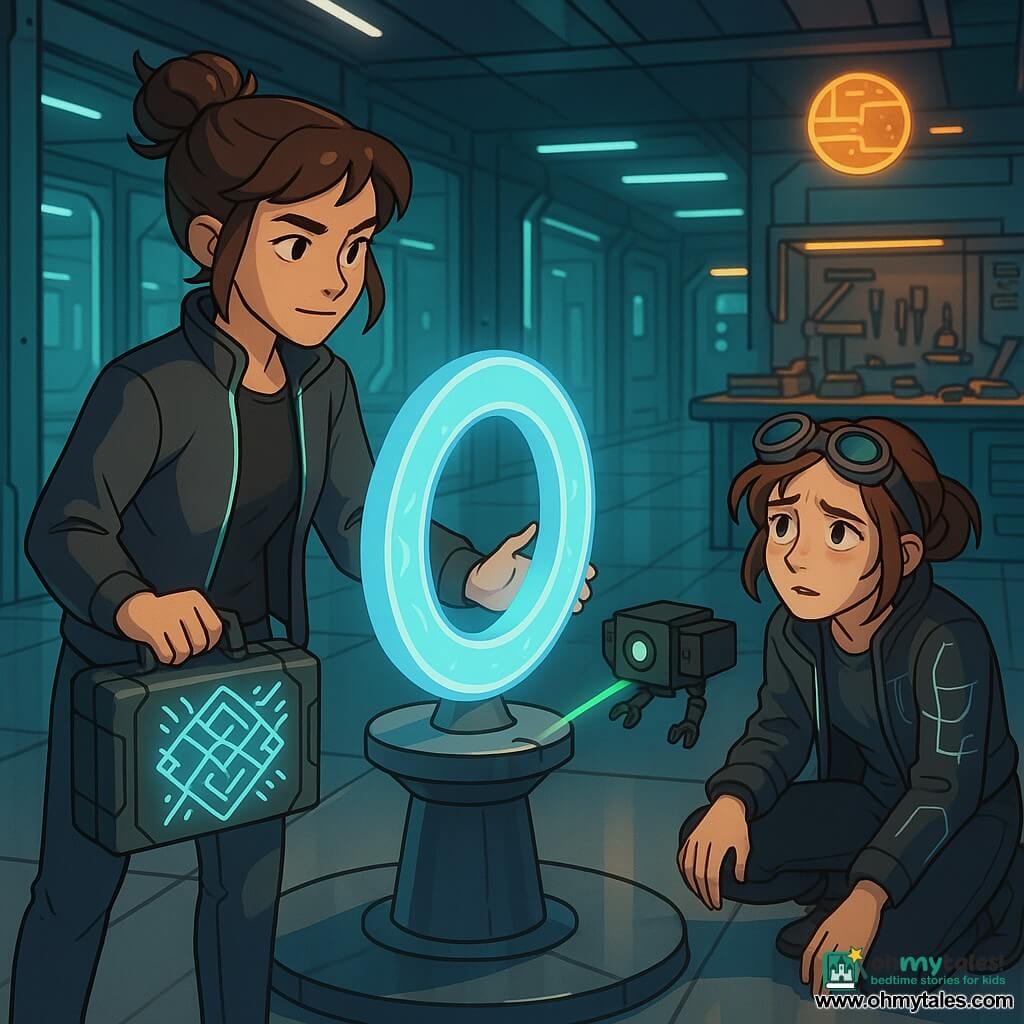
A portable casing shaped like a suitcase, its surface patterned with thin, glowing lines. The Aurora Core's transport unit.
Someone had rolled it out here.
Nova's eyes tracked quickly. Tools lay scattered, not like careful work, but like someone had swept a storm across the benches. A cracked screen on the far wall flickered with scrolling code.
“Sunny,” Nova whispered, “tell me the Aurora Core is still in the main chamber.”
There was a pause—too long.
Sunny's voice dropped slightly, like it had learned worry. “The Aurora Core is no longer registering in the main chamber.”
Nova's jaw clenched. “Okay. That's… not ideal.”
A figure rose from behind a tall rack of parts. A woman, maybe mid-twenties, in a hooded jacket stitched with reflective circuit patterns. She had goggles pushed up on her forehead and a grin that looked practiced in the mirror.
Nova recognized her. Everyone in Lumenport's tech circles had heard the name: Prism Wren. A notorious “freelance inventor,” which was a polite way of saying she made clever things and then sold them to the highest bidder.
Prism lifted both hands. “Starwarden. Relax. I'm not here to hurt anyone.”
Nova kept her stance loose but ready. “Funny, because stealing the city's power future is a classic ‘hurt everyone' move.”
Prism's grin twitched. “Borrowing. I'm borrowing it.”
Nova tilted her head. “Oh, well, if it's borrowing, I'll just write it on the calendar.”
Behind Prism, the drone Nova had chased hovered, projecting a faint green grid over the suitcase casing. It was scanning locks.
Prism glanced at the drone. “Come on, little Sparkbug. Work faster. Heroes are so impatient.”
Nova took one careful step forward. “You don't have to do this. If you need resources, apply for a grant like every other genius.”
Prism snorted. “Grants are for people who enjoy waiting until their hair turns gray. I'm building something that could change everything. I need the Core's lattice pattern.”
Nova's eyes narrowed. “Change everything for who?”
Prism hesitated, just a flicker. Then her voice sharpened. “For the people who never get invited to your shiny lab tours.”
Nova's chest tightened. She'd grown up in the low-rise blocks near the docks, where streetlights sometimes blinked out for hours. She understood that anger. But she also understood what happened when anger drove the vehicle and nobody touched the brakes.
“I get it,” Nova said, and meant it. “But taking it like this? You're putting everyone at risk. Respect isn't just saying ‘please.' It's treating the whole city like it matters.”
Prism's eyes flashed behind her goggles. “Don't lecture me.”
“I'm not,” Nova said, softer. “I'm asking you to stop.”
For a second, the workshop held its breath.
Then Prism snapped her fingers.
The robotic hand on the table shot upward and launched itself like a spider, clamping onto Nova's forearm with surprising strength.
Nova blinked. “Seriously? Attacked by a polite wave?”
The hand squeezed. Not crushing, but holding tight.
Prism darted toward the suitcase unit. “Sparkbug—open it!”
Nova drew a slow breath. No panic. No rage. Just focus.
She let her energy slip into the robotic hand—gentle, precise—like slipping a new song into a music player. The hand froze, then released her, fingers twitching uncertainly.
Nova gave it a little pat. “Thanks. Boundaries are important.”
She lunged, grabbing the edge of the suitcase casing.
Prism yanked back. “Let go!”
“After you,” Nova said through gritted teeth.
A beam of green light flashed from Sparkbug, cutting into the casing's lock.
Nova's wristband hummed sharply, warning her. The Core's lattice was sensitive. If it got jolted while unlocking—
“Sunny!” Nova barked. “I need the workshop's power grid rerouted, now!”
Sunny replied instantly. “Rerouting. Warning: doing so will dim lighting and disable nonessential systems.”
“Do it.”
The workshop lights faded to a moody twilight. Machines went quiet. The drone's green beam flickered as power dipped.
Prism cursed. “Hey! That's cheating!”
Nova tugged hard, twisting the suitcase away from Prism. “No, this is called ‘supervising a laboratory.' It's in my job description.”
Prism reached into her jacket and flicked something small onto the floor.
A coin-sized disc skittered under Nova's boot and popped—unleashing a burst of shimmering light. Not blinding, but confusing, like looking into a kaleidoscope made of street signs.
Nova's vision swam with color.
Prism's voice echoed around her. “Catch me if you can, Starwarden!”
Nova blinked through the glittering haze. Her energy-sense flared, searching not for shapes, but for charge—heat from a body, electricity from moving gadgets.
She found Prism's trail: a quick, warm streak heading toward the workshop's back exit—toward the main chamber.
Nova tightened her grip on the suitcase casing.
“Nope,” she muttered. “You're not taking the future out for a joyride.”
She ran.
Chapter 4: The Core and the Choice
Nova burst into the main chamber. The Aurora Core's ring of blue light was dimmer than before, as if it sensed trouble and didn't want to be involved.
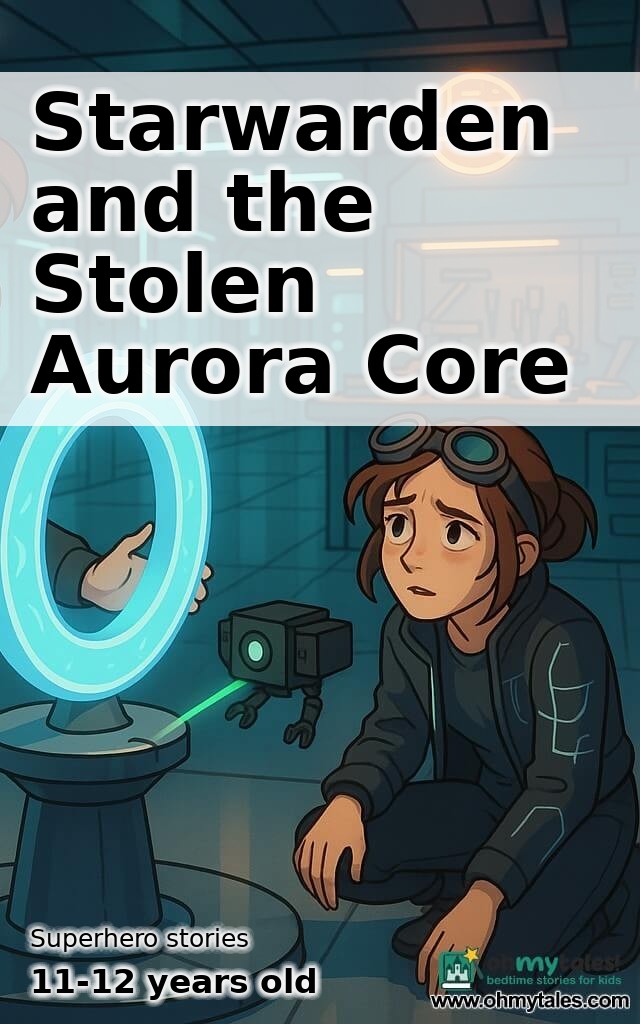
Prism was already there, crouched by the central pedestal where the Core's interface ports waited like open mouths. Sparkbug hovered beside her, projecting connection paths.
Nova skidded to a stop, holding the suitcase unit like a stubborn suitcase at an airport.
Prism looked up, breath quick, eyes sharp. “You're fast.”
Nova shrugged. “I had to be. The snack bar closes at nine.”
Prism's laugh was brief and surprised, like she hadn't planned on humor existing tonight. Then her face hardened again. “Give it to me.”
Nova took a step forward—but not too close. “Tell me what you're building.”
Prism's jaw worked. She glanced at the Core, then at Nova, like weighing two different storms.
“My neighborhood,” Prism said, voice quieter, “gets power cuts all the time. Hospitals get priority, sure, but kids doing homework by candlelight isn't exactly a city's proudest moment. I designed a mini-grid—small, local, strong. It could keep whole blocks powered without depending on the main lines.”
Nova's stomach twisted. She remembered those candlelit nights. The way homework shadows danced on the wall. The way adults tried to smile while worrying.
“That's… a good goal,” Nova admitted.
Prism lifted her chin. “Then move.”
Nova raised her free hand. “But you can't rip patterns out of the Core like it's a sticker book. If you destabilize it, Lumenport could lose power everywhere. Traffic, water systems, emergency signals—everything.”
Prism's gaze flickered. “I know what I'm doing.”
Nova's voice stayed calm, but firm. “Respect isn't just for people. It's for systems, too. You don't yank on something holding up a whole city.”
Sparkbug chimed, impatient. Prism tapped it, and the drone's tool-arm extended toward the pedestal.
Nova's wristband vibrated, sending a sharp pulse up her arm. The Core's energy field was reacting.
“Sunny,” Nova said, “I need a containment shimmer around the pedestal. Non-harmful. Just… a ‘please don't touch' bubble.”
Sunny responded, “Initiating shimmer. Note: this is essentially a very expensive ‘Do Not Lick' sign.”
A faint, transparent dome of light formed around the pedestal, like glass made from morning air.
Sparkbug bumped into it and bounced back with an offended chirp.
Prism's eyes widened. “That field will take minutes to override!”
Nova held her ground. “Then you have minutes to rethink.”
Prism's shoulders rose and fell. She looked less like a villain now and more like a person trapped between pride and desperation.
“I don't want to hurt anyone,” Prism said, and her voice sounded honest.
“Then don't,” Nova replied.
Prism stared at the dome, then at the suitcase casing in Nova's hands.
“You can't just expect people to wait,” Prism said. “Waiting is a luxury.”
Nova nodded slowly. “You're right. So let's not waste time. Work with me. There are rules here for a reason, but rules can also make room.”
Prism let out a shaky breath. “You'd help me?”
“I'll help you do it safely,” Nova said. “With permission. With oversight. With respect for the city and the lab.”
Prism's lips pressed into a thin line. For a moment, Nova thought she'd refuse—thought she'd run or fight.
Instead, Prism lowered her hands.
Sparkbug hovered uncertainly, like a dog waiting for a command.
Prism swallowed. “If I give up, they'll call me a thief anyway.”
Nova's voice softened. “You did steal. But you can choose what happens next.”
Prism's gaze locked on Nova's face. “And what happens next?”
Before Nova could answer, the Aurora Core's ring flared—bright, erratic. The earlier power reroute had stressed the system, and now the Core was trying to correct itself.
Sunny's voice rang out, louder than usual. “Warning: Aurora Core field instability detected. Uncontrolled oscillation possible.”
Prism's eyes went wide. “That's not supposed to—”
Nova moved instantly. She set the suitcase casing down carefully and thrust both hands toward the ring. She didn't push energy into it like a battering ram. She listened with her senses—felt the jittery rhythm, the uneven pulse.
Like a heart skipping beats.
Nova breathed in, steadying herself, and shaped her own energy like a metronome. Calm. Even. Patient.
“Sunny,” she said, “guide me. Give me the frequency.”
“Transmitting,” Sunny replied. “Also, please try not to explode the lab. I'm fond of my walls.”
Nova's wristband flashed patterns into her skin—numbers, pulses, timing. She matched them, smoothing the Core's surge the way you might smooth wrinkles from a sheet.
Prism watched, stunned. “You're… syncing with it.”
Nova grunted. “Yeah. It's like… convincing a lightning bolt to do yoga.”
The ring's light steadied, becoming blue again, deep and calm.
The air stopped crackling.
Nova exhaled slowly, arms aching.
Prism stepped forward, voice small. “I didn't think it would spike like that.”
Nova looked at her. “That's why we don't ‘borrow' city-scale tech in the middle of the night.”
Prism winced. “Fair.”
Nova straightened. “Now—help me secure the field. You clearly know your way around the interface.”
Prism hesitated only a second, then nodded sharply. “Tell me what you need.”
Together, they moved: Nova stabilizing the energy flow, Prism shutting down the drone's access attempts and resetting the pedestal's locks with quick, skilled hands.
Sunny announced, “Stability restored. Theft attempt… reduced to ‘regrettable learning experience.'”
Nova shot the ceiling a look. “Sunny.”
“Sorry,” Sunny said. “I'll workshop my empathy module.”
Prism gave a breathy laugh, then turned serious. “What happens to me now?”
Nova met her eyes. “You come with me. You tell the lab director what you were trying to do—and why. I'll back you up on the ‘why,' but I won't lie about the ‘what.'”
Prism's shoulders slumped, then squared. “Okay.”
Nova nodded once. “That's courage.”
Chapter 5: A Deal in the Bright Morning
By the time the lab director arrived—Dr. Maelin Rho, tall and stern with silver hair clipped into a sharp braid—the sky outside had begun to lighten. Dawn painted Lumenport's towers with peach and gold, turning windows into small suns.
Prism stood beside Nova in the main chamber, hands visible, Sparkbug powered down at her feet like a sulky pet.
Dr. Rho's eyes moved from Prism to Nova to the Aurora Core's steady ring. “Report,” she said crisply.
Nova spoke first, clear and direct. She described the breach, the drone, the attempt to access the Core, and the instability spike.
Prism swallowed, then added her part. “I tried to steal the lattice pattern. I thought I could use it to build a mini-grid for my neighborhood. I didn't mean to destabilize anything.”
Dr. Rho's gaze was sharp enough to slice paper. “Intent does not erase risk.”
Prism flinched but didn't look away. “I know.”
Nova stepped in, not shielding Prism from consequences, but refusing to let her be flattened. “Prism understands what she did was wrong. She also has a design that could help people. If we handle this right, we can protect the lab and still build something useful.”
Dr. Rho's expression didn't soften, but something in her eyes shifted—like a door unlocking one careful click at a time.
“Respect,” Dr. Rho said at last, “is the foundation of every discovery. Respect for safety. Respect for the community. Respect for the work of others.”
Prism nodded, cheeks red. “I didn't show it.”
Dr. Rho folded her arms. “You will now. You will assist HelioLab under supervision. Your mini-grid idea will be reviewed properly. And you will speak to the council about your neighborhood's outages—openly, not through sabotage.”
Prism blinked. “You're not… calling security?”
“I am,” Dr. Rho said, and held up a finger as Prism's face fell. “To document the incident. To set boundaries. Not to throw away a mind that could do good—if it learns responsibility.”
Prism's shoulders shook with relief she tried to hide. “Thank you.”
Dr. Rho looked at Nova. “Starwarden. You stabilized the Core.”
Nova rubbed the back of her neck. “It was either that or let the lab turn into a glowing sad story.”
Dr. Rho's mouth twitched—almost a smile. “You did well. And you did it without humiliating anyone.”
Nova glanced at Prism. “I've been humiliated by enough vending machines to know it doesn't help.”
Sunny chimed in, “For the record, the vending machine won. Twice.”
Nova sighed. “Sunny, please. We have guests.”
Prism let out a real laugh this time, bright and surprised.
Later, when paperwork was started and the Core was safely locked away, Nova walked Prism back through the prototype workshop. The morning light made the gadgets look friendlier, like they'd woken up in a better mood.
Prism paused at the table with the robotic hand. She picked it up gently and set it back in its cradle.
“Sorry about that,” she murmured to the hand.
Nova arched an eyebrow. “Apologizing to a robot?”
Prism shrugged. “It didn't ask to be a grappling hook.”
Nova nodded approvingly. “Respect. See? You're learning.”
They reached the lab's front doors. Outside, Lumenport's streets were waking: delivery drones humming, commuters laughing, a kid tugging a parent toward a bakery window.
Prism looked at the city, then at Nova. “You're not… like the heroes in the vids.”
Nova leaned against the doorframe. “Too short? Too curly? Too likely to trip over my own cape that I don't even wear?”
Prism smiled. “Too… real.”
Nova's voice softened. “Real is good. Real means you remember who you're protecting.”
She stepped out into the brightening day, the sunlight catching her neon stitching like small, hopeful sparks.
Behind her, HelioLab stood safe. The Aurora Core pulsed steadily. And somewhere in the city, people who had never heard of Nova Quill kept living their lives—because someone had stayed up all night to guard them.
Nova lifted her chin, shoulders squared, stance firm—proud, not because she'd won a fight, but because she'd chosen courage with kindness.
Starwarden watched over Lumenport as the sun climbed higher, and her steady light did not brag.
It simply shone.