Chapter 1: The Man with the Aurora Cape
In the city of Lumenport, the night never stayed plain for long. Neon signs hummed like friendly bees, sky-trams stitched bright lines between towers, and the river looked as if it had swallowed a handful of stars.
Above it all drifted a man with an aurora-colored cape.
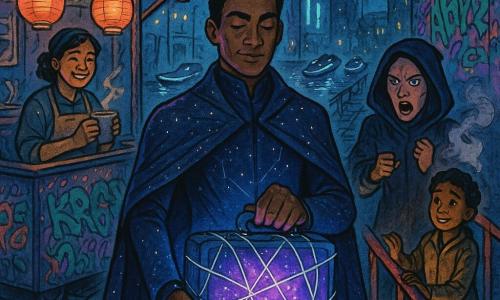
His name was Orin Vexley—though most people knew him as SpectraKnight. He wasn't the biggest hero in Lumenport, and he wasn't the loudest. He didn't shout speeches from rooftops or pose for billboards. He worked like a lighthouse: steady, stubborn, always there when the fog rolled in.
Orin was tall and lean, with copper-brown skin and a sharp jaw that looked carved by careful hands. His hair was a dark curlstorm he never quite managed to tame. Over one eye he wore a thin prism-lens visor, which glowed faintly whenever he focused. His suit was midnight blue with lines of shifting light that moved like slow lightning under glass. The cape—his favorite part—rippled with colors that changed with his mood: teal when calm, gold when hopeful, violet when afraid.
And tonight?
It flickered violet.
Orin hovered above Lantern Avenue, listening. The city had a sound when it was safe: laughter leaking from cafés, wheels swishing, music from open windows. But now there was another sound, low and wrong, like a giant humming a sad note through the pavement.
His wristband chimed—three quick pulses.
“SpectraKnight,” crackled the voice of Tamsin Cho from City Response. Tamsin ran the emergency network from a room full of screens and caffeine. “We've got a situation. Power dips across the South Grid. Streetlights blinking. Trams stalling. People reporting… fog? Inside buildings.”
“Fog doesn't pay rent,” Orin muttered, and pushed forward on a stream of light. His boots didn't exactly fly; they rode his own hard-light projections, like invisible stepping-stones that appeared just before his feet.
As he moved, he saw it: pale mist crawling along the street, curling around ankles, climbing walls. It wasn't the friendly kind that made the morning look magical. This fog looked hungry.
A kid in a yellow hoodie stood frozen beside a stalled tram, clutching a skateboard like a shield.
Orin dropped down, landing softly. “Hey. You're okay. Eyes on me.”
The kid swallowed. “It—it's in my throat. Like I'm swallowing winter.”
Orin's cape flashed violet again. Fear slid into him the way cold water sneaks under a door.
He remembered another night, years ago, when he wasn't SpectraKnight—just Orin, a lab engineer with too much ambition and not enough sleep. A reactor test. A blinding flare. His own light turned against him for one terrifying second.
The memory bit hard.
Orin inhaled slowly, then exhaled with purpose. “Okay,” he told himself, “fear is just energy that hasn't learned its job yet.”
He raised his palm. A warm, honey-gold glow formed—a hard-light lantern, shaped like a simple globe.
“Hold this,” he said, placing it carefully in the kid's hands. It was light you could feel, like a gentle weight, like a promise.
The kid stared. “It's… warm.”
“Warm means you're still here,” Orin said. “Now head to higher ground. The community center has filtered air. Go.”
The kid ran, lantern bobbing like a small second sun.
Orin turned back to the fog. It pulsed, almost as if it noticed him noticing it.
“Alright,” he whispered. “Let's meet whoever's hiding behind the weather.”
Chapter 2: The Fog That Fed on Fear
Orin sprinted into the mist, his visor switching through spectra—infrared, ultraviolet, everything his tech could interpret. The fog didn't show up like normal vapor. It shimmered with tiny dark flecks, like pepper sprinkled into milk.
Nanotech, he realized. A swarm.
“Orin,” Tamsin said through his comm, “you're seeing this too? Sensors show micro-drones. Thousands. Maybe millions.”
“Yeah,” Orin said, and coughed as the fog tried to press into his mask seals. “They're not just blocking light. They're… reading something.”
“How do you read fog?” Tamsin asked.
Orin watched the mist coil toward a crowd waiting outside a closed metro station. People were arguing, shivering, clutching bags. The fog thickened around them as if it loved the noise.
“It's responding to emotion,” Orin said. “It's feeding on fear.”
A woman with a stroller tried to push through. The fog swarmed closer, and her eyes widened.
“Nope,” Orin said, stepping forward. He flicked his wrists, and two hard-light shields bloomed into place—translucent blue panels with bright edges. He angled them, creating a corridor.
“Ma'am,” he called, voice firm but kind, “follow the blue path. Don't stop. Keep breathing slow. Like you're blowing up a balloon.”
The woman nodded quickly and hurried through. The fog bumped against the shields like frustrated moths.
Orin's heart still thumped too fast. The fog kept whispering at the edge of his mind—not with words, but with a suggestion: What if your light fails? What if you can't protect them?
His cape jittered violet.
Then he saw something on the street—a mural half-hidden by mist. A painted phoenix, bright orange and red, wings spread wide over a row of tiny houses. Someone had written beneath it in bold letters: KEEP GOING.
Orin stared for one long second.
“Okay,” he told himself again. “Keep going.”
He expanded his shields, bending the light into a dome over the metro entrance. The fog hit it and scattered, forced to swirl around rather than through. It thinned slightly.
“Tamsin,” he said, “trace the swarm's signal. There's a controller somewhere. A beacon.”
“Already on it,” she replied. “Signal echoes from… the Arts Quarter.”
Orin blinked. The Arts Quarter in Lumenport wasn't just galleries and theaters. It was a whole neighborhood where sidewalks were painted with constellations, where sculptures hung from balconies, where music spilled from doorways like confetti. It was also full of old buildings with weird basements and unused tunnels—perfect places to hide a device that turned fear into fuel.
“Of course it's the Arts Quarter,” Orin said. “Villains love dramatic lighting.”
“Please be careful,” Tamsin said, and there was an edge in her voice—she cared, but she knew Orin didn't need a lecture. “If the fog is fear-sensitive, your own emotions could feed it.”
Orin smiled, just a little. “Then I'll have to be brave on purpose.”
He launched upward, stepping on invisible light-stairs over the street, and shot toward the glowing skyline. Below him, fog crawled like a slow tide.
Ahead, the Arts Quarter waited—bright, bold, and under siege by something that hated brightness most of all.
Chapter 3: Neon Canvases and Hidden Beacons
The moment Orin crossed into the Arts Quarter, the air changed.
Instead of sleek glass towers, the buildings here wore personality. Brick walls became giant canvases—whales swimming through galaxies, dancers made of paint splashes, robots holding bouquets. Strings of lanterns zigzagged above alleys. A street musician's hologram played saxophone on repeat, even though there was nobody left to listen.
And the fog?
It tried harder here, thickening like someone was pouring it from a bucket.
Orin landed beside a sculpture garden filled with metallic flowers that opened and closed with the wind. Their petals clicked softly, like worried teeth.
A voice came from behind a painted kiosk. “If you're here to buy a postcard, we're closed. If you're here to stop the creepy mist, please continue being you.”
Orin turned.
A woman stood there in paint-splattered overalls and bright green sneakers. Her hair was shaved on one side and piled into a messy bun on the other. A pair of goggles sat on her forehead like she expected art to explode.
She held a portable projector like a weapon.
“I'm Junie Rell,” she said. “Local artist. Part-time volunteer. Full-time person who refuses to let my neighborhood get eaten by weather.”
Orin's cape flashed teal for a second—relief. “SpectraKnight. Thanks for staying.”
Junie peeked past him. “Most people ran when the fog started whispering. It… it makes you remember stuff. Bad stuff.”
Orin didn't answer immediately. His visor dimmed, as if thinking. “Yeah,” he said finally. “I've noticed.”
Junie lifted the projector. “I can help. I've got light rigs. Not fancy like yours, but bright. Fog hates bright.”
“Fog hates courage more,” Orin said, then realized how corny that sounded. “Sorry. That came out like a motivational poster.”
Junie snorted. “In the Arts Quarter, that's basically a greeting.”
A tremor ran through the street. Somewhere nearby, a building's windows flickered from warm gold to sickly gray.
Orin's visor caught it—an energy pulse beneath the cobblestones, repeating like a heartbeat.
“There,” he said, pointing toward an old theater with a marquee that still read: TONIGHT: STARS IN A JAR.
Junie's eyebrows shot up. “That theater's been closed for years. They said the basement flooded.”
“Maybe it did,” Orin said. “Maybe someone likes damp places for their gadgets.”
They moved quickly, Junie jogging beside him. The fog thickened as they approached the theater, swirling in tighter spirals.
At the entrance, the doors were chained shut. Orin placed two fingers on the lock, and a thin thread of light slid into the metal, warming it. The chain softened—not melting into a mess, but loosening neatly, like a knot that decided to cooperate.
Junie whistled. “Your powers are like… polite lasers.”
“I try,” Orin said.
Inside, the theater smelled of dust and old popcorn. Seats sat in rows like sleepy teeth. The stage curtain was half-torn, revealing a painted backdrop of a starry sky.
But the stars on the backdrop were wrong.
They weren't paint.
They were tiny, hovering points of light—real, flickering, like trapped fireflies.
Junie hugged her projector. “Okay. That's unsettlingly pretty.”
Orin stepped closer. The points of light moved as he moved, watching him.
His cape trembled violet again.
“Orin,” Tamsin's voice whispered in his ear, “signal is strongest under you. Whatever's controlling the swarm is beneath the stage.”
Orin swallowed. Basements, tunnels, enclosed spaces—his least favorite combination. Fear pressed in, and the fog seeped under the theater doors like it had been invited.
Junie noticed his pause. “Hey,” she said quietly. “You don't have to pretend you're not scared. Just don't let it drive.”
Orin looked at the stage, then at the glowing “stars.”
“I am scared,” he admitted. “But I'm also responsible.”
Junie nodded once. “Then let's be responsible loudly.”
She clicked her projector on. A beam burst out, painting the theater walls with a sunrise—orange, pink, gold. The fog recoiled slightly, as if offended by cheerfulness.
Orin's cape shifted toward gold.
“Good,” he breathed. “We go down.”
Together, they stepped onto the stage—into the heart of the storm's secret.
Chapter 4: The Echo Machine
A trapdoor waited near center stage, half-hidden by the torn curtain. Orin pulled it open, and a breath of cold air rose up, smelling of wet stone and old wires.
Stairs led down into darkness.
Junie shined her projector beam like a flashlight, though it still looked like a sunrise. “If we meet a villain, can you let me do the dramatic line? I've been practicing.”
Orin started down. “Only if it's not too dramatic.”
Junie followed. “No promises.”
The basement wasn't flooded. It was… converted.
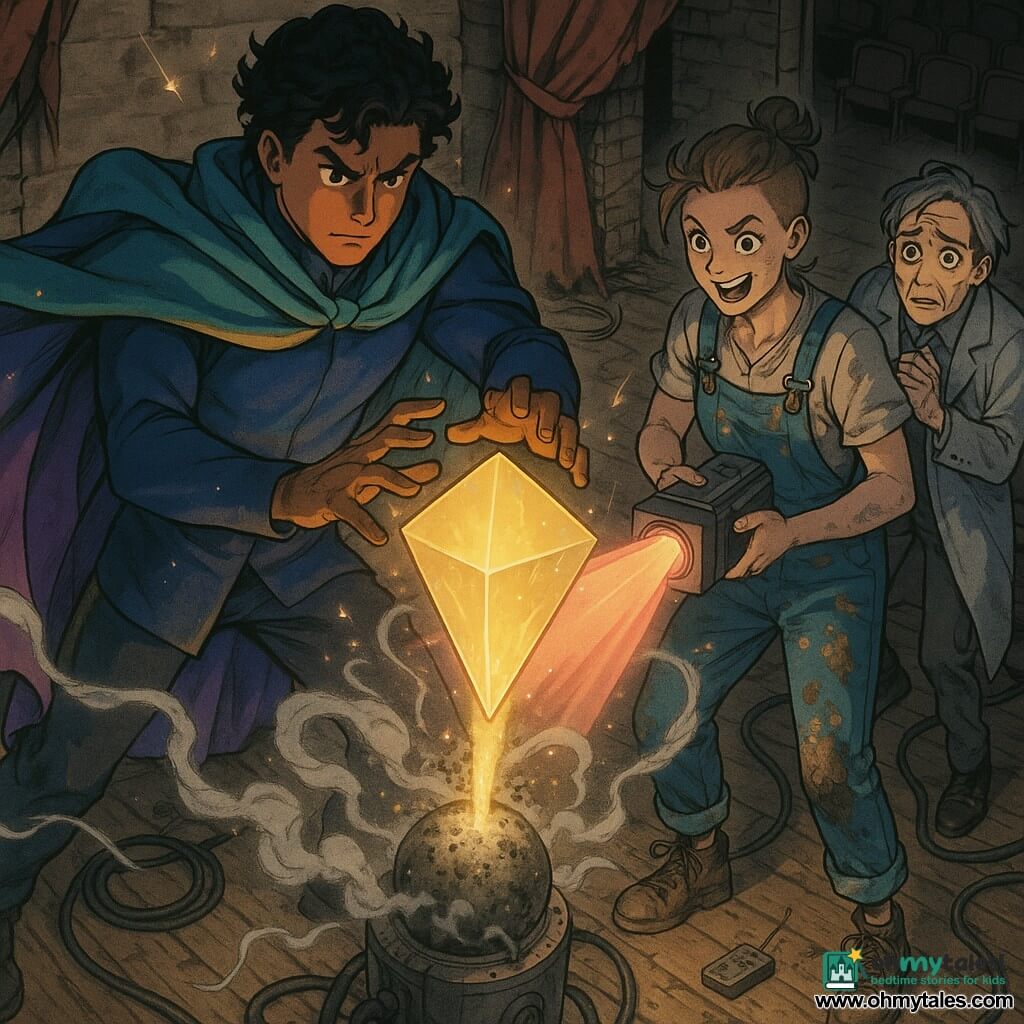
Cables ran along the walls like black vines. Metal panels formed a makeshift lab. In the center stood a machine shaped like a giant tuning fork wrapped around a sphere—its surface rippling with fog trapped behind a shimmering barrier.
The sphere pulsed each time the city above seemed to gasp.
Orin's visor zoomed in. He saw the micro-drones docking and launching from ports on the machine, like tiny bees returning to a hive.
A voice drifted from the shadows. Smooth. Confident. Almost friendly.
“SpectraKnight. Lumenport's favorite nightlight.”
A man stepped into view wearing a long coat stitched with reflective thread. His hair was silver-white, slicked back, and his eyes were the color of storm clouds. He carried a small remote the size of a candy bar.
“I'm Dr. Morrow Vane,” he said, bowing slightly as if they were at a party. “Inventor. Former consultant. Current… misunderstood visionary.”
Junie muttered, “He looks like he irons his socks.”
Orin kept his gaze steady. “You're pumping fear into the streets.”
“Fear is already there,” Vane said pleasantly. “I'm simply collecting it. Recycling it. Turning it into usable energy. People waste so much emotion, you know.”
Orin's stomach tightened. “You're hurting them.”
“I'm improving them,” Vane corrected, clicking the remote. The machine's sphere brightened, and the fog inside swirled faster. “When people face fear, they evolve.”
Junie raised her projector. “There are easier ways to evolve. Like reading books. Or trying broccoli.”
Vane glanced at her as if noticing a fly. “Ah. The artist. Always with your unnecessary color.”
Junie's jaw clenched. Orin felt his own fear flare—fear of failing, fear of losing control, fear of what this machine might do if it surged.
The fog in the sphere swelled, sensing him.
Orin closed his eyes for half a heartbeat and remembered the phoenix mural: KEEP GOING.
He opened his eyes and spoke, clear and calm. “Fear isn't your fuel.”
Vane smiled. “Oh, but it is. Watch.”
He pressed the remote.
Above them, the theater lights flickered, and Orin heard distant screams—not loud, but enough to twist his chest. The machine drank it in. The sphere glowed a deeper gray, like a storm cloud learning to shine.
Orin's cape snapped violet.
Junie nudged him, quick and sharp. “Hey. Aurora Cape. Look at me.”
Orin blinked.
Junie grinned—wide, stubborn, brave. “If you're scared, fine. Be scared. But do it while punching his plans in the face.”
Orin let out a short laugh, surprised it existed. The laugh warmed his ribs.
His cape flickered from violet toward teal.
“Okay,” he said. “Plan: you paint. I shield.”
Junie lifted her projector and aimed at the machine. “Time for unnecessary color!”
A sunrise exploded across the sphere, bright and warm. The fog inside churned angrily, as if someone had thrown glitter into its soup.
Orin threw out a hard-light net—thin, flexible strands that snapped onto the machine's drone ports, clogging them. Micro-drones bumped into the net and bounced off like confused gnats.
Vane's smile slipped. “You can't simply—”
Orin stepped forward, shaping a spear of light in his hand—not sharp like a weapon, but like a glowing baton. He struck the remote from Vane's grip with a clean, controlled hit. It skittered across the floor.
Vane hissed, reaching for it.
Junie slid in front, projector blazing. “Nope. Finders keepers.”
Vane recoiled from the bright beam, shielding his eyes. “You think light solves everything? Light is fragile.”
Orin stood taller. “So is fear. That's why it tries to hide.”
He planted both palms toward the sphere and focused—not on the fog, not on the whispers, but on the faces he'd seen tonight: the kid with the skateboard, the woman with the stroller, the people holding each other in the street. He pictured their relief as the lantern warmed their hands.
His cape turned gold.
A dome of hard-light formed around the machine, sealing it. Inside, the fog battered the walls, but it couldn't slip out.
Tamsin's voice crackled. “Orin, readings show the swarm losing coordination!”
“Good,” Orin said through clenched teeth. “Then we finish it.”
But Vane wasn't done. He darted to a side panel and yanked a lever.
The machine screamed—metal on metal, a high whine like a violin string about to snap.
Junie's eyes widened. “That sounds like the opposite of safe!”
Orin's visor flashed a warning: OVERLOAD IMMINENT.
If the sphere burst, the fear-fog would flood the city all at once.
Orin swallowed hard.
This was the moment fear wanted to drive.
Instead, Orin grabbed it by the collar.
“Junie,” he said, voice steady, “keep the light on it. As bright as you can. I'm going to redirect the discharge.”
“To where?” she shouted over the rising whine.
Orin glanced at the ceiling, imagining the city above, the people, the murals, the music.
“Up,” he said. “Into the sky.”
He braced his feet and began shaping something bigger than he'd ever shaped before—an enormous prism of hard-light, angled like a giant crystal funnel.
His arms shook. Sweat slid down his neck. The fog inside the sphere thrashed, feeding on every doubt.
Orin felt the doubts. He didn't deny them.
He worked anyway.
Because perseverance wasn't a mood. It was a choice you repeated until it became a path.
Chapter 5: The Sky Lantern Over Lumenport
Junie turned her projector to maximum. The sunrise on the sphere became nearly blinding, the colors so warm they felt like a hug.
Vane stumbled back, furious. “Stop! You don't understand what you're wasting!”
Orin didn't look at him. Orin looked at the prism he was building—light folding into light, edges humming, angles precise. It hovered above the machine like a crystal mouth aimed at the ceiling.
The machine's sphere swelled, its surface rippling like liquid metal.
Tamsin's voice came fast. “Orin, you've got seconds!”
Orin's lungs burned. His visor flickered. For a terrifying instant, the old memory of the reactor flare surged—light exploding out of control, his own creation turning wild.
His cape flashed violet again.
Fear whispered: You can't hold it. You'll fail. They'll get hurt.
Orin's hands trembled.
Then, faintly through the floorboards above, he heard something else.
Not screams.
Music.
Someone, somewhere in the Arts Quarter, had started playing a drum beat. Maybe a street performer too stubborn to stop. Maybe a recording that kept going. The rhythm was steady, fearless, like footsteps on a bridge.
Boom—boom-boom—boom.
Orin matched his breathing to it.
Boom: inhale.
Boom-boom: hold.
Boom: exhale.
His cape warmed to gold.
“Not today,” he whispered.
The sphere ruptured.
Fog-energy erupted upward—gray and frantic, like a storm trying to become a creature.
Orin's prism caught it.
The discharge slammed into the hard-light funnel, and Orin redirected it through the ceiling in a focused beam. The theater roof shook, but didn't collapse; the energy punched through in a column of pale light that shot into the open night sky, high above Lumenport.
Outside, citizens would later describe it as a “reverse lightning bolt”—a beam that carried darkness away instead of bringing it down.
Inside the basement, the fog drained from the machine with a final angry swirl, then vanished into the beam's path like smoke sucked into a vacuum.
The whine died.
Silence rushed in, thick and startled.
Orin dropped to one knee, panting. The prism dissolved into harmless sparks that drifted down like glittery snow. His cape faded to teal, tired but calm.
Junie lowered her projector, blinking. “Okay,” she said, “that was… ridiculously cool.”
Vane, face pale with shock, stared at the now-dark machine. “You… you threw away my masterpiece.”
Orin stood slowly. “It was never a masterpiece. It was a trap.”
Vane's shoulders sagged, but his eyes still held that storm-cloud stubbornness. “You can't erase fear. It always comes back.”
Orin nodded. “True. But we can choose what we do with it.”
He stepped closer—not threatening, just present. “You're smart, Dr. Vane. Use that brain to build something that helps. Not something that feeds on people when they're weakest.”
Vane looked away, jaw tight. “Spare me your glowing advice.”
Junie crossed her arms. “Says the guy who literally built a glow-ball of feelings.”
Orin almost laughed again, but instead he tapped his comm. “Tamsin. The controller's down. Fog's dispersing.”
On cue, the air in the basement felt lighter, as if the walls had been holding their breath and finally let it go.
Tamsin exhaled audibly over the line. “Copy that. Response teams are moving in. Orin… nice work.”
Orin glanced at Junie. “Couldn't have done it alone.”
Junie lifted her projector like a trophy. “Art saves the day. Again.”
Footsteps thundered above as city responders arrived. Vane didn't run. He stood there, trapped between pride and reality, watching as the machine—his Echo Machine, a fear-harvester—sat silent.
Orin didn't gloat. He was too tired for that, and besides, Lumenport still needed him to be steady.
As they led Vane away, Orin looked up through the hole in the ceiling. The beam had faded, leaving only stars—real ones—scattered across the night like small, patient promises.
“Junie,” Orin said, “your neighborhood's going to be okay.”
Junie's grin softened. “Yeah,” she said. “And you?”
Orin touched the prism-lens over his eye. “I'm learning.”
“Learning what?” she asked.
Orin watched a responder hand a blanket to a shivering man, watched a pair of teens help an elderly neighbor down the steps.
“That fear doesn't mean stop,” he said. “It means pay attention. Then keep going anyway.”
Chapter 6: A Truce Painted in Sunrise
By morning, Lumenport looked like it had survived a strange dream.
Streetlights steadied. Trams ran again. The river went back to holding regular reflections instead of anxious ones. In the Arts Quarter, people returned cautiously, blinking at the clean air like it was new.
Orin stood on a rooftop near the theater, watching crews patch the ceiling. His cape fluttered in a mild breeze, mostly teal with thin streaks of gold.
Junie climbed up beside him with two cups of something steaming. “I bribed a café owner to open early,” she said. “In exchange, I promised to repaint the menu board.”
Orin took a cup. “What is it?”
“Hot chocolate,” Junie said. “Because you looked like you fought a blender full of ghosts.”
Orin sipped. It was sweet and steady, like a reward for not giving up.
Down in the street, a group of kids gathered around the phoenix mural. Someone had added a new line beneath KEEP GOING in fresh paint:
TOGETHER.
Orin felt something loosen inside him—something tight he hadn't noticed he'd been carrying.
Tamsin's voice came through his comm, calmer now. “City Council wants to thank you officially. You know, medals, speeches, the whole thing.”
Orin grimaced. “Do they have to?”
Junie leaned in, whispering, “Say yes. Then I can heckle politely.”
Orin smiled. “Tell them… I'll show up. Briefly.”
“Also,” Tamsin added, “Dr. Vane requested to speak with you.”
Orin stiffened. “Now?”
“He's at the Resolution Center,” Tamsin said. “Not prison—yet. He surrendered his tech designs and claims he wants a ‘long-term arrangement' with the city.”
Junie raised an eyebrow. “That sounds suspiciously like the start of a speech.”
Orin finished his hot chocolate. “Let's hear him out.”
The Resolution Center was a bright building with glass walls and indoor trees. It was designed to make hard conversations feel less like battles. Vane sat at a table with no cuffs, just a tired posture and a cup of water he hadn't touched.
When Orin entered, Vane's eyes lifted. They looked less like storm clouds today and more like leftover rain.
“I expected a crowd,” Vane said.
“I don't like crowds,” Orin replied, taking a seat. Junie stayed standing behind him, projector strapped to her shoulder like a loyal pet.
Vane folded his hands. “My machine is destroyed. My research is in city hands. My reputation is… paste.”
Junie said, “You're welcome.”
Orin shot her a quick look, not angry—just asking for calm.
Junie zipped her lips and made a tiny key-turning motion.
Vane continued, voice quieter. “I was wrong to force fear onto people. I told myself it was for progress. But it was… for control.”
Orin waited. Perseverance wasn't only about pushing forward; sometimes it was about staying present when it was easier to walk away.
Vane swallowed. “I can help repair what I damaged. The micro-drones can be repurposed—air filters, search-and-rescue scouts, infrastructure repair. If the city allows it. Under supervision.”
Orin studied him. “Why offer that?”
Vane hesitated, then said, almost grudgingly, “Because when you redirected the overload… you could have let it destroy the theater. You could have saved yourself by running. You didn't.”
Orin's cape shifted, a soft gold edge. “Running would have been easier.”
“And yet,” Vane said, “you persisted.”
Junie couldn't help it. “He's annoyingly good at that.”
Orin nodded once. “A truce isn't a trophy,” he said. “It's work. Every day.”
Vane looked at the table. “I can work.”
Orin extended his hand, not as a dramatic gesture, but as a simple start. “Then we'll build something better. No fear-harvesting. No secret swarms.”
Vane stared at the offered hand like it was a foreign language. Then, slowly, he shook it.
Outside, in the Arts Quarter, Junie later painted a new mural on the theater wall. It showed a city under a sky-lantern—an enormous prism of light—while people below held hands, shared blankets, and looked up with brave faces. In the corner, she painted a small figure with an aurora cape, and beside him, an artist with a sunrise projector.
Underneath she wrote:
COURAGE IS FEAR WITH A JOB.
That evening, Orin walked Lantern Avenue again. The street was alive with music and chatter. A kid in a yellow hoodie rolled by on a skateboard and called, “Nice cape, SpectraKnight!”
Orin waved. “Nice wheels!”
His cape rippled gold, then teal, steady as a lighthouse.
In Lumenport, fear would visit again—because it always did. But it wouldn't rule.
Not while SpectraKnight kept showing up.
Not while the city kept going.
Together.