Chapter 1: The Man with the Prism Cape
Neon Harbor never really slept. It blinked.
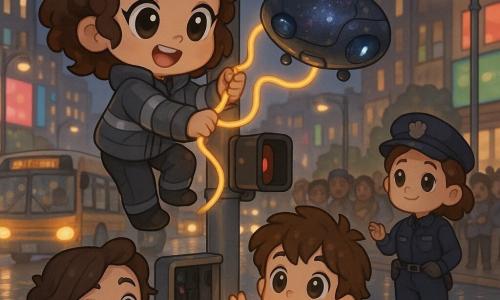
Streetlights pulsed like slow heartbeats. Delivery drones hummed between rooftops. And the sky—always a little too bright—held a faint shimmer from the city's protective dome.
On a windy ledge above Seventh Avenue, an adult man stood with his boots planted like commas in a sentence that refused to end.
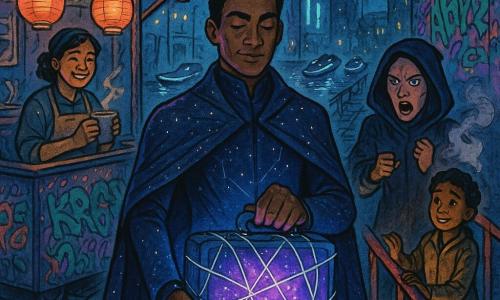
His name was Calder Voss. Most people knew him as Prismade.
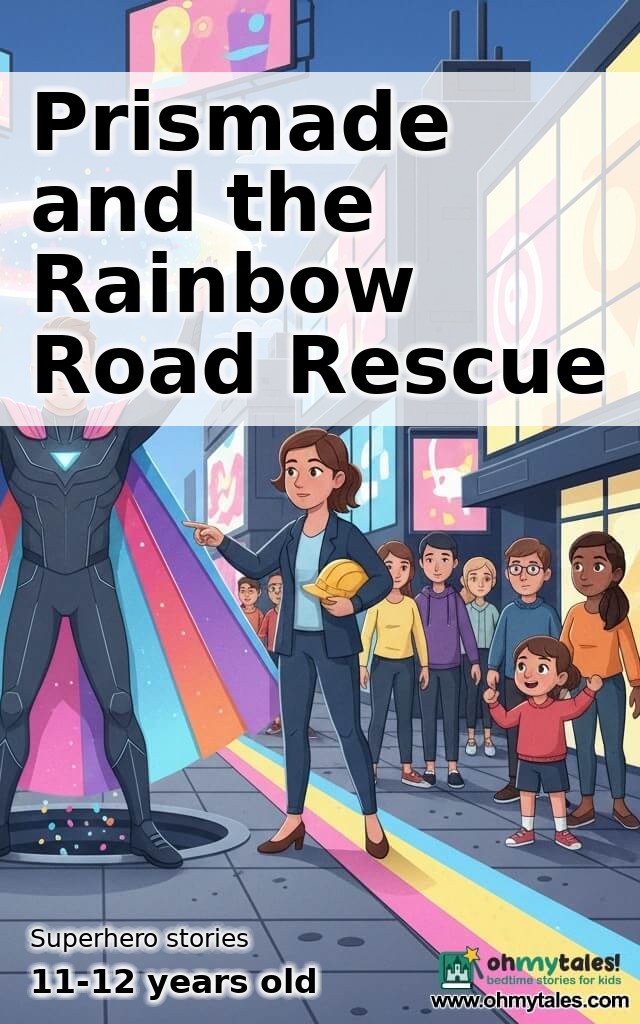
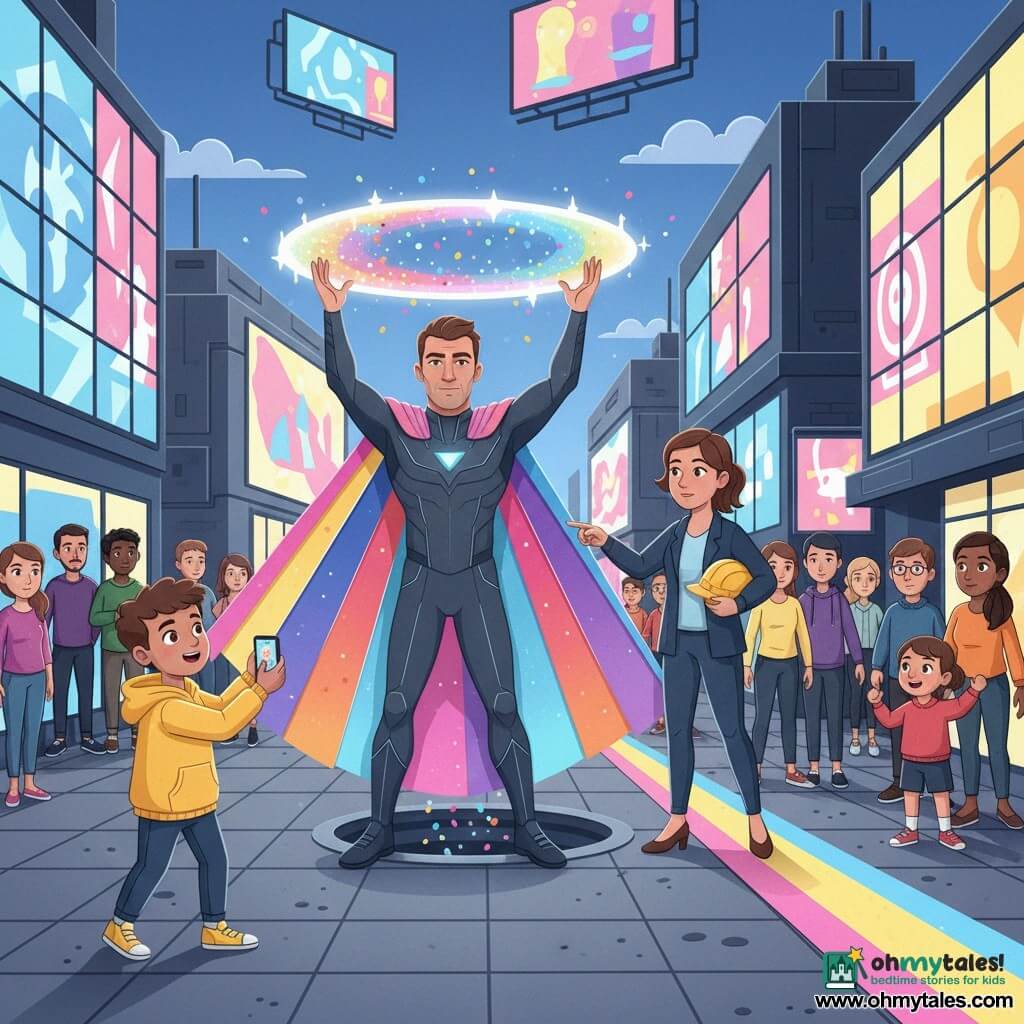
He wasn't the biggest hero in Neon Harbor, but he was the brightest—literally. His cape was woven with prismatic threads that bent light into sharp colors. His suit was charcoal-gray with thin lines that glowed when he charged his power. Across his chest, a small, silver emblem shaped like a split diamond caught every passing beam and threw it back as a rainbow spark.
Calder rolled his shoulders and listened.
A city had a sound when it was safe: laughter, late buses, someone practicing trumpet far away and missing the same note three times. Tonight, the music was wrong. Too many sirens. Too many footsteps running in the same direction.
His wrist-comm chimed. A calm voice—Mayor Liora Quell—cut through the static.
“Prismade, we've got a breach warning near Dock District. And—” her voice dipped, like she hated the next part “—the crowd sensors show panic ripples headed toward Skyscreen Square.”
Calder sighed. “Skyscreen Square. Of course. Because if anything wants attention, it goes where the biggest screens are.”
“You're close,” the mayor said. “Please—keep people moving. Safely.”
“Safely is my favorite way,” Calder replied. He smiled, then leapt.
For a moment he fell through a canyon of glass and light. Then he snapped his arms outward, and his cape stiffened like a wing. It caught the air with a crackle of color, and he sailed between towers, leaving a brief ribbon of rainbow behind him.
Below, traffic had knotted up. People looked up, pointed, and some even cheered—until a deep, metallic groan rolled across the city like thunder dragging a chain.
Calder angled toward the sound.
“Okay,” he muttered. “No big deal. Just the city trying to fold itself in half.”
Chapter 2: The Glitch in the Sky
Dock District smelled like salt, oil, and hot metal. Huge cranes stood frozen, their arms raised like they were surrendering to the night.
And in the middle of the shipping yard, the air was… wrong.
A rip in the dome's inner layer flickered above the ground, as if reality had a torn corner. Blue-white pixels sparked along its edge, popping like tiny fireworks. Every few seconds, the tear widened with a hiccuping sound, and objects near it—loose bolts, a soda can, a drifting plastic bag—tugged toward it like they were curious.
Calder landed on a container and crouched. His suit-lines brightened.
At ground level, a group of workers backed away. A kid in a yellow hoodie—maybe twelve—stood too close, phone held high, filming.
Calder called out, “Hey! Hoodie Kid! Awesome camera angle—now try it from way farther back.”
The kid blinked. “But—this is going viral.”
Calder pointed to the rip. A gust yanked at the kid's hood.
“Yeah,” Calder said, voice steady. “So will you, if you don't move.”
That did it. The kid stumbled backward, eyes wide, and joined the workers.
Calder hopped down and approached the tear carefully. The air tingled against his skin, like he was walking into static.
He extended his right hand. Light gathered at his palm, compressed into a bright, spinning hexagon.
Prismade's power wasn't just “shooting lasers,” like some people assumed. He could shape light into solid forms for a short time—bridges, shields, rails—anything he could picture clearly. The catch was that his constructs depended on focus. If he panicked, the light would shatter like glass.
He breathed in. Breathed out.
The rip pulsed.
Something moved inside it. Not a creature—more like a shadow made of skipped frames. It jerked in and out of view, stuttering as if the universe couldn't decide where it belonged.
Calder's wrist-comm buzzed. “Prismade,” the mayor said, “what are you seeing?”
“A problem with poor manners,” Calder said. “It's pulling at everything. Like a vacuum with stage fright.”
A sharp clang sounded behind him. A cargo trolley rolled, wheels squealing, pulled toward the rip. Two workers grabbed it, but their boots slid on the concrete.
Calder snapped his hand forward.
A band of light shot out, forming a glowing rail along the ground—an anchor line. It wrapped around the trolley's base like a luminous belt and locked into the pavement with a bright, triangular spike.
The trolley stopped.
The workers fell backward, panting.
“Okay!” Calder shouted, forcing cheer into his voice. “Everyone is officially not getting swallowed by the weird sky-mouth today. You're welcome.”
The workers laughed—nervous, but real. Panic loosened a little.
And then the rip flared.
A cluster of pixel-sparks burst outward and zipped across the yard, like angry fireflies. They darted toward the street.
“Mayor,” Calder said, watching them go, “they're heading for Skyscreen Square.”
“Of course they are,” the mayor replied, sounding like she'd aged ten years in one sentence. “Prismade—people are already gathering there.”
Calder looked at the tear again. He couldn't close it and chase the sparks at the same time.
His jaw tightened. Responsibility felt like a weight sometimes—like carrying the whole city in your backpack.
He made his choice.
“Dock workers!” Calder called. “I need your help. We're going to keep this thing from widening until I get back.”
A tall woman in a hard hat raised her hand. “How?”
Calder's eyes flashed with ideas. “Teamwork. And very shiny geometry.”
Chapter 3: Building the Safe Passage
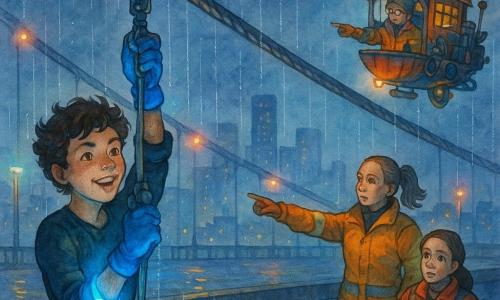
Calder raced along the dock, laying down lines of light like a painter with a glowing brush. He planted four prismatic pylons around the tear—each one a thick, translucent beam that hummed softly, shifting through colors.
“Okay,” he said, pointing. “You four—stand by those pylons. Don't touch the rip. Don't poke it. Don't name it.”
A worker grinned. “Too late. I already named it ‘Gary.'”
Calder deadpanned. “Gary better behave.”
He turned to the rest. “We're creating a safe passage. People will need to evacuate this area without getting pulled in. I can make a light-bridge corridor, but it needs to stay stable. If I lose focus, it flickers.”
The hard-hat woman—her badge read “Mara”—nodded. “So we help you focus?”
“Exactly,” Calder said. “I'm going to build it. You're going to keep it clear and guide folks through—calm voices, simple directions. Cooperation is basically a superpower that doesn't require spandex.”
Mara laughed once, sharp and bright. “You hear that? We're heroes. No capes required.”
Calder raised his arms. Light surged from his suit-lines, streaming outward. It formed a corridor—a long, arched tunnel of glowing panels, like a crystal hallway. The floor lit up with arrows. The walls shimmered with soft gradients that made everything inside look warm and safe.
“Safe Passage is live,” Calder said, voice low. “Mara—take the lead.”
Mara stepped to the entrance and shouted, “All right! Single file! Follow the arrows! Keep your hands to yourself, including off the glowing walls, even if they look like candy!”
A kid whispered, “They do look like candy.”
Calder pointed at him. “I heard that. They taste like disappointment.”
The kid giggled and moved along.
For a few minutes, it worked beautifully. People flowed through the corridor, away from the tug of the rip. The light held steady. Calder focused on each panel like it was a note in a song.
Then his wrist-comm chirped again, urgent.
“Skyscreen Square is spiking with disturbances,” Mayor Quell said. “The giant displays are glitching. People are crowding closer instead of leaving.”
“Because humans are moths,” Calder muttered. “And screens are the world's biggest lamp.”
A new tremor shook the dockyard. The rip widened a hair. The tug strengthened. Mara grabbed a railing to steady herself.
Calder clenched his fists. If he left, this might get worse. If he stayed, Skyscreen Square could become a chaos magnet.
He looked at the workers—tired, brave, holding their positions.
Mara met his eyes. “Go,” she said simply. “We've got the passage. We'll keep it clear.”
Calder swallowed. Trust was risky. Trust was also necessary.
He nodded. “Stay in pairs. Keep talking to each other. If the corridor flickers, don't run—slow down, breathe, and keep moving.”
Mara gave a quick salute. “Captain Candy-Walls, understood.”
Calder smiled despite himself.
He stepped back, locked the corridor's pattern into a repeating loop—simpler, sturdier—and shot a final band of light to reinforce the pylons.
Then he launched into the sky.
As he soared over the city, he glanced down and saw the corridor still glowing, people moving through it calmly, guided by workers calling steady instructions.
A safe passage, built by many hands.
“Good,” Calder whispered. “That's what a city is supposed to do.”
Ahead, Skyscreen Square blazed like a digital sunrise.
And it was about to explode into trouble.
Chapter 4: Skyscreen Square, Where Trouble Loves Attention
Skyscreen Square was the loudest place in Neon Harbor, even when nothing was happening. Giant screens wrapped around buildings like bright scarves, playing ads, news, music videos, and live sports. The pavement itself held thin light-strips that shifted with the crowd, like the ground was reading everyone's mood.
Tonight the screens weren't playing anything normal.
They were stuttering.
A hundred faces flickered across them—smiling, then frowning, then replaced by static that formed shapes: spirals, jagged lines, and a symbol like an eye made of broken pixels.
People stood in a wide circle, craning their necks. Some laughed nervously. Some recorded. A street vendor held a tray of candied nuts and shouted, “Two for one, end-of-the-world special!”
Calder dropped onto a rooftop edge above the square. The air felt charged, like the moment before lightning.
On the biggest screen, a figure formed—tall, angular, made of shifting squares of light. It didn't have a real face, just the suggestion of one.
The crowd gasped.
The figure's voice boomed from hidden speakers, chopped and echoing. “NEON HARBOR… YOUR SIGNAL IS WEAK.”
A boy near the front whispered, “Is this an ad?”
Calder muttered, “If it is, I want to speak to their manager.”
He leapt down into the square, landing with a sharp clap of air. His cape flared like a prism fan. The crowd turned, and a wave of recognition moved through them.
“Prismade!”
“It's him!”
“Can you make a rainbow sword?”
Calder raised his hands. “Hi, everyone! Great place to hang out! Terrible time to ignore safety rules!”
The pixel-figure on the screen tilted its head. “PRISMADE. LIGHT-BOY. YOU ARE A VARIABLE.”
Calder squinted up. “And you are… what, exactly? A haunted screensaver?”
The figure's edges buzzed. “I AM VANTAGLITCH. I ENTER THROUGH BREACHES. I FEED ON ATTENTION. YOUR CITY MAKES SO MUCH OF IT.”
A ripple moved through the crowd—fear, fascination, both tangled together.
Calder stepped forward, voice clear. “All right, Vantaglitch. You want attention? Here's some: leave my city alone.”
Vantaglitch's eye-symbol expanded across multiple screens at once. The pavement light-strips flickered, trying to match the new mood: anxious, frantic.
Several screens detached—yes, detached—from their mounts with grinding noises. Like floating billboards, they hovered over the square, rotating slowly.
People screamed and backed up.
Calder's chest tightened. A falling screen could hurt someone. Not on his watch.
He snapped his fingers, and a wide shield of solid light sprang up above the nearest group. The hovering screen slammed into it with a dull thud and bounced away like it had hit a trampoline.
“Okay!” Calder shouted. “New rule: nobody gets flattened today!”
He glanced around. Too many people. Too many exits blocked by hovering screens and panicked clusters.
He needed another safe passage—here, now, fast.
Calder planted his feet. “Listen up! I'm making a corridor to get you out. Follow it. No pushing. Help the smaller kids and anyone who looks lost. Cooperation mode: activated!”
A teenage girl rolled her eyes. “Is that a real mode?”
“It is if you choose it,” Calder said. “Also, it's free and doesn't drain your phone battery.”
Some people laughed. The tension loosened—just a notch, but enough.
Calder thrust his arms outward.
Light surged across the square, forming a glowing path that curled around obstacles: a ribbon of prismatic floor panels with low, transparent rails. It led toward a side street where the screens couldn't reach as easily.
“Go!” Calder called. “Follow the rainbow road!”
A small boy tugged his dad's sleeve. “Dad, he said rainbow road!”
Dad, pale but trying, said, “Then we're going. Now.”
The crowd began to move, guided by the rails. People helped each other step over a fallen kiosk. A woman carried someone's dropped backpack until she caught up with them. Two kids held hands as they walked, copying Calder's steady breathing.
Calder kept his eyes on the hovering screens. Each one was a threat, but also a distraction. Vantaglitch wanted the crowd's fear. Wanted their attention like fuel.
Calder looked up at the screens. “Hey, Vantaglitch! Over here! I'll give you all the attention you can handle!”
He formed a spear of hard light—not sharp, not violent, just a strong beam like a battering ram. He slammed it into a hovering screen's edge, knocking it sideways into an empty space where it could drift harmlessly.
Vantaglitch's voice crackled. “YOU CANNOT WIN. THE MORE YOU SHINE, THE MORE I SEE.”
Calder gritted his teeth. “Then I'll shine responsibly.”
Chapter 5: The Bright Plan
Calder's safe passage carried most of the crowd into the side street, but Vantaglitch wasn't done.
The pixel-entity spread across the screens like spilled ink. The eye-symbol multiplied. The hovering billboards formed a loose ring above Calder, rotating faster.
“PRISMADE,” Vantaglitch said, “MAKE THEM WATCH.”
A blast of static burst from the screens—more confusion than force, like a loud visual noise that made people want to stare. Heads turned back toward the square, drawn in.
Calder felt a flash of frustration. “Nope. Not doing this.”
He needed cooperation again—this time, not just to move people, but to change what they were paying attention to.
He tapped his wrist-comm. “Mayor Quell. I need your help. And I need it in the next ten seconds.”
“I'm here,” the mayor said instantly.
“Can you override the screens?” Calder asked, ducking as a hovering billboard swooped. “Not fully—just enough to broadcast one message on all of them.”
A pause. “That network is locked down. But… we can route emergency alerts. What do you want to show?”
Calder looked at the square: the screens, the crowd in the safe passage, the vendor still holding candied nuts like it was his job to outlast the apocalypse.
He inhaled. “Show them… something kind. Something ordinary. Something that makes people look at each other instead of the screens.”
The mayor's voice softened. “I think I know. Stand by.”
Calder sprinted across the square, placing light anchors at key points—short pillars that would hold up a larger construct.
Vantaglitch noticed. “YOU BUILD. I BREAK.”
A billboard dove toward him. Calder slid, cape scraping sparks of color across the pavement, and snapped a light-net upward. The net caught the billboard and slowed it, lowering it like a giant, clumsy leaf.
“No breaking,” Calder said, breathless. “We just fixed the floor last week.”
His anchors began to hum together, forming a lattice. He wasn't building a weapon. He was building a lens.
“Mayor,” he said, “any time now!”
The screens suddenly went black.
The crowd gasped—then murmured. Black screens felt wrong here, like silence in a concert hall.
Then text appeared in bright white across every display:
LOOK FOR SOMEONE WHO NEEDS HELP. BE THE HERO NEXT TO YOU.
Under the words, the screens showed live camera feeds—not of Vantaglitch, not of chaos—but of the safe passage. People helping each other. A kid offering his hoodie to an older man who looked cold. Mara's dock workers guiding evacuees. A teenager holding the vendor's tray steady so his nuts didn't spill.
It wasn't flashy. It was human.
Calder's throat tightened. “Yes,” he whispered. “That.”
The crowd's attention shifted—not toward the screens, but toward the people beside them. Shoulders relaxed. Hands reached out. Someone laughed softly as they realized they were on camera doing something decent.
Vantaglitch's eye-symbol flickered, unstable. “NO. ATTENTION IS MINE.”
Calder stood beneath the ring of hovering billboards and raised his arms. His anchors flared, and a huge prismatic lens formed above him—an airy disc of solid light, spinning slowly.
The lens caught the glow from every screen and redirected it downward in a soft, wide beam—like moonlight made of rainbows. It didn't blind. It calmed. It turned harsh pixels into warm color.
Vantaglitch shrieked in digital distortion. Its shape broke apart, scattering into a swarm of tiny glitch-sparks that swirled frantically.
Calder spoke firmly, like talking down a frightened animal. “You feed on messy attention—fear, panic, crowds staring at you. But this—this is focused. This is cooperative.”
He adjusted the lens, narrowing the beam into a gentle funnel aimed at a nearby maintenance hatch where the city's signal conduits ran.
The glitch-sparks were drawn in—not ripped, not crushed, but guided, like leaves following a stream.
Calder grimaced. Guiding a digital entity through light physics felt like convincing a tornado to use an umbrella.
“Mayor!” he called. “When it's in the conduit, seal it. Patch the breach source at the docks. Now!”
“I'm on it,” the mayor said. “Teams are moving.”
The last glitch-spark zipped toward Calder's face like an angry mosquito. Calder held up one finger, and a tiny prism-cage snapped around it.
“Got you,” he murmured. “No more screen-hopping.”
He flicked his wrist and sent the caged spark into the funnel.
The square's hovering billboards slowed, then drifted back toward their mounts, clicking into place as if embarrassed.
The giant screens returned to normal programming. An ad for sparkling water appeared, cheerful and unaware.
Calder exhaled so hard his cape fluttered.
In the side street, people clapped. Someone shouted, “Rainbow road for the win!”
Calder raised a hand. “Everyone did the winning,” he called back. “I just provided the decorative lighting.”
Chapter 6: A Quiet Street, Still Glowing
By dawn, Neon Harbor looked washed clean. The dome shimmered steady. The dock breach had been sealed, reinforced with tech teams and—according to Mayor Quell's message—a “surprising amount of duct tape.”
Calder walked along a small street just off Skyscreen Square, where the buildings were shorter and the light was gentler. The pavement was dry. The air smelled like fresh bread from an early bakery shift.
The street was calm—no sirens, no frantic footsteps. Just the soft clack of a newspaper box being opened, and a cat perched on a windowsill like it owned the morning.
Calder's suit-lines dimmed as his power drained, leaving him pleasantly tired. Hero tired. The kind that didn't feel like losing—more like finishing a long run and remembering you can breathe.
Mara approached from the corner, hard hat tucked under her arm. She looked as if she'd been up all night, but her eyes were bright.
“Dock's stable,” she said. “Safe passage held. Nobody got swallowed by ‘Gary.'”
Calder chuckled. “Good. Tell Gary he's grounded.”
Mara nodded toward the quiet street. “People are talking about what happened. Not just about you. About… them. About helping. About not freaking out.”
Calder leaned against a lamppost, watching a couple of kids pedal by on bikes, their laughter bouncing off brick walls.
“That's the best kind of story,” he said. “The kind where everyone gets a page.”
His wrist-comm buzzed one last time. Mayor Quell's voice came through, warm with relief. “Prismade. Thank you. And… the emergency broadcast? People loved it. They're asking for it to stay up once a week.”
Calder smiled. “A city reminder to be decent? That might be the most futuristic thing we've done.”
Mara snorted. “Careful, hero. You're going to start a trend.”
Calder straightened. The street remained peaceful, stitched together by ordinary sounds and the afterglow of cooperation.
He looked down the road—past the bakery, past the quiet storefronts—and let himself enjoy the calm.
Not because danger was gone forever.
But because, for now, Neon Harbor was safe.
And it had learned how to build its own light.