Chapter 1: The Sign That Blinked
Fog dragged its cold belly across the Pine-Hush Woods, swallowing the moon until it looked like a coin at the bottom of a well. Twig, a small gray wolf with ears a little too big for his head, crept along the old deer trail. He didn't run—not yet. He never wasted speed unless he had to. Caution, he believed, was a kind of courage that didn't show off.
The woods were full of signs tonight.
Not signs like “Beware” carved into bark—though there were plenty of claw marks and warnings, too—but signs the way Twig meant them: the tilt of a mushroom like a pointing finger, a crow feather placed neatly on a stone, the way wind could suddenly change direction as if it had remembered something important.
Twig kept his eyes on the ground. He'd learned the hard way that staring into the dark for too long made the dark stare back.
Then he saw it.
A birch tree ahead wore a pale scar shaped like an eye. Not just any eye—an eye that seemed to blink, slowly, in time with Twig's steps.
He froze. The forest held its breath.
“Okay,” Twig whispered to the tree, because talking to a creepy blinking eye made him feel less like prey. “I see you.”
The “eye” blinked again. A thin line of sap slid down like a tear.
Twig's heart thumped. He took one careful step closer. The scar wasn't fresh; it was old. Yet the blinking looked… alive.
A sound like paper rubbing paper drifted through the fog. Twig turned his head.
From the shadows, a rabbit hopped out—except it wasn't hopping normally. It stopped, lifted one paw, and pointed straight at the birch tree, as if it was a signpost.
The rabbit's eyes were wide and shiny, reflecting the moon-coin. It didn't speak. It just pointed.
Twig swallowed. “You want me to go there.”
The rabbit nodded once—very sharp, very mechanical—then vanished back into the fog like it had never existed.
Twig stared at the birch. The eye blinked again.
He could walk away. He could pretend it meant nothing.
But the woods had been whispering signs for days. The stream had run backward for a minute. The owls had hooted in the wrong order. Even the stones on his favorite hill had shifted into a spiral overnight.
Something was wrong, and the forest was trying to tell him.
Twig lifted his chin. “Fine,” he muttered. “I'm listening.”
He pressed his nose to the birch's “eye.” The bark was icy. The sap smelled like bitter almonds and storms.
The eye blinked—and the world blinked with it.
For a heartbeat, Twig saw a different forest behind the bark: trees bent like ribs, mist thick as wool, and pale signposts stuck in the ground like bones. All of them pointed in different directions, but every arrow held the same symbol: a small star inside a circle.
Then the vision snapped shut. Twig stumbled back, breathing hard.
A whisper slid through the leaves: Find the star.
Twig's tail lowered. Fear crawled over him, prickly as burrs. Yet, under it, a thin thread of hope tugged at his chest, gentle and stubborn.
“If there's a star,” Twig said softly, “then there's a way out.”
He followed the deer trail deeper into the fog.
Chapter 2: The Whispering Signposts
The deer trail ended at a place Twig had never seen before, even though he knew Pine-Hush Woods like his own paws. It was a clearing, but not a friendly one. The grass was colorless, flattened as if something heavy had slept there for a long time. In the middle stood a circle of signposts—dozens of them—each made from a different kind of wood.
Oak, pine, birch, ash.
Some had arrows carved into them. Some had symbols. Some had no markings at all, yet Twig still felt them pointing at his thoughts.
A chilly wind slid between the posts, making them creak and murmur. It sounded like a crowd whispering secrets into cupped paws.
Twig stepped into the circle. Immediately, the whispers got louder.
Left. Right. Down. Back. Now.
He turned his head, trying to find where the voices came from, but the signposts didn't have mouths. They only had splinters.
One post leaned toward him, its arrow carved into a crooked grin. A symbol was burned into its wood: a circle with a star inside.
Twig's throat tightened. “That's the one.”
The signpost shuddered, and its arrow shifted—no, not shifted. The wood itself twisted, as if the sign was re-writing its own direction. The arrow swung to point toward a narrow gap between two black fir trees.
Twig followed the arrow with his eyes. The gap looked wrong. The darkness there was too solid, like a closed door pretending to be air.
Behind him, another signpost creaked and pointed a different way. Another pointed straight up, toward the moon. Another pointed at Twig, as if accusing him.
Twig backed away from the circle. The whispers rose into an urgent hiss.
Go. Go. Go.
“Stop,” he snapped, surprising himself. His voice sounded small but steady. “I'll go. Just—stop crowding my brain.”
The whispers faded to a low rustle, like embarrassed leaves.
Twig stared at the gap between the firs. The thread of hope inside him pulled tight, like a leash. If he didn't follow, the woods would keep twisting signs at him until he couldn't tell up from down.
He took a breath and stepped toward the gap.
The moment he entered, the air changed. It wasn't fog anymore. It was something thicker—mist that felt like wet cloth pressing against his fur. The trees around him bent inward, as if they were listening.
A soft voice floated past his ear, too close.
“Lost little wolf.”
Twig spun. Nothing. Only mist, curling like fingers.
“I'm not lost,” he said, though his paws were trembling. “I'm following signs.”
A chuckle sounded—dry and quiet, like a twig snapping far away. “Signs can lie.”
Twig's ears flattened. “Then why show them?”
No answer. Only the mist tightening around him.
He kept walking, placing each paw carefully. The ground under him felt springy, like moss hiding something hard and sharp underneath.
Soon, he saw another sign—a trail of pale stones arranged in a line. Not random. Deliberate. They formed a path leading forward, and each stone had a scratch mark shaped like a tiny star.
Twig's hope-thread warmed. “Okay,” he murmured. “That's not a lie. That's help.”
He followed the stones.
But as he walked, he noticed something else: the stones behind him were turning over by themselves, hiding their star scratches. The path erased itself as he moved, as if it didn't want to be followed twice.
Twig quickened his pace without meaning to.
A long, low moan rolled through the trees—like a distant horn, or a giant sigh.
The mist thickened.
Twig whispered, mostly to himself, “Hope. Just keep hoping.”
Ahead, the stones ended at a door.
Not a real door with hinges—there were no buildings here—but an arch of twisted branches grown together. In the center hung a sheet of darkness, smooth as ink.
On the arch, carved deep, was the star-in-circle symbol.
Twig stared. Every hair along his spine lifted.
The woods had handed him a doorway.
He only had to decide whether to step through.
Chapter 3: The Door of Ink
Twig stood before the branch-arch and listened. The darkness in the doorway made no sound at all, which was somehow worse than growling. It was silence so perfect it felt like a trap.
He lowered his head and sniffed.
The ink-dark smelled like old rain, cold ashes, and something sweetly rotten—like fruit left too long in a hollow log.
Twig's stomach turned. He looked back over his shoulder. The mist behind him was now busy erasing the last of the stone path, smoothing it into plain dirt. The forest was closing its paw around him.
“Fine,” Twig muttered. “You want me forward? I'm going forward.”
He stepped into the doorway.
For a second, he felt like he'd plunged into a deep pond. Darkness pressed against his eyes. The air became thick and heavy. His paws didn't touch ground, then suddenly they did—hard.
Twig stumbled onto stone. He blinked rapidly.
He was in a tunnel.
Not a tunnel dug by badgers or washed out by water. This one was carved straight through rock, tall enough for an elk to walk through without ducking. The walls were wet and glittered faintly, as if someone had sprinkled crushed stars into the stone.
Along the tunnel, wooden signs hung crookedly from iron nails. Their arrows pointed in conflicting directions, and their messages were carved in messy scratchings:
THIS WAY OUT
NO WAY OUT
TURN BACK
TOO LATE
FOLLOW THE STAR
Twig's chest tightened. “That's… not helpful.”
A small voice replied from above, “It's helpful if you like guessing.”
Twig jumped and looked up.
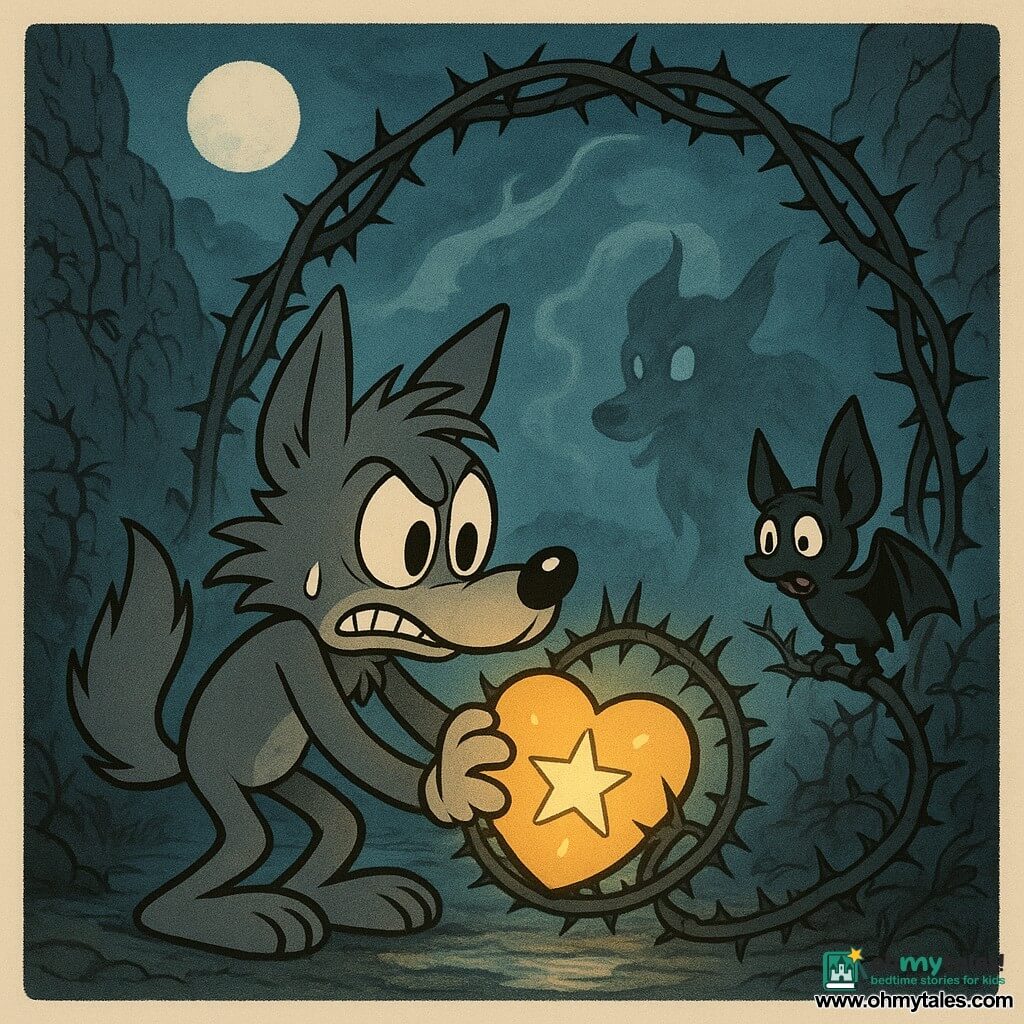
A bat hung from the tunnel ceiling, wings folded like a cloak. Its eyes shone like two tiny beads.
Twig narrowed his gaze. “Are you a sign too?”
The bat swung slightly. “I'm more of a comment.”
Twig huffed. “Great. The tunnel has a comedian.”
The bat chuckled. “Name's Soot. Don't worry—I'm not here to eat you. I prefer insects and drama.”
Twig glanced at the signs again. “Do you know which one is telling the truth?”
Soot shrugged with its wings. “Truth gets slippery down here. Signs learn to trick travelers. They like watching you choose.”
Twig took a slow breath. His fear was a heavy pack on his back, but the hope-thread inside him still tugged forward. He scanned the signs, looking past the words to the tiny details.
One sign read TURN BACK, but the arrow was cracked and splintered, like it had been forced. Another read FOLLOW THE STAR, and the carving of the star-in-circle was cleaner, deeper, as if made with purpose.
Twig stepped toward that sign.
Soot's head tilted. “How'd you pick?”
Twig pointed with his nose. “It's the only one that looks like it wants to help, not scare me.”
“Everything here wants to scare you,” Soot said cheerfully. “But some things still help. Rare, but not extinct.”
Twig followed the “FOLLOW THE STAR” arrow. The tunnel bent and narrowed, the ceiling lowering until Twig's ears brushed stone. Water dripped somewhere, counting seconds.
Drip. Drip. Drip.
The sound changed. It became… footsteps.
Twig froze. The footsteps weren't behind him. They were in front, padding closer through the dark curve of tunnel.
Soot whispered, “Oh no. That's a Listener.”
“A what?”
A shape slid into view, and Twig's mouth went dry.
It looked like a wolf, but wrong—too tall, too thin, with fur that moved like smoke. Its eyes were pale, almost blank, like moons with no light. Its ears were huge, and they tilted toward Twig as if tasting every heartbeat.
It didn't sniff. It listened.
Twig held his breath, but his heart refused to be quiet. It hammered fear into the air.
The Listener's head turned toward him with slow certainty.
Soot hissed, “Don't think loud.”
Twig's paws went numb. How do you not think?
The Listener stepped closer. Its feet made no sound, but the tunnel seemed to flinch around it.
Twig forced his mind to a single image: the star inside the circle. A sign of exit. A sign of hope.
The Listener stopped. Its ears twitched, confused. It leaned nearer, as if trying to hear the shape of Twig's thoughts.
Twig kept the star in his mind, bright and simple. He imagined it like a small lantern. He wrapped his fear around it, hiding it behind the hope-thread.
The Listener's blank eyes narrowed. It tilted its head, then—slowly—turned away, sliding back into the tunnel curve.
Twig's legs nearly folded with relief.
Soot exhaled. “Not bad, pup.”
Twig swallowed. “So… hope is quieter than fear?”
Soot grinned. “Hope is steadier. Harder to sniff out.”
Twig nodded once, shaky but determined. “Then I'll be steady.”
He continued down the tunnel, following the star-mark sign, while the dripping and the darkness listened from afar.
Chapter 4: The Library of Bones
The tunnel ended with a sudden drop in temperature that made Twig's breath puff white. He stepped into a wide chamber lit by a faint bluish glow. The light didn't come from torches. It came from the walls themselves, where crystals grew like frozen tears.
In the center of the chamber stood shelves.
Not wooden shelves like a den's storage. These were built from bones—long ribs stacked carefully, skulls holding up planks, vertebrae lined like beads. Neatly arranged, almost respectful.
Twig's stomach flipped. “This is a library,” he whispered.
Soot fluttered down and landed on a bone shelf, as casual as if it were a branch. “Yep. The woods keep records.”
Twig stared at the “books.” They weren't paper. They were thin slabs of bark, slate, and dried fungus caps, each marked with symbols. Stars, circles, spirals, scratches like claw-messages.
Twig walked slowly between shelves. The air smelled of dust, cold stone, and old stories.
A whisper came from the shelves, soft and papery: Choose.
Twig stopped at a slab of bark marked with the star-in-circle. He reached out with one paw. The bark was warm.
The moment he touched it, images flooded his mind.
He saw Pine-Hush Woods, but twisted: signposts growing like weeds, arrows turning, trails re-writing themselves. He saw animals wandering in circles, following lies until they collapsed from exhaustion. He saw the Listener wolves drifting through mist, collecting frightened thoughts like fallen feathers.
Then he saw something else: a small glowing star trapped inside a ring of thorns deep under the woods, pulsing weakly. Every pulse made a true sign appear somewhere above—only for the lying signs to scramble and confuse it.
Twig jerked his paw back, panting.
Soot's voice was quieter now. “That's the Heart-Star.”
Twig stared at the symbol. “If I free it…”
“The signs stop fighting,” Soot said. “Paths settle. The woods remember which way is home.”
Twig glanced around at the bone shelves. “And the bones?”
Soot looked away. “Those are the ones who followed the wrong signs too long.”
Twig's ears drooped. Fear tried to shove hope off a cliff inside him. He imagined himself as another neat piece of the library.
He clenched his jaw. “I won't be a book.”
A dry rustle sounded from the far end of the chamber. Twig turned.
A figure stood between shelves: a stag, but made of shadow and crystal light. Antlers branched like dead trees. Its eyes glowed dimly, and on its forehead was the star-in-circle—cracked.
It spoke without moving its mouth. The words arrived inside Twig's skull, cold and heavy.
You follow signs. Signs follow you.
Twig forced himself not to run. He planted his paws. “Are you guarding the Heart-Star?”
I guard the records, the shadow-stag replied. And the price.
Twig's throat tightened. “What price?”
The stag lowered its antlers slightly. A true sign must be carried through fear. The carrier must not abandon it.
Twig swallowed. “I'm small.”
Small things fit through narrow places.
Twig's eyes flicked to the shelves, to the bones, to the silent warning. His hope-thread trembled but did not break.
“What do I carry?” Twig asked.
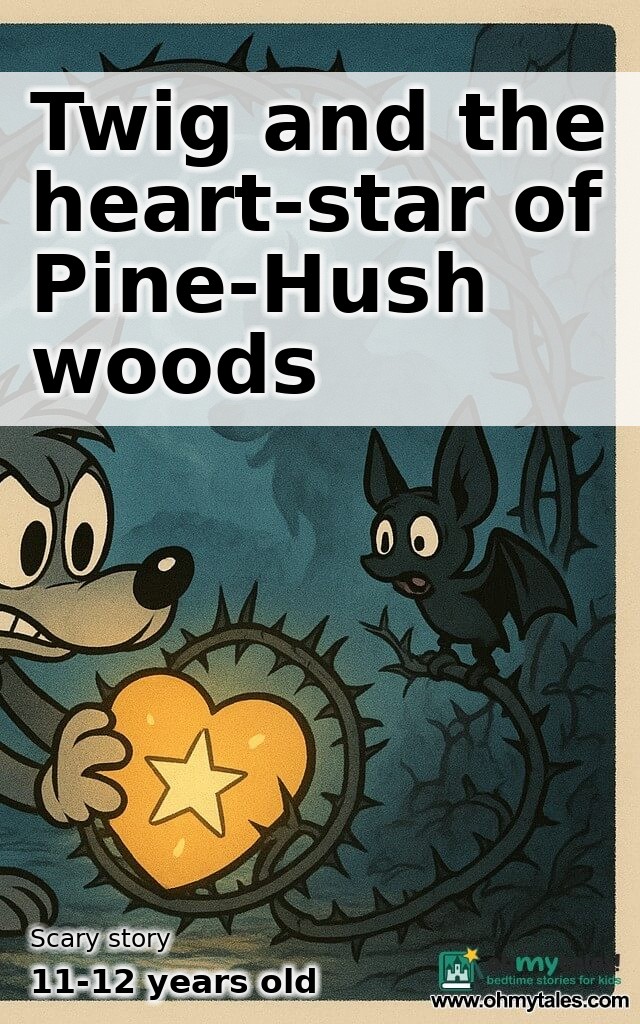
The shadow-stag moved aside, revealing a stone basin on the floor. In it lay a small object: a circle of thorny vine, and inside it, a faintly glowing star-shaped seed.
Twig stepped closer. The light was weak, but it painted his paws in silver.
The whispers in the library rose: Take it. Don't. Take it. Don't.
Twig stared at the seed. It pulsed like a tired heartbeat.
He thought of the woods above, of trails that should lead home but didn't. He thought of other animals trapped in loops, ears drooping, eyes dull.
He reached into the basin.
The thorns pricked his paw. Pain flashed bright.
Twig hissed, but he didn't let go. He curled his toes around the thorn-ring and lifted the seed carefully, cradling it like a fragile ember.
The chamber shuddered. Crystals flickered. The bone shelves rattled softly, as if the library had gasped.
Soot clung to a skull handle. “You actually did it.”
Twig held the seed close to his chest. It warmed his fur. The hope-thread inside him now felt like a rope.
The shadow-stag's voice pressed into his mind: Now find the Thorn Gate. The Heart-Star returns through it.
Twig nodded, even though his mouth was dry. “Show me the sign.”
A new sign appeared on the stone floor—scratches forming a star-in-circle arrow pointing to a narrow passage at the back.
Twig tightened his grip on the thorn-ring. “Okay,” he whispered to the seed. “I've got you.”
Behind the shelves, the darkness stirred, listening.
Chapter 5: The Thorn Gate
The passage led upward in a spiral, so tight Twig's shoulders brushed the walls. The air grew warmer, but not comforting—more like the breath of something waking.
The seed pulsed against his chest. Each pulse made a faint symbol shimmer on the stone ahead: a star, then a circle, then an arrow. True signs. Clear signs.
And still, the false signs tried to interfere.
Carvings appeared on the walls: TURN BACK, SAFE HERE, DROP IT, LET IT REST.
Soot flew ahead, eyes narrowed. “Don't read those.”
Twig forced himself to look only at the shimmering star-marks. “I'm not.”
A distant moan drifted up the spiral. The Listener was coming.
The footsteps—silent, but somehow heavy—pressed through the tunnels behind them. Twig could feel the attention like a cold paw on his neck.
Soot's voice sharpened. “Run, pup. Steady hope is great, but speed helps too.”
Twig ran.
His paws slapped stone. The thorns bit his skin through the vine-ring, leaving tiny stings like reminders: Don't drop me.
The passage opened suddenly into an outdoor place, but not the forest above. Twig stumbled into a ravine filled with pale mist. The walls rose steep on either side, covered in thorn vines and twisted roots.
At the far end stood a gate made entirely of thorns, woven into an arch. In its center hovered a dark circle like a hole cut from the world.
On the ground before the gate was the star-in-circle symbol, scratched again and again as if by desperate claws.
Twig panted. “That's it.”
Soot landed on a thorn vine and winced. “Ow. This gate is not bat-friendly.”
Behind them, the mist in the ravine thickened, rolling forward like a tide. Within it, two pale eyes appeared—then the tall smoky shape of the Listener.
Twig's legs shook. The gate was close, but the ravine felt suddenly too long, like a nightmare hallway.
The Listener slid nearer, ears angled forward. It didn't rush. It didn't need to. It believed fear would trip Twig for it.
Twig clutched the seed. The light inside it fluttered.
The Listener's voice slid into the air, thin as smoke. “Give… it… back.”
Twig took a step toward the gate. His paws slipped on damp stone. He caught himself.
“Twig!” Soot shouted. “Don't listen. Think of the star!”
Twig shut his eyes for half a second. He pictured the star seed brightening, pictured clear paths in Pine-Hush Woods, pictured animals finding their dens again, pictured morning light cracking the fog.
He opened his eyes.
The Listener was closer now, and the mist around it writhed with smaller shapes—shadows without faces, like fear without bodies.
Twig forced himself forward, one step at a time.
The thorn gate loomed. Its vines shifted, thorn tips clicking together like teeth. The dark circle inside it pulsed.
A final false sign flashed across the ground in wet-looking scratches: NO ONE WILL THANK YOU.
Twig's ears flattened. For a moment, that one hurt more than the others. Doing the right thing and staying alone—he knew that feeling.
Then he glanced at Soot, who was hovering by the gate, wings trembling with effort.
Soot tried to grin. “I'll thank you. In my own dramatic way.”
Twig snorted, despite everything. “Good.”
The Listener lunged without sound. Its smoky body stretched, reaching.
Twig leapt.
He landed at the base of the thorn gate, yelping as thorns scraped his sides. He raised the seed with both paws, pushing it toward the dark circle.
The gate shuddered. The thorns tightened as if resisting. The seed's glow dimmed, nearly snuffed.
Twig felt panic rise, hot and choking.
He lowered his forehead to the thorn-ring and whispered, “Please. Just… go home.”
The seed pulsed once—stronger. Warmth surged through Twig's paws, not burning, but brave. The star flared, and the thorn ring softened, its sharpness relaxing like a fist unclenching.
Twig pushed the seed into the dark circle.
For an instant, the ravine went perfectly silent.
Then the darkness in the gate cracked like ice. Light spilled out—not blinding, but steady, moon-pale and dawn-bright at the same time. The light washed over the thorns, turning them into ordinary vines. It rushed down the ravine, pushing back the mist.
The Listener recoiled. Its pale eyes widened, and its smoky fur tore into strips of fog.
“No,” it hissed, and the sound finally had fear in it.
The light touched it, and the Listener unraveled, becoming only mist again, then nothing at all.
Twig sagged to the ground, panting, paws stinging.
Soot landed beside him, looking unusually quiet. “You did it.”
The air changed. The ravine walls seemed less steep. The sky above lightened from ink to gray.
On the ground, true signs appeared—simple and calm. A line of stones. A trail of flattened grass. An arrow scratched into dirt pointing toward the familiar scent of pine and home.
Twig stared at the path. The hope-thread inside him loosened into a warm, gentle knot.
He got to his feet. “Let's go,” he said, voice rough but steady.
Soot fluttered up. “Lead the way, hero wolf.”
Twig snorted again. “Don't call me that.”
“Fine,” Soot said. “Bravely cautious wolf.”
Twig couldn't help it. He smiled, just a little.
Chapter 6: The Woods Remember
They returned to Pine-Hush Woods through a gap in the ravine that became, somehow, the same deer trail Twig had started on. The fog was thinner now, drifting instead of clinging. The trees stood straighter. Even the shadows looked less hungry.
Signs were still everywhere, but they felt different.
A mushroom tilted like a pointing finger—toward a real stream, flowing the right way. A crow feather lay on a stone—beside a clear set of pawprints leading toward a burrow. Two owls hooted in a calm, correct rhythm, like they were counting the night properly.
Twig paused at the birch tree with the blinking eye-scar.
It didn't blink anymore. It was just a scar, pale and quiet. The sap tear had dried.
Twig breathed out slowly. “Thank you,” he told the tree, feeling a bit silly.
Soot perched on a low branch. “So what happens now? Does the forest throw a party? Confetti leaves?”
Twig glanced around at the dark pines, the soft moon, the steady trail. “No party,” he said. “Just… normal.”
Soot made a dramatic sigh. “Normal is underrated.”
As they walked, they passed animals moving through the woods—no humans, only fur and feathers and cautious eyes. A pair of foxes trotted without snapping at shadows. A hedgehog waddled along a true path of stones. A nervous deer lifted its head, sniffed, and then followed a clear sign of broken twigs that led it safely around a sinkhole.
The signs didn't shout anymore. They didn't scramble or twist. They simply offered direction, like a gentle paw on the shoulder.
Twig's own fear didn't vanish, either. It still sat inside him, watchful and ready. But it no longer held the leash. Hope did.
Soot flapped beside him. “You're going to be famous in the bat gossip circles.”
Twig rolled his eyes. “Please don't.”
“I will,” Soot promised. “But I'll exaggerate your ears.”
Twig's ears flicked. “They're already big.”
“Exactly. Easy material.”
They reached a small hill where Twig could see the woods spread out like a dark ocean. Far off, a faint glimmer pulsed beneath the ground—subtle, steady—the Heart-Star resting where it belonged.
Twig sat, tail curled around his paws. The night was still shadowy, still full of unknowns, but it felt… honest.
Soot settled next to him, oddly companionable. “You did something hard,” the bat said, voice softer. “You held onto one good thing while everything tried to steal it.”
Twig stared at the moon-coin. “I was scared the whole time.”
Soot nodded. “So?”
Twig thought about it. He remembered the Listener's blank eyes, the bone library, the thorn gate snapping like teeth.
Then he remembered the seed's warmth, small but stubborn.
“I guess,” Twig said slowly, “being scared doesn't mean you have to stop.”
Soot's wings wrapped around itself like a blanket. “That's the smartest thing I've heard all week. And I listen to echoes for a living.”
Twig let the quiet settle.
Before they parted ways, Twig nudged a small star-shaped stone into the dirt beside the trail, a tiny sign for anyone who needed it.
Then, very softly, he said to the woods and to himself, “If you're lost, keep one little light. Just one. It's enough to start.”
And the forest, remembering, rustled back like a lullaby.
Good night, brave heart.