Chapter 1
Malik had a talent for noticing the tiny things other people missed: the way the streetlights blinked twice before they settled, the cat prints on fresh cement, the sour-sweet smell of rain before a cloud even showed its face.
So when he saw the shadow move, he didn't tell himself it was “just nothing.”
It happened at the end of Juniper Alley, the kind of place the town forgot on purpose. The alley was long and narrow, squeezed between two rows of old brick buildings. No one walked there unless they had to. The dumpsters were always full. The wind always sounded like it was whispering.
At the far end sat a house that looked like it had been holding its breath for years.
Its windows were dark, but not empty-dark—more like the dark of a room where someone was waiting.
“Are you sure this is the right place?” asked Avery, rolling her wheelchair carefully over a crack in the pavement. She made it look easy, like she and the chair were a single, smooth creature.
“Juniper Alley,” Malik said, reading the street sign that had a corner bent like it had been bitten. “And the house at the end. That's what your cousin wrote.”
Avery's cousin had sent a message that was half joke, half dare:
IF YOU'RE BRAVE, COME SEE WHAT'S UNDER THE HOUSE THAT DOESN'T LIKE LIGHT.
Malik hadn't planned on coming alone, so he'd asked Theo. Theo showed up with a backpack and a grin that didn't quite reach his eyes.
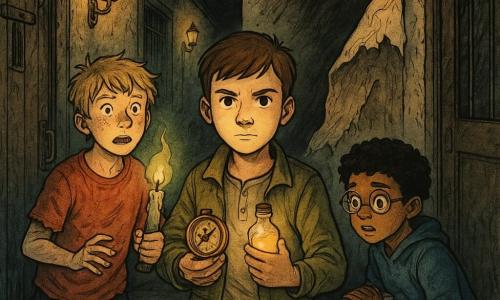
“I brought snacks,” Theo announced. “And a flashlight. And… um. A screwdriver, because I saw it in a movie once.”
“Great,” Malik said. “We're basically professionals.”
They reached the front gate. It wasn't locked, which was almost worse than being locked. The metal bars were cold and damp, and the hinges complained when Malik pushed.
As they stepped into the yard, the air changed. It smelled like wet leaves and old paper. The grass was tall enough to hide ankles. The front porch leaned slightly to the left, like it was trying to listen to the ground.
Malik looked up at the house. For a second, he thought he saw movement in an upstairs window—something sliding past the curtain.
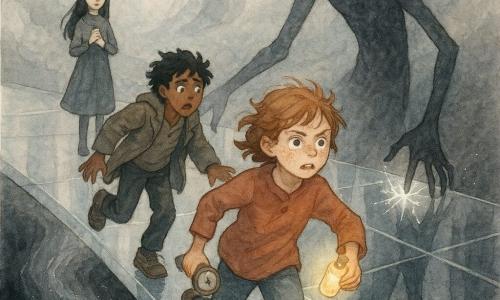
Then, along the porch boards, a shadow moved the wrong way.
Not the way it should move when clouds pass the sun. Not a simple stretch or shrink. This shadow flowed, like ink in water, creeping against the direction of the light.
Malik's throat tightened.
“Did you see that?” he whispered.
Theo squinted. “See what? The house judging us?”
Avery's gaze stayed fixed on the porch. “I saw it,” she said quietly.
The shadow slipped beneath the door as if the wood were as thin as fabric.
And from inside, something tapped once—slow, polite, and patient.
Chapter 2
The front door opened with a sigh, as if it had been waiting to be useful again.
Inside, the air was cooler. Dust floated in the flashlight beam like tiny pale moths. The hallway smelled like cedar mixed with something faintly metallic, like a coin held too long in a warm hand.
“Okay,” Theo said, too loudly. “This is normal. Just an abandoned house. Filled with… history.”
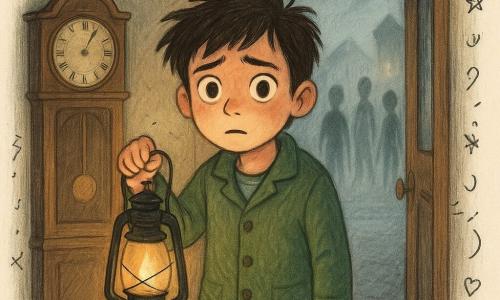
Avery rolled forward first, her flashlight steady. Malik followed, noticing every detail: wallpaper peeling in long strips like shedding skin, framed pictures turned face-down, and a grandfather clock frozen at 11:11, its hands stuck like they were holding their breath.
At the end of the hallway, there was a mirror.
It didn't reflect the three of them.
It reflected the hallway, but empty—no kids, no wheelchair, no flashlights. Just the house by itself, staring back.
Theo leaned toward it. “That's… a trick mirror, right? Like funhouse stuff?”
Malik tried to laugh, but it came out thin. He stared at the mirror, then at his own hand, then at where his hand should be in the glass.
Nothing.
Avery lifted her palm and waved. “It's not showing us.”
“Maybe it's dirty,” Theo offered, but his voice had shrunk.
Malik's eyes slid to the floor. Near the mirror, the dust looked disturbed, as if something had dragged itself across.
A line in the dust led toward a door under the stairs.
The door was small, almost hidden. It had a brass knob that gleamed too brightly, like it had been polished recently.
“Under the house,” Malik murmured, remembering the message.
Theo took a step back. “Or, hear me out, we could go above the house. Like… the roof. Roofs are normal.”
Avery's lips pressed together. “If your cousin is messing with us, I want to know. And if he isn't…”
“If he isn't,” Malik said, “then someone else is.”
He reached for the knob. The brass was cold enough to sting. He twisted, and the door opened with surprising ease.
A narrow staircase dropped into darkness.
The air rising from below smelled like damp stone and something sweet—like overripe fruit.
Avery angled her chair. The stairs were too steep for her to go down in it, but she didn't look embarrassed or helpless. She simply assessed the problem, like she was reading a math question.
“There has to be another way down,” she said. “A ramp or a back entrance. Basements usually have something.”
Theo pointed his flashlight at the stairs. “Or a trap.”
From the dark below, a sound drifted up: a soft shuffling, like someone brushing their fingers over dry leaves.
Malik swallowed. His heart beat faster, not just with fear, but with that other feeling—the one that came before solving a puzzle.
“Let's find the other way,” he said. “Together.”
They backed away from the stair door and moved deeper into the house, each step sounding too loud on the warped floorboards.
Behind them, the small door under the stairs eased shut on its own.
It clicked, like a lock turning.
Chapter 3
They found the kitchen, which looked like it had been abandoned mid-thought. A cracked teacup sat on the table. A spoon rested beside it, stained dark at the tip.
Malik's flashlight slid over the cabinets. One was open just a little, like a mouth.
Theo poked it with the screwdriver. “If a ghost jumps out, I'm suing.”
“Can you sue a ghost?” Avery asked.
“Watch me.”
Avery's humor sounded steady, but Malik noticed her fingers tightened around her flashlight.
He noticed other things too: muddy footprints on the tile, leading not to the back door but to the pantry. And a faint scratching from behind the pantry wall, like something was writing with a nail.
Malik stepped closer. The scratching stopped.
He pressed his ear against the wall. Silence. Then, very softly:
“Shhhhhh.”
He jerked back, hitting the pantry door with his elbow. The door swung open.
Inside, shelves lined the walls. But there wasn't food. There were jars, dozens of them, each filled with cloudy liquid.
Something floated in each jar.
Not organs or eyeballs, nothing like a horror movie. Just… shadows. Little twists of darkness, like curled smoke caught in glass.
Theo leaned in. “Nope. Nope nope nope.”
Avery shone her light across the jars. “They're moving.”
They were. The shadows drifted and nudged against the glass as if they could sense the beam.
At the back of the pantry, behind the last shelf, was a trapdoor in the floor. Its handle was a loop of rope tied in a neat bow.
Like someone expected a child to open it.
Malik's mouth went dry. “This is the way down.”
Theo looked at the jars again, then at Malik. “Why would anyone keep… shadow soup?”
Avery's eyes narrowed. “Maybe it's not someone. Maybe it's the house.”
The trapdoor creaked when Malik lifted it. Cold air rose from the opening, and with it a smell like wet earth and pennies.
A wooden ladder disappeared into blackness.
“I'll go first,” Malik said before he could change his mind.
Avery's gaze snapped to him. “No. We promised—together.”
Malik felt a warm rush in his chest, not from bravery but from being seen. “Okay,” he said. “Together.”
Theo sighed dramatically. “Fine. But if I get eaten, I'm haunting both of you.”
Malik climbed down, hands stiff on the ladder rungs. Theo followed, muttering under his breath. Avery stayed above for a moment, angling her flashlight down.
“I'll find another way,” she said. “There has to be one. Don't do anything heroic.”
“Heroic is overrated,” Malik called up, trying to sound casual.
“Good,” Avery said. “Then don't.”
The trapdoor closed, and Malik and Theo stood in a basement corridor made of stone. The air was colder here, and the dark seemed thicker, like it didn't want to let go.
Their flashlight beams stretched ahead and were swallowed.
Then Malik saw it again: the moving shadow.
It slid along the wall beside them, even though neither flashlight pointed that way. It seemed to watch them, flattening and widening like a creature trying to press itself through a crack.
Theo whispered, “If that's you doing a prank, Malik, I'm never sharing snacks again.”
“It's not me,” Malik whispered back.
The shadow lifted, like a hand rising. It pointed down the corridor.
And somewhere far ahead, something answered with a low, pleased hum.
Chapter 4
They followed the corridor because the alternative was standing still and letting the basement decide what happened next.
The stone walls were damp. Water dripped from somewhere overhead in slow, patient drops. The floor was uneven, scattered with tiny bones that might have been from mice—or something else small and unlucky.
Theo tried not to look down. “This is the worst field trip ever.”
Malik kept his eyes moving. On the walls, faint chalk marks formed crooked arrows and symbols that reminded him of school doodles—stars, spirals, stick figures—but shakier, like the person drawing had been scared.
Then the corridor opened into a wide room.
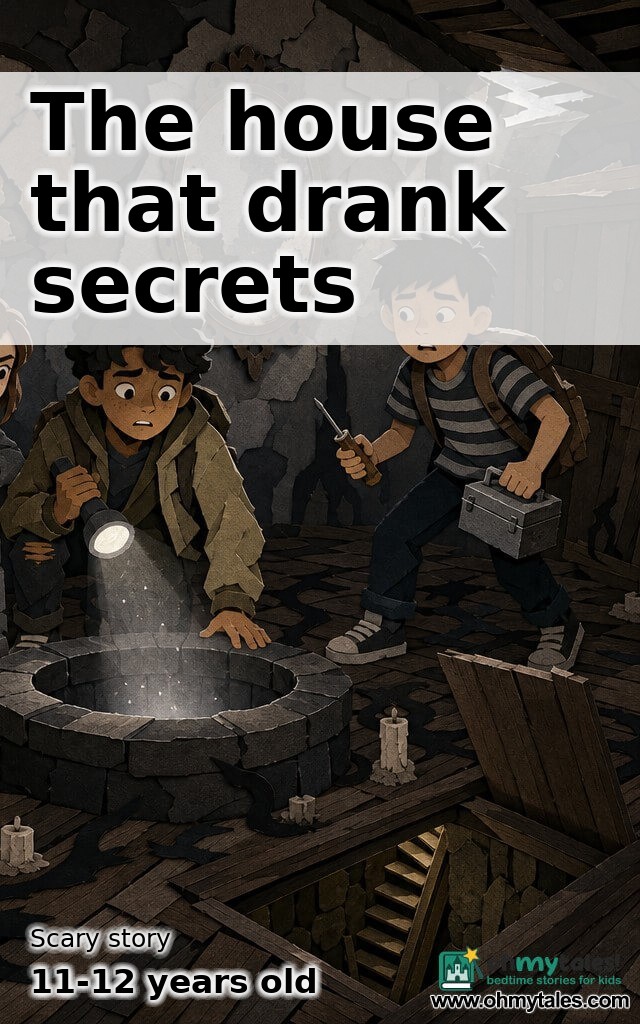
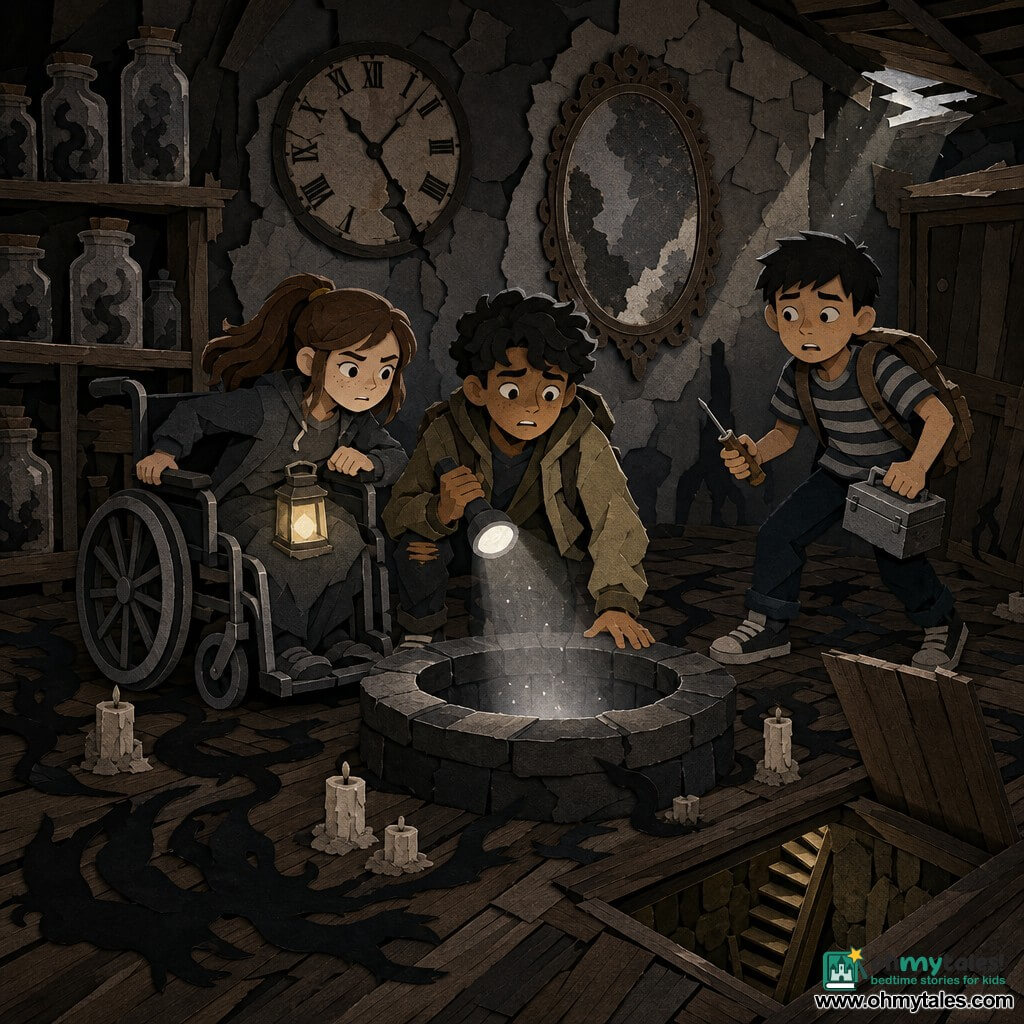
In the center stood a well.
Not a normal backyard well, but an indoor one made of black stone, its rim smooth as if polished by countless hands. A thick rope hung over a wooden beam above it, and the bucket was missing.
Around the well, candles sat in circles. None were lit, yet the room wasn't completely dark. A dim gray glow seeped from the well itself, as if something down there was breathing light upward.
Theo edged closer, then stopped. “I hear… something.”
Malik listened. At first, only the drip-drip of water. Then, beneath it, a whispery sound. Not words—more like a crowd murmuring in another room.
The shadow slipped around Malik's feet, curling like a cat that didn't trust him yet.
Malik's stomach tightened. “It wants us here.”
“That's not comforting,” Theo said.
A sound scraped behind them.
They whirled. A door in the stone wall—one Malik hadn't noticed—was opening.
Avery rolled into the room, slightly out of breath, hair messy like she'd fought the house and won.
“I found a ramp,” she said, then looked at the well. Her voice went quieter. “Or… something found me and decided to be polite.”
Theo let out a shaky laugh. “Avery, please tell me you brought a flamethrower.”
“I brought common sense,” she said. “And trust me, it's barely enough.”
Malik nodded toward the well. “This is what your cousin meant. I think the house is collecting shadows.”
Avery's face tightened. “For what?”
As if answering, the whispering rose, clearer now. It sounded like many voices speaking at once, all trying to use the same mouth.
“Return… what was… taken…”
Theo hugged his backpack to his chest. “Is it talking to us?”
Malik stepped toward the well. The gray glow brightened, and the shadow at his feet climbed up his leg like cold smoke.
He froze.
Avery reached out and grabbed his sleeve. “Malik. Don't.”
Her grip was firm, steady. Trust made physical.
Malik breathed in, then out. The shadow loosened, slipping away from his leg. He stepped back.
“Good,” Avery said softly. “We don't do what it wants just because it's loud.”
Theo pointed at the candles. “Maybe we should light them? Like… ritual equals safety?”
Avery shook her head. “Or ritual equals ‘congratulations, you opened the wrong door.'”
Malik scanned the room again. His eyes landed on something wedged between two stones near the well: a small metal box, dull and scratched, with a latch.
He crouched and pulled it free. It was heavier than it looked.
“What's in it?” Theo asked.
Malik lifted the latch.
Inside lay a folded piece of paper and a key tied to a string.
The paper crackled when he unfolded it. The handwriting was uneven, like the writer had been shaking.
DON'T LOOK DOWN FOR TOO LONG.
THE WELL DOESN'T HOLD WATER.
IT HOLDS WHAT PEOPLE TRY TO HIDE.
IF YOU WANT OUT, GIVE IT A SECRET—BUT NOT YOURS.
Theo blinked. “That's… oddly specific.”
Avery's eyes moved to the key. “A key for what?”
At the edge of the room, the moving shadow rose again, taller now, and shaped itself into something almost human—almost, but wrong at the joints, like a puppet held by a nervous hand.
It tilted its head as if listening.
The whispering surged.
“Secret… secret… secret…”
Theo swallowed. “So… we feed it a secret, and it lets us go? That's the deal?”
Malik stared at the note again. Not yours.
He looked at his friends. Avery's face was pale but focused. Theo tried to smile and failed.
Trust, Malik thought, wasn't just believing someone wouldn't hurt you.
Sometimes it was believing they'd help you think when fear made your brain slippery.
“Not ours,” Malik said. “So we need someone else's secret.”
Avery frowned. “That sounds awful.”
“It does,” Malik admitted. “Unless… it means something different.”
He glanced at the jars of shadows upstairs in the pantry. “The house is already stealing things people hide. Maybe we don't have to steal a secret. Maybe we have to return one.”
Theo's eyes widened. “Like… give it back what it took?”
The shadow-figure leaned forward, and the gray glow from the well pulsed, eager.
Avery pointed at the key. “Then the key must open something that holds a secret.”
Malik's gaze traveled along the stone wall. There—almost hidden—was a narrow door with a keyhole shaped like an eye.
The house seemed to wait.
Chapter 5
The key slid into the eye-shaped lock with a soft click, like a tongue tasting sugar.
Malik turned it. The door swung inward.
A cold draft rolled out, carrying a smell like old blankets and rain-soaked wood.
Beyond the door was a small room with shelves. Not jars this time—boxes. Dozens of them, each labeled with a name in faded ink.
Some names were clear. Others had been scratched out so hard the wood was gouged.
Theo leaned in. “These are… people.”
Avery rolled closer, her flashlight tracing the labels. “Town names. I recognize some.”
Malik's eyes snagged on a box labeled: ELIAS WREN.
“That's my cousin,” Avery whispered. Her voice had a sharp edge now. “He didn't just write a message. He—”
She stopped. Her jaw tightened.
Malik touched the box carefully, like it might burn. The wood felt colder than the stone.
“What's inside?” Theo asked, voice small.
Malik lifted the lid.
The air inside smelled like paper and breath. In the box lay a small notebook with a rubber band around it, and a photograph of a boy—Avery's cousin—standing in front of the Juniper Alley house, grinning like he'd won a contest.
On the back of the photo, in newer ink, was written:
I HEARD IT TALK. IT PROMISED ME STORIES. I GAVE IT ONE. I SHOULDN'T HAVE.
Avery's hands trembled, then steadied. “He's not just missing,” she said. “He's… trapped in here.”
Theo swallowed hard. “In a box.”
The whispering from the well seeped into the room, thin as spider silk.
“Open… open… share…”
Avery looked at Malik. Her eyes were bright, but she didn't blink. “The note says give it a secret, but not ours. Elias gave it one. Maybe it took him because he gave it something it liked.”
Malik opened the notebook. Pages were filled with messy writing, as if Elias had scribbled in a hurry.
He wrote about the house. About the shadows in jars. About the mirror that erased people. About the well that “drank” secrets and grew stronger.
And then one page had a sentence written over and over, darker each time:
IT WANTS THE THING YOU WON'T SAY OUT LOUD.
On the last page, Elias had written a single secret—something personal, something raw. Malik's eyes caught a few words before he forced himself to look away.
Avery reached out. “Don't read it,” she said.
“I didn't,” Malik lied, then corrected himself because trust mattered. “I saw enough to know it's private.”
Avery exhaled. “Thank you.”
Theo shifted from foot to foot. “So what now? We can't feed it Elias's secret. That feels… mean.”
Malik stared at the boxes. Names. Lives. Everyone in town had things they held close—fears, regrets, wishes. The well had been collecting them like trophies.
“Maybe we don't feed it,” Malik said. “Maybe we lock it.”
Avery's eyebrows rose. “How?”
Malik pointed to the boxes. “These are secrets it took. If we return them—if we stop hiding them in here—maybe it loses power.”
Theo made a face. “Return them to who? Like… go door to door? ‘Hi, ma'am, here's the thing you never told anyone'?”
Avery almost smiled, and in the dark that small almost-smile felt like a lantern. “Maybe not like that.”
Malik flipped back to the note from the metal box. Give it a secret—but not yours.
“What if,” Malik said slowly, “we give it a secret it doesn't want?”
Theo stared. “A secret it doesn't want is…?”
Malik looked at Avery, then at Theo. He felt the weight of the moment, like a door about to close.
“A secret about itself,” Malik said. “Something it's been hiding.”
Avery's eyes widened. “That it needs secrets to exist.”
Theo blinked. “That it's… hungry.”
Malik nodded. “That it's weak without them.”
The whispering from the well grew harsher, as if it had heard.
“NO.”
The shadow-figure outside the room slammed against the stone doorway, stretching like tar. The lights flickered gray.
Avery's voice stayed steady. “It hates that idea.”
“Good,” Malik said, heart pounding. “That means we're close.”
He grabbed the metal box from earlier and shoved the note and key inside. Then he seized the notebook, careful not to open it again.
Theo pointed toward the well room. “How do we tell it its own secret? It's not like we can whisper it into its ear.”
Malik looked at the mirror memory—the mirror upstairs that didn't show them. “We need something that makes it face itself.”
Avery nodded slowly. “The mirror.”
Theo groaned. “Of course it's the creepy mirror.”
The shadow slammed again, and the stone door shuddered.
“RUN,” Avery snapped.
They didn't argue.
Chapter 6
The basement corridor seemed longer on the way back, like the house was stretching it, pulling taffy with their fear.
Behind them, the shuffling grew louder, not footsteps exactly—more like a heavy cloth being dragged across stone. The shadow-figure hissed without lungs.
Theo panted, pushing his legs to move faster. Malik kept glancing back, flashlight beam wobbling.
Avery rolled hard and fast along the ramp she'd found, her wheels humming. She didn't fall behind. She didn't let fear turn her into a problem to solve.
They burst into the kitchen. The pantry jars rattled on their shelves as if something inside them was cheering.
Malik slammed the pantry door shut. It bounced open by itself.
“Nope,” Theo said, and wedged the screwdriver into the doorframe. It held—barely—like a toothpick against a tide.
The hallway mirror waited, dull in the dust.
They skidded to a stop in front of it.
Still no reflections. Just the empty hallway, empty house, empty air.
Avery lifted the notebook Elias had written in. “We need it to face itself,” she said. “How?”
Malik's mind raced. The mirror erased them from its view. It didn't recognize living bodies—or maybe it refused to. But it did reflect the house.
“What if the mirror only shows what belongs here?” Malik said.
Theo's eyes widened. “So if we put something of the house in front of it…”
Avery looked back toward the kitchen. “The shadow jars.”
Malik shook his head. “Too many. And the pantry is—”
A bang echoed from behind the pantry door. The screwdriver bent slightly.
Theo yelped. “The pantry is mad.”
Malik scanned the hallway and spotted the grandfather clock, frozen at 11:11. Beneath it was a small drawer half-open.
Inside lay a pouch of black sand—oddly heavy. Malik scooped a handful. The grains stuck to his fingers like they were eager.
He brought the sand to the mirror and let it fall.
In the mirror, the sand didn't drop.
It rose.
The black grains streamed upward, forming a twisting shape—the same wrong-jointed figure they'd seen in the basement, except now it was trapped behind glass, pressed into two dimensions.
The air turned colder.
Avery swallowed. “That's it.”
The shadow in the mirror writhed, as if furious at being seen.
Malik lifted the notebook, closed. “We tell it what it is,” he said, voice shaking. “We say it out loud.”
Theo looked at Malik, then Avery. His face was pale, but he nodded. “Together.”
Avery's voice was low and clear, like reading a truth you can't unlearn. “You are not a monster from the dark. You are a hunger.”
The mirror-shadow thrashed.
Malik stepped forward. His heart hammered, but he made himself speak. “You survive on secrets. Without them, you fade.”
The hallway lights flickered. The house groaned, deep and angry, like wood complaining after years of silence.
Theo forced out the words, almost a shout. “That's your secret! You're weak!”
For a moment, everything paused.
Then the mirror cracked—not breaking, but spiderwebbing with lines of pale light. The black sand on Malik's fingers grew hot, as if embarrassed.
From the kitchen, the pantry door burst open. Jars rolled and shattered on the floor. Shadows poured out like spilled ink, rushing toward the hallway.
Avery grabbed Malik's wrist. “It's losing its grip,” she said. “Do something!”
Malik looked at the mirror. The trapped shadow writhed behind it, caught in its own reflection.
He remembered the note: give it a secret—but not yours.
He opened the metal box and pulled out the paper again. On the back, Malik scribbled fast with Theo's pencil:
YOU CAN'T KEEP WHAT IS MEANT TO BE CARRIED TO THE LIGHT.
It wasn't poetry. It was a promise.
He pressed the paper flat against the cracked mirror.
The mirror flared with gray-white light, bright enough to sting their eyes.
The shadow in the glass shrieked—a sound like wind trapped in a bottle. The rushing spilled-shadows in the hallway paused, confused, and then—one by one—lifted like birds startled from the ground.
They streamed back toward the pantry, but not into jars. Through the ceiling, through the walls, through the cracks in the house, escaping.
The house shuddered.
Then, suddenly, it was quiet.
The mirror went dull again.
And in it, for the first time, Malik saw them.
Three kids, dusty and wide-eyed, breathing like they'd just outrun a nightmare.
Theo stared at his own reflection as if it might vanish. “I have never been happier to see my own face.”
Avery's shoulders sagged in relief. “Elias,” she whispered. “We still need to—”
A soft sound came from the floor near the stairs. A loose board shifted.
Malik knelt and pried it up.
Underneath was a shallow space, and inside sat a small envelope, clean and dry, as if it had been placed there yesterday.
On the front, written in the same shaky hand as the note, was:
FOR THE ONES WHO DIDN'T LOOK AWAY.
Chapter 7
Outside, Juniper Alley looked the same—gray sky, crooked bricks, weeds pushing through cracks. But Malik felt like he'd stepped out of a colder world into a slightly warmer one.
They didn't run all the way home. They walked fast, yes, and they didn't stop glancing behind them, but they stayed together.
At the corner where the alley met the main street, Avery finally spoke. “Open it,” she said, nodding at the envelope.
Malik's fingers were still a bit shaky, but he slid a thumb under the flap.
Inside was a single sheet of paper and something else: a tiny glass vial filled with black sand, sealed with wax.
Theo leaned away from it. “Absolutely not. That is cursed seasoning.”
Malik unfolded the paper. The handwriting was Elias's.
IF YOU'RE READING THIS, YOU DIDN'T GET BOXED.
GOOD.
THE HOUSE DOESN'T JUST TAKE SECRETS—IT TAKES THE TRUST BETWEEN PEOPLE. IT MAKES YOU THINK YOU'RE ALONE WITH YOUR FEAR.
DON'T LET IT.
THE VIAL IS A PIECE OF IT. BURY IT SOMEWHERE BRIGHT. SOMEWHERE PEOPLE LAUGH.
AND HERE'S THE SECRET I COULDN'T SAY OUT LOUD:
I WASN'T BRAVE UNTIL I HAD TO TRUST SOMEONE ELSE.
THANK YOU FOR BEING THAT SOMEONE, EVEN IF I'M NOT THERE TO SAY IT.
Avery pressed the paper to her chest. For a second, her face crumpled, then smoothed again into something fierce.
“We're going to find him,” she said.
Theo's voice was gentle now, the jokes put away like a flashlight when the sun comes up. “We will. But first… the vial.”
They chose the brightest place they could think of: the playground behind the library, where the swings squeaked and kids had carved their initials into the wooden bench. Even in gloomy weather, it felt like a place that belonged to laughter.
Malik dug a small hole under the biggest oak tree. Its roots twisted like knuckles through the soil, strong and stubborn.
Avery held the vial. She didn't hesitate. “Ready?” she asked.
Malik nodded. Theo nodded.
Avery set the vial in the hole like it was something delicate, not dangerous. Malik covered it with dirt. Theo pressed the soil down with both hands, as if sealing a lid.
For a moment, Malik thought he saw a thin, dark thread of shadow try to slip upward.
Then the wind shifted. A group of younger kids burst through the gate, chasing each other, shrieking with laughter. Their voices rang through the playground.
The dark thread snapped.
Malik exhaled slowly, like he'd been holding air in his lungs since Juniper Alley.
Avery wiped her eyes with the heel of her hand. “So,” she said, voice steady again, “we buried its piece in the light.”
Theo nodded. “And we didn't give it our secrets.”
Malik looked at both of them. “We did something better,” he said. “We shared the fear. We trusted each other with it.”
Avery's mouth tilted into a real smile now, small but bright. “That's how you starve a thing like that.”
They sat on the bench for a minute, watching the swings move. The sky was still gray, but it wasn't pressing down as hard.
Malik kept Elias's letter folded in his pocket. A secret deposited, not into darkness, but into the ground beneath a place where people laughed—safe for now, and waiting.
And far away, at the end of Juniper Alley, the house stood silent.
But for the first time, it looked less like it was waiting…
…and more like it was listening, uneasy, to the sound of trust.