Chapter 1: The Corn That Whispered
Milo Reed didn't mean to cut through Greyclover Field. He really didn't.
He had been biking home from his friend Tessa's place with a paper bag of cookies balanced in the basket, and the sky had turned the color of bruised peaches—pretty, but warning you anyway. The paved road bent the long way around the fields. The shortcut was a thin dirt track that sliced straight through the corn.
Milo hesitated at the entrance.
The corn stood taller than his dad's shed, leaves sharp as folded paper. A breeze slid through it with a dry, shivering sound—like a crowd whispering behind their hands.
“Two minutes,” Milo told himself. “In and out.”
He pushed his bike in, one hand on the handlebar, the other gripping the paper bag close to his chest like it could protect him.
The path narrowed fast. Corn stalks leaned in, brushing his shoulders. The air smelled of damp soil and something faintly sweet, like old candy. Milo tried to focus on normal things: the squeak of his front wheel, the crinkle of the bag, the distant call of a crow.
Then the crow stopped.
Silence dropped so suddenly Milo almost stumbled. Even the breeze seemed to hold its breath.
A soft sound came from somewhere ahead. Not footsteps—more like a slow drag, as if something heavy was being pulled through the dirt.
Milo froze.
“Hello?” he called, and instantly regretted it. His voice sounded too loud, like he'd shouted in a library.
The dragging stopped.
For a second, Milo could hear his own heartbeat—thump, thump, thump—like someone knocking from inside his ribs.
Then the corn whispered again. Not the usual rustle. This felt… shaped.
Milo couldn't make out words, but he understood the meaning anyway: come closer.
“Nope,” Milo muttered. He turned his bike around, but the path behind him didn't look right. The corn seemed thicker, the gap tighter, like the field had swallowed the entrance.
He pulled a small object from his pocket: a smooth stone with a streak of white running through it, like a tiny lightning bolt trapped inside. His grandma had given it to him after he'd gotten lost once at a county fair.
“Keep this,” she'd said. “It's a remembering stone. When you're frightened, it helps you remember the way you want to go.”
Milo had laughed at the name back then. Now he rubbed his thumb over the white streak, clinging to the memory of Grandma's warm kitchen and the smell of cinnamon toast.
“Okay,” he whispered. “I want to go home.”
The corn didn't move aside. The path stayed narrow.
Somewhere ahead, the dragging started again—closer this time.
Milo swallowed. Courage wasn't something you felt. It was something you did while your stomach tried to tie itself into a sailor's knot.
He pushed forward, one careful step at a time, bike bumping along behind him.
The field seemed to watch him. The leaves brushed his ears like fingers. The sky above was a thin strip, turning from peach to deep purple.
And then Milo saw it: hanging from a stalk at eye level, a piece of torn cloth fluttering like a tiny flag. It was blue, with white stars.
His chest tightened.
“That's… Tessa's bandana,” he whispered.
Tessa always wore it like a headband when she played soccer. Milo knew because she'd teased him once for wearing socks with sharks on them.
The bandana snapped in the wind, even though the air around Milo was still.
Something in the corn sighed.
Milo tightened his grip on the remembering stone. If Tessa had been here, she might still be here. And if she was scared—really scared—she'd need someone to be brave on purpose.
“I'm coming,” Milo said, louder than before. “Hold on, Tessa.”
The corn rustled, like it was laughing without sound.
Chapter 2: The Scarecrow With No Face
The path bent, then bent again, twisting like it had a secret. Milo's bike snagged on roots, and he had to lift it, grunting under his breath.
“Note to self,” he muttered, “shortcuts are lies.”
A dim shape appeared ahead—taller than the corn, wide-shouldered.
Milo's first thought was relief. A person. A farmer.
Then the shape didn't move like a person. It stood stiff, arms spread.
A scarecrow.
Milo approached cautiously. The scarecrow wore a patched coat and a straw hat that sagged at one corner. Its arms were tied to a wooden crossbar with thick rope. Its head… was a sack.
No face had been drawn on it. No button eyes. No stitched smile.
Just blank burlap, stretched smooth, as if whatever had been inside had pushed outward, trying to escape.
Milo stopped a few feet away. The scarecrow seemed to tilt slightly toward him, though there was no wind.
“Hi,” Milo said, because his mouth did not seem to understand the concept of staying closed.
The scarecrow's sack-head twitched.
Milo's skin prickled. He stepped back, but his bike wheel caught on something. He looked down.
The dirt was scored with long dragging lines, like someone had pulled a rake through it. The lines led right up to the scarecrow's post.
Then, slowly, the scarecrow's head turned. Not the post—just the sack, rotating like it had a neck.
A voice whispered from inside the burlap. It wasn't loud. It wasn't even fully a voice. It was more like a thought someone else was thinking too close to Milo's brain.
Milo… Reed…
Milo's knees went watery. “How do you know my name?”
The scarecrow's rope creaked, and one arm jerked as if it wanted to lift off the crossbar.
Come closer. I can show you the way.
Milo's thumb pressed hard into the remembering stone until it almost hurt. He focused on Grandma's voice: When you're frightened, remember the way you want to go.
“I want to go to Tessa,” Milo said firmly. “Not… wherever you want.”
The scarecrow went very still.
Then the corn around Milo shivered, all at once. The leaves rattled like teeth. The scarecrow's blank face seemed to swell, the burlap tightening as if something behind it was smiling.
Tessa is already here, the voice whispered. She is very quiet now.
Milo's stomach flipped. Anger sparked through his fear, hot and sharp. “What did you do to her?”
The scarecrow's hat lifted slightly, even though nothing touched it. Beneath the brim, the burlap bulged outward, forming the hint of a nose that wasn't really there.
We keep what wanders in, it whispered. We stitch the field with footsteps.
Milo backed away, pulling his bike. The dragging marks in the dirt looked like giant finger trails.
Then the scarecrow moved.
Not walking—sliding. Its post scraped forward through the soil, leaving a fresh groove. Straw hissed inside its sleeves like dry snakes.
Milo's breath hitched. He swung his bike around and ran, half dragging it, half letting it crash and bounce. Corn leaves slapped his arms and cheeks. The path forked—two narrow corridors of stalks.
He didn't have time to choose carefully. He chose the left one because it looked slightly brighter.
Behind him, the scrape-scrape of the scarecrow followed, slow but steady.
Milo clutched the remembering stone and pictured his home: the porch light, the crooked welcome mat, his dad's laugh. He pictured it so hard it made his eyes sting.
“Home,” he gasped. “Home. Home.”
The scrape stopped.
Milo risked a glance back.
Nothing but corn.
But the air felt colder now, and the whispers had changed. They weren't inviting anymore.
They were counting.
One… two… three…
Milo ran faster, trying not to listen.
Chapter 3: The Lantern Under the Leaves
The path spilled into a small clearing where the corn fell back like curtains. Milo stumbled in, nearly tripping over his own bike, and stopped short.
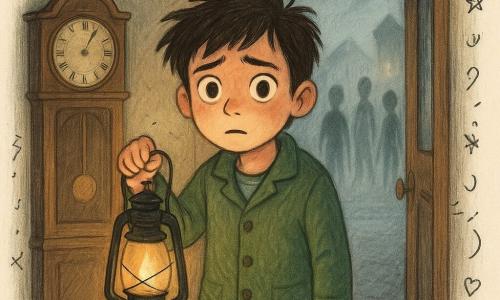
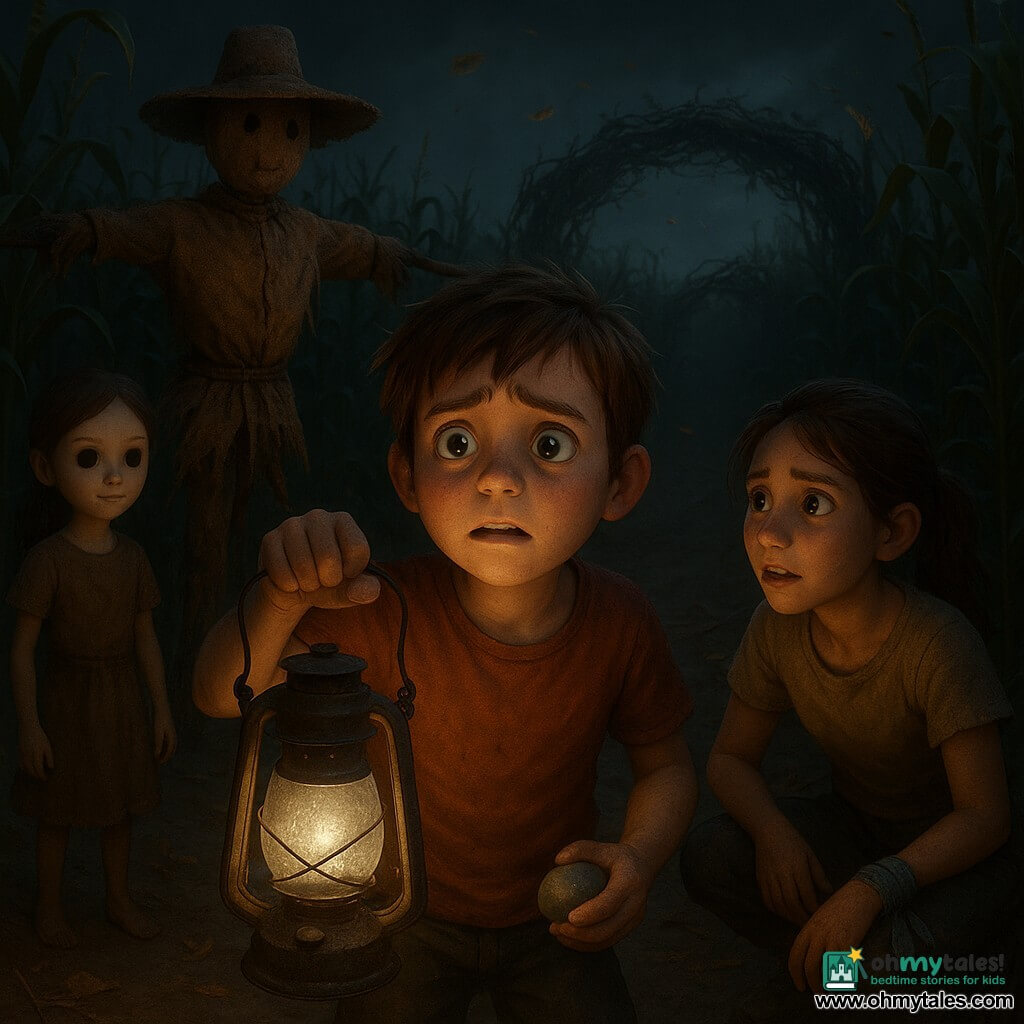
In the center of the clearing sat an old lantern, its glass dusty but glowing with a steady, pale light—too pale to be fire, too calm to be electricity. It lit the clearing in a sickly moonshade.
Beside it lay something else: a notebook.
Milo's first instinct was to grab the lantern and run, but his feet wouldn't move. The light felt like an eye.
He forced himself closer. The notebook's cover was mottled and damp, like it had been out in rain. Milo swallowed, then flipped it open.
The pages were filled with messy handwriting and smudged sketches of corn stalks, the scarecrow, and strange symbols that looked like tiny hooks.
One line was underlined so many times the paper tore:
DO NOT ANSWER THE FIELD WHEN IT SPEAKS.
Milo's stomach sank. He had definitely answered.
A second line, written lower on the page, made his throat tighten:
If you forget who you are, it can wear you.
Milo looked up quickly, half expecting the corn itself to be staring back.
A rustle came from the edge of the clearing. Milo lifted the lantern.
“Tessa?” he called.
A shape emerged slowly, pushing aside stalks.
It was a girl.
Milo's relief burst out of him so fast it almost made him dizzy. “Tessa!”
But then she stepped into the lantern-light, and Milo stopped.
The girl looked like Tessa—same height, same dark hair. But her eyes were wrong. Not the color. The way they moved.
They didn't blink.
And her smile was too still, like it had been pinned on.
“Milo,” she said. Her voice was nearly perfect. Nearly.
Something wet shone on her sleeve, and Milo realized she was wearing Tessa's blue bandana tied around her wrist.
Milo's hands tightened on the lantern handle. “Where's the real Tessa?”
The girl tilted her head. “I am Tessa.”
“No,” Milo said, his voice shaking. “Tessa would say I bike like a wobbly flamingo.”
The girl's smile trembled, as if the idea of wobbling had to be translated.
“You bike,” she said carefully, “like a… wobbly flamingo.”
Milo took a step back. “Stop it.”
The lantern-light flickered. The corn around the clearing leaned in.
The girl's smile stretched wider. Too wide. “The field learned her,” she whispered, and for a second her voice sounded like the corn—dry and many-mouthed. “Now it can be her.”
Milo's heart hammered. His mind rushed for a plan and came up with one small, stubborn thing: remember.
He shoved his hand into his pocket, gripping the remembering stone. The smoothness grounded him. Grandma's kitchen. Cinnamon toast. The sound of rain on the window while she told stories about being brave even when your knees shook.
“I'm Milo Reed,” he said firmly. “I don't belong to this field.”
The girl's eyes narrowed, and the lantern's glow dimmed. “You will,” she said, and her voice layered into two, then three—like a chorus trying to sound human. “We keep what wanders in.”
Milo grabbed the notebook and snapped it shut. He lifted the lantern, holding it out like a shield. The pale light pushed back the shadows under the corn leaves.
The girl flinched—just slightly, but enough for Milo to notice.
“You don't like the light,” Milo said.
The girl hissed softly, and the corn hissed with her.
Milo backed toward the far edge of the clearing. “Where did you get this lantern?”
The girl's head jerked toward the notebook, then back. Her mouth opened, and the words that came out weren't hers at all.
It belongs to the one who remembered.
Milo's gaze flicked to the notebook again. Someone had been here before. Someone who had fought back.
“Fine,” Milo whispered. “Then I'll remember harder.”
He ran—lantern swinging, notebook tucked under his arm, bike abandoned in the clearing like a fallen friend. Behind him, the girl's footsteps didn't chase so much as glide, and the corn began to count again.
Four… five… six…
Milo squeezed his eyes for one second and pictured a door—his front door—opening.
He opened his eyes and kept running.
Chapter 4: The Maze That Eats Names
The corn corridors twisted into a maze that made no sense. Milo should have hit the back fence by now. Greyclover Field wasn't that big.
Yet the stalks never thinned. The sky above shrank to a dark ribbon. The lantern's pale light made the corn look like green bones.
Milo slowed, panting, and looked around. Every direction looked the same: walls of corn, dry leaves, shadows that seemed to bend in to listen.
He opened the notebook with shaking hands, holding the lantern close so the pages glowed.
There were more warnings, written in hurried strokes:
THE FIELD TRIES TO TRADE YOU FOR A STORY.
IT WILL OFFER YOU A SHORTCUT.
IT WILL OFFER YOU A FRIEND.
Milo's throat tightened. Friend. Tessa's copy.
He flipped a few pages and found a sketch: a lantern drawn with a circle around it, then an arrow toward a rough map of a clearing and a crooked line that ended at a rectangle labeled GATE.
Underneath, the writer had scrawled:
LIGHT SHOWS WHAT IS REAL.
SAY YOUR NAME OUT LOUD.
SAY SOMEONE ELSE'S NAME IF THEY ARE LOST.
Milo swallowed. The corn rustled like it approved of swallowing.
He lifted the lantern higher. “I'm Milo Reed,” he said. His voice sounded small, but it was still his. “And I'm looking for Tessa Calder.”
The lantern brightened, just a little, and the shadows under the leaves pulled back. The path ahead sharpened, becoming more solid, less like a suggestion.
A whisper slid through the corn: Tessaaa…
It sounded like the field was trying on her name, tasting it.
Milo clenched his jaw. “No. Her name isn't yours.”
He walked forward carefully, lantern held up, repeating their names like stepping-stones.
“Milo Reed. Tessa Calder. Milo Reed. Tessa Calder.”
The maze fought him. Corridors that should have connected ended in dead-ends. Paths that were open moments ago seemed to pinch shut when he turned his head.
At one corner, the scarecrow appeared again, half hidden among stalks. Its blank sack-head leaned toward the lantern-light, as if sniffing.
Milo kept moving, refusing to look at it too long.
“You can't have me,” he said through his teeth. “I'm not a lost glove.”
The scarecrow's rope creaked. A dry chuckle seeped through the burlap.
Everyone is lost eventually.
Milo's fear rose like cold water. He wanted to run, but the notebook's warning echoed: The field tries to trade you for a story.
He took a breath, forced his feet to stay steady, and aimed the lantern directly at the scarecrow's face.
The pale light spilled over the burlap, and for a heartbeat Milo saw something beneath it—an outline, like a human face pressed from inside, struggling to form.
The scarecrow recoiled. The corn hissed in annoyance.
Milo used the moment. He turned and hurried down a corridor that suddenly looked clearer, as if the lantern had burned away a layer of lies.
The air changed.
A smell drifted to him—soap and wet pavement and a familiar strawberry shampoo.
“Milo?” a voice called, faint and frightened.
Milo stopped so fast he nearly dropped the lantern. “Tessa?”
“Milo! Where are you? It's so dark!”
Her voice came from somewhere ahead, deeper in the maze. It didn't sound copied. It sounded shaky and real, like someone trying not to cry.
Milo's chest ached with relief. “Stay where you are! I have a light!”
He ran toward the sound, lantern bobbing.
The corridor opened into a narrow pocket between the corn walls. There, crouched low with her knees hugged to her chest, was Tessa Calder—dirty, scratched, eyes wide.
When she saw Milo, she let out a breath that shook. “You're real.”
Milo crouched beside her. “You're real. That's the important part.”
Tessa gave a short, hysterical laugh that sounded like she'd swallowed a squeak toy. “I hate this field.”
“Same,” Milo said. Then, softer, “Are you hurt?”
“My pride,” Tessa muttered. She wiped her face with her sleeve. “I thought I could find my dog. I saw him run in here and I—” Her voice cracked. “Everything started moving.”
Milo swallowed. “I found your bandana.”
Tessa blinked. “I… dropped it. And then I saw—” She shuddered. “Someone who looked like me.”
Milo's grip tightened on the lantern. “Yeah. I met her. She's not you.”
Tessa leaned closer to the light, eyes darting to the corn walls. “It keeps whispering my name. Like it wants me to forget it belongs to me.”
Milo opened the notebook and showed her the page. “We have to say our names. Out loud.”
Tessa swallowed, then lifted her chin. “Tessa Calder,” she said, voice trembling but clear.
The lantern brightened again.
The corn around them rustled angrily, like a crowd losing a game.
Milo stood and offered his hand. “We're getting out.”
Tessa took it. Her grip was sweaty and fierce. “Lead the way, Wobbly Flamingo.”
Milo snorted, despite everything. “That's how I know you're you.”
Together, they walked, lantern-light cutting a thin, hopeful path through the maze.
Behind them, the corn began to count again—faster, sharper.
Seven… eight… nine…
Chapter 5: The Gate of Thorns
The maze tightened as if it sensed them leaving. Corn leaves scraped their arms like claws. The lantern's pale light flickered, and Milo hugged it closer.
Tessa stayed at his shoulder, whispering their names under her breath like a spell. “Milo Reed. Tessa Calder. Milo Reed. Tessa Calder.”
The scarecrow's scrape returned, louder now, like a shovel dragged across stone.
“Don't look back,” Milo said.
“I wasn't planning to,” Tessa snapped, then immediately added, “Sorry. Fear makes me mean.”
“Fear makes me sweaty,” Milo said. “It's fair.”
The corridor opened suddenly, spilling them into a wider strip of ground where the corn thinned. Ahead stood a gate.
It wasn't the rusty farm gate Milo expected. This gate was woven from thorny vines, braided into an arch. Pale seedpods dangled like teeth. The opening beyond it showed darkness, not the road—just a blank, waiting black.
Tessa's fingers tightened around Milo's wrist. “That doesn't look like out.”
The lantern dimmed, as if nervous.
Milo opened the notebook with frantic hands. Pages fluttered. He found a line scrawled near the back:
THE LAST DOOR IS A LIE UNLESS YOU CARRY YOUR OWN MEMORY THROUGH IT.
Milo's mouth went dry. “We have to remember something real,” he said.
Tessa frowned. “Like what? My locker combination?”
Milo almost laughed. “Something stronger.”
The corn behind them rustled, and the counting reached a final whisper.
Ten.
A cold pressure rolled toward them, like the field inhaling. The shadows between stalks thickened, and the copy of Tessa slipped into view at the edge of the lantern-light, smiling that pinned smile.
Beside her, the scarecrow scraped forward, its blank face aimed at Milo like a question.
“Give her back,” Milo said, voice shaking. “Give us the road.”
The fake Tessa tilted her head. “Trade,” she whispered. “Leave one. Take one.”
Tessa made a small strangled sound. “No.”
Milo's mind spun. The field wanted a story. It wanted a person to wear. It wanted him to step into the darkness and forget.
He squeezed the remembering stone so hard it pressed a sharp edge into his palm. Pain flashed, bright and clean.
He remembered the day Grandma gave him the stone. Not the words—her hands. The way they were small but strong, kneading bread dough like it was nothing. The way she'd looked at him and said, “Bravery isn't loud, Milo. It's steady.”
Milo lifted the lantern toward the thorn-gate. “I remember,” he said, and his voice grew steadier as he spoke. “I remember my grandma's kitchen. I remember cinnamon toast. I remember the sound of rain and the porch light and my dad singing badly while washing dishes.”
Tessa blinked hard, tears shining. “I remember my mom's laugh when she tries not to laugh. I remember the smell of grass after soccer. I remember my dog, Peanut, snoring like a tiny chainsaw.”
The lantern flared—pale light turning almost silver.
The thorn-gate trembled. The seedpods rattled like bones.
The fake Tessa's smile faltered. The scarecrow hissed from deep inside its straw.
Milo stepped closer to the gate. Darkness breathed from the opening, cold and thick, smelling of old cellars.
He swallowed. “We go together,” he told Tessa.
Tessa nodded, jaw clenched. “Together.”
They clasped hands, and Milo held the lantern out in front like a promise.
As they stepped under the thorn arch, the vines writhed, trying to snag their clothes, to hook their memories and pull them back. Milo felt a sharp tug at his mind—like someone trying to snatch his name right off his tongue.
He fought it by saying it out loud.
“I'm Milo Reed!”
“Tessa Calder!” Tessa shouted, fierce now.
The lantern burned brighter, and the thorns recoiled as if scorched. The darkness thinned, peeling away like fog in sunlight.
For a heartbeat, Milo saw the field for what it was: not endless, not alive like a monster, but stitched together from fear—layers of it, folded over and over until it felt solid.
Then the gate spat them out.
They stumbled onto gravel. Real gravel. Milo nearly cried at how ordinary it felt.
Behind them, the corn stood still, pretending it had never moved at all. The thorn-gate was gone. Only a simple break in the stalks remained, like an innocent doorway.
Tessa sucked in a breath. “We're out.”
Milo nodded, trembling. “We're out.”
A faint whisper drifted from the corn, softer now, almost disappointed.
Come back…
Milo lifted the remembering stone and closed his fingers around it. “No,” he said quietly. “We're going home.”
Chapter 6: The Dream That Let Go
Milo walked Tessa to the edge of her street, both of them jumpy at every rustle of leaves. When her porch light clicked on and her mom flung the door open, Tessa ran into the safety of her arms so fast she nearly knocked them both over.
Milo didn't stay for the questions. He couldn't have explained the counting, the copy, the gate made of thorns. He just waved weakly and headed home, the remembering stone warm from his grip.
His dad was in the kitchen when Milo slipped in, face pale, clothes torn at the sleeves. The smell of dish soap filled the air.
“Milo?” his dad asked, startled. “What happened?”
Words stacked up in Milo's throat and got stuck. “Got… turned around,” he managed.
His dad's eyes softened. He didn't push. He just pulled Milo into a hug that was solid and real and smelled like warm laundry.
That night, Milo lay in bed staring at the ceiling. The dark corner of his room looked too much like the corn's shadows. Every creak of the house sounded like rope tightening.
He held the remembering stone under his pillow and tried to breathe slowly.
“Bravery isn't loud,” he whispered, repeating Grandma's words. “It's steady.”
Sleep came anyway, creeping in like fog.
Milo found himself standing at the edge of Greyclover Field again.
Moonlight painted the corn silver. The air was cold and sweet. The path into the field waited, narrow as a dare.
Milo's heart jumped—until he noticed something different.
He wasn't alone.
Grandma stood beside him, wearing her old raincoat, the one with the torn pocket she never fixed. Her hair was tucked under a scarf. She looked exactly as Milo remembered, like she'd stepped out of a warm memory and into this strange night.
“Milo,” she said gently.
Milo's throat tightened. “Grandma? Are you… real?”
She smiled, and it wasn't pinned on. It crinkled at the corners, warm as toast. “As real as you need me to be.”
The corn whispered, a low, hungry sound.
Grandma turned toward the field. “You've been frightened,” she said, as if noting the weather.
Milo nodded. “It tried to take Tessa. It tried to… wear her.”
Grandma's gaze stayed calm. “Fear likes costumes. It wants to look bigger than it is.”
The corn began to count, the numbers sliding through the stalks like snakes.
One… two… three…
Milo's stomach clenched, but Grandma touched his shoulder. Her hand felt steady and strong.
“Do you remember what you did?” she asked.
“I… said my name,” Milo whispered. “And I remembered.”
“Good,” Grandma said. “Then do it again. But this time, don't run. Look at it.”
Milo stared at the corn. The stalks swayed, leaning toward him. Shadows wriggled between the rows, eager and cold.
His fear rose up, ready to flood him.
He held the remembering stone in his dream-hand, and it shone faintly, like a small captured star.
“I'm Milo Reed,” he said. His voice wobbled, then steadied. “I'm twelve years old. I like sharks on my socks and I hate math homework and I'm brave even when I'm scared.”
The corn hissed.
Grandma nodded. “Now tell the field what you want.”
Milo swallowed. “I want you to leave me alone,” he said. “I want your whispers to stop.”
The corn rustled, louder, annoyed. The counting sped up, trying to drown him.
Four… five… six…
Milo felt his fear tugging at him, trying to pull him into the maze again. He imagined the thorn-gate, the fake Tessa's smile, the scarecrow scraping closer.
He didn't push the fear away. He didn't pretend it wasn't there.
He just stood with it.
“My fear is real,” Milo said, voice firm. “But it's not in charge.”
The lantern appeared in his other hand, as if his memory had made it. It glowed pale silver, steady as a lighthouse.
Milo lifted it toward the corn.
The stalks recoiled. The shadows thinned. The counting stumbled.
Seven… eigh—…
The number broke apart, scattering like dry leaves.
Grandma's hand squeezed his shoulder once. “That's it,” she murmured. “You're bigger than the story it wants to tell.”
The corn field sighed, long and tired, like a monster losing interest when it couldn't get a reaction. The stalks lowered, no longer looming. The path widened, turning into an ordinary dirt track that led back to the road.
Milo blinked. The air warmed. The sweet, rotten smell faded, replaced by night grass and distant chimney smoke.
Grandma smiled. “Go on,” she said. “Wake up.”
Milo's eyes opened in his bed.
Morning light spilled across his blanket, bright and honest. The corner of the room was just a corner again. The house creaked in its normal, sleepy way.
Milo reached under his pillow. The remembering stone was there, cool and smooth.
Outside, the wind stirred the trees—not corn—and the sound was simply the sound of leaves, not whispers.
Milo sat up, heart calm for the first time since the shortcut.
He wasn't fearless.
But he was free.