Chapter 1: The Red Smear
On a gray November morning, Jamie found the smear.
He was late for homeroom, backpack straps digging into his shoulders, breath steaming in the cold. Halloway Middle School crouched behind iron gates, its brick face scarred with ivy and rain. The great clock over the main hall had been part of the building since before his parents were born; its hands were like the strokes of an old marker, bold and patient. Everyone called it the Halloway Clock, but the older boys whispered another name: the Bleeding Clock.
Jamie slowed where the linoleum of the corridor met the polished marble of the foyer. A thin ribbon of something dark and glossy ran from the clock's face, across the stone, and toward the main entrance. It was like someone had dragged a finger through time and left a stain.
"Gross," muttered Mason, one of Jamie's friends, coming up behind him. Mason's sneakers squeaked a rhythm on the marble. "Did someone spill paint?"
"Looks like... jam," said Aria, tugging her scarf tighter. She was careful and clever, forever reading old books she shouldn't, and she knelt to examine the smear. The "jam" caught the light and seemed to glint a little on its own—no texture, a slick surface that made Jamie's skin prickle.
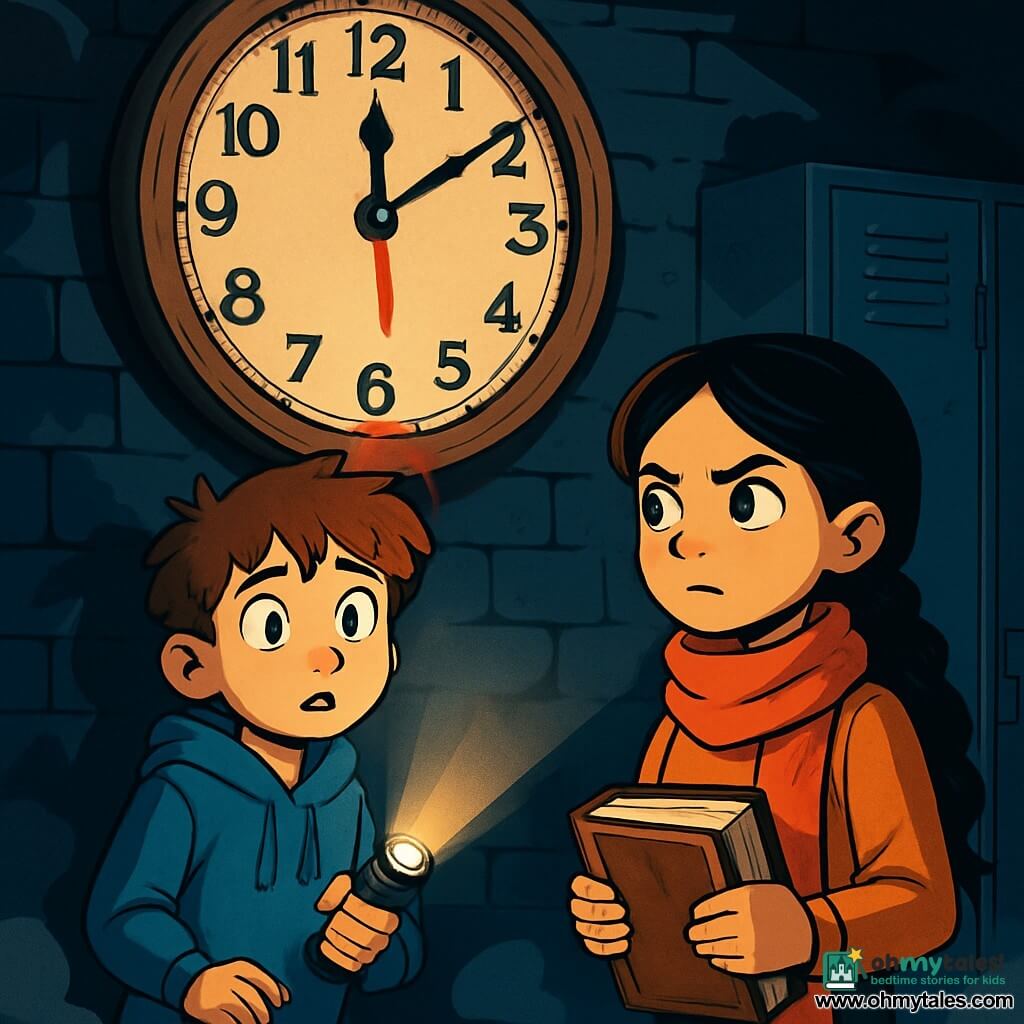
They circled the clock. Its face was cracked like an old teacup. The hands were stopped at 12:17. A faint, metallic scent hung in the air, like pennies rubbed together. The stain ended in a neat drop at the base of the clock, as if someone had tried to wipe it and given up.
"Mrs. Wren's going to have a fit," Mason said, peering up at the clock tower. "She likes things tidy."
Jamie thought of the stories they'd been warned about every year in assembly: late nights when the wind was wrong, when the clock's face leaked crimson, when a small boy wandered down the hall humming a song that no one remembered. Stories were stories—until you saw something real. He felt a small, unfamiliar tug of curiosity and fear that would not let go.
"Let's check the library," Aria said. "If it's not paint, someone must know what it means."
They left a trail of muddy footprints and the echo of their footsteps as they hurried past lockers and peeling posters for the upcoming winter dance. Jamie kept glancing back at the clock, its stopped hands like the held breath before a thunderstorm.
Chapter 2: The Bent Page
The library smelled of dust and lemon cleaner, of used paper and the safe quiet of stories. Mrs. Wren, who had hair the color of old parchment and a way of peering over her glasses like she could see everything at once, greeted them without surprise.
"It has been happening again," she said softly when they showed her the photo Aria had taken on her phone. The three of them clustered in a corner between encyclopedias, while amber light slanted through high windows.
"You mean the Bleeding Clock," Mason said, half-laughing to hide the way his throat had tightened. He hadn't meant to say the name out loud.
Mrs. Wren's fingers brushed the spine of a thick, leather-bound ledger on the shelf. "This school keeps records. There are things recorded here that never make it to the newspapers. Sometimes, the past taps at the present."
She fetched the ledger, and they hunched over it. The pages were full of neat, tiny handwriting and yellowed newspaper clippings pasted in with glue browned by time. Aria's eyes widened at a photograph: a boy no older than Jamie in a sweater with a crooked collar, standing beside the statue of the school's founder. Under the photo, a single column read: ELIAS WREN — ATTENDANCE MISMATCH — ABSCONDED — 1954.
"Elias Wren?" Jamie read aloud, the name tasting odd. "Like—"
"Not related," Mrs. Wren said. Her voice had gone thin. "But the same name often returns in the margins of this town's history. We've had years when the clock refused to keep time. Each time, someone remembers an Elias."
Aria ran her finger under a line of a brittle, handwritten note. "Here. 'He was last seen at the clock. Said the hands were bleeding. Said time hurt him.'"
"Time hurts him?" Mason snorted, then looked embarrassed at his own laugh.
"It could be a metaphor," Jamie said. He was trying to sound sensible for their sake. He didn't want to admit that the little hair at the back of his neck kept lifting. "But why would it bleed on a school clock?"
Mrs. Wren closed the ledger with more force than necessary. "Because something in this school refuses to be forgotten. Sometimes things that are full of fear and loneliness tangle themselves inside places that remember. You boys and girls are old enough to listen. But be careful. The past doesn't always want visitors."
Be careful. The warning sank into Jamie like a stone dropped into deep, dark water. It made him look at the smear in a different way—not a smear of paint, not a prank, but a sign.
"Let's come back tonight," Aria said before anyone else could stop her. "We can bring a flashlight. We can find out what's really going on."
Jamie surprised himself by nodding. He'd always been the kind of boy who liked to know the truth. The thought of walking away while something in the school wept red at midnight felt worse than any fear.
Chapter 3: Midnight and a Song
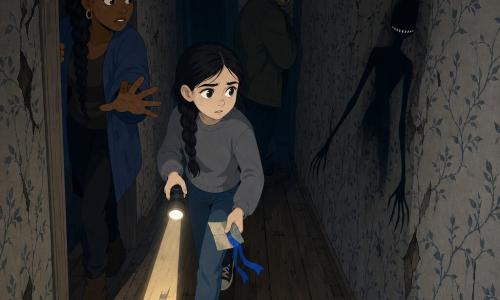
The school at night was not the school at all. It was a place of long shadows and muffled sounds, where the ordinary things—the trophy cases, the vending machines, the rows of lockers—looked as if they'd been draped in someone else's skin. The moon poured like cold milk through the high windows of the foyer, and the clock's face gleamed like glass.
They waited at eleven, breathing in the hollow time between day and night. Mason's phone flashed an impatient blue. Aria had a small pack with a thermos of cocoa and a bundle of string. Jamie's palms felt sweaty against the flashlight.
"Promise me we leave if something weird happens," Mason said. His voice shook.
"Promise," Jamie said.
"Promise," Aria echoed, though her eyes were fixed on the clock and not on him. They didn't move when the janitor's truck rumbled away or when a distant dog barked. They only watched.
At 12:17, the clock made a sound like a dry cough. The hands trembled, and a sliver of dark oozed from the hairline crack at the twelve. It shivered down the face in a slow, reluctant ribbon and pooled at the base into a small bead. The bead fell, slow as a thought, and hit the floor with a soft, wet whisper.
Jamie felt his stomach lurch. Up close, the smear didn't look like paint. It glinted like wet stone, and there was a faint metallic tang that pricked the back of his tongue when he breathed.
"Do you hear that?" Aria whispered.
At first they heard only the building's same old sighs. Then, underneath it, a sound like someone humming a simple tune—low and thin, like a record with a scratch. The tune was the sort of thing a child forgets and then remembers in a dream: three notes rising like a question, two falling like an answer.
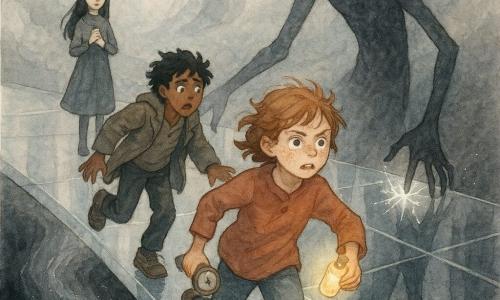
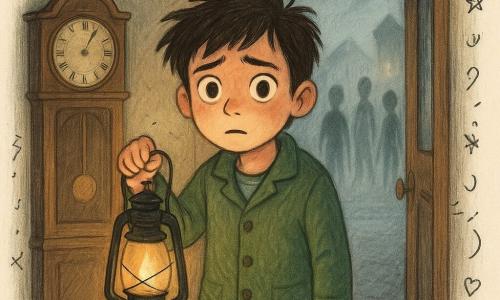
A shape moved. It was small and slight, something between a boy and an impression of one, like steam caught in the shape of a child. He stood near the clock, hands folded as if he were trying to keep them warm. His eyes were too big and too empty, like paper cutouts, and in the pale light they looked like two glass marbles.
"Who are you?" Jamie asked, because no one else did.
The boy's mouth opened the way a book opens to a new page. "I can't stop it," he said. His voice was muffled, as if he spoke through cotton. "The hands hurt. They bleed time."
Fear climbed Jamie's spine. The school felt heavy, the kind of heavy that presses on your chest. The boy's fingers were pale and cold as driftwood. As he moved, the air around him seemed to chill further, breath freezing in small puffs.
"Mason," Aria urged, planting a hand on his arm. "Stay."
The boy looked at them then, and something like recognition trembled upon his face. Warmth flashed like a coin and then went out. "You came back."
"We want to help," Jamie said before he could stop himself. The words sounded braver than he felt. "Who are you? Why are you here?"
He swallowed hard. "Elias," the boy said. "I— I was left behind."
The clock sighed, and a bead of the dark crimson fell. The sound it made was not merely wet; it was like a page tore. A memory brushed Jamie—faces in a parade of sorrow, hands that let go, a small boy's shoes left by the school gate.
Elias - the name from the ledger. Jamie felt, suddenly, as if the whole ledger were a map with a route leading straight to this boy.
"You're not alone," Aria said. She took a step forward, the courage in her voice like a small lamp. "We won't leave you."
Elias's lips trembled. "You can't stay long. The clock wants its stories to be the only ones here."
A sound like wind slid down the staircases. The overhead lights flickered. For a second, the school felt like a throat ready to swallow them whole.
Chapter 4: The Hidden Room
Elias could not move away from the clock. His figure stood anchored as if threaded to the mechanism, and sometimes, when the hands twitched, his whole form shuddered.
"We need to get inside it," Aria said. "To see what's trapped in there."
"Get inside a clock?" Mason blurted. "Are you serious? We'll get crushed by gears."
"Not into the gears," Aria said firmly. "Inside the clock face. There might be something hidden— something that holds his memory."
Mrs. Wren's ledger had a note about the clockmaker's apprentice, a small piece of handwriting that read: "Small key hidden behind the statue. Said to bind works and hearts." It was a slender chance, but it was a chance. They found the brass key tucked into the hollow of the statue of the founder on the landing, dusty and cold as a coin, and carried it like contraband.
The door at the back of the clock was a panel of rusted metal; it groaned when Jamie slipped the key in and turned. Behind it, instead of cogs and pendulums, was a tiny staircase spiraling down. The air smelled of old wood and a hint of roses.
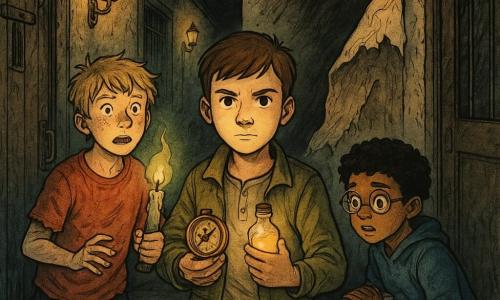
They went down, the flashlight wavering, until they reached a room no larger than a pantry. It was full of things wrapped in cloth: a pair of worn boots, a music box with a cracked enamel horse, a school sweater with stitching undone, a child's scarf knotted with care. On a small table there was a bundle of letters tied with twine. Aria untied them with fingers that did not tremble.
They were letters to Elias. Notes folded into the shape of hearts and schedules and a tiny scrap from a child's handwriting: "Will you come to the winter play? Don't be shy." There were drawings of a boy with a crooked smile, a poem scrawled with a name at the end—Elias—in big, blunt letters.
And beneath the letters, wrapped in oilcloth, a small, cracked pocket watch with the initials E.W.
Jamie picked it up. It was warm in his hand, like a small animal. The cover opened with a sigh to reveal a tiny, faded photograph of a boy with dark hair and a lopsided grin. The same face as before—Elias. On the back was written, in careful looping script: "Remember me."
A sob rose in Jamie's throat. When he looked up, Elias's outline had come closer to the doorway. He watched them with a kind of wonder that made his features almost beautiful for a heartbeat.
"Why was this hidden?" Aria asked.
The letters, the watch, the forgotten notes—everything had been sealed away, as if someone had tried to bury a boy's life so it would not be messy, not make anyone uncomfortable. Jamie felt anger, not because anyone had done wrong now, but because someone had turned away.
"Because they were afraid," Elias said, his voice a thread. "They thought if they tied me to the clock, it would keep me safe. But the clock keeps me alone."
"Who tied you?" Mason whispered. "Who left you?"
Elias's eyes filled with something like salt. "They left me. Said I was trouble. Said I'd break the rhythm. I hid, and then I couldn't find my way out."
Aria sat cross-legged on the floor, holding the pocket watch. "He needs to be remembered properly," she said. "Not hidden. We have to tell his story."
"But how do you convince a ghost to leave his clock?" Mason asked. His voice cracked. The idea of asking Elias to forget the only thing that had kept him from floating away felt cruel.
Jamie thought of the ledger, of Mrs. Wren's careful fingers, and of the smear in the foyer. The clock was bleeding because the story of Elias had been cut out of the town like a carved-out heart. If you remind a story of itself, maybe it heals.
"Maybe he doesn't need to leave," Jamie said. "Maybe he needs someone to stay, to remember, to say his name and tell the truth."
Elias's outline flickered like a candle in wind. "They all promise to remember. No one ever does."
"Then we'll remember," Aria said. "Tonight. We'll tell everyone. We'll make sure he has a place where someone says his name every year. He deserves that."
Elias looked at them as if trying to press his face to a window. "Will you really?"
"Yes," Jamie said, with more certainty than he'd expected.
Chapter 5: The Night of Names
They did not shout Elias's name in the hallways the way some stories imagined, not with torches and theatrical cries. Instead, they asked for small, true things. They wrote a plan on the back of an envelope and carried it like a map.
First, they took the pocket watch and the letters to Mrs. Wren. Her hands shook when she read them, but not with fear. They shook with some old sorrow that had been waiting for permission to be seen. She read one aloud in the library at dawn, the quiet of her voice folding around the words like a blanket.
"To Elias," she said. "I was too scared to be your friend in the daylight. I'm sorry."
Aria typed up what they found and sent it to the town's historical society, whose members loved facts like fishermen loved nets. Mason, who was better at persuasion than he let on, convinced a few other kids to join. Jamie wrote a piece for the school paper, careful and steady, that told the truth of a boy who had been left and remembered and forgave—not because he had to forgive, but because forgiveness was a way out.
That night, the students and some teachers who had heard the story came at dusk. Some of them only stayed to watch; some came to be a part of a small, shameless ceremony. They brought candles. They stood in a loose circle in the foyer, the clock looming above them like a moon.
Mrs. Wren placed the pocket watch beneath the clock as if making an offering. One by one, they said Elias's name. Not in a chant, but in whispers and in voices that were deliberate, each syllable a small, warm thing placed into the air. Some children read the lines from the letters. Someone hummed the three-note tune Elias had murmured. They lit the candles and let the smoke curl up like birds.
Jamie felt unusual things: shame for the town's past slowness to notice, a fierce pride in this rightness they had created in a room heavy with denial. He stepped forward, the light playing on his face, and said aloud the truest thing he could:
"We remember you, Elias Wren. You are not just a story."
As the words left Jamie's mouth, the clock shivered. The smear on the floor seemed to breathe. A bead of the dark slid slowly, fearfully, back up the clock face as if something were being pulled out. Elias's shape uncoiled from the mechanism like water released from a jar.
He looked lighter—no longer a cutout boy but more like someone turning toward morning. The eyes that had been hollow now held color: the green of new leaves. The hands that had been cold warmed like someone stepping into the sun.
"I tried to be brave," Elias told them softly. Tears—the color of rust but gentle as old apples—slid down his cheeks. "I was ashamed. I thought if no one said my name, I might vanish, or maybe the hurt would stop. But the forgetting hurt me more."
"You're not forgotten now," Aria said.
Elias smiled, small and genuine. "Will you be my friends?" he asked, as if friendship were currency he had been trading for years with no returns.
Jamie felt something inside him fold and open at once. "Yes," he said, and it was as simple and as world-changing as that. "Yes, we'll be your friends."
The school held its breath. For the first time in decades, the clock's hands moved without complaint. The crack on its face mended like a seam. The smear on the floor dried into nothing, and when the last candle guttered, there was only a faint sheen where the crimson had once been.
Chapter 6: Dawn and a Promise
At dawn, light slid over the school's roof and found them in the foyer, sleep-rough and bright-eyed. Some of the older teachers had stayed until the first trains, telling stories of times when the clock had been wrong and how children had fixed it by naming the problem aloud. The town's historical society announced a small plaque to be placed in the library—"In memory of Elias Wren. Remembered, 1954 and 2025."
Jamie did not think of the plaque as a finality. It was more like a doorway. Elias came to school like a soft rumor. He sat at the back of assemblies, no longer phantom but flesh that could be bumped and laughed at. He walked the halls with them, sometimes silent, sometimes humming the three-note tune. People stopped being awkward; remembering forced them to be kinder.
"What changed?" Mason asked on the walk home, kicking at a loose cobblestone.
"Stories always have power," Aria answered. "But it's what you do with them—who you tell them to—that matters. We gave Elias a name in the open. We offered him a place in the light."
Jamie thought of the pocket watch, now resting in the library case under glass. He thought of Mrs. Wren's lined hands and the ledger that kept the town's small and private histories. He thought of Elias's voice and how fragile bravery could be.
That evening, Jamie sat on his bed with his own old watch in his palm. He thought about how time had been bleeding in the school, how small acts of remembering had stopped the hurt. He understood, suddenly and clearly, that courage wasn't the loud heroism of the stories. It was the quiet choice to look at someone who's hurting and to say, "I see you."
He thought of Elias standing by the clock, the small boy's eyes turning toward the future. He promised himself something like a vow: to remember better, to hold open that small space where lonely things could step out into the sun.
Outside, night drew its curtains and the town settled into sleep. The Halloway Clock ticked on above the hall—steady, human, patient. If you walked past the foyer now and then, you could still hear a faint tune, barely hummed, as if someone was practicing the right way to be brave.
When Jamie turned off his lamp and the room slipped into darkness, he was not afraid. The world could be a cold and lonely place, he knew that now; it could bruise and forget. But there would be names afterward: small, stubborn lights that refused to be erased. And there would be him—twelve years old and more certain than he had ever been—that when someone bleeds time, someone else should always be there to bind the wound with memory and kindness.