Chapter 1: The Map on the Wall
Monday morning smelled like dry markers and pencil shavings. In Mr. Patel's classroom, a big world map hung near the window. It usually felt like decoration, like a poster in a hallway.
Today, it felt different.
Mr. Patel tapped the map gently with a ruler. “Class, our school has a partner class in another country. It's called a twinning program. We learn about each other's lives.”
Eli, Max, and Jonas sat together, as usual. They were all almost ten—Eli had just turned ten last month, Max would be ten in two weeks, and Jonas liked to say he was “ten in spirit” even though his birthday was still far away.
Mr. Patel pointed to a small place on the map. “Our partner class lives here. Right now, their country is in a war.”
The room went quiet, the kind of quiet that makes you hear someone's chair squeak like it's shouting.
Max raised his hand. “War is… like when soldiers fight?”
“That's part of it,” Mr. Patel said, keeping his voice calm. “A war is a big conflict between groups or countries. People argue in a way that becomes dangerous. It can damage homes and schools. It can make normal life harder.”
Jonas frowned. “But why don't they just… stop?”
Mr. Patel nodded, as if Jonas had asked the most important question in the world. “Many people try to stop it. Some leaders talk. Some helpers bring food and medicine. Some neighbors protect each other. But stopping a war can take time.”
Eli looked at the map again. He imagined a classroom like theirs, but with different streets outside the window. He tried not to imagine anything scary. Instead, he imagined kids raising their hands, whispering jokes, passing notes.
“What can we do?” Eli asked.
Mr. Patel smiled softly. “We can write them a message of support. We can be kind. We can show them they are not alone.”
Max leaned toward Eli and whispered, “We should write the best message ever. Like… the ultimate friendly message.”
Jonas whispered back, “With jokes. And snacks.”
Eli almost laughed, then thought of the word war again. He didn't feel like laughing much. But he did feel something else: a steady, brave sort of readiness.
“Yeah,” Eli said quietly. “Let's help.”
Chapter 2: Questions That Fit in a Backpack
At recess, the boys walked the edge of the playground where the grass met the fence. It was their thinking path, like a secret meeting place, except it wasn't secret at all.
Max kicked a small stone. “So war is a conflict. Like the biggest argument ever.”
Jonas made a face. “My parents argue about dishes. That's a conflict too, right?”
Eli nodded. “A conflict is when people want different things and can't agree.”
Max's eyes narrowed. “But our parents don't… you know… send tanks.”
“Because they talk,” Eli said. “Or they cool down. Or they compromise.”
Jonas scratched his head. “Compromise is when both people give a little?”
“Exactly,” Eli said, glad he knew the word. It made him feel useful.
They sat on a bench. The metal was warm from the sun.
Max asked, “Do kids there still do math?”
Eli shrugged. “Maybe sometimes. But maybe they have to do school in different places. Or online. Or they have to stop when it isn't safe.”
Jonas looked down at his sneakers. “That's not fair.”
“No,” Eli agreed. “It isn't.”
Max pulled a granola bar from his pocket like it was a serious tool. “If I was there, I'd share this.”
Eli smiled a little. “We can't send food right now. But we can send words. Words can be like… a flashlight. Not huge, but still helpful.”
Jonas brightened. “We could tell them about our class hamster!”
Max laughed. “Yes! Mr. Nibbles would unite all nations.”
Eli pictured the hamster's tiny paws and puffed cheeks. It felt good to think of something small and normal.
But Eli also wanted to be careful. “We shouldn't pretend everything is perfect,” he said. “We should be honest and kind. Like, ‘We're thinking of you. We hope you're safe. We're here with you.'”
Max unwrapped his granola bar. “And we can ask what they need. Like, maybe they want drawings or stories.”
Jonas nodded. “And we can tell them what we do when we feel scared. Like breathing. Or talking to someone.”
Eli looked at the sky, bright and ordinary. He thought about how lucky “ordinary” was.
“Let's write a message that says we care,” he said. “And that peace matters.”
Max chewed thoughtfully. “Peace is when people solve problems without hurting each other.”
Jonas added, “And when you can do homework without explosions.”
Max elbowed him. “Jonas!”
“It's true,” Jonas said, not joking this time.
Eli stood up. “After school, we'll draft it. Together.”
Chapter 3: The First Draft and the Funny Line
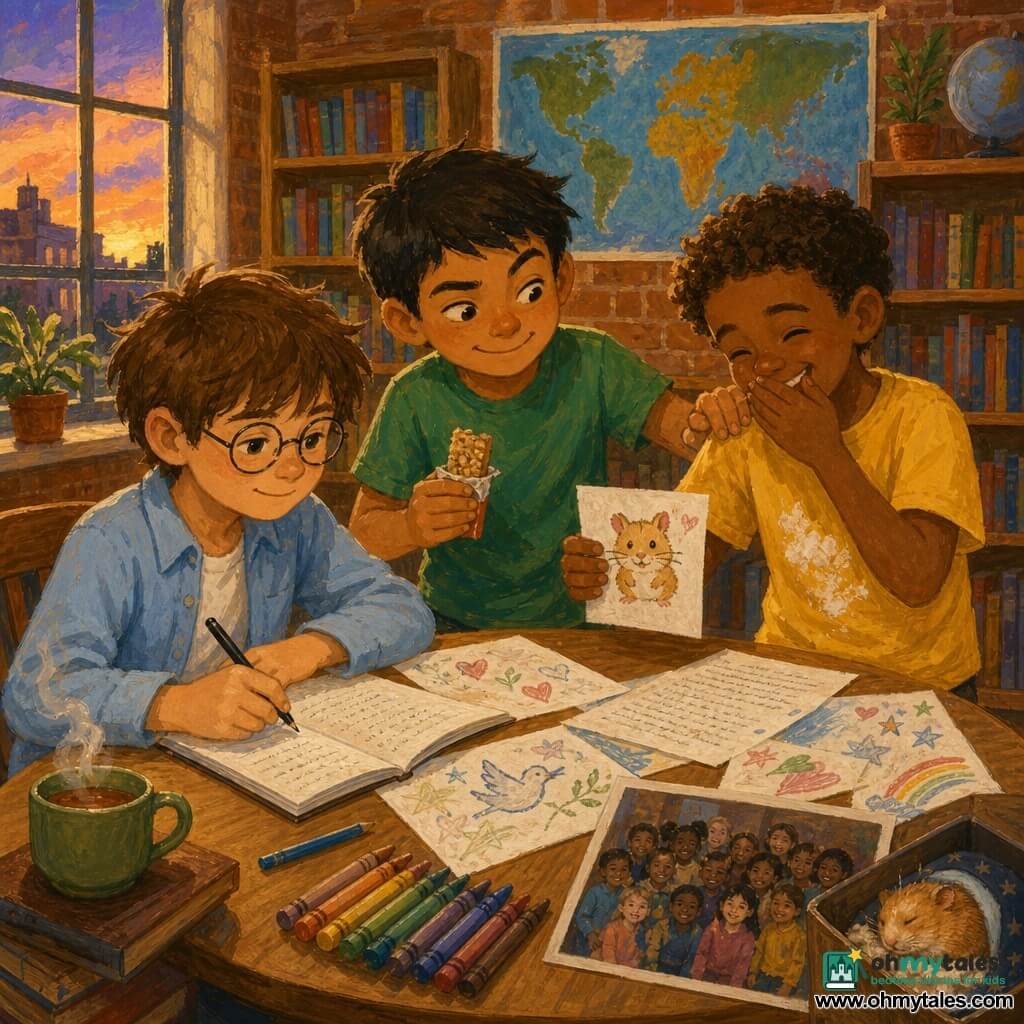
After school, they met at the library. It smelled like paper and quiet. The librarian, Ms. Ortega, gave them a look that said, Please don't wrestle between the shelves.
They chose a table near a window. Eli opened a notebook. Max lined up three pens like they were tiny soldiers—then quickly frowned and moved them into a happy rainbow instead.
Jonas whispered, “Okay. What do we say first?”
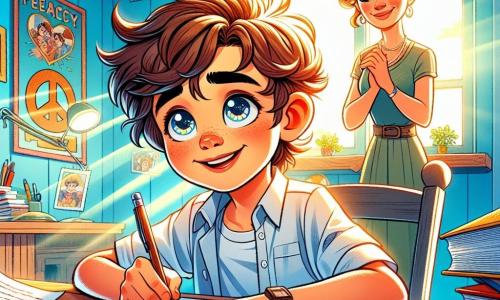
Eli wrote, slowly, because first sentences mattered.
“Dear friends,” he said out loud. “Simple.”
Max nodded. “Not too fancy.”
Jonas tapped the table. “We should say who we are.”
Eli wrote: “We are three boys from Class 4B. We are almost 10 years old.”
Max grinned. “Write that I'm basically ten.”
Eli wrote: “One of us is ten, one is nearly ten, and one says he is ten in spirit.”
Jonas smiled proudly. “That's me.”
They paused. The hard part was next.
Eli took a breath. “We should name the war, but gently. Like, we know something tough is happening.”
Max leaned in. “Try: ‘We heard that your country is going through a war, and we feel worried for you.'”
Eli wrote it, then read it back. It sounded caring, but not too dramatic.
Jonas said, “Add: ‘You are not alone.' That's important.”
Eli added the sentence.
Max raised a hand like he was in class. “Can we explain what we think peace is? Like, we believe in talking.”
Eli wrote: “In our class, we are learning that conflicts can be solved with words, listening, and help from others.”
Jonas said, “And teamwork!”
Eli added: “We believe teamwork makes people stronger.”
Max looked thoughtful. “But what if they're scared? We should be real.”
Eli nodded. He wrote: “If you feel scared, we hope you have safe adults and friends around you. When we feel worried, we talk to someone we trust and we take slow breaths.”
Jonas waved his hand. “Now the hamster!”
Max laughed silently, shoulders bouncing, remembering Ms. Ortega.
Eli wrote: “Our class hamster, Mr. Nibbles, sends tiny brave vibes.”
Jonas whispered, “Tiny brave vibes!” and snorted, then clapped a hand over his mouth.
They read the whole message. It was kind, but Eli still felt something missing.
“What about asking them about their life?” Eli said. “Not just talking at them. Like we're equals.”
Max nodded. “Yes. Ask about their favorite books. Or games.”
Jonas added, “Or if they have pets. Or what food they miss.”
Eli wrote: “If you can, please tell us about your day, your favorite things, or what you like to learn. We want to know you.”
They sat back. The message looked like a bridge made of words. Not a giant bridge, but sturdy.
Max pointed at one line. “Maybe we should say we hope for peace, but also that we know peace takes work.”
Eli wrote the final part: “We hope for peace for you and for everyone. We know peace happens when people keep trying to talk and help, even when it is hard.”
Jonas exhaled. “That's good.”
Eli closed the notebook gently, like it held something fragile and important.
Chapter 4: Sending the Message, Doing Small Peace
The next day, Mr. Patel asked for volunteers to share the draft with the class. Eli's heart thumped, but his hand went up anyway.
Max's hand shot up too. Jonas raised his hand a second later, as if it needed a little encouragement.
At the front, Eli held the notebook while Max and Jonas stood beside him like a team. Eli read the message aloud. Some kids in the class nodded. A few looked sad. Nobody laughed at the serious parts, and Eli was glad.
When Eli reached “tiny brave vibes,” a quiet ripple of smiles passed through the room—like a window opening for fresh air.
Mr. Patel said, “Thank you. This is thoughtful and respectful.”
A girl named Hana raised her hand. “Can we also do something here? Like a fundraiser?”
Mr. Patel nodded. “We can. We'll talk to the principal and make sure it is safe and organized.”
Max whispered to Eli, “Like selling bookmarks!”
Jonas whispered, “With Mr. Nibbles on them.”
Eli whispered back, “And maybe peace symbols. Not complicated, just simple.”
Mr. Patel continued, “But remember: helping isn't only big events. It is also daily choices. Listening. Sharing. Being fair.”
He wrote three words on the board: “Dialogue. Help. Solidarity.”
“Solidarity,” Mr. Patel explained, “means standing with someone. It means you don't turn away.”
Later, in the hallway, Eli saw two younger kids arguing over a soccer ball. Their voices were getting louder. The ball sat between them like a stubborn rock.
Max started to walk past, but Eli paused.
He stepped closer. “Hey,” Eli said calmly. “What's the problem?”
“He took it!” one kid said.
“It was my turn!” the other kid said.
Eli thought of the map and the word conflict. This was small, but it was still a conflict. And small practice mattered.
Eli pointed to the ground. “How about this: one of you takes three shots, then the other takes three shots. We count. Deal?”
The kids hesitated, then nodded. The argument shrank, like a balloon letting out air.
Max stared at Eli. “Look at you, Mr. Peace Ambassador.”
Jonas added, “Your badge is invisible but powerful.”
Eli rolled his eyes, but he smiled. “It's just sharing.”
Max shrugged. “Sharing is basically superhero stuff.”
That afternoon, they typed the message neatly and printed it on clean paper. Mr. Patel scanned it, along with a class photo where everyone held up paper doves they had cut out. Mr. Nibbles appeared in the corner of the photo, asleep in his wheel, like he had already done his part.
When Mr. Patel pressed “send,” the email whooshed away into the internet.
Eli imagined it traveling like a paper airplane across the sky.
Chapter 5: A Reply Like Morning Light
Three days later, Mr. Patel walked into class holding his laptop with both hands. His face looked serious, but his eyes were warm.
“We received a reply,” he said.
Chairs scraped. Max made a noise like “Eee!” but stopped when Jonas shushed him.
Mr. Patel projected the email on the screen. The class leaned forward.
The message was from the partner teacher, and it included lines written by the students.
Eli read silently as Mr. Patel read aloud.
“Dear friends,” it began. “Thank you for your letter. We read it together. Some of us smiled for the first time in days.”
Max swallowed hard.
Mr. Patel continued, “We are doing lessons in a community center now. We bring our notebooks in backpacks. Sometimes we have to stop and wait. But we keep learning when we can.”
Jonas whispered, “They're still doing school.”
Eli felt a tight feeling in his chest, like he wanted to hold something carefully.
Mr. Patel read more: “We liked your hamster. We do not have a class pet right now, but one student's grandma has a cat who visits. We take turns drawing it.”
A small laugh escaped Max, gentle and relieved.
Then Mr. Patel read: “We want peace too. We try to be kind to each other because that is something we can control. When we are worried, we sit with a friend, drink warm tea, and tell stories.”
Eli pictured warm tea, steam rising like a tiny cloud. A simple thing that could still exist.
At the end, the email said: “Please keep writing. It helps to know you are there.”
The room stayed quiet for a moment, but it was a different quiet than before. It felt full, not empty.
Mr. Patel said, “Class, what did we learn from this?”
Hana raised her hand. “That support matters.”
Another boy said, “That learning can keep going, even when life is hard.”
Max raised his hand. “That a hamster can bring world peace.”
Some kids giggled, and even Mr. Patel smiled.
Eli raised his hand last. “That we can't fix everything,” he said carefully, “but we can do something. We can choose words instead of yelling. We can share. We can send support. And we can keep hoping.”
Mr. Patel nodded. “Hope is not pretending. Hope is action, even small action.”
That week, the class made peace-themed bookmarks to sell at the school fair. The money would go to a trusted relief group Mr. Patel had researched with the principal. Eli, Max, and Jonas worked the table together.
Max called out, “Bookmarks! They help your book AND your brain!”
Jonas added, “And they are 100% Mr. Nibbles approved!”
Eli shook his head, smiling, and straightened the stack so it looked tidy.
As the fair ended, the sun lowered, turning the school windows gold. Eli looked up at the map in the hallway. The partner country was still far away, and the war was still real.
But now there was also a thread connecting two classrooms.
It was made of words, drawings, and steady kindness.
Eli imagined the other kids reading their next message. He imagined them smiling again, even if just a little.
He tucked that thought into his mind like a bookmark—saving the place where hope lived, ready to return to it whenever he needed.