When Lina Heard the Word
Lina woke to rain tapping on her bedroom window. Rain sounded like small drums. She liked that noise. It made the morning feel calm. Downstairs, the radio said a new word. Lina sat on the stairs and listened. The word was 'war'. It sounded heavy and confusing.
Her mother was making tea. Her mother had a clear voice. She explained slowly, in the kind way she always did. "Sometimes, in faraway places, people disagree and fight," she said. "We call a big, long fight between countries a war. It makes life hard for many people."
Lina had questions. She asked them one by one. "Are bombs like in the films?" Her voice trembled a little. Her mother shook her head and made sure she sounded calm. "Not the films," she said. "Real life is quieter and sadder. But we do not need to imagine scary parts. What matters is what we can do now."
Her mother told her new words, simply. "A conflict is a problem where people can't agree. A refugee is someone who leaves home to be safe. Humanitarian means help for people who need food, medicine, or a place to sleep. Solidarity is when we stand together and support each other."
Lina repeated the words softly. They felt strange and big in her mouth. Her mother put out a bowl of warm toast. "You can learn them," she said, "and ask more. Learning helps us feel steady."
Lina decided to walk to school. The rain had stopped. Puddles reflected houses and the grey sky. She watched her shoes make small splashes. On the way, the town notice board had a new poster. It said, We Welcome Families. There were drawings of hands holding a house and a cup of tea. The letters were friendly, like someone trying to comfort.
At school, the teacher spoke gently. "If you hear things about the news, tell someone you trust," she said. "And remember: asking 'How can I help?' is a good question." Lina wrote the words 'How can I help?' in the margin of her notebook. They looked like a promise.
Boxes, Bicycles, and Busy Hands
The school decided to make welcome boxes. The whole class joined. Lina's hands were busy. She folded a soft blanket, wrote a card, and drew a small sun. Drawing made her feel useful. The class gathered items: plates, toothbrushes, a toy car, a warm hat. Each object carried a message: you are welcome here.
The teacher explained more new words without making them heavy. "To evacuate is to move someone to a safe place quickly," she said. "An asylum is a place where people can stay to be safe while things are fixed. 'Ceasefire' is a time when fighting is stopped so people can rest or talk. These words help us talk about what happens, but they are also about finding safety."
A parent from the town came to help sort donations. He was Mr. Santos, who owned the bakery. He smelled like bread and cinnamon. He smiled and said, "Small things add up. A pair of warm socks can mean a lot to someone." His eyes were kind. He handed Lina a cardboard box and tied it with tape. "Label it," he said. "Write 'For a family' in bold."
Lina labelled her box and imagined it sitting on a table in a new home. She put in a little teddy that she had outgrown. "It will keep them company," she thought. The class decorated the boxes with bright paper and stickers. The school bus would take them to the community centre later.
That afternoon, Lina biked to the community centre with her friend Marcus. The sky had come clear, and bicycle bells rang. The centre was a hall with tall windows. People were inside, arranging chairs and unpacking boxes. There were volunteers with scarves and badges. They moved in a calm rhythm. Lina felt small and part of a bigger effort.
An older woman at a table taught a lesson that felt gentle and practical. She showed how to fold a blanket to save space, how to pack cereal so it wouldn't spill, and how to write a clear name tag. "Organization is quiet kindness," she said. Lina liked that sentence. It sounded like a secret recipe.
A sudden announcement called everyone to the front. A family would arrive that evening. The town had prepared rooms with beds, toys, and hot soup. Lina felt a flutter in her belly. She was nervous, but not alone. The adults were steady and calm. They spoke in short sentences. They explained what would happen. "We will greet them," said the teacher. "We will listen. We will offer a towel and a hot drink. We will not ask everything at once."
Lina practised a small greeting. She wrote it down on a piece of paper: "Hello. My name is Lina. Welcome." The words were simple. They kept her heart steady.
Meeting Sami
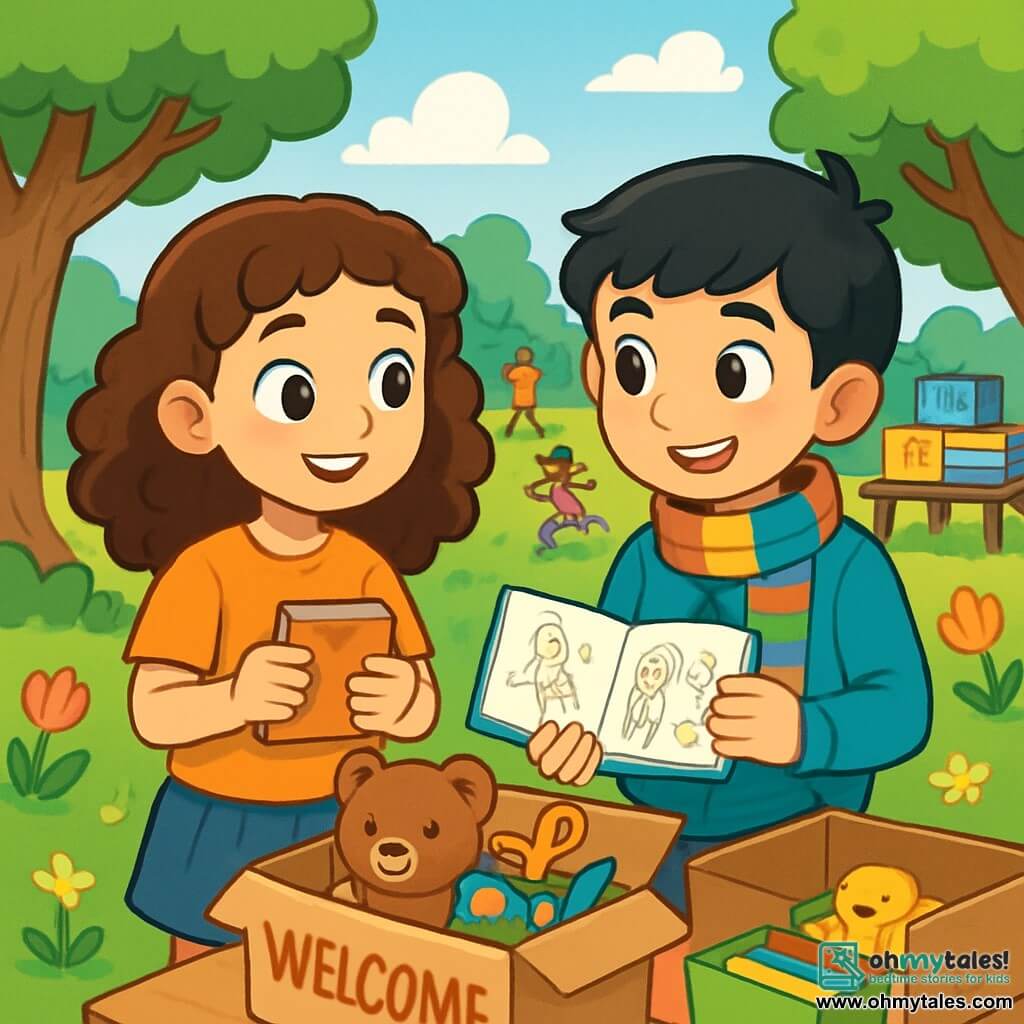
When the family arrived, they moved slowly off the bus. Lina saw a boy with a scarf wrapped around his head. He looked to be about Lina's age. He held a small book like a shield. His mother had tired eyes, but she smiled politely. The volunteers guided them gently and showed the children's beds.
Lina stood to the side, hands folded. Her mother touched her shoulder. "You can say hello if you want," she whispered. Lina took a breath.
"Hello," she said. "My name is Lina. Welcome."
The boy looked up and blinked. "Sami," he said, in a voice that surprised Lina. Hearing his name felt like being given permission to begin. Sami's English sounded a little different. He had new words in his voice, soft syllables from far away. Lina liked the sound.
Sami showed Lina the little book he had brought. It was full of stickers and pencil drawings of planes and clouds. "I used to draw a lot," he said. His English mixed with a few words Lina didn't know, but his eyes were easy to read. He pointed at a sticker of a dog and smiled. They both laughed. A small laugh can make a heavy day lighter.
Lina learned more new words that afternoon. Sami used the word 'home' in a way that made Lina's chest tighten. He said, "Home is where my mum keeps the tea." Lina understood that home was a place of small, ordinary things. She wrote that sentence in her mind.
That evening, volunteers served soup. People sat at long tables and ate slowly. There were small acts of help all around: someone braided hair, someone showed a child the bathroom, someone found a missing shoe. Lina helped by bringing Sami a blanket and showing him where the crayons were. They drew a sun together and added a tiny house next to it.
At bedtime, Sami asked Lina if she missed her own bed. She told him she liked the bump in her duvet where her cat curled up. Sami's face changed for a moment, thoughtful. "I miss my cat," he said. "She likes to hide in boxes."
"A cat," Lina repeated. "Cats make a place feel like home."
Sami nodded. "We had to get on a bus and leave quickly," he said. Lina listened. He did not tell everything. His voice had a small crack, but it was honest and calm. The adults had said not to press for stories that are hard. Listening could be a way to help, too.
That night, Lina lay awake with the sounds of strangers settling in. She felt tired but also a little proud. She had spoken and done something useful. She had learned words and had met someone whose life had changed. She wrote in her notebook: Today I met Sami. He draws dogs.
The Handshake and What We Keep
Days passed. The town helped the new families find clothes, find doctors, and register at the school. People brought stories of practical help. A dentist offered a day of free checks. A family lent a bicycle. At school, the children learned the new words and made a big mural. The mural had many hands painted in different colors holding a map of the town. Underneath, Lina painted a tiny handshake.
The idea to make a small ceremony came from Mrs. Patel, the librarian. "We do not fix everything," she said, reading from a list she had written. "But we can build welcome. We can practice kindness. We can show solidarity with a simple action." She suggested a handshake if people felt comfortable. A handshake is a small human gesture. It says, I see you. I stand with you.
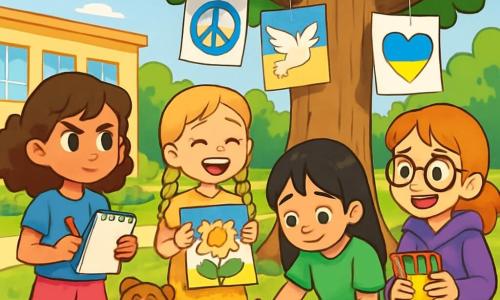
The town agreed. There would be a little gathering in the square. There would be soup, music, and a place where people could write messages on colorful cards. Children made a wall of messages: Hope, You are not alone, Welcome. Lina helped to tape them up. Her words were small: Sending you a warm hug. She felt shy about the hug, but it seemed right.
On the day of the gathering, the sky was soft and blue. Tables lined the square with bowls of stew and plates of bread. People moved in gentle flows. Lina saw Sami again. He had learned some English words that made him smile more easily. He had also learned a new word: 'ceasefire'. He told Lina it sounded like a bell stopping, and Lina liked that image. "A ceasefire can be the start of talking," she said.
At the front of the square, a small bench was set for the handshake. It was not a big ceremony. It was a friendly, quiet moment. Adults explained carefully that a handshake is an option, not a rule. Some people bowed, some hugged, some waved. Lina's mother knelt and took her hand. "This is a moment to choose how we show kindness," she said.
When it was Lina and Sami's turn, both of them looked at the bench and then at each other. There were people smiling and a few cameras for newspapers, but Lina did not look at them. She looked at Sami's hands. They were warm and slightly dusty from where he had helped move boxes. Lina reached out. Their hands met.
The handshake was small. It felt simple and honest. It held a lot in a tiny movement. Lina thought of the words she had learned. She thought of blankets and crayons and the mural. In that touch, she felt the meaning of welcome and solidarity. Sami squeezed her hand back, and she could tell he felt steadier.
Afterwards, people clapped softly. The band played an easy tune. Children danced. Sami and Lina walked to a table and wrote messages on cards together. Sami wrote in his language and added a few letters in English; Lina helped him translate. They wrote: Stay safe. We are your friends.
As the day ended, Lina and her mother walked home. The streetlights came on and fuzzed the edges of the buildings with a gentle glow. Lina kept thinking about the day's small actions. Helping did not always feel like a news headline. It felt like folding a blanket well, making a cup of hot chocolate for someone, listening when someone was tired, sending a message that said, You are not alone.
That evening, Lina made a list in her notebook. She wrote the words she had learned that week and next to each one she put a small example of how she could help.
- Conflict — talk calmly, listen, ask questions.
- Refugee — welcome someone new, share toys and books.
- Humanitarian — support helpers who bring food and medicine.
- Solidarity — stand with others, make cards, join efforts.
- Ceasefire — hope for pauses that let people rest and talk.
- Evacuate — help people find safe places and give comfort.
- Asylum — support places that keep people safe.
She drew a tiny handshake beside the last word. Lina felt calmer. The list made the world seem less fuzzy and more like a map with paths she could walk on.
A week later, Sami's family found a longer-term place to stay. It was a small flat above a bookstore. They painted one wall yellow because yellow made them smile. Lina and Sami promised to meet at the playground every Saturday. They shook hands again, and the handshake felt like a shared secret: we have done this together.
Before bed that night, Lina told her mother what she had learned. Her voice was steady. "We cannot stop faraway things from happening," she said, "but we can be kind here. We can welcome, help, and send messages that say we care."
Her mother hugged her and said, "That is a very good start."
Lina put the notebook away. She felt like she had woven a small safety net with her actions and the actions of others. It was not perfect, but it was real. Her town had done small, sensible things that helped people feel less alone.
As Lina closed her eyes, she thought of a quiet image: many hands reaching out, pulling a blanket tight around someone, and a small handshake between two children that held a promise to keep being kind.
In the morning, the radio played a short story about aid workers and teachers who stayed to help. Lina smiled. The words were no longer so strange. She had learned them, one careful step at a time. She had learned that even when big words feel heavy, small acts of welcome, listening, and solidarity can make a big difference.
And so Lina slept, knowing that in her own small way she could help. She had learned new words, met a friend, and understood that the world could become kinder through simple, steady actions. The handshake she shared was small, but it summed up what she had understood: that help can begin with a greeting, a pack of biscuits, a card, or a warm blanket. It begins with people choosing to stand together.